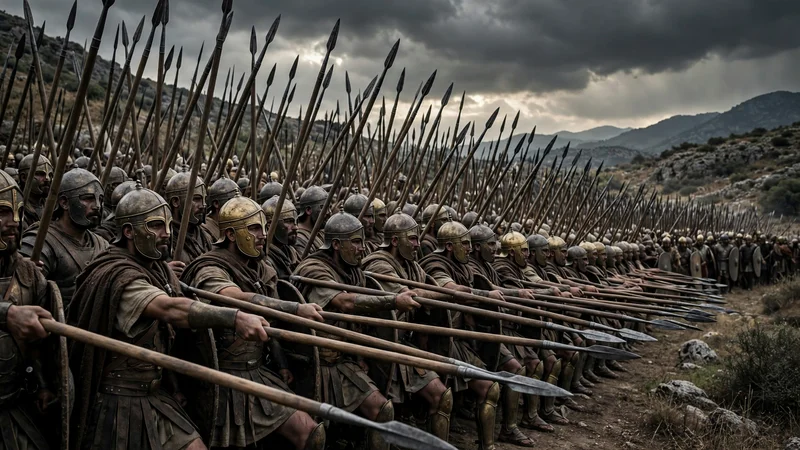
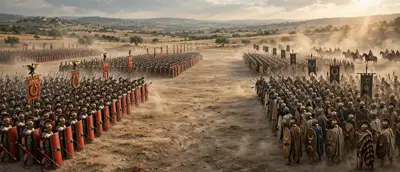
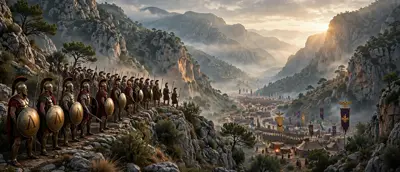
Darius III swept the battlefield. Literally. Before the armies met at Gaugamela, Persian engineers spent days flattening the plain, clearing stones and filling ditches so the king's scythed chariots could race across open ground. It was the most carefully prepared battlefield in ancient history. And it might be the worst home-field advantage any commander ever built, because Alexander the Great had already figured out how to ruin it.
Why Did Darius Sweep the Battlefield Clean?
Two years earlier, at Issus in 333 BC, Alexander had done something Persian courtiers still flinched to say out loud: he had beaten Darius in person, scattered a larger Persian army, and captured the king's own family in their camp. Darius ran. Our Battle of Issus explained walks through that disaster in detail. Gaugamela was the sequel, and Darius had spent two years making sure the sequel went differently.
He raised men from every corner of the empire. Bactrians, Sogdians, Indians, Armenians, Syrians, Medes, Sacae horsemen: the whole map showed up. Darius called it the largest army Persia had ever fielded, and the ancient writers believed him. Arrian, the most careful of them, repeats Persian strength figures in the hundreds of thousands, while modern historians cut that to somewhere between 50,000 and 250,000 men. Still enormous. Still, by every account, far bigger than anything Alexander brought.
The Battle of Gaugamela was Alexander the Great's decisive victory over the Persian king Darius III on October 1, 331 BC, on the plains of northern Mesopotamia near modern Erbil, Iraq. Outnumbered at least two to one, Alexander's 47,000 Macedonians shattered the Achaemenid army in a single afternoon, ending the Persian Empire's 220-year rule.
And Darius didn't stop at men. He parked around 200 scythed chariots on the field, blades bolted to their wheel hubs, the closest thing the ancient world had to tanks. Curtius Rufus adds 15 war elephants, beasts Alexander's army had never faced. Then he ordered the ground itself leveled, so nothing would slow a chariot charge. You can see the logic. Flat ground, fast chariots, overwhelming numbers. What could go wrong?
Something worth knowing about Darius: he was not a coward and not a fool. Before the battle he offered Alexander peace on staggering terms, half the empire, his daughter's hand, 30,000 talents of silver. Parmenion, Alexander's veteran general, reportedly said he would accept the terms if he were Alexander. Alexander answered that he would too, if he were Parmenion. Then he marched on. Darius had one card left. He played it at Gaugamela.
The Night the Moon Went Dark
Eleven days before the battle, the moon turned red. A total lunar eclipse crossed the sky over Mesopotamia on September 20, 331 BC, and two armies camped four miles apart both watched it happen. You can imagine what that did to them. The Persians took it as an omen of disaster. Alexander's seer, Aristander, told the Macedonians the opposite. The moon was Persia's symbol, he said, and its darkening meant Persia's fall. So Alexander sacrificed to the sun, the moon, and the earth. And his army slept easier than Darius's.
The night before the battle, Parmenion came to Alexander's tent with a suggestion: attack under cover of darkness. The Persians outnumbered them badly, and a night attack would even the odds. Alexander refused. Plutarch reports his answer: he would not steal his victory. Maybe those were his exact words, maybe a line polished by admirers later. But the decision was real, and it was cold-blooded. Because Darius had guessed Alexander might try exactly that. The Persians stood to arms all night, exhausted, waiting for an attack that never came. Alexander's men slept.
Read that again. Darius spent the night before the biggest battle of his life with his whole army awake and jumpy. Alexander slept. Discipline beat numbers before the first spear was thrown.
How Do You Beat an Army Five Times Your Size?
Alexander's answer started before sunrise. He marched his army onto the field in an oblique formation, drifting steadily to the right, toward the Persian left. The reason was simple and brutal: if he marched straight ahead, the far wider Persian line would wrap around both his flanks and swallow him. By sliding right, he forced the Persians to stretch left to keep up. And stretching is where big armies come apart.
He was also drifting off the ground Darius had leveled. Off the flat patch, the scythed chariots were useless. All that sweeping, and Alexander just walked around it. Honestly? This might be my favorite detail of the whole battle. Darius had built the perfect racetrack, leveled by hand over days, and Alexander simply refused to race on it.
But what about the flank he left behind? Here is the part of the plan most summaries skip. Alexander stacked a second line of infantry behind his main phalanx, with orders to turn around and fight if the Persians got behind them. He knew encirclement was coming. He planned for it the way you'd plan for rain.
Against the chariots he had a trick too. Light infantry were told to open lanes in the formation, let the chariots run through harmlessly, then pull the drivers down from behind. The chariots that veered wide were met with javelins. Simple? Sure. It worked anyway.
October 1, 331 BC: Gaugamela, Phase by Phase
The chariot charge fizzles. Darius opened with his scythed chariots, screaming across the field at the Macedonian line. The light troops opened their ranks, the chariots thundered through empty lanes, and the drivers were dragged down from behind. Others were stopped by javelins before they even arrived. The most feared weapon on the field did almost nothing. All that sweeping of the ground, wasted.
The Persians take the bait. Watching Alexander slide right, Bessus, the Bactrian satrap commanding the Persian left, sent his cavalry sweeping around to cut the Macedonians off. More Persian horsemen followed. And in stretching to catch Alexander, the Persian left opened a gap between itself and the Persian center. This is the moment the whole battle turned on. A seam, maybe a few hundred yards wide, in the line of the largest army on earth.
Alexander charges the seam. Alexander had been waiting for exactly this. He gathered his Companion Cavalry, the heavy shock horsemen of the Macedonian right, formed them into a wedge, and drove straight into the gap. Then he turned left, into the flank of the Persian center, aiming for one man: Darius. This is the part that sounds made up. It isn't. Arrian describes it plainly. Alexander didn't try to grind the Persian army down. He went for the king.
Darius runs. Darius, in his chariot at the center, watched the wedge coming. His royal guard fought, then broke. And Darius fled the field. The sources argue about exactly when he ran. Not about the fact. When the King of Kings turned his chariot around, the Persian center folded, because an army built on one man's authority does not survive that man's flight.
The left nearly breaks. Here is the honest part of the story. While Alexander was driving at the Persian center, the Persian right, under Mazaeus, hammered Parmenion's Macedonian left. It was desperate fighting. Parmenion sent riders begging Alexander to come back, so Alexander wheeled his cavalry around and rode hard for the left. Too late to matter. The Persians there were already beaten. The Macedonian phalanx had held. Barely. But it held.
The pursuit. Alexander chased Darius until dark, riding miles into the night. Darius got away, but his empire didn't. The Persian army dissolved into the Mesopotamian dusk: tens of thousands dead, the camp and baggage captured, the king gone.
Three Moments That Won the Battle
1. The gap. Everything at Gaugamela comes back to the seam Bessus opened when he stretched his cavalry to chase Alexander's drifting right. Alexander's whole plan was built to create exactly that opening, and when it appeared he was already moving. Most battles are won by the army that makes the fewest mistakes. Gaugamela was won by the army that manufactured the enemy's mistake.
2. Darius's flight. This is the uncomfortable truth about ancient kingship: the army was the king's body, and when the head fled, the body died. Darius wasn't leading from the front the way Alexander was. He sat in a chariot behind his guards. And when he ran, tens of thousands of men who were still fighting stopped fighting. Compare that with Alexander, who was in the wedge, in the dust, where his men could see him. Leadership you can see beats leadership you can't.
3. The chariots that did nothing. Darius had bet a huge part of his battle plan on 200 scythed chariots and a leveled field. Alexander neutralized both with one drift to the right and a simple order. Open the ranks. Let them through. Done.
The Butcher's Bill: Casualties on Both Sides
The ancient sources agree on the shape of the butcher's bill even when they fight over the numbers. Macedonia's losses were tiny. Persia's were catastrophic.
Arrian, drawing on the accounts of Alexander's own generals Ptolemy and Aristobulus, puts Macedonian dead at about 100 men, with over a thousand horses lost. Curtius Rufus says around 300 Macedonians died. Diodorus says about 500. Pick your source. The answer is the same in every one: a few hundred, against an army that size. That's almost absurd. That's the number that made the ancient world gasp.
Persian losses are where the sources go wild. Arrian claims 300,000 Persians killed and even more captured, a figure nobody today believes. Curtius says 40,000 dead. Diodorus says 90,000. Modern historians land somewhere in the tens of thousands. The honest version: Persia lost a huge share of its field army, its camp, its baggage train, and its king's nerve. The exact body count is lost to ancient exaggeration.
And one more number that matters: Alexander was 25 years old. Twenty-five. He had been king for five years. Think about what you were doing at 25.
A Note on the Numbers: What the Sources Actually Say
Let's be straight about something: everything you just read about troop strengths comes with asterisks the size of chariot wheels. The ancient sources on Gaugamela? Macedonian court history, Greek storytelling, and Roman retellings written centuries later. Arrian wrote in the 2nd century AD, nearly 500 years after the battle, working from lost eyewitness accounts. That helps. But those eyewitnesses were Alexander's own generals, and they had reasons to make the Persian army look enormous and the victory look miraculous.
So here is what holds up. Alexander's 47,000 is the solid number. Arrian breaks it down as roughly 40,000 infantry and 7,000 cavalry, and nobody seriously disputes it. The Persian strength is the fog. Ancient sources claim 250,000 to a million men. A million men cannot be fed, watered, or commanded on a Mesopotamian plain in 331 BC. Modern estimates run from 50,000 to 250,000. Even the low end means Alexander was outnumbered. Even the high end means the ancient sources were lying. Both can be true.
Here is the downside nobody likes to admit: we will never know exactly how big Darius's army was, which means we will never know exactly how outnumbered Alexander was. The 5-to-1 figure you see everywhere is a guess built on guesses. What we know for certain is the outcome, and the outcome is what ended the empire.
Why Gaugamela Actually Mattered
Gaugamela didn't just win a battle. It deleted an empire. The Achaemenid Persian Empire had ruled the ancient Near East for over 200 years, from the Indus to the Aegean. One afternoon on a Mesopotamian plain ended it.
The aftermath came fast. Babylon, the richest city on earth, opened its gates to Alexander without a fight. Its satrap Mazaeus, the same man who had nearly broken Parmenion's wing at Gaugamela, surrendered the city and was rewarded with its governorship. Susa fell next, with its legendary treasury. Persepolis, the ceremonial heart of the empire, was taken and burned in 330 BC, a fire some sources say Alexander ordered while drunk and later regretted.
Darius ran east, into Media, trying to raise one more army. He never got the chance. In July 330 BC, his own satrap Bessus had him murdered and left his body by the roadside. Alexander found it, covered it with his own cloak, and gave Darius a royal burial. Then he hunted Bessus down. You can argue about Alexander's motives, but the message was unmistakable: the throne of Persia had changed hands, and it wasn't going back.
The bigger story is what replaced Persia. Alexander was crowned at Arbela as King of Asia. Then Greek language, art, and cities spread across the lands Persia had ruled. The Hellenistic age, the world of Alexandria, Antioch, and the libraries that carried Greek learning to Rome and beyond, starts at Gaugamela. If you want to see how empires survive when the center fails, our Battle of Cannae guide shows Rome enduring the same kind of disaster. Persia didn't.
3 Lessons from Gaugamela
Gaugamela is a battle, but it's also a case study in winning against the odds. Three lessons worth stealing:
1. Make the big army fight your battle. Alexander never tried to match Persian numbers. He made the Persians stretch, open a gap, and fight on ground where their chariots were useless. When you're outnumbered, the worst thing you can do is play fair. Change the shape of the fight until your advantages are the ones that count.
2. Aim at the head, not the body. Alexander didn't try to kill 100,000 Persians. He tried to reach one man. Darius's flight ended the battle faster than any amount of killing could have. Systems built on a single leader are brittle. Find the single point of failure.
3. Exhaustion is a weapon. Darius kept his army awake all night expecting an attack. Alexander slept. By the time the battle started, one side was already tired. Rest, preparation, and showing up fresh will beat a bigger, tireder opponent more often than people admit.
Frequently Asked Questions
Who won the Battle of Gaugamela?
Alexander the Great won decisively. On October 1, 331 BC, his roughly 47,000 Macedonians and Greeks shattered Darius III's Persian army on the plains near Arbela in modern-day Iraq. Darius fled the field, and the Achaemenid Persian Empire effectively collapsed within months.
How many soldiers fought at the Battle of Gaugamela?
Alexander's army is well documented at about 47,000 men, roughly 40,000 infantry and 7,000 cavalry according to Arrian. Persian strength is disputed: ancient sources claim 250,000 to a million, but modern historians estimate 50,000 to 250,000. Either way, Alexander was heavily outnumbered.
What tactics did Alexander use at Gaugamela?
Alexander marched obliquely to the right, forcing the wider Persian line to stretch and open a gap between its left wing and center. He held a second line of infantry ready to turn and fight if encircled, neutralized the scythed chariots by opening lanes in his formation, then drove his Companion Cavalry in a wedge through the gap straight at Darius. When Darius fled, the Persian army broke.
What happened to Darius III after Gaugamela?
Darius fled east to Media, trying to raise a new army. In July 330 BC, his satrap Bessus murdered him and left his body by the road. Alexander found it, covered it with his own cloak, and gave Darius a royal burial, then hunted Bessus down.
Sources
- Wikipedia, Battle of Gaugamela
- ThoughtCo, Alexander the Great: Battle of Gaugamela
- History is Now, The 331 BC Battle of Gaugamela and Alexander the Great
- Seven Swords UK, The Battle of Gaugamela (331 BC): Alexander the Great