He was 23 years old. He'd been king for three years. And on a November morning in 333 BC, Alexander the Great woke up to discover that the most powerful man on earth had marched an army around behind him, cut his supply lines, and was waiting on a riverbank with — if you believe the ancient sources — half a million men. Most generals, in that position, retreat. Alexander attacked. What happened next at the Battle of Issus is the single most audacious victory of his career — and the day the Persian Empire started dying.
The Trap: Darius Gets Behind Him
To feel the danger Alexander was in, rewind a few weeks. After smashing the Persian satraps at the Granicus River in 334 BC, Alexander had spent a year mopping up Asia Minor. Then he fell seriously ill at Tarsus — ancient sources blame a chill from bathing in the freezing Cydnus River — and while he recovered, Darius III acted.
The Persian King gathered an enormous army in Babylon and marched west. His plan was sound: get behind Alexander, cut the Macedonian supply lines running back through the mountain passes, and force a battle on ground of his choosing. It worked — almost too well. While Alexander was still moving south, Darius slipped through the passes at night, reached the coastal town of Issus, and found the Macedonian wounded and sick Alexander had left there. His men killed them all. Then Darius took up a strong defensive position along the Pinarus River and waited.
When Alexander got the news, the situation was stark. His army — roughly 40,000 men — was now trapped between the sea, the mountains, and a Persian army at least two or three times its size, sitting on his road home. Every rule of ancient warfare said: don't fight here. Alexander's response was to march his men through the night, arrive at dawn, and fight anyway.
The Ground: 2.6 Kilometers That Decided an Empire
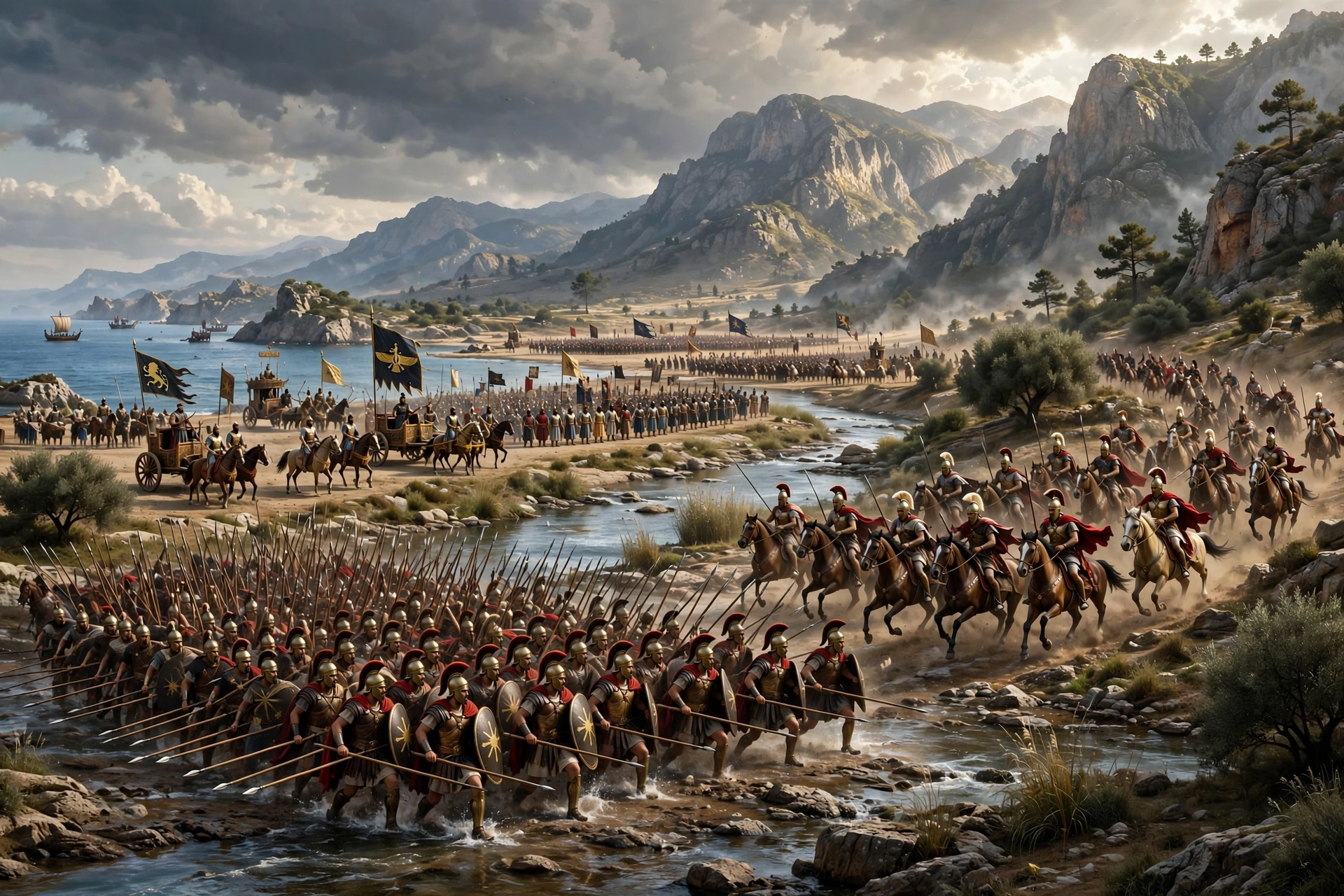
Here's the thing about Issus that makes it a masterclass: the battlefield itself was the real story. The coastal plain at the Pinarus is only about 2.6 kilometers wide — sea on one side, mountains on the other, a river running across the middle. Darius had chosen it as a defensive position. But in choosing it, he'd walked into a paradox: the narrow ground that protected his flanks also made his enormous numbers useless. You can't deploy half a million men — or even 150,000 — on a 2.6-kilometer front. Most of Darius's army could only stand behind the front ranks and watch.
Alexander saw it instantly. Where Darius saw a strong position, Alexander saw a funnel — and he was about to pour his smaller, harder, better-drilled army straight through it.
The Battle: November 5, 333 BC
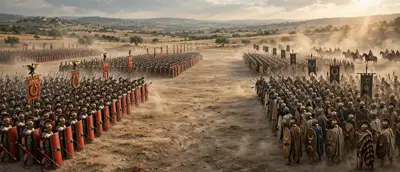
Darius drew up his line behind the Pinarus with care: heavy cavalry on the seaward flank, Greek mercenary hoplites — the best infantry Persia had — in the center, light troops and archers screening the front. It was a solid, professional deployment.
Alexander's deployment was a gamble stacked on a gamble. He put his veteran general Parmenion in command of the left — the Thessalian and allied cavalry by the sea, with orders to hold at all costs. The phalanx held the center. And Alexander himself took the right wing: the Companion cavalry, the hammer of the Macedonian army, the men he'd led since he was a teenager.
The battle opened with Alexander doing something that must have looked like suicide. Instead of advancing evenly, he shifted his whole line right, toward the mountains — thinning his already outnumbered front to mass strength where it mattered. Then, at the critical moment, he led the Companions in a wedge charge straight at the Persian left-center: not at the army, but at the king. Darius had stationed himself in the center in his chariot, visible to everyone, because Persian kings led from the middle and their presence was the army's spine.
Alexander aimed at the spine. His cavalry smashed through the Persian left, wheeled inward, and drove straight for Darius. The phalanx, meanwhile, ground forward across the river against the Greek mercenaries in some of the hardest infantry fighting of Alexander's career — the sources describe the sarissas (eighteen-foot pikes) doing terrible work in the crush.
The King Runs
And then the moment that decided the ancient world: Darius ran.
Accounts differ on exactly when — whether his chariot horses bolted or he ordered the retreat himself — but the effect was the same. The King of Kings, the living symbol of Persian authority, fled the field while the battle still raged. In an army built around the person of the monarch, that was the end. The Persian center collapsed. The wings, seeing the royal standards go down, broke and ran. What had been a battle became a rout, and the rout became a slaughter as the Macedonian cavalry rode down the fugitives for miles.
The butcher's bill tells the story: Macedonian losses were about 150 killed, 4,500 wounded, 302 missing. Persian dead ran to somewhere between 20,000 and 40,000. But the real prize wasn't the body count. Darius had abandoned his camp — and in it, his war treasury and his entire royal household. Alexander captured them intact.
What Alexander did next is one of the most famous episodes of his life, and it reveals the politician inside the conqueror. He treated the captured Persian royalty with conspicuous honor and respect — a calculated mercy that sent a message across the empire: surrender to Alexander and you keep your dignity; resist and you get Issus. It was psychological warfare as statecraft, and it worked.
Break the king's nerve and the army dies with it. Alexander understood that. Darius proved it.
Aftermath: The Road to Tyre and Egypt
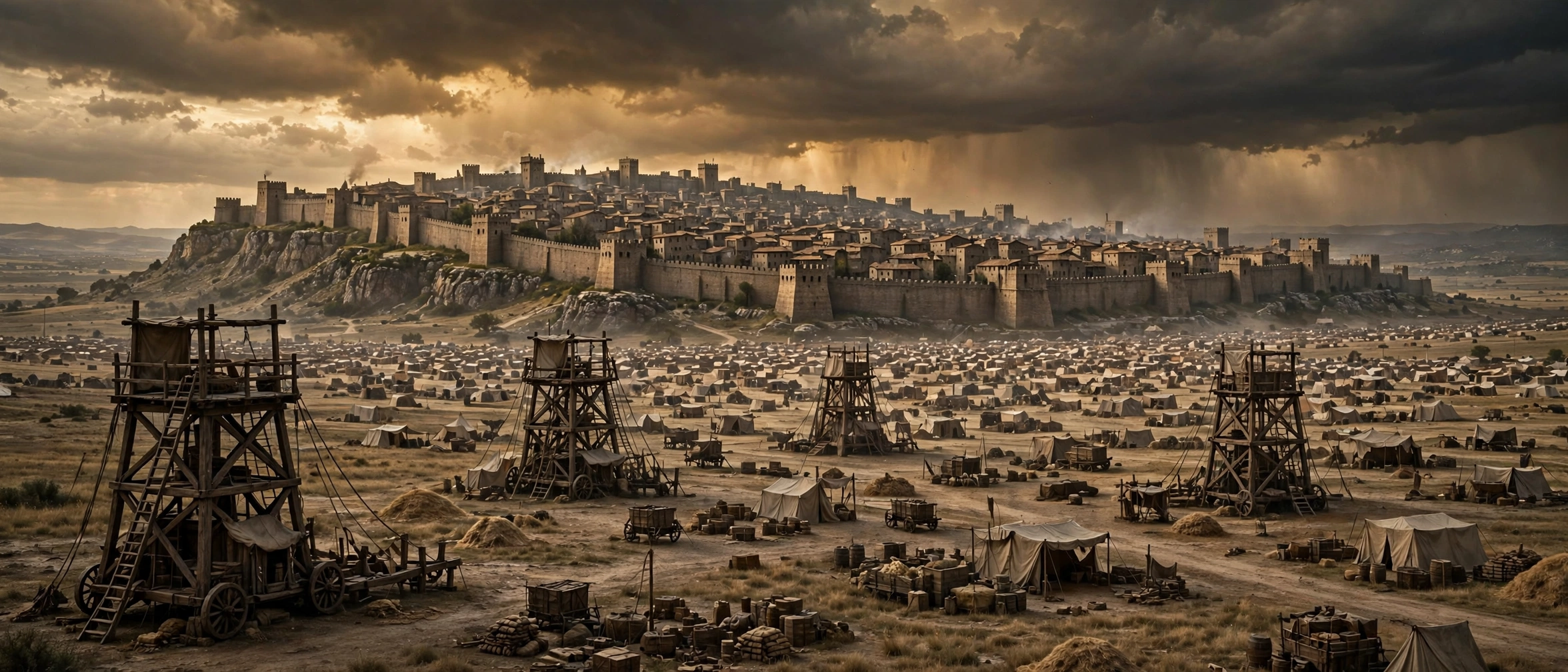
Issus didn't just win a battle — it threw open a continent. With Darius's field army shattered, the Levantine coast lay open. Alexander marched south, taking city after city. Tyre, the great Phoenician island-fortress, held out and paid for it with a seven-month siege that ended in its destruction — Alexander even built a causeway from the mainland to reach it, a mole of stone that permanently joined the island to the shore. Then Egypt, which surrendered without a fight and crowned him Pharaoh.
Darius, meanwhile, tried to negotiate. He reportedly offered Alexander half his empire — everything west of the Euphrates — plus a royal marriage alliance. Alexander's answer was immortal in its bluntness: he would accept nothing less than everything. The two kings would meet once more, two years later at Gaugamela in 331 BC, where Darius would lose again and the Persian Empire would fall for good. (For a different kind of encirclement, see our Cannae guide — Hannibal's masterpiece, two thousand years of military textbooks in a single afternoon.)
Why Issus Still Matters
Three reasons this battle echoes down 2,300 years.
First, it's the purest example in history of defeating numbers with geometry. Darius brought the bigger army to a battlefield where bigness didn't fit. Every general since — from commanders studying "force-to-space ratios" to modern staff colleges — has Issus in the curriculum as the warning: numbers only count if you can deploy them.
Second, it's the battle that made Alexander a legend rather than just a successful king. Beating Persian satraps at the Granicus was impressive. Beating the King of Kings himself, face to face, with the worse position and a third of the men — that was myth-making. After Issus, Alexander wasn't just winning. He was Alexander.
Third, the mosaic. In a Roman villa at Pompeii, buried by Vesuvius in 79 AD, archaeologists found the Alexander Mosaic — a breathtaking, million-tesserae depiction of this exact battle, Alexander charging with his lance leveled at a terrified Darius. It's one of the most famous artworks of the ancient world, and it shows Issus: the locked eyes of the two kings across four centuries. Whoever commissioned it understood what the battle meant. So should we.
What the Sources Argue About
One honest footnote before the end: our picture of Issus comes mostly from Arrian, writing some 450 years after the battle — but working from the memoirs of Ptolemy, who actually fought there and later became Pharaoh of Egypt. That's about as good as ancient sourcing gets. Even so, the other accounts — Diodorus, Curtius — disagree on the details: the Persian numbers (the ancient texts claim anywhere from 250,000 to 600,000), the exact moment Darius fled, even whether Alexander took a sword wound to the thigh in the fighting.
Here's the rule of thumb historians use: trust the skeleton, doubt the numbers. The date, the place, the narrow plain, Darius's flight, the captured camp — that framework is solid, confirmed across independent sources. The headcounts are ancient exaggeration, the kind every victorious army indulged in. Strip away the inflation and Issus only gets more impressive: Alexander didn't beat a million men. He beat a real, professional, much larger army — with geometry, nerve, and a cavalry charge aimed at one man.
FAQ
When was the Battle of Issus?
November 5, 333 BC — the traditional date, on the Pinarus River near the town of Issus in Cilicia, in what is now southern Turkey.
Who won the Battle of Issus?
Alexander the Great, decisively. His roughly 40,000 Macedonians broke a Persian army modern historians estimate at 100,000–150,000. Darius III fled the field; his camp, treasury, and royal household were captured.
How big were the armies at the Battle of Issus?
Ancient sources claim up to 600,000 Persians — not credible. Modern historians estimate 100,000–150,000 Persians against Alexander’s roughly 40,000. The narrow 2.6-kilometer plain meant Darius could never deploy his full strength.
Why did Darius lose at Issus?
He chose a battlefield too narrow for his numbers, and Alexander aimed his Companion cavalry straight at the king. When Darius fled, an army built around the person of the monarch collapsed with him.
What happened after the Battle of Issus?
The Levantine coast lay open. Alexander marched south, destroyed Tyre after a seven-month siege, took Egypt without a fight, and was crowned Pharaoh. Darius offered half his empire for peace; Alexander demanded all of it.
Where was the Battle of Issus fought?
On the coastal plain of the Pinarus River (the modern Payas River) near Issus, in ancient Cilicia — in what is now southern Turkey, by the northeastern corner of the Mediterranean.
Alexander’s other great outnumbered victory belongs in our ranking of the most one-sided battles in history, and the seven-month siege of Tyre that followed Issus features in our longest-sieges guide. For modern battles where bold maneuver beat the odds, see El Alamein — and for the twentieth century’s great seaborne gamble, D-Day.
Sources
- Arrian, Anabasis of Alexander — the primary ancient account (based on Ptolemy's memoirs).
- Plutarch, Life of Alexander.
- Diodorus Siculus, Library of History, Book XVII.
- N.G.L. Hammond, Alexander the Great: King, Commander and Statesman.