On the fourth day of the battle, five Marines and a Navy corpsman raised an American flag on top of a dead volcano. A photographer named Joe Rosenthal clicked his shutter almost by accident. That photograph, of the flag-raising on Mount Suribachi, became the most reproduced image of World War II. But the battle was not over. Not even close. It would grind on for another month across eight square miles of black volcanic ash, and when it ended, nearly 7,000 Americans and almost every Japanese defender were dead. This is the story of Iwo Jima, and why the Marines paid that price for so little ground.
What Was the Battle of Iwo Jima?
In early 1945 the United States was bombing Japan from airfields in the Mariana Islands, but the B-29 bombers had a problem. The flight was long, Japanese fighters picked at them, and damaged bombers had nowhere to land on the way home. Halfway between the Marianas and Tokyo sat a pork-chop-shaped volcanic island called Iwo Jima, "sulfur island," with two airfields the Japanese had built and were improving. Take the island, and American fighters could escort the bombers all the way, while crippled B-29s could put down on Iwo Jima instead of ditching in the ocean.
That was the cold logic. The hot reality was that the island was defended by Lieutenant General Tadamichi Kuribayashi, one of the smartest defensive commanders of the war, with about 21,000 men, months of preparation, and orders that amounted to: sell this island as dearly as possible.
And here is the uncomfortable question the battle still raises: was it worth it? The island’s airfields did save bomber crews, hundreds of them. But the price was the bloodiest fight in Marine Corps history to that point. People have argued about that trade ever since.
Kuribayashi’s Trap: The Tunnels Under the Ash
Most Japanese commanders in the Pacific fought the way their doctrine told them to: meet the Americans at the beach and die gloriously. Kuribayashi, who had studied in the United States and understood American firepower, did the opposite. He pulled his men back from the beaches. He built no grand above-ground fortifications for the battleships to flatten. Instead his engineers dug.
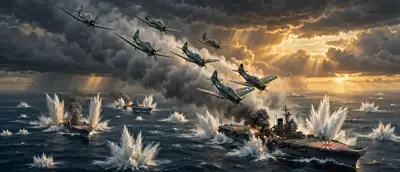
And dug. By February 1945 the island was honeycombed with miles of tunnels, some five stories deep, connecting hundreds of concrete pillboxes, blockhouses, and artillery positions, all camouflaged under black volcanic sand. The bombardment that was supposed to soften the island, three days of naval shelling plus air strikes, barely scratched this underground fortress. The guns were still there. The men were still there. Waiting.
If you have ever wondered what "defense in depth" actually looks like, this was it: not a line to break through, but a whole island turned into a sponge designed to soak up attackers and bleed them, yard by yard.
D-Day on the Black Sand: February 19, 1945
The landing itself was eerie. The first waves hit the beaches at 9 a.m. and met almost no resistance. Marines later said it felt wrong, like walking into an empty room. Then, when the beaches were packed with men and machines, Kuribayashi’s guns opened up from every direction at once. The volcanic ash, fine as talcum, swallowed boots and wheels. Vehicles bogged down. Foxholes collapsed. Men dug in sand that would not hold a shape.
The first day cost the Marines over 2,400 casualties. The planners had guessed the island might fall in five days. It would take thirty-six.
Look, the ash deserves its own mention, because it shaped everything. You could not dig in it. You could not run in it. Wounded men sank into it. The island itself was fighting the Marines alongside the Japanese.
Suribachi and the Flag: February 23
Mount Suribachi, the dead volcano at the island’s southern tip, dominated the landing beaches, and taking it was the first real objective. On the morning of February 23, Marines fought their way to the summit and raised a small flag. Hours later, a second, larger flag went up so it could be seen across the island. Five Marines and a Navy corpsman lifted it into a stiff wind. Joe Rosenthal, an Associated Press photographer, raised his camera and took the shot without even looking through the viewfinder.
The photo hit American newspapers within days and did something no battle report could do: it gave a war-weary public an image of victory. The men in the photo became national heroes. Three of the six would not survive the battle. That sentence is worth sitting with. The most famous image of triumph in the Pacific War was taken in the middle of a fight that still had a month to run.
The Meat Grinder: March 1945
After Suribachi, the battle moved north into the island’s central highlands, and this is where Iwo Jima earned its reputation. The Japanese fought from caves and tunnels that had to be cleared one by one, with flamethrowers, grenades, and demolition charges. There was no front line. There were just strongpoints, each one a small siege.
The fighting was intimate and horrible in a way naval bombardments and air raids never are. Marines described clearing the same bunker complexes day after day, because tunnels let Japanese soldiers reoccupy positions the Americans thought they had taken. Progress was measured in yards. A good day might gain a hundred.
By mid-March the island was declared secure, but "secure" was a paperwork word. Hundreds of Japanese soldiers were still underground, and the last organized resistance did not end until March 26, when a final Japanese attack, Kuribayashi’s own last charge, was destroyed near the airfields.
The Flag Raisers: What Happened to the Six Men
The six men in Rosenthal’s photograph deserve more than a caption. They were: Sergeant Michael Strank, Corporal Harlon Block, Private First Class Franklin Sousley, Private First Class Ira Hayes, Private First Class Rene Gagnon, and Pharmacist’s Mate Second Class John Bradley. Three of them, Strank, Block, and Sousley, were killed in the fighting that followed. They never knew their image had become famous.
The three survivors were pulled from the battle and sent home to sell war bonds, turned into symbols of a victory the public desperately wanted. Ira Hayes, a Pima Indian from Arizona, never adjusted. He was celebrated as a hero and haunted by survivor’s guilt in equal measure, and he died in 1955, alone and struggling, at thirty-two. His story became a folk song and a film, but the man himself never found peace.
There is a lesson here about what fame does to soldiers, and it is not a cheerful one. The photograph told America the battle was won. For the men in it, the battle was still killing them.
The Cost: 36 Days in Numbers
Here are the figures, stated plainly. The United States suffered about 26,000 casualties: 6,821 killed and roughly 19,200 wounded. Of the roughly 21,000 Japanese defenders, nearly all died. Only about a thousand were taken prisoner, many of them wounded or unconscious. It remains one of the rare battles in the Pacific where American casualties exceeded Japanese ones.
Admiral Nimitz’s famous line about Iwo Jima, that "uncommon valor was a common virtue," was not empty ceremony. The battle produced 27 Medals of Honor, more than any other single battle in American history. Read that again. Twenty-seven.
Was Iwo Jima Worth It? The Honest Debate
This is the section most summaries rush past, and it matters. The official reason for the invasion was the airfields. And the airfields delivered: by war’s end, more than 2,200 B-29s had made emergency landings on Iwo Jima. If even a fraction of those crews would otherwise have been lost, the island paid for itself in American lives saved. Fighter escorts based on Iwo Jima also flew with the bombers to Japan.
Critics answer that the B-29 campaign was already shifting, that the emergency landings are hard to count cleanly, and that 6,821 dead is an enormous price for eight square miles of volcanic rock. Honestly, both sides have a point, and the argument has never really been settled. What is not arguable is the courage of the men who fought there. The strategy can be debated forever. The valor cannot.
If you take one judgment from this article, take this: Iwo Jima is what happens when unstoppable force meets an immovable object, and both sides know it. Kuribayashi knew he could not win. He fought anyway, to buy time. The Marines knew the price going in. They paid it anyway. That is not glory. That is something harder and sadder, and it deserves to be remembered straight.
What the Sources Say: A Note on the Numbers
Casualty figures for Iwo Jima are among the best documented of the Pacific War, because both sides kept records and American after-action reports were thorough. The 6,821 killed and ~19,200 wounded are US Marine Corps figures. Japanese strength is usually given as about 21,000, with the great majority killed. The "2,200 emergency landings" figure for B-29s comes from US Army Air Forces records. Where estimates differ, I have used the commonly cited range.
Frequently Asked Questions
Why was Iwo Jima so important?
Its airfields sat halfway between the Mariana Islands and Japan. Taking them let American fighters escort B-29 bombers all the way to Japan, and gave damaged bombers an emergency landing strip. Over 2,200 B-29s eventually landed there in emergencies.
How many Americans died at Iwo Jima?
About 6,821 Americans were killed and roughly 19,200 wounded, for about 26,000 total casualties over 36 days. It was the bloodiest battle in Marine Corps history at the time.
What is the famous Iwo Jima photograph?
On February 23, 1945, AP photographer Joe Rosenthal photographed five Marines and a Navy corpsman raising the US flag on Mount Suribachi. It became the most reproduced image of WWII. Three of the six men in the photo were killed later in the battle.
How long did the Battle of Iwo Jima last?
Thirty-six days, from February 19 to March 26, 1945. Planners had hoped for about five days. The Japanese tunnel defenses turned it into a month-long grind.
Sources
- Britannica: https://www.britannica.com/event/Battle-of-Iwo-Jima
- National WWII Museum: https://www.nationalww2museum.org/war/articles/battle-iwo-jima
- Wikipedia: https://en.wikipedia.org/wiki/Battle_of_Iwo_Jima