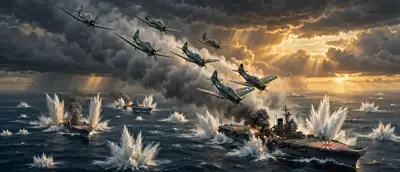
It was a quiet Sunday morning in paradise. Sailors at Pearl Harbor were sleeping in, some heading to church, others nursing hangovers from Saturday night in Honolulu. At 7:48 AM, the first wave of Japanese aircraft came out of the northern sky, and in the next two hours the United States Pacific Fleet was shattered. When it was over, 2,403 Americans were dead, the pride of the Navy lay burning in the harbor, and nothing about the twentieth century would ever be the same.
The Road to December 7
Pearl Harbor did not come out of nowhere, though it felt that way to the men in the harbor. Japan had been at war in China since 1937, committing atrocities that horrified the world, and America had been tightening the screws. In July 1941, after Japan occupied French Indochina, President Roosevelt froze Japanese assets and cut off oil exports. That was the decisive move. Japan imported nearly all its oil, and without American oil its navy and war machine had about two years of fuel left.
Tokyo faced a choice: pull back from China and accept humiliation, or seize the oil fields of Southeast Asia and dare America to stop them. The army and navy chose the second option, and the navy added a twist. Admiral Isoroku Yamamoto, who had studied at Harvard and knew America's industrial power firsthand, insisted that any southern advance had to start by crippling the US Pacific Fleet. His logic was cold. Hit hard enough, and America might negotiate instead of fighting a long war across the Pacific.
Negotiations continued in Washington right up to the attack, which is one of the grimmest details of the whole story. Japanese diplomats were still talking peace while the carriers were already steaming toward Hawaii.
Why Japan Gambled on a Surprise Attack
Here is the uncomfortable truth about Pearl Harbor: from Tokyo's perspective, it was rational. Japan's leaders knew they could not win a long war against American industry. Their own wargames said so. So they bet everything on a short, sharp shock: destroy the battleships, the pride of the fleet, and buy a year or two to fortify a defensive perimeter across the Pacific. Then, they hoped, a war-weary America would accept a negotiated peace.
Yamamoto himself reportedly said he could run wild for six months to a year, but had no confidence after that. He was right about the timeline and wrong about the psychology. The gamble assumed Americans would calculate. Instead, Pearl Harbor made them furious, and fury does not negotiate.
You have probably wondered whether wars start from miscalculation more than malice. Pearl Harbor is maybe the purest example. Japan did not attack out of blind hatred. It attacked because its leaders convinced themselves a surprise blow was the least bad option. They were catastrophically wrong about what the blow would do to American will.
Sunday Morning, 7:48 AM
The strike force was formidable: six aircraft carriers under Vice Admiral Chuichi Nagumo, launching 353 aircraft in two waves. They approached from the north, where American patrols were thinnest, under complete radio silence. An American radar station actually detected the incoming planes at 7:02 AM, but the officer on duty assumed they were a scheduled flight of B-17s from California. The warning died in that assumption.
Commander Mitsuo Fuchida, leading the first wave, radioed the famous signal when surprise was confirmed: "Tora, tora, tora," tiger, tiger, tiger. The first bombs fell at 7:48. What followed was methodical destruction. Torpedo bombers skimmed the harbor and gutted the battleships moored in Battleship Row. Dive bombers hit airfields, destroying American planes on the ground before they could get airborne. A second wave came an hour later to finish the job.
The Americans fought back with whatever they had: rifles, machine guns, a few anti-aircraft batteries that got into action. Individual heroism was everywhere and changed nothing about the outcome. In two hours it was over, and the harbor was a vision of hell, black smoke, burning oil, and sinking ships.
The Arizona and the Battleships
The human cost centered on one ship. At about 8:10 AM, a bomb penetrated the forward magazines of the battleship USS Arizona. The explosion lifted the 31,000-ton ship out of the water and broke her in two. She sank in nine minutes with 1,177 men aboard, nearly half of all the Americans killed that day. The Arizona still lies in the harbor, and the men are still entombed in her. Oil still seeps from the wreck, drop by drop, which survivors called the tears of the Arizona.
Seven other battleships were damaged or sunk: the Oklahoma capsized, trapping men inside who tapped on the hull for days before rescuers could reach some of them. The California, West Virginia, and Nevada were heavily damaged. In total, 188 American aircraft were destroyed, most on the ground.
But here is the detail that decided the Pacific War: the American aircraft carriers were not there. Enterprise, Lexington, and Saratoga were all at sea on December 7. Neither were the fuel tank farms, the repair yards, or the submarine base seriously damaged. Japan had destroyed the weapon of the last war, the battleship, and missed the weapon of the next one, the carrier. That miss would haunt them at Midway six months later.
A Date Which Will Live in Infamy
The next day, Franklin Roosevelt went before Congress and gave the most famous speech of his presidency. "Yesterday, December 7, 1941, a date which will live in infamy, the United States of America was suddenly and deliberately attacked by naval and air forces of the Empire of Japan." Congress declared war within the hour, with one dissenting vote. On December 11, Germany and Italy declared war on the United States, solving Roosevelt's other problem: how to get into the European war.
The transformation of American society was instant and total. Isolationism, which had been the dominant mood for years, evaporated overnight. Millions volunteered. Factories that had made cars started making tanks and planes. The sleeping giant line, often attributed to Yamamoto, may be apocryphal, but the sentiment was real. America had been hit, and America was now all in.
America's Greatest Intelligence Failure?
People still argue about whether Pearl Harbor could have been prevented, and the honest answer is complicated. American codebreakers had cracked Japanese diplomatic codes and knew war was coming. Warnings were sent to Hawaii. But nobody in Washington expected the blow to fall at Pearl Harbor itself. The Philippines, Malaya, the Dutch East Indies, those were the expected targets. Hawaii was considered too far, too well defended, too unlikely.
Admiral Kimmel and General Short, the commanders in Hawaii, paid with their careers. Whether that was fair is still debated. They made real mistakes, parking aircraft wingtip to wingtip against sabotage, which made them perfect bombing targets, and skimping on reconnaissance. But they were also victims of a system that sent vague warnings and expected local commanders to fill in the blanks.
Conspiracy theories about Roosevelt letting it happen have been investigated to death and found empty. The truth is more ordinary and more damning: a bureaucracy that could not imagine the unlikely, and an enemy that specialized in doing exactly that.
Why Pearl Harbor Backfired on Japan
Strip away the drama and Pearl Harbor was a strategic catastrophe for Japan, and the reasons are worth stating clearly. First, it united American opinion completely. There would be no negotiated peace, no war weariness, no settlement. Second, it missed the carriers, the fuel, and the repair yards, the things that actually mattered for a Pacific war. Third, it woke an industrial power that would outproduce Japan roughly ten to one in ships and planes.
Japan got its six months of running wild, just as Yamamoto predicted. It seized Malaya, the Philippines, the Dutch East Indies. Then came Midway in June 1942, where America sank four Japanese carriers, and the tide never turned back. By 1945, American bombers were burning Japanese cities and the fleet that had attacked Pearl Harbor lay at the bottom of the Pacific.
Honestly, Pearl Harbor is the clearest lesson in military history about the difference between tactics and strategy. Tactically, it was brilliant: surprise, precision, devastating execution. Strategically, it was suicide. The operation succeeded perfectly at achieving the exact opposite of what Japan needed. If you remember one thing about December 7, remember that.
Pearl Harbor Today
If you visit Oahu now, the harbor is peaceful in a way that feels almost defiant. The USS Arizona Memorial straddles the sunken battleship, white and quiet, and you can look down through the water at the wreck. Oil still rises from the hull, a few drops at a time. The National Park Service calls them the tears of the Arizona, and standing there, watching them surface eighty years later, the phrase does not feel sentimental. It feels accurate.
Nearby, the battleship Missouri is moored, the ship on whose deck Japan formally surrendered in 1945. The symbolism is deliberate: the war began at the Arizona and ended at the Missouri, bookends four years apart. About 1.8 million people visit each year. Most of them leave quieter than they arrived. Some places do that to you.
Frequently Asked Questions
What happened at Pearl Harbor in simple terms?
On the morning of December 7, 1941, Japanese carrier aircraft launched a surprise attack on the US naval base at Pearl Harbor, Hawaii. In about two hours, 2,403 Americans were killed, 8 battleships were damaged or destroyed, and 188 aircraft were lost. The next day, the United States declared war on Japan, entering World War II.
Why did Japan attack Pearl Harbor?
Japan needed oil and raw materials for its war in China, and the United States had cut off oil exports in July 1941 over Japan's aggression. Japanese leaders believed a surprise strike could cripple the US Pacific Fleet long enough for Japan to seize Southeast Asia unopposed. It was a gamble on a short war.
How many died at Pearl Harbor?
2,403 Americans were killed and 1,178 were wounded. Nearly half the dead, 1,177 men, were aboard the battleship USS Arizona, which exploded and sank. Japanese losses were comparatively light: 29 aircraft and 5 midget submarines.
Did Pearl Harbor bring America into World War II?
Yes. President Roosevelt called December 7 a date which will live in infamy and asked Congress for war the next day. Germany and Italy then declared war on the United States on December 11, bringing America into the war in both the Pacific and Europe.
Sources
- National WWII Museum: https://www.nationalww2museum.org/war/articles/pearl-harbor
- Britannica: https://www.britannica.com/event/Pearl-Harbor-attack
- Wikipedia: https://en.wikipedia.org/wiki/Attack_on_Pearl_Harbor