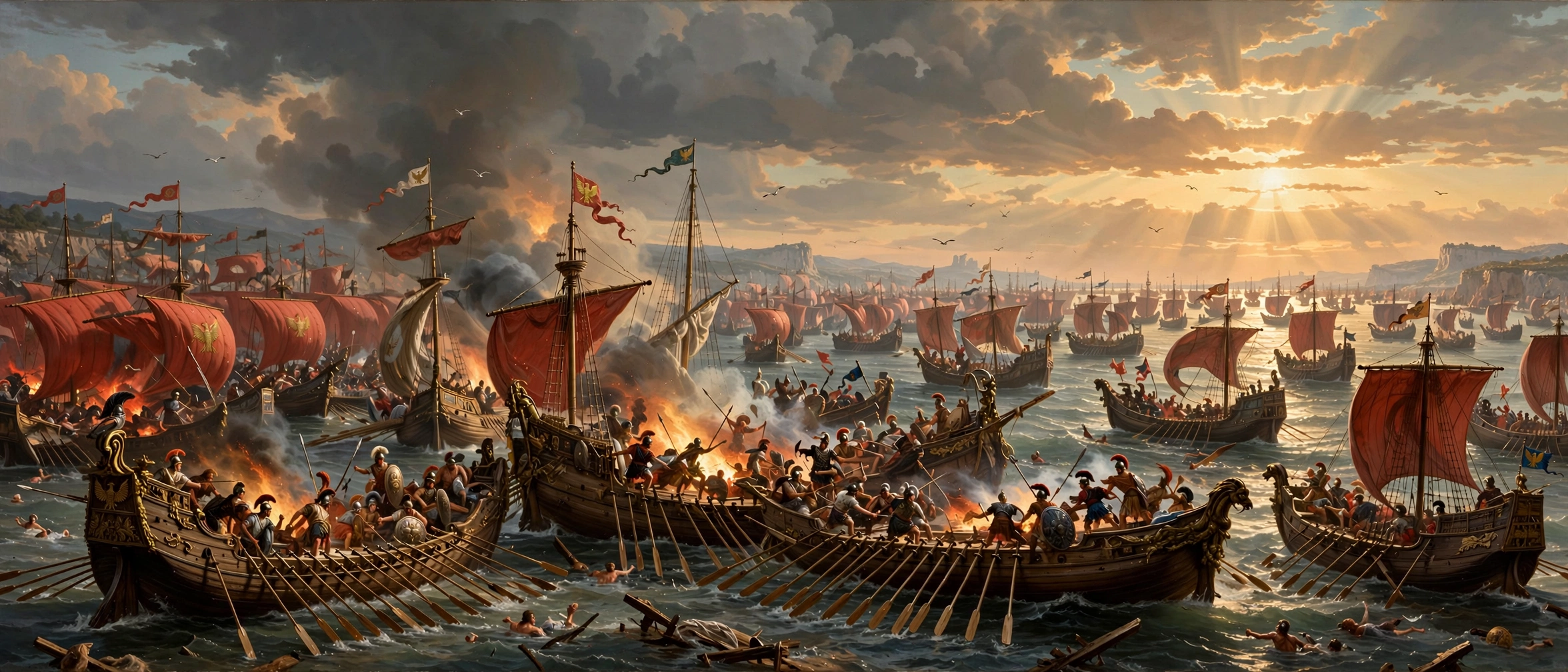
What happened at the Battle of Actium? On September 2, 31 BC, off the coast of western Greece, the fleet of Octavian — Rome's ambitious young heir to Julius Caesar — met the combined fleet of Mark Antony and Cleopatra VII of Egypt in a naval battle that decided the fate of the Roman world. Octavian won. His commander Marcus Agrippa crushed Antony's heavier ships. Cleopatra broke away with her squadron in mid-afternoon and Antony, inexplicably, followed her off the field. Within a year both were dead. Octavian became Augustus, the first Roman emperor, and the Republic never came back.
That is the short version. The strange part is how lopsided the odds were — and how long it took the killing to actually happen.
> ### ⚡ TL;DR — The Battle of Actium in 30 Seconds
> - On September 2, 31 BC, Octavian's fleet under Marcus Agrippa defeated Mark Antony and Cleopatra VII off the coast of Actium, Greece.
> - Antony arrived with about 500 warships but could crew barely half of them — disease and Agrippa's blockade had gutted his fleet before a single ram struck.
> - Cleopatra fled mid-battle with her squadron; Antony abandoned his flagship to follow her, and the rest of his fleet was destroyed.
> - The battle ended the Roman Republic's last civil war; Octavian became Augustus, Rome's first emperor, within a few years.
The Battle of Actium was a naval battle fought on September 2, 31 BC, off the coast of Actium in western Greece, where Octavian's fleet under Marcus Agrippa defeated the combined fleet of Mark Antony and Cleopatra VII. The victory ended Rome's final civil war and made Octavian — soon Augustus — the unchallenged master of the Roman world.
The Road to Actium: Two Romans, One Crown
Rome was technically still a republic in 31 BC. Nobody alive believed it.
Julius Caesar's assassination in 44 BC had kicked off a decade of civil wars. The winners of the mess — Octavian, Mark Antony, and Marcus Lepidus — formed the Second Triumvirate and carved up the Roman world. Antony took the East. Octavian took the West. Lepidus, the least interesting of the three, was sidelined by the other two within a few years. It was always going to come down to two men.
Antony's problem was Cleopatra. Or rather, Antony's problem was what Rome thought about Cleopatra.
Antony had married Octavian's sister Octavia to seal the alliance, then abandoned her for the Egyptian queen. He paraded his relationship through the eastern Mediterranean and, in 34 BC, held the infamous "Donations of Alexandria" — a public ceremony in which he handed Roman-controlled territories and the grand title "King of Kings" to Cleopatra and her children, including her son Caesarion, whom many believed was Julius Caesar's child. To Octavian back in Rome, this was not romance. It was a loaded weapon.
And Octavian knew exactly how to use it. When Antony's general Plancus defected and brought Octavian a copy of Antony's will, Octavian read it to the Senate: Antony wanted to be buried in Alexandria, alongside Cleopatra. Rome's war hero wanted his bones in Egypt. The Senate was furious. In 32 BC, Rome declared war — not on Antony, technically, but on Cleopatra. The distinction fooled nobody, least of all Antony.
Here is the question people ask most: why did it have to be a sea battle at Actium? Antony's generals argued for a land fight — they were Romans, land fighting was their trade, and Cleopatra's presence was already poisoning morale among the Roman officers. According to the Ohio State University's ancient history notes on the battle, Cleopatra refused to leave and insisted on the naval option, and Antony sided with her. Whether that was love, politics, or a terrible misread of the odds is a debate that has lasted two thousand years.
The Fleets: 500 Ships Against 400 (That Were Really 230 Against 400)
By the spring of 31 BC, Antony had moved his forces to the mouth of the Ambracian Gulf, near the promontory of Actium on Greece's western coast. On paper his fleet was magnificent: roughly 500 warships, including massive quinqueremes — 200-foot monsters with bronze-plated prows and bronze rams that, according to Warfare History Network, weighed up to three tons each. These ships carried 400 rowers apiece plus towers of archers and catapults. In a head-on ramming contest they were nearly indestructible.
Paper lied. Malaria swept through Antony's camps that summer. Desertion ate at his crews. And Marcus Agrippa — Octavian's admiral, the man who actually ran the naval side of everything Octavian ever won — had spent months methodically cutting Antony's supply lines, capturing key bases along the coast, and tightening a blockade around the Ambracian Gulf. By the time the battle came, Antony could crew barely half his fleet. The BBC History Magazine battle brief on Actium puts the real numbers bluntly: Antony's 500 ships had shriveled to roughly 230 that could actually sail and fight.
Octavian's fleet was about 400 ships, mostly lighter Liburnian galleys — smaller, faster, crewed by well-trained men who hadn't spent the summer starving in a malarial swamp. Agrippa arranged them in an arc from north to south, blocking the gulf's mouth. Antony had to come out to him or starve in place.
What Happened at the Battle of Actium: September 2, 31 BC
The battle began around midday — both sides spent the morning staring at each other across the water, neither eager to blink first. Antony eventually led his fleet out of the straits toward the open sea. Then, as the USF Actium Project's reconstruction describes it, Antony was forced to extend his line out from the protection of the shore and finally engage.
What followed was a strange fight. Antony's quinqueremes were designed for one thing: powerful, head-on ramming. But his crews were undermanned — many of the rowers were sick or inexperienced — so the great ships could not execute the maneuvers they were built for. Agrippa's captains knew this. They kept a respectful distance from those bronze prows and refused the ramming game entirely. Octavian's lighter ships couldn't damage the big hulls by ramming either, so the battle turned into something closer to a land battle fought at sea: ships grappled together, archers fired volleys of arrows and sling bullets, catapults hurled stones, and marines boarded with spears and swords.
For hours neither side broke. Then the turning moment arrived.
Mid-afternoon, the wind shifted. Cleopatra's Egyptian squadron — about 60 ships, positioned behind Antony's line, carrying the war chest — raised sail and punched through the center of the melee, heading south. And Antony, watching from his flagship, did something no general in history has ever adequately explained: he abandoned his fleet, transferred to a smaller vessel, and followed her.
What happened next was collapse. The remaining Antonian fleet fought on, but the departure of their commander broke their spirit. Agrippa closed in with fire projectiles. Ancient writers describe the end as a great burning of Antony's ships — one wrote that the sea was choked with royal wreckage, the water flecked with purple and gold. By late afternoon it was over. Of Antony's original fleet of some 500 warships, only a few more than 60 returned to Egypt. According to Plutarch's calculations, cited by historian David Califf, Agrippa captured around 300 ships. Roughly 5,000 of Antony's men were dead; Octavian lost about 2,500.
A week later, Antony's land army — which had outnumbered Octavian's — surrendered without a fight.
Turning Points: Three Moments That Decided It
1. The blockade did the real killing before the battle started. Agrippa's seven-month campaign to strangle Antony's supply lines was the actual decisive operation of the Actium campaign. Malaria, starvation, and desertion cut a 500-ship fleet to ~230. Antony's men were too sick to row their own ships properly. If you want to know why Octavian won, start here, not on September 2.
2. Antony chose the sea. His generals wanted a land battle — Roman infantry against Roman infantry, where training and numbers were on Antony's side. Cleopatra insisted on the naval fight, and Antony listened to her. He fought the one battle his weakened fleet could not win, on ground chosen by his enemy.
3. The wind shifted, and then the two people Rome cared about most left the field. Whether Cleopatra's breakout was a pre-planned escape with the treasury or a panic-stricken flight — historians still argue both — the effect was the same. When Antony followed her, the battle ended. Generals who leave their army mid-fight don't get a second act. Antony and Cleopatra escaped to Egypt, which was its own kind of victory: they lived. But they never commanded anything again.
My Take: Actium the Battle Is Overrated — Actium the Campaign Is Underrated
Here is my honest opinion, and it cuts against the legend: the Battle of Actium itself was not a great naval battle. It was a mopping-up.
The great 20th-century Roman historian Ronald Syme — whose book on the Augustan revolution is still the standard — was blunter than that. He called Actium's actual military scale "lame" and even "shabby." He had a point. The famous confrontation was hours of clumsy grappling between a starving, disease-racked fleet and a fleet that refused to fight it fairly, followed by the two enemy leaders sailing away in the middle of it. The drama was enormous. The tactical brilliance was not.
But here is the underrated half of the story, the part that deserves more credit: Agrippa's campaign of starvation. While Octavian got the statues, Agrippa spent months doing the unglamorous work — seizing coastal bases, cutting supply lines, shrinking Antony's operational space until the great eastern fleet was a hollow shell. Rome's empire wasn't won by a dramatic afternoon off the coast of Greece. It was won by logistics, over months, by a man who understood that a fleet that can't eat can't fight. The lesson of Actium isn't about rams and galleys. It's that sieges beat battles when you can afford to wait.
---
> ### ⚔️ A New Epic Battle Every Day
> Love military history? Subscribe to Echoes of Battle on YouTube (@EchoesOfBattleHistory) — a new epic battle every day, cinematic and free.
> Next up: the largest sea battle ever fought — The Largest Naval Battle in History: Leyte Gulf 1944 — 282 warships, four battles, four days.
---
Aftermath & Legacy: One Year to the End of the Republic
Antony and Cleopatra fled to Alexandria. They had some ships, they had the treasury, and they had one more year. Octavian came after them anyway.
Antony tried to hold Egypt. His remaining forces melted away through desertion. Believing — wrongly, according to most accounts — that Cleopatra was already dead, he stabbed himself on August 1, 30 BC, and died in her arms in her mausoleum. Cleopatra negotiated with Octavian, failed to secure her children's future, and took her own life on August 12, 30 BC — the asp-in-the-fig-basket story is famous, but historians have questioned the method for two millennia. Octavian had her son Caesarion — Julius Caesar's only biological son, the one man with a competing claim to Caesar's legacy — executed.
Then Octavian did what no Roman had ever done: he took everything. Egypt, the richest province in the Mediterranean, became his personal possession. The Senate, terrified and exhausted after a century of civil war, handed him power after power. In 27 BC, at age 35, he accepted the name Augustus. The Republic — the system of consuls, Senate, and citizen assemblies that had governed Rome for nearly 500 years — was dead in all but name. The Empire, which would rule the Mediterranean world for centuries, had begun.
The consequences are still under your feet if you live in the West: Roman law, Roman languages, Roman roads, Roman cities — the version of Rome that shaped the modern world is Augustus's version. And Augustus's version started with a disease-racked fleet limping out of a Greek gulf on a September afternoon.
What If Antony Had Won at Actium?
Counterfactuals are the historian's guilty pleasure, and this one is worth the indulgence.
An Antony victory probably does not save the Republic. It more likely splits the Roman world in two: a Greek-speaking East centered on Alexandria, where Antony and Cleopatra had already been building a Hellenistic monarchy with the Donations of Alexandria, and a Latin West. The Republic's institutions were already hollow; both men were building monarchies, they just disagreed on the language and the capital.
The real what-if is about Cleopatra's Egypt. Had Antony won, the Ptolemaic dynasty — nearly 300 years of Greek rule over Egypt — would have survived and fused with Roman power. A hybrid Greco-Roman eastern empire, centered on Alexandria instead of Rome, might have changed the center of gravity of the whole classical world. Alexandria was already the Mediterranean's greatest city of science and learning. Imagine it as the capital.
Instead, Octavian absorbed Egypt, and Alexandria became a province. The Library's decline, the annexation of the East, the next five centuries of Roman rule — all of it follows from that September afternoon. Rome won the war of propaganda too: Antony is remembered as the lover who threw away an empire for a woman, and Cleopatra as the seductress. Both of those are Octavian's version. The actual Antony was one of the most capable generals of his generation — and the actual story is that he lost the war in the summer, not on September 2.
Actium vs Trafalgar: Two Sea Battles, One Lesson in Reverse
Comparing Actium to Trafalgar — two of history's most famous naval battles — shows how much warfare changed, and how much stayed identical.
At Trafalgar in 1805, Horatio Nelson took 27 British ships against 33 French and Spanish ones and cut straight through their line, deliberately breaking every rule of naval combat. At Actium in 31 BC, Agrippa did the opposite: he refused to fight Antony's line head-on at all. Nelson won by aggression; Agrippa won by patience.
The numbers invert too. Nelson was outnumbered and won through maneuver. Agrippa had the lighter fleet and won by not letting the heavy fleet use its strength. Both battles share one eerie parallel: the commanders who lost were trapped by their own ships' design. Antony's quinqueremes were too big to maneuver; Villeneuve's combined fleet was too unwieldy to coordinate.
And the stakes rhymed. Trafalgar ended Napoleon's dream of invading Britain and secured a century of British naval supremacy. Actium ended the Roman civil wars and secured four centuries of Roman imperial rule. Both battles killed fewer men than the legend suggests and changed everything anyway. The lesson I draw from both: in naval war, the fleet that controls the terms of engagement — speed at Trafalgar, patience at Actium — wins before the first shot is fired.
Sources & Caveats: What We Actually Know
Everything we know about Actium comes from the winners' side, and you should read every ancient account with that in mind.
Our most detailed narrative comes from Plutarch, who wrote his life of Antony roughly 150 years after the battle. Plutarch is our main source for the battle sequence, Cleopatra's flight, and Antony's decision to follow her — and Plutarch wrote for readers who already knew Octavian had won and built an empire. The USF Actium Project's reconstruction of the battle leans on these same accounts and is worth reading for its technical breakdown of the fleet actions. The Ohio State University's ehistory notes give the clearest academic summary of the tactical mismatch between quinqueremes and Liburnians. BBC History Magazine's battle brief supplies the fleet numbers (400 vs 500, reduced to 230) and the campaign context. Missed History's Actium article provides the aftermath timeline — the land army's surrender a week later, and the August 30 BC death dates.
What is uncertain: exact ship counts (ancient sources inflate numbers; modern estimates range from Wikipedia's 250-400/250-500 brackets down to the BBC's 400 vs ~230). Whether Cleopatra's flight was panic or a pre-arranged exit — Plutarch says panic, but as Missed History notes, some modern historians argue it was the only viable exit strategy, treasury and all. And the "shabby" verdict of Ronald Syme reminds us that the battle's fame rests on its consequences, not its conduct.
Frequently Asked Questions
Who won the Battle of Actium?
Octavian and his admiral Marcus Agrippa, decisively. They destroyed or captured roughly 250-300 of Antony and Cleopatra's ships, killed over 5,000 of their men, and lost about 2,500 of their own. Antony and Cleopatra escaped with roughly 60 ships, but their army surrendered a week later and both were dead within a year.
Why did Cleopatra leave the Battle of Actium?
Historians still debate it. The ancient account by Plutarch says she panicked and fled, and Antony, unable to stay without her, abandoned his fleet to follow. Some modern historians argue it was a pre-planned exit strategy — her squadron carried the war chest, and getting it back to Egypt intact was arguably the rational move once the battle turned. What is certain: her departure collapsed what remained of Antony's fleet.
How did the Battle of Actium create the Roman Empire?
It removed Octavian's last rival. With Antony and Cleopatra dead by August 30 BC and Egypt annexed as Octavian's personal possession, no one was left to challenge him. The Senate granted him sweeping powers, and in 27 BC he took the name Augustus — the first Roman emperor. The Roman Republic, in place for nearly 500 years, was over.
How many ships fought at the Battle of Actium?
Octavian brought about 400 lighter Liburnian galleys; Antony arrived with roughly 500 warships but could crew only around 230, because disease and Agrippa's blockade had hollowed out his manpower. Cleopatra's squadron of about 60 ships broke away mid-battle; of Antony's original fleet, only about 60 ships made it back to Egypt, and some 300 were captured or sunk.
Sources
- Plutarch, Life of Antony (most detailed ancient account of the battle and its aftermath)
- The Actium Project, University of South Florida — battle reconstruction
- Ohio State University ehistory, "The Battle of Actium" — tactical analysis
- BBC History Magazine, "Actium, 31 BC: the beginning of the end for Mark Antony and Cleopatra"
- David J. Califf, Battle of Actium (study of the Actian campaign and its sources)
- Missed History, "The Sea Battle That Birthed an Empire"