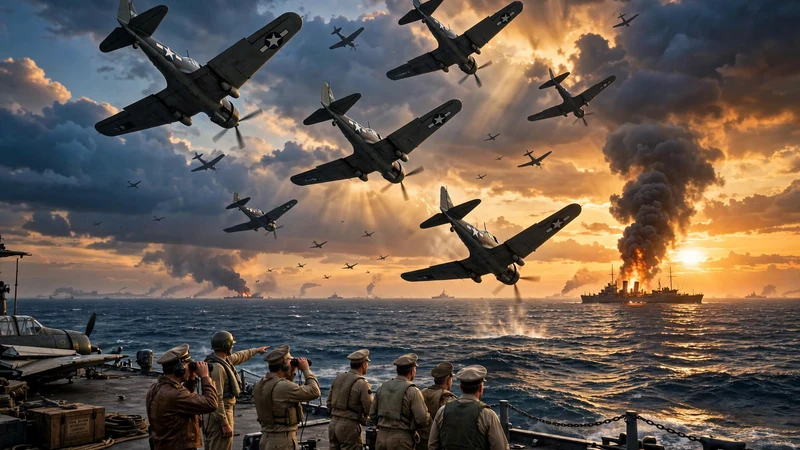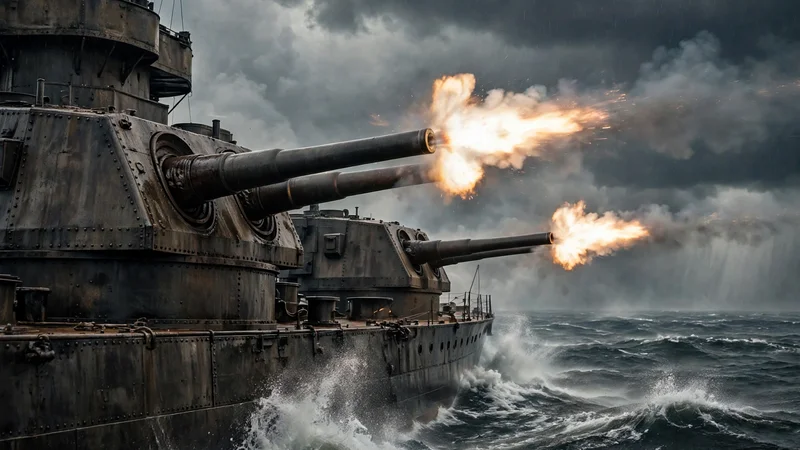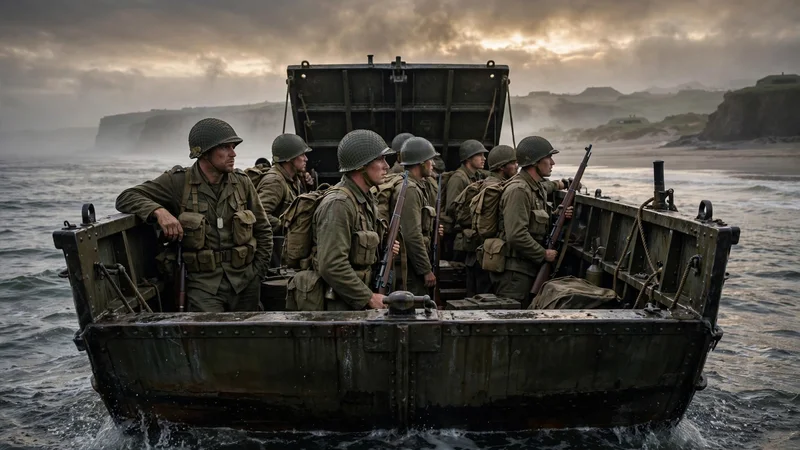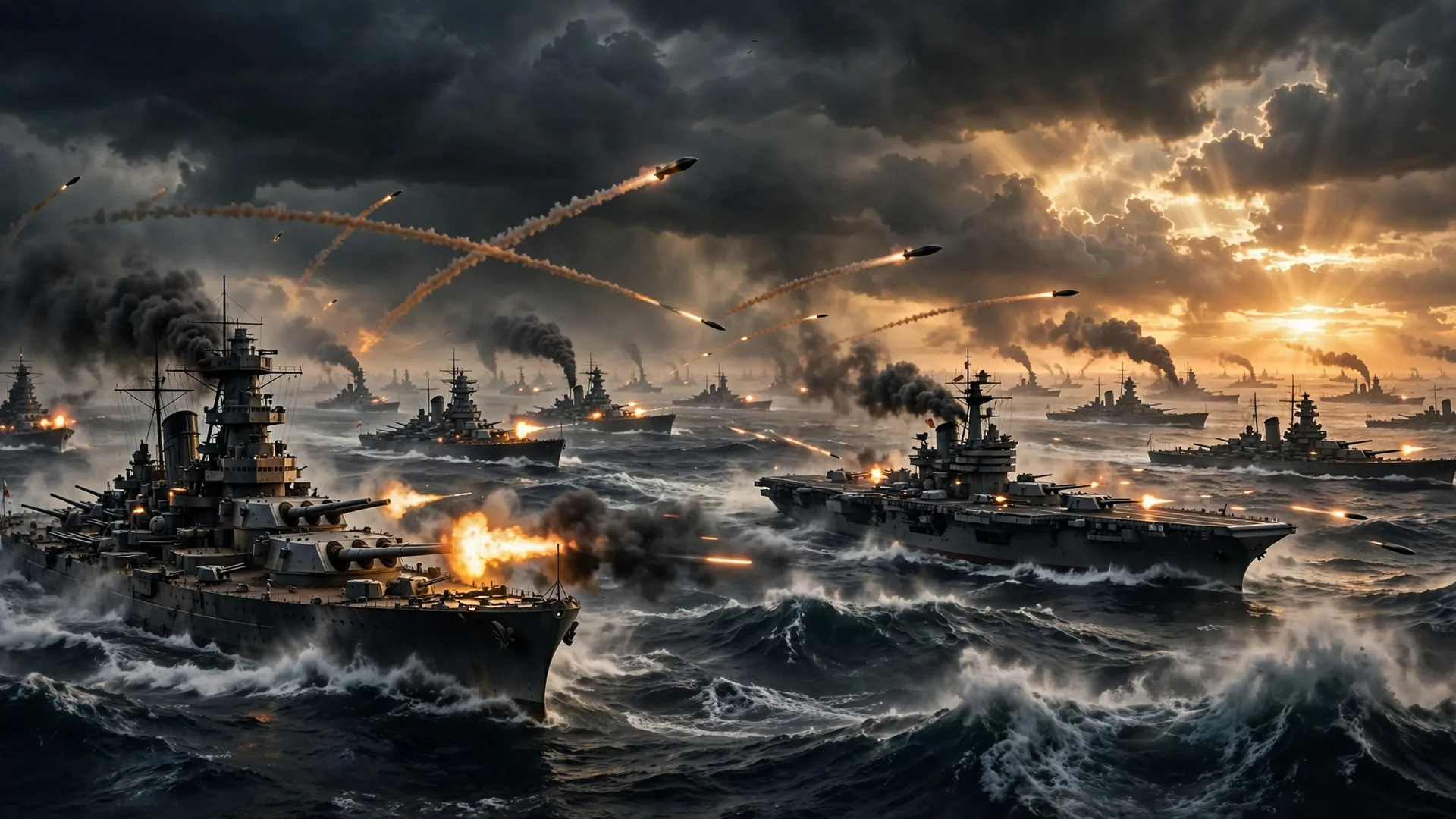
Four days. Four battles. One stretch of Pacific water bigger than the entire Philippines — and more warships in action than in any sea fight before or since. That was the Battle of Leyte Gulf, fought October 23–26, 1944, and it is the best answer to a question history buffs keep asking: what was the largest naval battle in history?
The Short Answer: Leyte Gulf, October 1944
Naval historian Thomas J. Cutler counts 282 American, Japanese, and Australian ships actually engaged — with hundreds more in supporting roles — and nearly 200,000 men fighting across more than 100,000 square miles of ocean. The US Third and Seventh Fleets, with 34 carriers and 12 battleships, met nearly everything Japan had left: four carriers, nine battleships including the giants Yamato and Musashi, and dozens of cruisers and destroyers.
Counts vary — some tally 216 American warships against 64 Japanese; others push past 370 hulls by counting auxiliaries and transports. But no counting method changes the verdict: nothing else comes close. As Naval War College professor George Baer put it, Leyte Gulf was "in tonnage engaged and space covered, the greatest naval battle of all time."
Japan lost roughly 26 warships — four carriers, three battleships, six heavy cruisers, eleven destroyers — plus 300 aircraft and 12,500 men, against about seven American warships and 3,000 men. It wasn't a battle. It was a funeral for a navy.
Why Leyte Gulf Became So Big
On October 20, 1944, General Douglas MacArthur waded ashore at Leyte — "I shall return," fulfilled. Japan's fleet was a shadow of its Pearl Harbor self, but the Philippines sat astride Japan's oil lifeline from Southeast Asia, so Tokyo gambled everything on one throw: Operation Sho-Go 1.
The plan: Vice Admiral Jisaburo Ozawa's carrier force — nearly empty of trained pilots — would steam south as bait, luring Halsey's Third Fleet away from the beaches. Then Vice Admiral Takeo Kurita's Center Force, built around the superbattleships Yamato and Musashi, would punch through San Bernardino Strait and fall on the landing fleet, while Vice Admiral Shoji Nishimura's Southern Force attacked through Surigao Strait. Three prongs, one target.
The plan scattered the fighting across hundreds of miles of sea, so each prong produced its own battle. And the Americans had a split command — Halsey's Third Fleet answered to Admiral Nimitz, Kinkaid's Seventh Fleet to MacArthur. No single admiral ran the whole show — a confusion that nearly caused a disaster at Samar.
Japan's last fleet sailed into Leyte Gulf with everything it had. It sailed out with nothing.
Battle One: The Sibuyan Sea — The Day the Musashi Died
October 24. Kurita's Center Force was steaming through the Sibuyan Sea when Halsey's carrier aircraft found it. Halsey's carrier aircraft found it and attacked all day. The main victim was the Musashi, sister ship of the Yamato and one of the two largest battleships ever built.
The Musashi took 19 torpedo hits and 17 bomb hits — punishment no ship before or since has survived — before rolling over and sinking with more than a thousand of her crew. Kurita briefly turned back, then resumed course. Bloodied but still coming.
Battle Two: Surigao Strait — The Last Battleship Duel
That night, October 24–25, Nishimura's Southern Force steamed up Surigao Strait into a trap. Admiral Jesse Oldendorf's Seventh Fleet battle line was waiting across the strait's northern exit: six battleships in line, cruisers on the flanks, destroyers and PT boats in the narrows. Nishimura sailed straight into them. In naval terms, Oldendorf had "crossed the T" — every one of his guns could fire; only Nishimura's forward guns could reply.
Torpedoes tore into the Japanese column first; then the battleships opened up with radar-directed salvos in the dark. Nishimura's flagship Fuso blew apart. His force was practically annihilated — only a single destroyer limped away.
Here is the detail that makes sailors' eyes mist over: five of Oldendorf's six battleships — West Virginia, Maryland, Tennessee, California, and Pennsylvania — had been sunk or crippled at Pearl Harbor on December 7, 1941. Raised from the mud, rebuilt, and sent back to sea, they had their revenge at Surigao Strait. No two battle fleets have fought a gun duel since — Surigao Strait was the last battleship-vs-battleship battle in history.
Battle Three: Off Samar — Taffy 3's Impossible Stand
Dawn, October 25. Halsey had taken the bait — his entire Third Fleet was steaming north after Ozawa's decoy carriers, leaving the San Bernardino Strait unguarded. Kurita's Center Force, four battleships including the Yamato, six heavy cruisers, two light cruisers, and eleven destroyers, came through the strait and found... Task Unit 77.4.3. "Taffy 3."
Taffy 3 was six small escort carriers — slow, unarmored, built for submarine patrols — screened by three destroyers and four destroyer escorts under Rear Admiral Clifton Sprague. Its planes carried depth charges, not armor-piercing bombs. Its destroyers' five-inch guns couldn't dent battleship armor. Between Kurita and the helpless invasion transports, there was nothing else.
Then came one of the most celebrated fights in American naval history. The destroyer USS Johnston, under Ernest Evans, broke formation and charged the Japanese fleet alone, launching torpedoes at the cruiser line. The Hoel and Heermann followed. The destroyer escort Samuel B. Roberts closed to point-blank range and dueled a heavy cruiser. Carrier planes attacked with whatever they had — some making dry runs with empty guns.
And it worked. Kurita, convinced he faced a far larger American force, broke off and withdrew. The cost: Taffy 3 lost two escort carriers (Gambier Bay and St. Lo), two destroyers (Johnston and Hoel), the Samuel B. Roberts, and more than 1,500 men. Japan lost three heavy cruisers.
Battle Four: Cape Engaño — The Decoy That Fooled Halsey
While Taffy 3 was fighting for its life off Samar, Halsey was 300 miles to the north, doing exactly what the Japanese had hoped: smashing Ozawa's decoy force off Cape Engaño on October 25–26. All four Japanese carriers went down. Ozawa's ships carried barely a hundred aircraft between them — empty shells, sacrificed to pull Halsey away.
The decoy worked — Halsey steamed north, and Kurita came through the open strait. Then Kurita turned back at Samar, and the whole plan collapsed. The irony: "Engaño" is Spanish for deception. Halsey sailed straight into a place literally named "the lure" — and historians have argued about it ever since.
The Kamikazes Make Their Debut
Leyte Gulf also saw the first organized kamikazes. On October 25, off Samar, Japanese pilots began deliberately crashing their aircraft into American ships. The escort carrier USS St. Lo took a hit that touched off her magazines — she blew apart and sank in thirty minutes, the first major warship lost to a suicide attack.
A lone kamikaze had struck the Australian cruiser HMAS Australia four days earlier, on October 21, but Leyte Gulf was where the tactic became doctrine. Japan, out of trained pilots and modern aircraft, had found a weapon that traded one obsolete plane and one pilot for a chance at a warship. Over the war's final year, kamikazes would become Japan's signature weapon.
The Runner-Up: Jutland, 1916
If Leyte Gulf is the biggest naval battle, Jutland is the biggest gunfight. On May 31, 1916, Britain's Grand Fleet under Admiral John Jellicoe met Germany's High Seas Fleet under Admiral Reinhard Scheer off Denmark — 250 warships, nearly 100,000 men, and 58 dreadnought battleships and battlecruisers.
It was a confused, brutal fight. British battlecruisers blew up with sickening regularity — poor ammunition handling turned hits into magazine explosions, and HMS Queen Mary vanished with nearly all hands. Watching two of his battlecruisers explode, Vice Admiral David Beatty is supposed to have remarked: "There seems to be something wrong with our bloody ships today."
Germany won the scorecard — Britain lost 14 ships and 6,784 men to Germany's 11 and 3,058. But Britain won the strategy: Scheer never risked his fleet again, and the blockade held until the war ended. A tactical draw, a strategic British win — and the largest all-dreadnought clash ever. Full story in our Battle of Jutland summary.
The Decisive One: Midway, 1942
Most people name Midway as the biggest naval battle of World War II — wrong on size, right on importance. Fought June 4–7, 1942, it involved far fewer ships than Leyte Gulf but was the most decisive carrier battle ever fought.
Japan sent four fleet carriers — Akagi, Kaga, Soryu, Hiryu — to take Midway Atoll. American codebreakers had cracked Japan's naval codes, and Admiral Chester Nimitz set an ambush with three carriers. In a single morning, US dive bombers destroyed three Japanese carriers in minutes; the fourth died that afternoon. Japan lost all four carriers, a heavy cruiser, and 3,000 men — including irreplaceable veteran pilots. America lost the Yorktown, a destroyer, and 362 men.
Historian John Keegan called it "the most stunning and decisive blow in the history of naval warfare." After Midway, Japan was on the defensive at sea for the rest of the war. It was smaller than Leyte Gulf — but no battle ever changed a war faster. Read our full Battle of Midway guide for the whole story.
The Era-Definer: Trafalgar, 1805
On October 21, 1805, off Cape Trafalgar, Admiral Lord Horatio Nelson took 27 British ships of the line against 33 French and Spanish ships under Admirals Villeneuve and Gravina — and destroyed them.
Instead of sailing parallel and trading broadsides, Nelson split his fleet into two columns and drove straight at the Franco-Spanish line, cutting it into pieces. The British captured or destroyed 22 enemy ships and lost none. But a French musketeer shot Nelson aboard HMS Victory, and he died below decks as the battle ended.
Trafalgar ended Napoleon's dream of invading Britain and gave the Royal Navy unchallenged command of the seas for a century. Sixty ships is a skirmish next to Leyte Gulf's 282 — but no naval battle ever bought its country more.
So What Counts as "Largest"?
Here's the honest answer: "largest naval battle" isn't one trophy — it's four.
- Most ships, men, and ocean: Leyte Gulf, 1944 — ~282 warships, ~200,000 men, 100,000+ square miles. No contest.
- Biggest all-gun duel: Jutland, 1916 — 58 dreadnoughts trading broadsides. The last great age-of-battleship fight.
- Most decisive single blow: Midway, 1942 — four carriers gone in a day, and the Pacific War's momentum reversed.
- Longest shadow: Trafalgar, 1805 — a century of British naval supremacy bought in one afternoon.
By the measure most people mean — sheer scale, hulls in the water, men at the guns — Leyte Gulf wins, and it isn't close. Jutland had nearly as many ships but half the men and a fraction of the sea room. Midway and Trafalgar were hinge moments of history fought with far smaller fleets.
Maybe that's why Leyte Gulf feels underrated — no single clean narrative, no six minutes like Midway, no martyred hero like Nelson. It was four battles stitched together by bad communications and desperate gambles. But measured in steel and sailors, the largest naval battle in history sailed out of Leyte Gulf in October 1944 — and only the Americans sailed home.
FAQ
How many ships fought at the Battle of Leyte Gulf?
About 282 warships saw action, in naval historian Thomas J. Cutler's count — 216 American, 2 Australian, and 64 Japanese — with nearly 200,000 men involved. Counts vary depending on whether auxiliaries and transports are included, so some sources give higher figures.
Was the Battle of Jutland bigger than Leyte Gulf?
By ships engaged, no. Jutland (1916) involved about 250 warships and 100,000 men, against Leyte Gulf's roughly 282 warships and 200,000 men. Jutland remains the largest all-gun naval battle ever fought, but Leyte Gulf was bigger in hulls, men, and the area of sea covered.
Why is Leyte Gulf less famous than Midway?
Midway (June 1942) was a clean, dramatic turning point — four Japanese carriers destroyed in a day by an underdog American force. Leyte Gulf, two years later, was a sprawling four-day, four-battle operation fought when the war's outcome was already settling, with no single six-minutes-that-changed-everything moment. Big as it was, it never got its movie-friendly hinge.
What were the kamikaze attacks at Leyte Gulf?
Leyte Gulf saw the first organized kamikaze attacks in history. On October 25, 1944, Japanese pilots deliberately crashed their aircraft into American ships off Samar, sinking the escort carrier USS St. Lo. A lone earlier strike had hit the Australian cruiser HMAS Australia on October 21.
Could Japan have won the Battle of Leyte Gulf?
No — the industrial gap was far too wide. Even a perfect tactical success, such as Kurita's force smashing the Leyte invasion fleet, could not have changed the war's outcome; the United States was launching new carriers and ships faster than Japan could sink them. At best, Japan could have bought time.
What was the last battleship-vs-battleship battle in history?
The Battle of Surigao Strait, fought on the night of October 24–25, 1944, as part of Leyte Gulf. Admiral Oldendorf's battle line — including five battleships raised from the mud of Pearl Harbor — crossed the T of the Japanese Southern Force and annihilated it. No two battle fleets have fought a gun duel since.
Leyte Gulf tops our ranking of the greatest battles of WW2 and our best Pacific War battles guide. For why the Axis position was hopeless long before 1944, see why Germany lost WW2.
Sources
- Thomas J. Cutler, The Battle of Leyte Gulf, 23–26 October 1944 (Naval Institute Press, 1994) — the definitive account: awm.gov.au/collection/LIB7251.
- U.S. Naval Institute Proceedings, "50 Years Ago: Leyte Gulf" — four actions, 216 U.S., 2 Australian, 64 Japanese warships: usni.org.
- Wikipedia — Battle of Leyte Gulf (dates, four engagements, losses, first organized kamikaze attacks, last battleship battle): en.wikipedia.org/wiki/Battle_of_Leyte_Gulf.
- Wikipedia — Battle off Samar (Taffy 3 composition, Kurita's force, losses, withdrawal): en.wikipedia.org/wiki/Battle_off_Samar.
- ThoughtCo — Battle of Leyte Gulf in World War II (Sho-Go plan, four engagements): thoughtco.com/battle-of-leyte-gulf-2361433.
- Defense Magazine — "How the Battle of Leyte Gulf Became History's Largest Naval Battle" (Surigao Strait, Samar, kamikazes): defensemagazine.com.
- Wikipedia — Battle of Midway (June 4–7, 1942; four carriers; Keegan quote): en.wikipedia.org/wiki/Battle_of_Midway.
- Wikipedia — Battle of Trafalgar (October 21, 1805; 27 vs 33 ships of the line): en.wikipedia.org/wiki/Battle_of_Trafalgar — see also Britannica and HISTORY.com.
- HISTORY.com — Battle of Jutland (May 31, 1916; 250 ships; losses): history.com/this-day-in-history/may-31/battle-of-jutland.