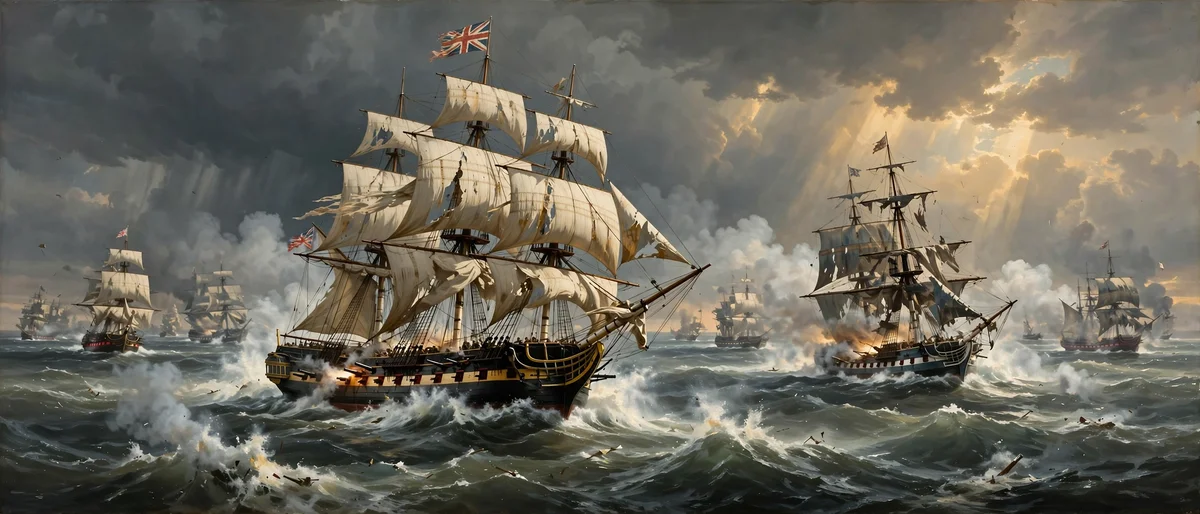
This Battle of Trafalgar summary comes down to one decision: on October 21, 1805, off the coast of Spain, Admiral Horatio Nelson took 27 British ships of the line straight at 33 French and Spanish ships — head-on, in two columns, against every rule in the naval manual — and broke the enemy fleet in half. Britain lost not a single ship. Napoleon lost the sea, and with it any hope of invading England. Nelson lost his life. If you only remember one thing from this Battle of Trafalgar summary, remember this: Nelson's tactics didn't just win the battle, they ended a war before it was finished.
The Road to Trafalgar: Napoleon's Invasion Plan
By 1805, Napoleon Bonaparte owned Europe. Austria, Prussia, Russia — he had beaten them all on land, or would soon. (Austerlitz was still two months away.) Only one enemy held out: Britain, sitting smug across twenty miles of water.
Napoleon had a plan for that. At Boulogne, on the French coast, he had assembled an invasion force of roughly 200,000 men with thousands of flat-bottomed barges, waiting for one thing: a window of safe passage across the English Channel. The window would never come unless the French and Spanish fleets could chase the Royal Navy away from the Channel long enough to let the barges cross. That was the entire job of the Franco-Spanish fleet at Cádiz — hold the Channel, and Britain falls.
The combined fleet was commanded by French Vice-Admiral Pierre-Charles de Villeneuve, with Spanish Admiral Federico Gravina as his second. Villeneuve was not a coward — he had served at the Nile — but he was a man who had learned to dread Nelson. He had slipped out of Toulon in April 1805, been chased across the Atlantic to the West Indies and back, and ended up blockaded in Cádiz, where he sat through the summer while Napoleon's orders grew sharper and his patience shorter.
Then came the orders that killed him. Napoleon, disgusted, replaced Villeneuve with Admiral Rosily. Villeneuve learned of it on October 18 and made the proudest decision of his life: rather than hand over his command in disgrace, he would sail out and fight. The fleet — 33 ships of the line, 18 French and 15 Spanish — cleared Cádiz harbor and headed into the Atlantic.
Waiting outside, already briefed and ready, was Horatio Nelson. He had spent the weeks before the battle doing something his captains would later call "the Nelson Touch": walking them through his entire plan, over and over, until every captain knew exactly what to do without a single signal. That preparation is the whole story of Trafalgar. Everything else was cannon fire.
What Ships Fought at the Battle of Trafalgar?
Twenty-seven British ships of the line sailed under Nelson, plus six frigates. Against them: 33 Franco-Spanish ships of the line.
The British flagship was HMS Victory, 104 guns, with Nelson aboard. The second column was led by his deputy, Vice-Admiral Cuthbert Collingwood, in HMS Royal Sovereign, 100 guns. Villeneuve flew his flag from the French Bucentaure, 80 guns. And the largest warship in either fleet belonged to Spain: the Santísima Trinidad, a four-decked monster carrying 136 guns — the heaviest broadside afloat.
But ships were only half the equation. The British crews were veterans — men who had been at sea for years under blockade duty, trained until loading and firing a cannon was muscle memory. The French and Spanish crews, by contrast, were largely raw. Many of Villeneuve's ships were undermanned, their gun crews barely drilled, their officers demoralized. A Spanish officer, Domingo Grandallana, later wrote that the British fought with a conviction their enemies simply didn't share. Numbers favored Villeneuve: 33 to 27. Almost everything else favored Nelson.
Nelson's Tactics Explained: The Nelson Touch
For 150 years, every admiral in Europe fought sea battles the same way: two fleets sailed in parallel lines and hammered each other until one side gave up or sailed away. The problem with the line of battle was that it almost never decided anything. The loser could always disengage by staying in formation. Nelson hated that. He wanted a battle that ended in annihilation.
His solution — the plan his captains called "the Nelson Touch" — was almost absurdly bold. Instead of a parallel line, Nelson divided his fleet into two columns and sailed them straight at the enemy line, at right angles, aiming to break through it in three places. His ships would cut the Franco-Spanish line into thirds, surround the middle section, and destroy it in a ship-to-ship melee before the enemy's leading ships — the van — could turn around and come back. It was, in modern terms, a crossing-the-T attack: sailing across the front of the enemy's line so that every British broadside fired down the length of enemy ships while the enemy could only reply with a few bow guns.
The risk was enormous. The approach meant sailing into the enemy's broadsides for nearly an hour, unable to fire back, in light winds. Any one of the leading British ships could have been dismasted and crippled before firing a shot. It was the kind of plan that works only if your crews are better than the enemy's — which is exactly what Nelson was betting on.
At about 11:40 that morning, as the columns bore down, Nelson had his signal lieutenant run up the most famous message in naval history: "England expects that every man will do his duty." Later he added a blunter one: "Engage the enemy more closely." No one needed the clarification.
The Battle of Trafalgar: Key Phases of October 21, 1805
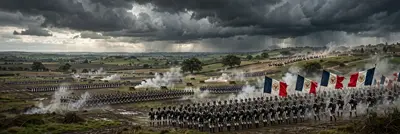
Dawn — Villeneuve wrecks his own line. The French admiral, seeing the British approach, ordered his fleet to turn back toward Cádiz. It was the worst possible order. In light wind, turning 33 ships around took hours, and Villeneuve's neat battle line dissolved into a ragged crescent. Nelson watched it happen and understood: the enemy had just handed him chaos. He would give it order.
Late morning — the approach under fire. Nelson's two columns closed slowly, taking fire for close to an hour. The British crews cleared for action and waited. Collingwood's Royal Sovereign — the fastest sailer — pulled ahead of its column.
Noon — the line breaks. Royal Sovereign smashed through the Franco-Spanish line first, raking the Spanish flagship Santa Ana at close range. About twenty minutes later, Nelson's Victory followed, breaking the line just astern of Villeneuve's flagship Bucentaure and firing a double-shotted broadside through her stern that swept her decks. The planned three-way split was now reality: the enemy's center and rear were surrounded, and the van — 12 or so ships — was sailing away, too far to help.
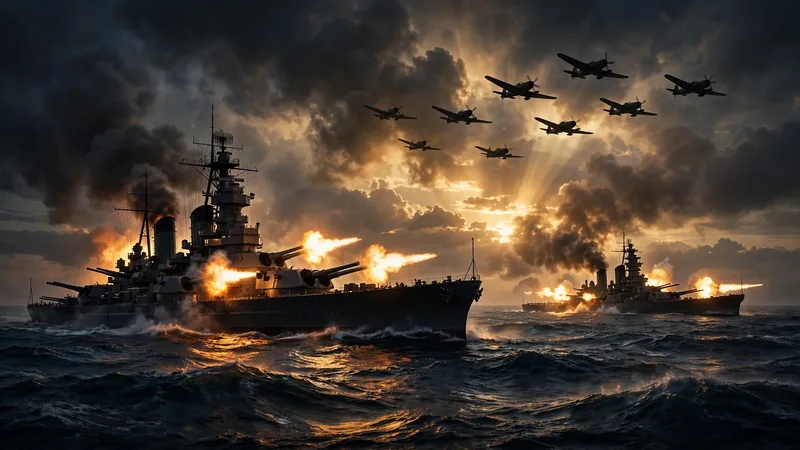
Afternoon — the melee. The battle dissolved into ship-to-ship duels at point-blank range. The French Redoutable engaged Victory so closely that the two ships were nearly locked together. It was from Redoutable's mizzen-top that a sharpshooter spotted the conspicuous figure on Victory's quarterdeck — Nelson, in full uniform with his stars blazing.
1:15 PM — Nelson falls. The musket ball struck Nelson in the shoulder, passed through his chest, and lodged in his spine. He was carried below, where he lived for three more hours — long enough to be told, repeatedly, that his fleet was winning.
Late afternoon — decision. One by one, the surrounded Franco-Spanish ships struck their colors. Villeneuve's Bucentaure was captured; Villeneuve himself became a prisoner. The enemy's van finally turned back, too late, and fled for Cádiz. When Nelson died at about 4:30 PM, he knew. His last words are reported as "Thank God I have done my duty." We should take that with the same pinch of salt we take all deathbed quotes — but the fleet's victory was real, and he knew it.
Turning Points: Three Moments That Decided Trafalgar
1. Villeneuve's dawn turn. If the Franco-Spanish fleet had kept its formation and fought a conventional line battle, the day might have been inconclusive — 33 decent ships against 27 excellent ones, and everyone sails home for dinner. By ordering the turn in light wind, Villeneuve handed Nelson a broken, ragged line that no commander could control. Admirals lose battles with orders like that.
2. The decision to break the line. This is the heart of this Battle of Trafalgar summary, and it was the boldest gamble of the war. Every other admiral alive would have formed a parallel line and traded broadsides all afternoon to a draw. Nelson's tactics — the two-column penetration — traded an hour of terrifying exposure for a decisive melee. The gamble worked because his captains had rehearsed it ("the Nelson Touch") and his gunners could fire three broadsides to the enemy's two. Audacity with preparation behind it isn't recklessness. It's just audacity.
3. The storm nobody planned for. Two days after the battle, on October 22–23, a ferocious Atlantic storm hit the surviving ships. It scattered the British fleet and wrecked most of the captured prizes — some sank, some were recaptured by their own crews, a few were driven ashore. Of the 18 enemy ships captured or destroyed in the battle, only 4 ever reached a British port as prizes. Trafalgar's victory was so complete that even a storm couldn't undo it — but the storm is the reason the prize lists vary from source to source.
Battle of Trafalgar Casualties: The Price on Both Sides
Who won the Battle of Trafalgar? Britain — completely. No British ship was lost. The Franco-Spanish fleet lost 18 ships captured or destroyed in the fighting (one blew up), with most of the rest crippled or fled.
The human cost tells the same story. British casualties were around 450–458 killed and about 1,200–1,208 wounded — remarkably light for a victory of this scale. The Franco-Spanish side lost roughly 4,400 killed, about 2,500 wounded, and 7,000–8,000 men taken prisoner. (Britannica's figures run slightly higher: about 1,500 British killed and wounded total, and some 14,000 Franco-Spanish lost, half of them prisoners.)
Those numbers are worth pausing over. Trafalgar was a one-sided battle by the standards of any age — a crushing, almost absurdly uneven result. But we should be honest about what they mean: thousands of French and Spanish sailors died because they were put in an impossible position by their own admirals and by Napoleon's strategy, not because they were cowards. The dead deserve that much accuracy.
Why Was the Battle of Trafalgar Important?
So why was the Battle of Trafalgar important — really, not just in the textbook sense?
First, it killed Napoleon's invasion plan on the spot. The barges at Boulogne never crossed. England was safe, and stayed safe for the rest of the war. If Villeneuve's 33 ships had won on October 21, Britain might have faced a land campaign against the greatest general of the age — a thought that should chill any British reader.
Second, it gave the Royal Navy something no navy had ever held for long: unchallenged supremacy for roughly a century. Britain could blockade France's ports, strangle its trade, land armies wherever it pleased — including, years later, in Portugal and Spain, where the Duke of Wellington's army gnawed away at Napoleon's empire in what he called his "Spanish ulcer."
Third, it forced Napoleon to fight Britain the only way left to him: economically. The Continental System — his attempt to close all of Europe to British trade — was a direct product of Trafalgar's defeat at sea. It failed, slowly and expensively, and the failure helped drag Napoleon into the Russian catastrophe of 1812.
And there's a fourth reason, harder to measure: Trafalgar became the founding myth of the modern Royal Navy. Nelson's funeral was a national event. His column went up in Trafalgar Square. For a hundred years, British admirals would ask themselves what Nelson would have done. Trafalgar began Napoleon's long defeat; our Battle of Waterloo summary picks up the story where it ended, ten years later. And if you want to see what a decisive naval turning point looks like in the age of carriers, our Battle of Midway explained is the closest modern echo — another outnumbered fleet, another morning that changed a war.
What the Sources Tell Us: A Note on the Numbers
Honest history comes with asterisks, and Trafalgar has its share. The ship-loss figures you see — 17, 18, even 22 enemy ships captured or destroyed — vary because sources count differently: some count only what was taken in the battle, others include ships the October storm finished off afterward. The widely cited figures here (18 captured or destroyed at the battle, only 4 prizes reaching British ports) are the standard synthesis; expect slight differences between Britannica, the National Maritime Museum, and naval historians.
Casualty totals are approximate for the same reason 19th-century records always are: the French and Spanish counts, in particular, were compiled from ships' rolls that didn't always survive the battle. Nelson's reported last words — "Thank God I have done my duty" — come from the officers at his bedside and may have been tidied up for posterity. Deathbed quotes usually are.
What isn't in doubt: the date (October 21, 1805), the commanders, the two-column attack, the result, and the storm. The rest is rounding.
3 Lessons from Trafalgar
Trafalgar is a battle, but it's also a case study in how to win against the odds. Three lessons worth stealing:
1. Brief your people until they don't need you. Nelson's real weapon wasn't the Victory — it was the weeks he spent walking his captains through the plan until every one of them could fight the battle without a single signal. When the smoke made signaling impossible, his fleet kept fighting exactly as designed. Leaders who explain the why get teams that act without being told.
2. Play to your edge, not the scoreboard. 27 against 33 looks like a losing hand. Nelson's tactics were built around the one thing the numbers couldn't show: his crews were better trained, better drilled, and better led. He designed a battle that rewarded exactly that advantage — close, chaotic, ship-to-ship fighting where skill mattered more than hull count. Never fight on the enemy's terms when you can choose the ground.
3. Safe plans give safe results. The parallel line of battle was the responsible, professional choice — and it produced indecisive afternoons for 150 years. Nelson's columns were terrifying and looked reckless on paper. The difference between recklessness and genius was preparation: he knew his crews, knew the enemy's weakness, and bet everything on both. Sometimes the cautious option is just a slower way to lose.
Frequently Asked Questions
Who won the Battle of Trafalgar?
Britain won decisively. Nelson's fleet captured or destroyed 18 Franco-Spanish ships on October 21, 1805, while losing not a single British ship. French Admiral Villeneuve was captured.
What tactics did Nelson use at Trafalgar?
Nelson abandoned the standard parallel line of battle. Instead, he sailed his 27 ships in two columns straight at the enemy's 33-ship line, breaking through it in three places — a move sometimes called "crossing the T." This surrounded the middle of the Franco-Spanish fleet and destroyed it ship by ship before the enemy's leading ships could turn back to help.
How did Nelson die at Trafalgar?
Around 1:15 PM, while pacing Victory's quarterdeck in full uniform, Nelson was shot by a French sharpshooter firing from the mizzen-top of the French ship Redoutable. The musket ball passed through his chest and lodged in his spine. He died about three hours later, after being told his fleet had won.
Why was the Battle of Trafalgar important?
Trafalgar ended Napoleon's plans to invade Britain and gave the Royal Navy unchallenged command of the seas for roughly a century. With France unable to challenge Britain at sea, Napoleon was forced into the failed Continental System and the disastrous Russian campaign that led to his downfall.
Sources
- Britannica — Battle of Trafalgar
- Wikipedia — Battle of Trafalgar
- National Maritime Museum — Trafalgar Influence on Navy Tactics (PDF)
- History.co.uk — Why the Battle of Trafalgar Was So Important for Britain
- ThoughtCo — Napoleonic Wars: Battle of Trafalgar