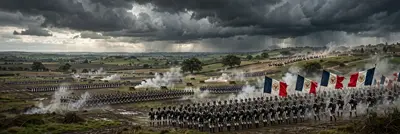
This battle of Austerlitz explained comes down to one trap. On December 2, 1805, near the village of Austerlitz in Moravia — in what is now the Czech Republic — Napoleon Bonaparte took about 73,000 French soldiers against a combined Austrian-Russian army of roughly 85,000, invited them to attack him, and then destroyed them. It took about nine hours. The Austrians lost their army, the Russians lost their nerve, and the Third Coalition — the alliance Britain had built to stop Napoleon — collapsed like a house in a storm. If you only remember one thing from this battle of Austerlitz explained, remember this: it is the single battle Napoleon himself called his masterpiece, the one every general since has tried to copy, and the one that made him master of Europe for a decade.
The Road to Austerlitz: 1805 and the Third Coalition
To understand what happened at the battle of Austerlitz, you need to know why two emperors were standing on a foggy hill in Moravia in the first place.
By 1805, Britain had had enough. Napoleon had crowned himself Emperor of the French in 1804, and his armies kept swallowing territory. So Britain spent its money — and it had a lot of it — buying allies. The result was the Third Coalition: Britain on the sea, Austria and Russia on land, with Prussia hovering on the sidelines, unpaid and uncommitted.
The coalition's plan started well enough. In the autumn of 1805, Napoleon pulled off one of his great maneuvers at Ulm: he surrounded an Austrian army under General Mack and forced it to surrender without a real battle. Roughly 60,000 Austrians laid down their arms. Napoleon marched into Vienna on November 13, 1805, unopposed. On paper, he was winning.
But the paper lied. His army was stretched thin, far from France, deep into central Europe. Russian armies under Kutuzov were retreating eastward, linking up with a second Russian force and with the remaining Austrian army. Every day they waited, the coalition grew stronger — Prussia was tilting toward joining, and Russian reinforcements were marching west. Napoleon needed a battle. The Allies, young and confident and advised by a chief of staff with a plan he was sure of, wanted one too.
The Allied army concentrated around the town of Olomouc, north of Austerlitz, with Tsar Alexander I of Russia and Emperor Francis II of Austria both present. Nominally in command was the veteran Russian general Mikhail Kutuzov — a man who had seen enough war to know that patience wins. Kutuzov's advice was simple: don't fight. Retreat east, let the French starve, wait for the reinforcements. Alexander, thirty years old and surrounded by ambitious young officers, overruled him. The Austrian chief of staff, Franz von Weyrother, had written an elaborate plan to smash the French right flank, and Alexander approved it.
That decision was the hinge of everything.
Napoleon's Trap: Giving Up the High Ground
Here is what made Austerlitz different from almost every battle before it — and what this battle of Austerlitz explained has to start with.
The battlefield was dominated by a long ridge called the Pratzen Heights. It was the strong central ground. Any competent commander would want it. Napoleon took one look at it and deliberately gave it up.
He pulled his center back, left his right flank obviously weak, and made a show of his fear. He sent a fake peace feelers to the Allied camp. He let his enemies see an anxious, nervous emperor, a man stalling for time. The Allies read all of it as weakness, and it confirmed exactly what Weyrother's plan needed them to believe: that the French right was about to collapse.
So they did what Napoleon wanted. On the morning of December 2, in darkness and thick fog, the Allies marched a huge part of their army down off the Pratzen Heights — the strongest ground on the field — and threw it at the French right flank. To do that, they thinned their own center. The Heights stood nearly empty, held by a thin screen.
Napoleon, standing on the Žuráň Hill, watched the fog swallow their columns. He had predicted everything: their plan, their route, their timing. When his staff asked when to strike, he reportedly said: wait. He wanted the Allied center to be truly hollow before he hit it.
This was the "Sun of Austerlitz" — the famous moment, around 9 in the morning, when the mist suddenly broke and pale winter sunlight flooded the battlefield. Napoleon ordered his center forward. Propaganda would later turn that morning sun into a sign from heaven. In reality, it was just good timing: the fog always lifted in the morning, and Napoleon had counted on it.
The Battle of Austerlitz: December 2, 1805
The battle of Austerlitz date to remember is December 2, 1805 — chosen deliberately by Napoleon, the first anniversary of his coronation. The fighting started in the fog before dawn.
The southern sector — the French right. The Allies hurled their left wing at the French right, around the villages of Tellnitz and Sokolnitz, held initially by a single French division. The plan was to roll up the whole French line. It nearly worked. The French right bent back under the weight of the attack. What saved it was the arrival of Marshal Davout's III Corps — men who had force-marched roughly 110 kilometers in about 48 hours to reach the battlefield. They slammed into the Allied advance and held the line. It was the hardest fighting of the day, and it bought Napoleon the time he needed.
The center — the killing stroke. At about 9 AM, as the mist lifted, Marshal Soult's IV Corps — some 16,000 men in two columns — stormed straight up the now-empty Pratzen Heights. The Allied center, stripped of its troops to feed the southern attack, couldn't stop them. The French took the heights and, with them, the middle of the Allied army. The Allied line was split in two. The battle was effectively decided within two hours of that assault.
The northern sector — cavalry and guards. In the north, around the Santon Hill, the French under Lannes and Murat held off Bagration's Russian right wing. There were massive cavalry clashes — thousands of horsemen wheeling and charging in the largest mounted battles of the Napoleonic era. Late in the day, the Allied commanders threw in their last reserve, the Russian Imperial Guard, against the French center. Napoleon's own Guard met them and broke them. It was the last throw, and it failed.
By 4 PM the battle was over. The Allied army was cut in half. The southern Allied wing, trapped, tried to escape across a line of frozen ponds — the Satschan ponds. French artillery fired on the ice. Men drowned. More on that in a moment, because the story you've heard about it is mostly propaganda.
The numbers tell the shape of the disaster. France: about 8,000 to 9,000 killed and wounded. The Allies: somewhere between 27,000 and 36,000 killed, wounded, and captured — the sources disagree on the exact figure, which is why honest histories give a range. The French also captured roughly 180 guns and about 50 enemy standards. An army of 85,000 had been ruined in nine hours.
Turning Points: Four Moments That Decided Austerlitz
1. Alexander overrules Kutuzov. This was the battle's true beginning, and it happened days before any shot was fired. Kutuzov understood the arithmetic: time favored the Allies, so don't fight. Alexander chose Weyrother's grand plan instead. When an old general tells you not to fight and you fight anyway, the battle is half lost before it starts.
2. The Allies abandon the Pratzen Heights. No one ordered them off the high ground by force — they walked off it themselves, in the dark, following Weyrother's plan. It is one of the great paradoxes of military history: the Allies gave up the best terrain on the field voluntarily. Every later disaster of the day flows from this single decision.
3. The "Sun of Austerlitz" — Soult's assault at 9 AM. The mist broke, Soult's two columns hit the hollowed center, and the Allied army was split in two. It took about two hours. Battles are usually won in minutes that took hours to prepare; these were those minutes. Once the heights were French, the Allies had no line left — only two disconnected wings that couldn't help each other.
4. The failure of the Russian Imperial Guard's counterattack. Late in the day, the Allies fed their finest troops — the Russian Imperial Guard — into the fight on the heights. Napoleon's Guard broke them. When your last reserve breaks, the army breaks. The retreat began, and the retreat is where armies are destroyed.
---
> ### ⚔️ A New Epic Battle Every Day
> Love military history? Subscribe to Echoes of Battle on YouTube (@EchoesOfBattleHistory) — a new epic battle every day, cinematic and free.
> Next in the Napoleon series: Battle of Waterloo 1815 Summary: Why Napoleon Lost — ten years after Austerlitz, his story ended.
---
What If Austerlitz Went the Other Way?
Counterfactuals are the historian's guilty pleasure, but some are worth the thought experiment, and this is one of them.
What if Alexander had listened to Kutuzov? Imagine the Allied army simply doesn't fight. It retreats east, burning supplies as it goes, linking up with fresh Russian troops and a Prussia that was days away from joining the coalition. Napoleon's army, stretched and freezing in Moravia, faces the choice between an exhausted pursuit into Russia in December — a preview of 1812, seven years early — or a humiliating retreat to Vienna. The Third Coalition survives. Britain's money keeps flowing. There is no Treaty of Pressburg, no Confederation of the Rhine, no Austerlitz legend. Napoleon remains a great general, but a contained one. The entire arc of his empire — the decade of French dominance — probably never happens, or happens far later and far weaker. The decision to fight at Austerlitz wasn't just a battle decision. It was the decision that created Napoleon's empire.
What if the fog had never lifted? Here's a smaller what-if with a bigger lesson. Napoleon's whole center assault depended on the morning mist clearing around 9 AM so Soult's columns could see the heights they were climbing. What if a dense fog had sat on the field all day? The French would have marched blind into Allied positions, the coordination of the trap would have frayed, and a battle Napoleon needed to be surgical could have dissolved into a messy, indecisive slog. It tells you something honest about "genius" in war: the greatest plan ever written still needed the weather to cooperate. Napoleon knew that, which is why he waited for the sun. But luck and timing are ingredients even masters don't control.
What if Davout's march had failed? Davout's III Corps covered about 110 kilometers in 48 hours and arrived in time to save the French right. If that march had fallen a day short — if the Allies had smashed the French right before Davout arrived — the entire trap collapses. Napoleon's center assault works only if his right holds. The Allies would have rolled up his flank, and Austerlitz would be remembered as Napoleon's reckless gamble, the battle where he gave up the high ground for nothing. History grades boldness by outcome; the march made the grade.
Austerlitz vs Cannae: Two "Perfect" Victories Compared
Austerlitz is often called Napoleon's masterpiece the way Cannae is called Hannibal's. The comparison is irresistible — both are studied in military academies, both were annihilation battles, both made their commander's legend. But my honest reading is that the comparison flatters Austerlitz and undersells Cannae, for one reason: Cannae was the harder trick.
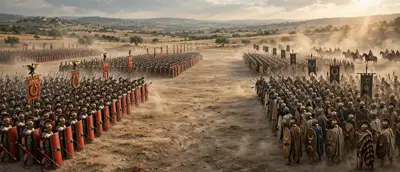
At Cannae (216 BC), Hannibal defeated a Roman army roughly twice his size through a maneuver no one had attempted at that scale — the double envelopment, Roman legions crushed in a pocket of Carthaginian infantry. He did it with a heterogeneous, multi-ethnic army, without reliable staff work, without maps as we know them, and against a Roman command structure that was crude but disciplined. It was invention.
Austerlitz, by contrast, was exploitation. Napoleon's trap was brilliant, yes — but it worked because the Allies handed him the script. They wrote their own defeat in Weyrother's disposition, marched off the heights themselves, and charged into a baited flank. Napoleon's genius was psychological: he read the enemy commander's mind and set a trap the enemy walked into willingly. Hannibal's genius at Cannae was structural: he imposed his will on an enemy that fought exactly as it intended to. One outthought a bad plan; the other broke a good army.
And here's the strategic difference that matters more. Cannae destroyed Rome's army — and Rome kept fighting for fourteen more years. Austerlitz destroyed the Third Coalition's army — and the coalition collapsed in weeks. If you measure a victory by its consequences, Austerlitz wins. If you measure it by the tactical craft required, Cannae wins. That's my take, and it's why I rank Cannae the greater tactical feat but Austerlitz the greater strategic triumph. Read our Cannae 216 BC piece and judge for yourself.
The Frozen-Lake Myth: What Really Happened at the Satschan Ponds
This is the part of the Austerlitz legend you should hold up to the light.
As the Allied army's southern wing collapsed, fleeing troops tried to cross the frozen Satschan ponds. Napoleon's 30th Bulletin of the Grande Armée — his official propaganda — reported that French artillery broke the ice and thousands of men were swallowed by the freezing water. Paintings were made. Poems were written. "Thousands drowned" became the popular image of Austerlitz.
It was, to put it plainly, inflated. When the ponds were later drained, very few bodies were found. Modern historians estimate the drowned numbered in the dozens — a tragedy, not a mass catastrophe. The French guns did fire on the retreating columns; some men did drown; but the thousands were Napoleon's invention, served up to a Parisian public that wanted its emperor's victory to sound biblical.
This matters for a reason beyond fact-checking. Austerlitz is the most romanticized battle of the Napoleonic era, and the romanticization started immediately — from the victor's own pen. When you read that the "Sun of Austerlitz" was providence, that the ice swallowed thousands, that Napoleon saw the entire battle unfold like chess from his hill — you're reading his press office. The real battle was messier: a French right wing that nearly broke, a desperate forced march, a center assault that had to land within a narrow window. The messiness doesn't make it less impressive. It makes it real.
Aftermath: What Austerlitz Changed
The political earthquake was immediate. An armistice was signed within days. On December 26, 1805, France and Austria signed the Treaty of Pressburg: Austria left the war, ceded territory to France and its German allies, and paid a war indemnity of 40 million francs. Russia withdrew its armies eastward. The Third Coalition was dead.
Britain, whose money had built the coalition, was stunned. The news killed Prime Minister William Pitt the Younger — not literally on the spot, but his health collapsed, and he died the following January. To him is attributed the famous line on hearing of Austerlitz: "Roll up that map; it will not be wanted these ten years."
The next year, 1806, the old order kept falling. Emperor Francis II abdicated as Holy Roman Emperor, dissolving an institution that had existed for a thousand years. Napoleon created the Confederation of the Rhine — a belt of German states tied to France. He stood at the peak of his power. His letter to Josephine after the battle said it plainly: "I have beaten the Austro-Russian army commanded by the two emperors."
And the battle's shadow stretched long. For the next century, every general with ambition wanted his own Austerlitz — a single, perfect, war-ending battle of maneuver. It became the textbook example of the battle of annihilation, studied from Paris to Prussia to America. It also became the trap its imitators fell into: later generals chased the fantasy of the perfect battle and forgot that Austerlitz worked because of the enemy's specific, contingent mistakes, not because the maneuver was a formula. The Schlieffen Plan of 1914 was, in a sense, Austerlitz envy — and it ended very differently.
Why the Austerlitz Legend Is Overrated — and What Deserves More Credit
Here's my opinion, and it's the kind of thing you won't find in the encyclopedia entries. The standard story of Austerlitz is that Napoleon was a chess master who saw twelve moves ahead. That story is overrated. What actually happened is that Napoleon read his opponent's plan — Weyrother's disposition was captured by French intelligence and studied beforehand — and then set a trap for a commander who was going to do exactly what the plan said anyway. That's still impressive. Reading an enemy's mind is a real skill. But it isn't prophecy; it's preparation plus an opponent who couldn't improvise. The Allies' failure was as decisive as Napoleon's brilliance, and histories that give Napoleon all the credit give Alexander and Weyrother none of the blame.
What deserves more credit: two things nobody puts on the poster. First, Davout's march — 110 kilometers in 48 hours through December mud, arriving in time to hold a collapsing flank. Without it, the trap fails and Napoleon is the gambler who lost. Second, the staff work. The Grande Armée moved on a timetable that modern armies would respect — multiple corps converging from different directions, arriving in sequence, fighting coordinated battles all day without radios. That level of operational control in 1805 was itself a weapon, and it gets less attention than the "Sun of Austerlitz" poetry. Austerlitz wasn't won by genius alone. It was won by a system that could march, time, and strike — with a genius on top.
Sources and Caveats
A note on honesty before the questions. The numbers at Austerlitz vary by source, and any article that gives you single, confident figures is rounding away real uncertainty. French strength is cited anywhere from 66,000 to 75,000; the Allied army from 85,000 to about 90,000. Allied losses are quoted between 27,000 and 36,000 killed, wounded, and captured. I've used the most commonly cited middle figures (~73,000 French, ~85,000 Allied, 27,000–36,000 Allied losses, ~8,000–9,000 French) and flagged the ranges where they matter. Quotes from the period — Pitt's map line, Alexander's "babies in the hands of a giant," Napoleon's letter to Josephine — are widely repeated in the historical literature and treated as traditional; deathbed-style attribution for 19th-century quotes always carries some doubt, and you should know that. The frozen-pond drowning figures are the one point where modern scholarship has firmly corrected the old legend: dozens, not thousands.
Frequently Asked Questions
Who won the Battle of Austerlitz?
Napoleon Bonaparte won, decisively. On December 2, 1805, about 73,000 French troops crushed the combined Austrian-Russian army of roughly 85,000 — ending the Third Coalition in a single day.
Why is Austerlitz called Napoleon's greatest victory?
Because he was outnumbered, faced two empires at once, and destroyed their combined army in about nine hours — through a deliberate trap rather than brute force. The battle ended a coalition, redrew the map of Europe, and established Napoleon as the dominant power on the continent for a decade.
What was the "Sun of Austerlitz"?
Around 9 AM, the morning mist over the battlefield suddenly broke, flooding the field with sunlight. Napoleon had been waiting for it: he launched his center assault on the Pratzen Heights in that moment. French propaganda turned it into a divine sign of his genius. In truth, morning fog always lifts — Napoleon had simply counted on it.
How many died at the Battle of Austerlitz?
French losses were about 8,000–9,000 killed and wounded. Allied losses were far heavier: between 27,000 and 36,000 killed, wounded, and captured. The famous story of thousands drowning in the frozen Satschan ponds was Napoleonic propaganda — modern evidence suggests dozens drowned, not thousands.
Sources
- History Tools — "The Austerlitz Battlefield" (facts table and battlefield survey)
- Warfare History Network — "The Napoleonic Wars: The 1805 Battle of Austerlitz"
- Myth and Memory — "Battle of Austerlitz: Napoleon's Strategy and Victory Explained"
- "Austerlitz Explained" — independent battle explainer (casualty breakdown cross-check)
- "Napoleon's Perfect Victory in 9 Hours" — documentary narrative (tactical sequence cross-check)