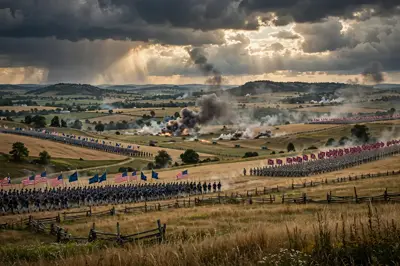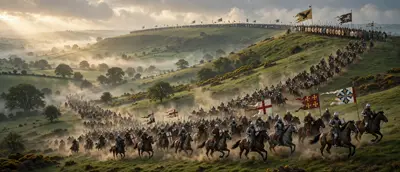
Napoleon lost his empire in a single Sunday. 18 June 1815, near the Belgian village of Waterloo. By nightfall his army was shattered, his empire finished, the 19th century's Stalingrad, and Europe was walking into a century of peace shaped by his defeat. Five compounding disasters did it: a waterlogged field, a farmhouse that refused to fall, thousands of horsemen thrown at unbreakable squares, a third of his army sent chasing ghosts, and a second enemy army arriving on his flank. Here's how it all came apart.
The Road to Waterloo: 100 Days Back from Exile
Napoleon should never have been on that field. In 1814, after the disastrous invasion of Russia and defeat by a grand coalition of European powers, he'd been forced to abdicate and shipped off to Elba, a small island off the Italian coast. Europe's monarchs redrew the map at the Congress of Vienna and assumed the Napoleonic era was over. They were wrong about that, as they'd been wrong about a few things. Small islands, as it turned out, don't hold ambitious men for long.
They assumed wrong. In February 1815 Napoleon escaped Elba, landed on the French coast with a handful of men, and marched on Paris. Royalist troops sent to stop him defected instead. By March he was Emperor again, ten years after Austerlitz, ten years after Trafalgar. The period that followed is called the Hundred Days. Eleven words that changed Europe twice.
Britain, Prussia, Austria, and Russia declared war immediately. Rather than wait for them to converge on France, Napoleon struck first into Belgium, hoping to smash the two nearest armies, Wellington's British-led force and the 72-year-old Blücher's Prussians, before they could join up. Divide and conquer. The oldest play in the book. And it nearly worked. What could possibly go wrong?
His opening moves nearly worked. On 16 June 1815 Napoleon beat Blücher's Prussians at Ligny while a separate French force held Wellington at Quatre Bras. But "nearly" is the word that defines the whole campaign. The Prussians were beaten, not destroyed. And then Napoleon made the decision that would haunt the 18th of June: he detached some 33,000 men, roughly a third of his force, under Marshal Grouchy to chase the retreating Prussians. Grouchy never found them in time. Those 33,000 men missed the battle entirely. A third of an army, spent on a ghost hunt.
The Battle, Hour by Hour: 18 June 1815
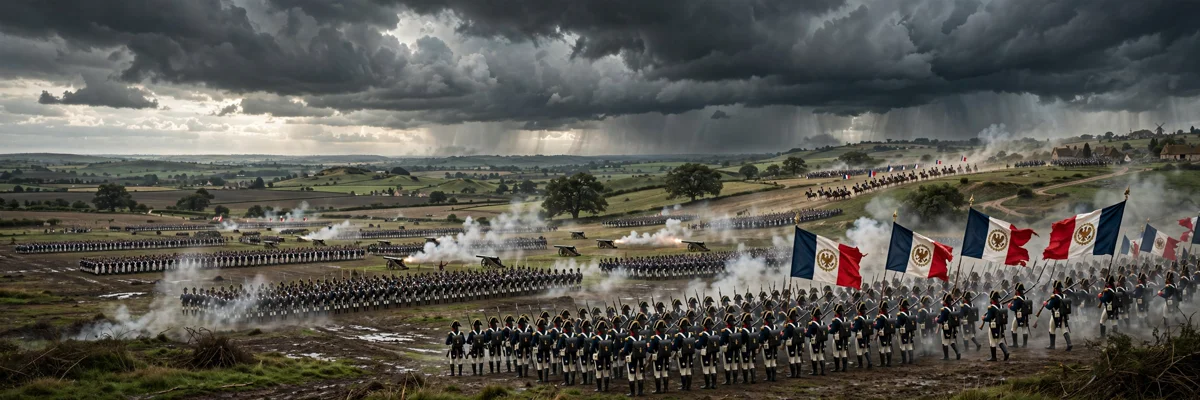
The two armies faced each other across a shallow valley about twelve miles south of Brussels. Wellington's Anglo-allied army, roughly 68,000 men, held a ridge along the road to Brussels. Napoleon had about 72,000 French troops opposite. And a third army, some 50,000 Prussians, was marching toward the field. Whether they arrived in time would decide everything. Both commanders knew it. The whole day was a race.
Around 11:30 a.m. The battle didn't open at the center. It opened at Hougoumont, a walled farm complex on Wellington's right flank. Napoleon meant it as a diversion to pull Allied reserves away. It became a trap for the French instead. The farm's defenders, British and allied troops fighting from behind garden walls and buildings, held all day. The fighting around Hougoumont ate French manpower and artillery for hours. The "diversion" never stopped. Diversions have a way of doing that.
Around 12:30 p.m. Eighty French guns opened fire on Wellington's line. But overnight rain had soaked the ground, and cannonballs that should have bounced through the Allied ranks buried themselves in mud instead. Wellington, a master of defensive warfare, had also tucked most of his troops behind the reverse slope of the ridge, out of the artillery's reach. Mud and a hill. Sometimes that's all it takes.
Around 1:30 p.m. The first great infantry assault. Some 17,000 men of the French I Corps under General d'Erlon advanced in deep, unwieldy columns against the Allied center between La Haye Sainte and Papelotte. Concentrated musketry threw them back, and then a thundering countercharge by British heavy cavalry finished the job, except the cavalry charged too far and got badly cut up by French lancers. Both sides were already bleeding. Nobody was winning yet.
Around 4:00 p.m. The most famous cavalry action of the day. Marshal Ney, who'd effectively taken tactical command after Napoleon fell ill in the saddle, hurled wave after wave of French cavalry, perhaps 10,000 horsemen over nearly two hours, at Wellington's infantry. The Allied foot soldiers formed hollow squares, bristling with bayonets, and the horses simply wouldn't charge into them. The cavalry flowed around the squares again and again, achieving almost nothing while French horses died by the thousands. And Ney attacked without infantry or artillery support. Horsemen alone can't break squares. Every cavalryman knew that. So why did Ney order it anyway?
Late afternoon. The moment Wellington had waited for. Prussian columns started appearing on the French right flank, attacking the village of Plancenoit. Napoleon had to feed his precious reserves into that fight, including the Young Guard. Plancenoit changed hands repeatedly in savage close fighting. But the pressure on Napoleon's flank never let up, and it kept draining the strength he needed for his main attack. The race was over. The Prussians had won it.
Around 6:00 p.m. Ney's men finally took La Haye Sainte, the farmhouse anchoring Wellington's center, and brought artillery up to rake the Allied line at point-blank range. This was Napoleon's best moment. But he was tied up with the Prussians on his flank and couldn't reinforce Ney in time. Wellington closed the gap. The best moment of the day, and there was nothing left to feed it. Timing is everything, and the timing was gone.
Around 7:30-8:00 p.m. The last throw. Napoleon committed the Imperial Guard, his elite, his symbol of invincibility, in a final attack on the Allied center. The Guard advanced uphill into concentrated volley fire from troops behind the ridge crest. It stalled. Then it broke. The cry that swept the French lines, "La Garde recule!" (The Guard retreats), collapsed French morale in minutes. Wellington ordered a general advance, the Prussians pressed from the east, and the French army dissolved into a panicked rout. The Prussians pursued through the night. Napoleon's last battle was over.
Why Napoleon Lost: The 5 Reasons
Any honest account of why Napoleon lost at Waterloo comes down to five causes. The military theorist Baron de Jomini, who studied the battle in depth, listed most of them first. He had the advantage of not being in it. Critics with no mud on their boots see the clearest.
1. The mud stole his morning. Heavy overnight rain turned the battlefield into a quagmire. Napoleon delayed his opening attack until nearly midday to let the ground dry. That delay was the single most expensive decision of the day: it gave Blücher's Prussians, marching through the same mud, the extra hours they needed to reach the field. As Jomini put it, the horrible weather "retarded till one o'clock the attack that should have been made in the morning". Was the mud Napoleon's enemy, or just his excuse? Waiting for perfect conditions handed the enemy the day.
2. Hougoumont swallowed an army. The farmhouse attack was supposed to be a feint. Instead Hougoumont became a black hole for French troops all day. Wellington never had to strip his center to hold it. Napoleon had to keep feeding men into an attack that gained nothing. A feint you're still feeding hours later isn't a feint anymore. It's a habit.
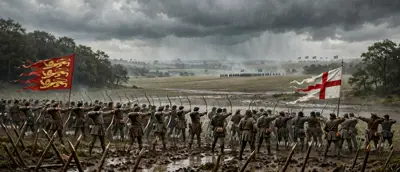
3. Ney's cavalry died for nothing. Some 10,000 French horsemen were spent in repeated charges against infantry squares, cavalry used without the infantry and artillery support it needs, the same kind of unsupported charges that had died at Agincourt four centuries earlier. Horses can't break disciplined squares, and Ney attacked without the combined-arms coordination Napoleon himself had once perfected. The master of combined arms, watching his marshal forget it. Four hundred years of lessons, ignored in an afternoon.
4. Grouchy's 33,000 men were in the wrong place. Detached to chase the Prussians after Ligny, Grouchy's corps never rejoined the battle. The Prussians he was chasing reached Waterloo anyway, 50,000 of them, on Napoleon's flank. Napoleon fought the battle outnumbered because he'd split his own army. He sent a third of his strength to prevent exactly what happened, and it happened anyway. The ghost hunt failed.
5. Wellington and Blücher were simply better that day. Jomini's second cause was "the admirable firmness of the British infantry, joined to the sang-froid and aplomb of its chiefs." Wellington's reverse-slope position, his iron grip on inexperienced troops, and Blücher's iron determination to march to Wellington's aid, the 72-year-old reportedly strapped to his horse after being injured at Ligny, were the human factors Napoleon couldn't overcome. Sometimes the other side just wants it more, and on June 18, they did. Old men on horseback beat the genius (strapped to his horse after Ligny, and he still got there first). That's the part nobody expected.
Aftermath: How One Day Rewrote Europe
Napoleon abdicated four days later, on 22 June 1815. No Elba this time. The British exiled him to St. Helena, a remote island in the South Atlantic, where he died in 1821. From master of Europe to a rock in the Atlantic in six years. That's what one Sunday can do. Makes you think about bad days at the office, doesn't it?
One man's fate was the smallest part of it:
- The Napoleonic Wars ended. Two decades of conflict that had consumed Europe, and cost millions of lives, finally stopped. The Congress of Vienna's settlement held, and apart from brief conflicts, Europe avoided continent-wide war for nearly a century.
- Britain's century began. Waterloo confirmed Britain as the dominant global power of the 19th century, at sea, in finance, in empire. The long Pax Britannica that followed was built on the wreck of Napoleon's ambitions.
- A new word for defeat. "Waterloo" entered English as shorthand for a final, crushing defeat. That's how completely one battle can end a story.
- A battlefield preserved. The field at Waterloo, south of Brussels, is still one of Europe's most visited battlefields. The Lion's Mound memorial marks the spot where the Prince of Orange was wounded.
So that's why Napoleon lost at Waterloo. Never one mistake. Five of them, stacked on top of each other in a single day, a day as decisive as Midway would be 130 years later. Empires rarely die of one wound. They die of five, all at once.
3 Lessons from Waterloo for Today
1. Don't let the perfect moment cost you the day. Napoleon waited for the ground to dry so his artillery would work properly. Tactically sound, strategically fatal. If you're waiting for perfect conditions, remember this: waiting usually hands the initiative to someone willing to move through the mud.
2. One army divided is two problems unsolved. Napoleon split his force to handle two enemies and ended up facing both at once, neither properly beaten. Half-measures against multiple threats tend to fail twice. When has dividing your army ever ended well? Concentrate on one decisive objective at a time.
3. Your reputation is not a reserve force. Napoleon committed the Imperial Guard expecting its legend to break the Allied line by shock alone. The legend died on that ridge. No brand, title, or past record wins today's fight for you. Only the strength you bring to it.
What the Sources Tell Us
Waterloo is one of the best-documented battles in history, and also one of the most argued-over. British, French, and Prussian accounts each claimed the lion's share of the credit for generations. Troop numbers vary by source. The widely cited figures are about 72,000 French against roughly 68,000 Anglo-allies, with around 50,000 Prussians arriving during the day, though some estimates run higher. Casualties are similarly approximate: about 25,000 French killed or wounded, thousands more captured or missing, against roughly 24,000 Allied and Prussian casualties. Horses died in enormous numbers, likely 7,000 or more. Think about that number.
The famous details come with their own debates: whether Napoleon was genuinely ill that day, how many of the cavalry charges were deliberate feints versus Ney's impetuosity, how close the battle really was before the Prussians arrived. Wellington himself called it "the nearest-run thing you ever saw in your life." No source disputes the outcome, or the century of European history it decided.
Sources
- History.com - "Napoleon defeated at Waterloo" - http://history.com/this-day-in-history/june-18/napoleon-defeated-at-waterloo
- The Peninsula Qatar - "Timeline of Napoleon's defeat at battle of Waterloo" - https://thepeninsulaqatar.com/article/14/06/2015/timeline-of-napoleon-s-defeat-at-battle-of-waterloo
- Myth and Memory - "Battle of Waterloo 1815: Napoleon, Blücher & His Defeat" - https://mythandmemory.org/military-history/battle-of-waterloo-1815-napoleon-blucher/
- Firstpost Explainers - "History Today: When the Napoleon era ended with Battle of Waterloo loss" - https://firstpost.com/explainers/history-today-when-the-napoleon-era-ended-with-battle-of-waterloo-loss-13897668.html
- The Waterloo Association - "Victor Hugo's Account of The Battle of Waterloo" - https://www.waterlooassociation.org.uk/2019/02/22/victor-hugos-account-of-the-battle-of-waterloo/
- Alessandro Barbero, The Battle: A New History of Waterloo (2003)
- Antoine-Henri Jomini, analysis of the causes of Napoleon's defeat (summarized in Goodreads History Book Club discussion) - https://www.goodreads.com/topic/show/239916-wellington-and-the-battle-of-waterloo---1815