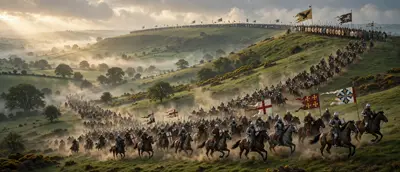
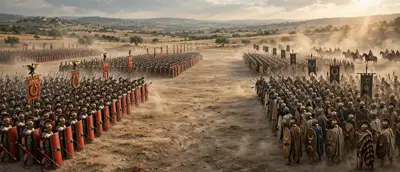
On the evening of August 26, 1071, the Roman Emperor sat wounded in a Seljuk tent, a prisoner of the man he had marched out to destroy. Romanos IV Diogenes had led the greatest army the Eastern Roman Empire could raise into the highlands of eastern Anatolia, bent on crushing the Turks of Sultan Alp Arslan and taking back the lost cities of Armenia. By nightfall his army was broken, his reserve commander had abandoned the field, and the fate of Anatolia — the recruiting ground and breadbasket of his empire — had shifted. This Battle of Manzikert summary tells the full story: how the battle was fought, why the Byzantines lost, and why one Friday afternoon in 1071 still shapes the map of the world.
What Was the Battle of Manzikert?
The Battle of Manzikert was fought on August 26, 1071, near the town of Manzikert in eastern Anatolia (modern Malazgirt, Turkey), between the Byzantine Empire under Emperor Romanos IV Diogenes and the Seljuk Sultanate under Sultan Alp Arslan. The Seljuk victory and the emperor's capture opened Anatolia to Turkish settlement, reshaping the medieval world.
The Road to Manzikert: Two Empires on a Collision Course
By the 1060s, the Byzantine Empire was a great power with a bleeding eastern frontier. Turkish horsemen had been raiding across the borderlands of Armenia for a generation, and the Seljuk Sultanate — the Turko-Persian Sunni Muslim empire founded by Tughril Beg in 1037 — now stretched from Central Asia to the edge of Anatolia. In 1063, Tughril's nephew Alp Arslan, whose name means "heroic lion," took the Seljuk throne and pushed his empire to its greatest extent.
In Constantinople, the throne itself was the problem. Romanos IV Diogenes was a career general who married the widowed Empress Eudokia Makrembolitissa in 1068 and became emperor. He was a soldier, not a courtier: the army loved him, the palace bureaucracy distrusted him, and the powerful Doukas family — the clan of his wife's first husband — watched him with open hostility. Romanos believed the answer to both problems was a great eastern campaign. Win in the east, and the court would have to respect him.
He campaigned in 1068, 1069, and 1070 with mixed but real success, and in 1069 the two empires even signed a peace treaty. Then, in March 1071, Romanos marched out of Constantinople at the head of a huge host — modern historians put it at roughly 40,000 men — aiming to retake the Armenian fortresses of Manzikert and Khlat. His plan rested on one assumption: that Alp Arslan was busy far to the south, besieging Aleppo in Fatimid-held Syria, and could not reach Anatolia in time.
That assumption was wrong. When word of the Byzantine advance reached him, Alp Arslan lifted the siege of Aleppo and force-marched his army north across hundreds of miles of summer-dry country. The chronicles say the sultan first sent envoys offering peace. Romanos refused them. He had come for a battle, and he would get one.
The Commanders: Romanos IV and Alp Arslan
Romanos IV Diogenes was about forty, a tall, brave, and energetic commander in the old Roman mold — and a politician out of his depth. He knew the Doukas faction at court wanted him gone, so he made a fateful choice: rather than leave his chief rival in Constantinople to plot, he brought Andronikos Doukas on campaign and gave him command of the army's reserve. It was a decision he would pay for on the evening of the battle.
His other lieutenants were capable men. Nikephoros Bryennios commanded the left wing, Theodore Alyates the right, and Joseph Tarchaneiotes led a detached force. But the army was a patchwork: Byzantine regulars and the famous Varangian Guard alongside Frankish and Norman mercenary knights, Armenian and Georgian contingents, Pecheneg and Oghuz Turkic horse archers, and a baggage train so enormous it slowed every march. Loyalty in such an army was a currency that could be spent only once.
Across the field stood Alp Arslan, one of the great commanders of the medieval world. By 1071 he had already built an empire stretching from the Hindu Kush to the Mediterranean's edge, and he understood war as a matter of speed, patience, and psychology. Later tradition — repeated with pride in Turkish histories — says that before the battle he prayed, tied his horse's tail in the manner of a man who did not expect to return, and dressed in white like a man ready for his own burial. Whether or not every detail is true, the story captures the man his enemies described: devout, disciplined, and utterly without fear.
What Armies Fought at the Battle of Manzikert?
The Byzantine army that marched into the plain before Manzikert was the last great field army of the old Eastern Roman system — and it showed both the system's strength and its rot. At its core were the thematic regulars, heavy infantry and cataphract cavalry, stiffened by the Varangian Guard, the axe-bearing Norse and English mercenaries who served as the emperor's personal bodyguard. Around them rode Frankish and Norman knights, men who charged first and asked questions later, and on the flanks skirmished the army's own Turkic horse archers — Oghuz and Pecheneg mercenaries whose loyalty was for sale. Modern historians estimate the Byzantine host at roughly 40,000 men when it left Constantinople, though desertion had already thinned it: Wikipedia's Battle of Manzikert entry notes that close to half the army deserted before the battle, and the Turkic mercenaries would defect to the Seljuk side during the fighting itself.
The Seljuk army was smaller, faster, and far more unified. Built around Turkic horse archers — men who had learned to shoot a bow accurately at full gallop before they could grow a beard — it was the classic steppe army: light, tireless, and almost impossible to pin down. Estimates of its size vary widely, from around 20,000 to as many as 35,000–50,000 in some accounts, with most modern historians settling in the 20,000–30,000 range. Alp Arslan did not need numbers. He needed room to maneuver, and the broad plain before Manzikert gave him exactly that.
The contrast decided everything before a blow was struck. Romanos commanded a heavy, polyglot army built for set-piece battle; Alp Arslan commanded a light, homogeneous one built to refuse set-piece battle. One side needed its enemy to stand still. The other side had no intention of standing still.
How the Battle Unfolded: August 26, 1071
Romanos had already made his first great mistake before the armies met. After taking the fortress of Manzikert without much trouble, he divided his forces, sending Joseph Tarchaneiotes with a large detachment — perhaps half the army — south toward Khlat to block the route he believed the Seljuks would use. When Alp Arslan's scouts appeared from a different direction entirely, that detachment was a day's march away and might as well have been on the moon.
On the morning of Friday, August 26, Romanos drew up what remained in the plain. He took the center himself, with the Varangian Guard around him. Bryennios held the left wing, Alyates the right, and Andronikos Doukas — the political enemy — held the reserve behind. Alp Arslan arrayed his horsemen in the crescent formation the Seljuks favored, the horns of the crescent curling forward, the center held back.
What followed was hours of frustration for the Byzantines. The Seljuk horse archers swept in, loosed clouds of arrows at the Byzantine wings, and melted away before the heavy cavalry could close. Again and again the Frankish and Norman knights, stung by the arrows, broke ranks and charged after the retreating horsemen — and again and again the horsemen wheeled, shot backward from the saddle, and led the pursuers into prepared traps. It was the feigned retreat, the oldest trick in the steppe playbook, and it worked exactly as designed. Romanos pushed his center forward through the afternoon, but the Seljuks simply gave ground, refusing the decisive clash he craved.
As evening approached, Romanos made the decision that lost him the battle. With darkness falling, he ordered the army to disengage and march back to the camp at Manzikert in good order. Any soldier who has ever tried it knows: breaking contact with an enemy cavalry army and turning your back in the open is the most dangerous maneuver in warfare. The Seljuks had been waiting all day for exactly this moment. As the Byzantine columns began their countermarch, Alp Arslan struck with his whole army.
The wings crumbled first. In the confusion, with dust and failing light hiding the standards, the order to withdraw was read as a rout. And then came the blow that no enemy could have struck: Andronikos Doukas, commanding the reserve — the one fresh force that might have steadied the line — rode off the field, and the word spread through the army that the emperor was dead. Mercenaries threw down their weapons and fled. The Oghuz Turks in Byzantine service crossed to their kinsmen. Only the center held, the Varangians locked around their emperor, fighting in a tightening ring as the Seljuks closed in.
Romanos fought until he could barely stand. He was wounded — the chronicles say he was cut down in the melee — and as full dark fell, the ring broke. The Emperor of the Romans, the heir of Augustus and Constantine, was taken alive on the field. The first Roman emperor captured in battle in more than eight hundred years, since the Persian king Shapur I took Valerian in 260, was now a prisoner in a Seljuk tent.
Turning Points: Three Moments That Decided Manzikert
The divided army. Long before the first arrow flew, Romanos halved his own strength. Sending Tarchaneiotes south toward Khlat was reasonable on paper — the emperor expected Alp Arslan to come from that direction — but it meant that on August 26, perhaps half the Byzantine army was marching through empty hills while the battle was fought without it. Alp Arslan, who kept his whole force in one hand, never made that mistake.
The evening withdrawal. Armies rarely die in the attack; they die in the retreat. Romanos's order to disengage at dusk was tactically sound — fighting a horse-archer army in the dark was suicide — but operationally fatal. The maneuver demanded a discipline his polyglot, exhausted army did not possess. The moment the columns turned, cohesion snapped, and the Seljuks, who had husbanded their strength all afternoon, struck a disorganized enemy. Manzikert was not won by the charge. It was won by the chase.
The reserve that never fought. Andronikos Doukas had every reason to want Romanos humbled, and on the evening of August 26 he got his wish. Whether he deliberately spread the rumor that the emperor was dead or simply fled and let the rumor spread itself, the effect was identical: the one intact body of troops that could have covered the withdrawal vanished, and panic did the rest. A battle that might have ended as a bloody draw ended as a catastrophe because the Byzantine army's own reserve commander chose the moment of crisis to settle a political score.
Battle of Manzikert Casualties: The Price on Both Sides
The butcher's bill at Manzikert was serious but not apocalyptic — and that distinction matters. Wikipedia's Battle of Manzikert entry, drawing on modern scholarship, lists Byzantine losses at roughly 2,000 to 8,000 killed and about 4,000 captured, with some 20,000 men recorded as having deserted. Seljuk casualties are unknown; the victors of a running cavalry battle seldom leave neat counts.
Those numbers deserve a second look, because they demolish the most persistent myth about the battle: that the Byzantine army was annihilated on the field. It was not. Large parts of it survived — the wings that broke, the mercenaries that fled, the detachment under Tarchaneiotes that never fought at all. Historians have pointed out that after the battle, Byzantium still possessed the military manpower and reputation to defend itself, and Alp Arslan's treaty demanded no territory whatsoever. The army lived. It was the empire's politics that died.
Why Was the Battle of Manzikert Important?
What happened in the week after the battle was stranger than the battle itself. Alp Arslan treated his captive with a courtesy that stunned both worlds. The famous exchange, preserved in the chronicles, runs like this: the sultan asked Romanos what he would have done had their positions been reversed. The emperor answered bluntly — he would have killed him, or paraded him through the streets of Constantinople. Alp Arslan replied that he would give him a heavier punishment: he would forgive him, and set him free.
The terms were heavy but not ruinous. The chronicles report a ransom of some 1.5 million gold pieces, an annual tribute of 360,000 gold pieces, and a marriage alliance — but no cession of territory. Alp Arslan loaded Romanos with gifts and gave him a Turkish escort for the journey home. The sultan, a devout Sunni Muslim, had shown his defeated enemy a mercy that the Christian sources of the time recorded with genuine admiration. It is worth saying plainly: at Manzikert, the Muslim victor behaved with a chivalry that the history books on every side still honor.
Constantinople did not deserve that mercy. While Romanos was still traveling home, the Doukas faction staged a coup, declared the absent emperor deposed, and crowned the young Michael VII. They repudiated the treaty — which meant, among other things, that the ransom would never be paid and the peace Alp Arslan had offered was dead. Romanos raised what forces he could, lost a brief civil war, and surrendered in 1072 on promise of his life. The promise was broken. He was blinded — so brutally that the wounds festered — and died in exile within months. The empire had murdered its own emperor to spite the man who had spared him.
That self-inflicted wound was the true disaster of Manzikert. With the central government consumed by a decade of civil war, the eastern frontier collapsed. Turkish tribes and warlords — no longer restrained by any treaty — poured into Anatolia, and within ten years most of the peninsula that had been the empire's heartland for seven centuries was gone, carved into Turkish beyliks. The empire that had once stretched from Italy to Armenia was reduced to a coastal rump, begging for help.
The help it begged for changed world history. In 1095, Emperor Alexios I Komnenos — the strong ruler who finally ended the chaos — appealed to Pope Urban II for western military aid against the Turks. Urban's answer, preached at the Council of Clermont that November, was the First Crusade. The road from Clermont to Jerusalem runs straight through the plain of Manzikert.
And the road runs further still. The Turkish settlement of Anatolia that began after 1071 was the seed of everything that followed: the Sultanate of Rum, the Ottoman beylik, and in time the Ottoman Empire itself. In modern Turkey, August 26 is still commemorated as the anniversary of the Malazgirt victory — the day Turks mark as the beginning of their history in Anatolia. One Friday's battle redrew the map for nine centuries.
What the Sources Tell Us: A Note on the Numbers
Medieval chroniclers loved big numbers, and Manzikert's are the biggest of all. Matthew of Edessa and the Muslim sources put the Byzantine host at 200,000 men or more; some accounts credit Alp Arslan with as few as 15,000. Modern historians treat these figures as what they are: propaganda, guesswork, and the fog of war. The serious estimates used today — roughly 40,000 Byzantines against 20,000 to 35,000 Seljuks — come from weighing the logistics of feeding an army on the Anatolian plateau against the known size of the Byzantine field forces of the period.
Two things are worth remembering when you see the old numbers repeated. First, the exact figures do not change the story: whether the odds were two-to-one or nearly even, the Seljuks won through maneuver and Byzantine disunity, not weight of numbers. Second, the medieval sources on both sides agree on the things that matter — the date, the capture of the emperor, the desertion of the reserve, and the generous terms — which is why historians trust the narrative even while cutting the headcounts down to size.
3 Lessons from Manzikert
Armies break at the seams, not at the point. The Seljuks could not break the Byzantine center by frontal attack, so they never tried. They broke the wings, forced the withdrawal, and let the maneuver do the killing. The lesson has outlived the bow and the horse: a force that cannot disengage in order cannot survive a bad day.
Political unity is a weapon, and disunity is a target. Andronikos Doukas did more damage to the Byzantine Empire in one evening than Alp Arslan's entire army did in a day. The battle was lost on the field; the empire was lost in the palace, when the coup against Romanos turned a ransom treaty into a dead letter and a decade of civil war into an open frontier.
The peace matters more than the battle. Alp Arslan won the war's decisive engagement and asked for no territory. It was Byzantium that threw the peace away. Manzikert is remembered as a military catastrophe, but the catastrophe was political — a reminder that the settlement after the fighting decides more than the fighting itself.
Frequently Asked Questions
Who won the Battle of Manzikert?
The Seljuk Turks under Sultan Alp Arslan won decisively on August 26, 1071. They broke the Byzantine field army of Emperor Romanos IV Diogenes, captured the emperor himself, and forced a ransom treaty. Though the sultan demanded no territory, the Byzantine civil war that followed opened Anatolia to Turkish settlement.
What happened to Emperor Romanos IV after Manzikert?
Alp Arslan ransomed him, loaded him with gifts, and set him free with a Turkish escort. But the Doukas faction in Constantinople had already deposed him and crowned Michael VII, repudiating the treaty. Romanos fought a brief civil war, surrendered in 1072, was blinded, and died in exile. He never ruled again.
Was the Byzantine army destroyed at the Battle of Manzikert?
No — that is the great myth of Manzikert. Modern historians note that much of the army survived the battle and that Alp Arslan's treaty demanded no territory. What destroyed Byzantium was the decade of civil war that followed, which left the Anatolian frontier undefended against Turkish migration and settlement.
Why is the Battle of Manzikert considered a turning point?
Because it broke the Byzantine hold on Anatolia, the empire's recruiting ground and breadbasket for seven centuries. Within a decade Turkish beyliks controlled most of the peninsula. The crisis led Emperor Alexios I to appeal to Pope Urban II in 1095, setting off the First Crusade — and began the long road to the Ottoman Empire.
Sources
- Wikipedia — Battle of Manzikert
- TRT World — How Turks Came To Anatolia: The Battle Of Manzikert
- Hürriyet Daily News — On the anniversary of a critical battle: Manzikert