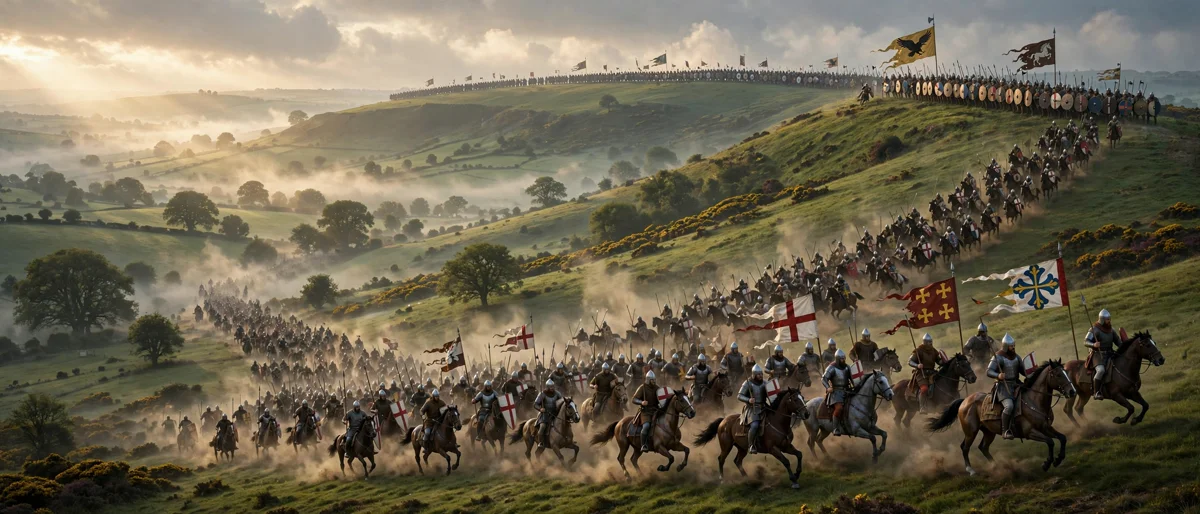
On October 14, 1066, two exhausted armies met on a windswept ridge near the English coast, and by sundown the entire future of the English language, culture, and nation had been rewritten in a single day of fighting. King Harold II of England lay dead. Duke William of Normandy stood victorious. This battle of Hastings 1066 summary covers the whole wild story: the rival kings, the forced marches, the shield wall, the feigned retreats, and the single arrow, real or legendary, that ended Anglo-Saxon England in one of the most consequential medieval warfare battles ever fought.
The Road to Hastings: Three Kings, One Empty Throne
The crisis started with a deathbed. On January 5, 1066, Edward the Confessor, King of England, died without a son or a clearly named heir. The most powerful nobleman in the kingdom, Harold Godwinson, moved fast. He was crowned King Harold II the very next day, January 6. That speed was the point. Slow, and someone else grabs the throne.
But two other men believed the crown was theirs.
The first was William, Duke of Normandy. Years earlier, the childless Edward had reportedly promised him the throne, and Harold himself had sworn a solemn oath in Normandy, around 1064, to back William's claim. When Harold took the crown anyway, William called it perjury. And started building an invasion fleet. What would you have done?
The second was Harald Hardrada, the fearsome King of Norway, who claimed England through older Viking-age agreements. In September 1066, Hardrada struck first, landing in the north with a great fleet. Harold now had two invasions coming at him at once. Lovely.
Harold II marched his army the length of England to meet the Norwegians, and on September 25, 1066, at Stamford Bridge near York, the English destroyed the Norwegian army and killed Hardrada. A brilliant victory. And it would cost Harold everything. His men had barely caught their breath when terrible news arrived from the south: on September 28, William had landed unopposed at Pevensey on the Sussex coast.
Harold turned his battered army around and force-marched roughly 240 miles south in less than three weeks. One full-scale battle, then a march to another. How do you even do that? Honestly, you don't, not really. By the time his scouts reported William's position near Hastings, many of his best men were dead, wounded, or worn down to the bone.
October 14, 1066: The Battle Hour by Hour
Morning. William deployed a combined-arms army of perhaps 7,000 to 10,000 men: archers and crossbowmen in front, heavy infantry behind them, armored cavalry on the wings. Harold held the high ground at Senlac Ridge with around 7,000 men drawn up in the famous shield wall, a dense, interlocked line of infantry with shields overlapping, spears and axes bristling outward. The English had almost no archers and no cavalry to speak of. Their plan was simple. Hold the ridge and let the Normans break themselves against it.
Late morning. The Norman archers opened the battle, loosing volleys uphill. Firing at an angle against raised shields, they did almost no damage. The Norman infantry charged next. Hurled back. Then the cavalry thundered forward. And the shield wall held, because horses won't willingly charge into a solid wall of spears. The English line bent. It didn't break.
Midday. Then a scare. Panic rippled through the Norman ranks: a rumor spread that William had been killed. William tore off his helmet and rode along his lines, shouting that he lived. A small act of leadership. It may have saved the invasion.
Afternoon: the turning trick. Norman cavalry began performing feigned retreats, charging, then wheeling away in apparent flight. Groups of English soldiers, hungry for victory after hours of standing defense, broke ranks and chased them downhill. Once isolated on open ground, the pursuers were ridden down by the same cavalry that had "fled." It happened more than once. And every time, the shield wall grew thinner.
Evening. As daylight faded, the English line finally wavered. King Harold was killed, by an arrow through the eye if you believe the famous Bayeux Tapestry tradition, though historians still argue about exactly how he died. With their king fallen, the remaining English fought on in the dusk but were steadily surrounded and cut down. William held the field. The Battle of Hastings was over.
Three Turning Points That Decided Hastings
1. Stamford Bridge came first. Harold's victory in the north was tactically superb and strategically fatal. Just weeks after Stamford Bridge, his army reached Hastings exhausted and under-strength, missing many of the housecarls, his elite household troops, who had fallen in the north. William, meanwhile, had been waiting, rested and supplied, since late September. See the difference?
2. Discipline beat fury. The feigned retreat is easy to describe and brutally hard to pull off. It takes cavalrymen who can flee convincingly without the retreat turning real. Norman discipline turned a trick into a weapon. English indiscipline turned pursuit into suicide. Battles are often decided less by courage than by which side keeps its shape longer.
3. A king is a single point of failure. Medieval armies were built around one man. So when Harold fell, no second-in-command could rally the line and no headquarters could issue new orders. The English army didn't just lose a battle that evening. It lost the only person it was organized to follow.
Aftermath: How One Day Rewrote England
William didn't rush. Why would he? He secured the coast, then marched on London, burning and intimidating as he went. On Christmas Day, 1066, Christmas Day, he was crowned King William I, William the Conqueror, in Westminster Abbey.
What followed was a transformation few single battles have ever caused. Here's the short version:
- A new ruling class. The Anglo-Saxon aristocracy was almost entirely replaced by Norman lords. England's elite now spoke French, and French remained the language of court and law for centuries, gradually fusing with Old English to create the modern English language itself.
- The Domesday Book. In 1086, William ordered a staggering survey of his new kingdom's land, people, and wealth, the Domesday Book, one of the most remarkable administrative documents of the medieval world.
- Castles and feudalism. Stone castles rose across the landscape, and Norman feudal structures reorganized English society from top to bottom.
- The end of an era. Anglo-Saxon England, its language, its laws, its culture, effectively ended on Senlac Ridge. Everything after was something new. It would be three and a half centuries before England won England's other legendary outnumbered victory, Agincourt, this time as the conqueror, not the conquered.
3 Lessons from Hastings for Today
1. Preparation beats reputation. Harold was the proven warrior, fresh off destroying a Viking army. William was the careful planner who had spent months building ships, gathering allies, and choosing his moment. When the two met, the planner won. In any competitive field, the person who prepares the ground usually beats the person living off past wins.
2. Hold your formation under pressure. The English shield wall was nearly unbeatable, until pieces of it abandoned their positions to chase a tempting opportunity. The Normans won by staying disciplined while their enemy got emotional. Whether in business, investing, or conflict, the side that keeps its discipline when provoked usually outlasts the side that reacts. You've seen this play out far from any battlefield.
3. Never build everything on one person. Harold's army was formidable but fragile: remove the king, and the entire organization collapsed in hours. Resilient teams, companies, and plans spread leadership around so that no single loss is fatal.
What the Sources Tell Us
Our two greatest witnesses to Hastings each had an agenda. Worth remembering when you read their accounts. The Bayeux Tapestry, a 70-meter embroidered narrative made within a decade of the battle, is essentially Norman propaganda in thread, though its detail is priceless. The Anglo-Saxon Chronicle gives the English perspective but was written by churchmen with their own loyalties.
The famous arrow-in-the-eye? The tapestry seems to show a figure with an arrow near his eye beside the words "Harold", but the embroidery is damaged and ambiguous there. No contemporary written source describes Harold's exact manner of death with certainty. Army numbers are equally uncertain: modern estimates put both sides at roughly 7,000 to 8,000 men, but no reliable contemporary count survives. What is certain is the outcome, and its consequences, which no one disputes.
Sources & further reading
- Wikipedia, "Battle of Hastings", en.wikipedia.org
- English Heritage, "1066 Battle of Hastings, Abbey and Battlefield", english-heritage.org.uk
Related Battles
Keep exploring decisive moments in military history:
 Medieval Warfare

 American Civil War

Frequently Asked Questions
Who won the Battle of Hastings?
William, Duke of Normandy, crowned William the Conqueror, defeated King Harold Godwinson on 14 October 1066.
How did Harold Godwinson die?
Tradition, following the Bayeux Tapestry, says an arrow struck him in the eye; contemporary accounts differ, but he was killed on the battlefield at Hastings.
Why was the Battle of Hastings so important?
It triggered the Norman Conquest, which reshaped England, its language, aristocracy, administration, and architecture, for centuries.
When was the Battle of Hastings?
14 October 1066, near the present-day town of Battle in East Sussex, England.