The battle of Marathon 490 BC summary starts like this: in September 490 BC, roughly 10,000 Athenians and their Plataean allies faced the army of the Persian Empire — the largest power on earth — on a coastal plain twenty-five miles north of Athens, and destroyed it in a single afternoon. No Spartans stood beside them. No one had ever beaten Persia on land before. The Greeks charged at a run, broke the line, chased the survivors into the sea, and then marched home to defend their city the same day. It is one of the most famous victories in all of ancient history — and almost everything you know about its most famous detail is probably wrong. Browse more Ancient Warfare battles to see how the era unfolded.
> ### ⚡ TL;DR — The Battle of Marathon, in 30 Seconds
> - In September 490 BC, an Athenian army of about 10,000 hoplites plus 1,000 Plataeans met Persia's invasion force under Datis and Artaphernes on the Marathon plain.
> - The Greeks attacked at a dead run with a thinned center and reinforced flanks; the Persian line collapsed, and the survivors fled to their ships.
> - According to Herodotus, the Persians lost 6,400 men while the Greeks lost 192 Athenians and 11 Plataeans — the first land defeat Persia had suffered in decades.
> - Pheidippides did NOT run from Marathon to Athens — that story was invented centuries later. His real run, recorded by Herodotus, was a 150-mile dash from Athens to Sparta before the battle.
> - The victory ended Persia's first invasion of Greece and bought the Greek city-states ten years before the second Persian invasion of 480 BC.
The Battle of Marathon was a decisive Greek victory fought in September 490 BC on the Marathon plain in northeastern Attica. An Athenian army of roughly 9,000 to 10,000 hoplites, joined by 1,000 Plataeans and led by the polemarch Callimachus and the general Miltiades, defeated a Persian invasion force commanded by Datis and Artaphernes for King Darius I. The Persians, who had invaded to punish Athens for supporting the Ionian Revolt, were routed to their ships, ending the first Persian invasion of Greece and giving rise to the marathon race.
Background: Why Persia Came to Greece
Revenge. That was the entire foreign policy.
In 499 BC, the Greek cities of Ionia — on the coast of what is now western Turkey, but under Persian rule — rose in revolt. Athens and the city of Eretria sent ships and men to help them. The joint force captured Sardis, the wealthy satrapal capital, and burned it. Then the Persians crushed the rebellion. But Darius I of Persia never forgot which cities across the Aegean had dared to meddle. According to Herodotus, Darius had his bow brought to him and shot an arrow toward heaven, asking Zeus to grant him vengeance on the Athenians — and ordered a servant to whisper "Master, remember the Athenians" into his ear before dinner, every day.
In 492 BC, Darius sent a first expedition; a storm wrecked its fleet off Mount Athos. In 490 BC, he sent a second one: a naval task force under two generals, Datis and Artaphernes (the king's nephew), carrying an army — modern estimates range from about 20,000 to 100,000 infantry with roughly 1,000 cavalry, while Herodotus gives wildly larger figures that no modern historian accepts — aboard some 600 triremes. It island-hopped across the Aegean, subduing the Cyclades, then crossed to Euboea, besieged Eretria, and captured it. The Persian landing party reached the bay near the town of Marathon, in northeastern Attica, about twenty-five miles from Athens.
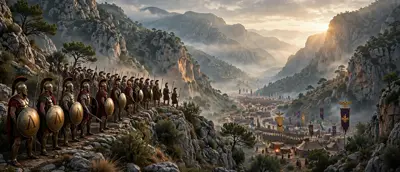
Athens was in trouble. Its army — all of it, the entire citizen militia of hoplite farmers and tradesmen — marched out to meet the Persians. One thousand men from the small city of Plataea marched too, the only Greek ally that answered. Sparta, Athens's great rival and the strongest military power in Greece, was asked for help. According to Herodotus, Athens's fastest courier was sent running to Sparta — and he ran roughly 150 miles in about two days. When he arrived, the Spartans told him they were in the middle of the Carneia, a nine-day religious festival during which war was forbidden. They would march — after the festival ended.
That courier's name, in Herodotus's telling, was Pheidippides. And that is the true story of the famous runner. Hold it; we'll come back to it, because the legend swallowed the truth whole.
The Greeks reached Marathon and did the sensible thing: they blocked the two exits from the plain, so the Persians couldn't march on Athens unopposed. Then they waited. For days, the two armies sat across the field from each other. Neither commander wanted to be the one to blink. The Persian cavalry made the open plain a death trap for Greek infantry; the Greek phalanx made any Persian approach toward the city a death trap for Persian infantry. Days passed — roughly five, by most reconstructions.
Inside the Greek camp, the ten generals (the strategoi) argued. They were split five to five: half wanted to attack, half thought attacking was suicide. The eleventh man, the polemarch Callimachus — technically the war-archon, a civil official — held the deciding vote. And here the story gets its first moment of genuine political drama. Miltiades, one of the generals, argued passionately for attack — and Callimachus sided with him. Then four of the other generals, convinced by the argument, ceded their days of command to Miltiades, making him effectively the commander-in-chief. Democracy, voting its way into a death-defying attack.
The Battle: A Single Afternoon in September
What happened next was, by the standards of ancient warfare, extraordinary.
Before dawn on the day of battle, word reached the Greek camp that the Persian cavalry was temporarily absent from its usual position — loading aboard ships, most likely, either to ferry around the coast toward Athens or because the army was preparing to re-embark. Miltiades saw the window and seized it. According to Herodotus's account, this was the first time Greeks charged at the double — at a full run — and the first time they dared to look without fear on men in Persian dress. Think about what that means. Every Greek soldier at Marathon grew up knowing Persia had swallowed Egypt, Mesopotamia, Ionia, and Thrace without breaking stride. They were about to run — in armor, for roughly a mile — directly at the empire that ate nations.
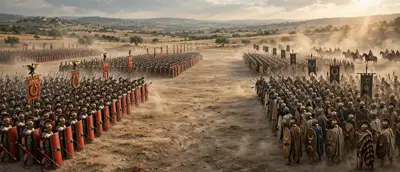
Miltiades's formation was the gamble that made the victory. His line was outnumbered, so he thinned his center to a few ranks deep and stacked his two wings strong with hoplites. The center's job was to bend; the wings' job was to break through the lighter Persian infantry on the flanks, wheel inward, and close like a fist. The Greeks crossed the field at a run — a mile in armor under Persian arrows — and slammed into the line.
The Persian center held. It held, and it pushed the thin Greek center back. For a moment it looked like the gamble had failed. Then the Greek wings, heavier and armored, smashed through the Persian flanks and began wheeling inward from both sides. The Persian center — which had pushed too far forward in its moment of success — found itself surrounded. Double envelopment. The Persian line broke into panic and ran for the ships beached along the shore. The Greeks followed them into the surf, fighting at the ships' hulls, capturing seven vessels.
By the end of the afternoon, the plain was quiet. According to Herodotus: 6,400 Persians dead against 192 Athenians. Eleven Plataeans fell too. The first Persian defeat on land in decades — Britannica's summary puts the point bluntly: the battle proved the superiority of the Greek long spear, sword, and armor over Persian weapons. And for the first time, somebody had beaten Persia in a pitched land battle.
But Marathon wasn't over. The Persian fleet, rather than sailing home, made for Cape Sounion — heading around the southern coast of Attica toward Athens itself, hoping to land an undefended strike at the city before its army got back. So the Athenians did something almost absurd: after fighting a pitched battle all afternoon in heavy armor, they force-marched the entire army roughly 25 miles back to Athens, arriving in the late afternoon in time to watch the Persian ships turn away from the coast. The Persians sailed back to Asia. Athens still stood. Days later the Spartans — 2,000 of them, having marched after the festival ended — arrived, toured the battlefield at Marathon, congratulated the Athenians, and went home.
---
> ### ⚔️ A New Epic Battle Every Day
> Love military history? Subscribe to Echoes of Battle on YouTube (@EchoesOfBattleHistory) — a new epic battle every day, cinematic and free.
> Want to see what happened when Persia came back ten years later? Read our companion piece: Battle of Thermopylae 480 BC: 300 Spartans' Last Stand.
---
Turning Points: What Actually Decided Marathon
1. The absent cavalry. The whole battle hinged on a single morning's intelligence: the Persian horsemen weren't where they usually were. On the open plain, cavalry would have shredded the Greek phalanx's flanks before it ever reached the Persian line. Miltiades attacked the moment that threat lifted. Timing — not numbers, not armor — was the hinge.
2. The vote to attack. People forget Marathon was almost never fought. Five of ten generals voted to sit behind their blockade and wait. If Callimachus had voted the other way, the Persians would likely have re-embarked, sailed around the coast, and attacked undefended Athens — which, given Eretria's fate that same year, meant sack and enslavement. A civil official's deciding vote in a war council arguably saved the city.
3. The deliberate thin center. Weakening your middle to strengthen your wings is a calculated risk that only works if your men hold under pressure long enough for the wings to do their work. The Greek center bent — dangerously — but it didn't break, and the Persian center's very success pulled it into the trap. Whether Miltiades planned the full double envelopment or simply made the formation trade he had to make, the result was the same: the Persian elite troops in the center, who had pushed deepest, were the ones enveloped.
4. The march home. The battle's least glamorous turning point was a forced march in the late-afternoon heat, in armor, on no rest — and it mattered as much as the fighting. If the Persians had landed at Athens and taken it while its army was twenty-five miles away, Marathon would be remembered as a Greek tragedy, not a triumph.
Aftermath & Legacy: What Marathon Actually Changed
The immediate effects were real. The first Persian invasion of Greece was over. Persia's aura of invincibility — built over decades of conquest — cracked; as Herodotus's account notes, subject peoples of the empire rose up in the years after the defeat, and order took years to restore. Darius began building a far larger army to finish the job properly, was delayed by an Egyptian revolt, died in 486 BC, and his son Xerxes launched the second invasion in 480 BC — the one that gave us Thermopylae and Salamis. Greece had bought itself a decade.
The long-term effects are where legend takes over, so here's my honest take.
Marathon is often sold as "the battle that saved Western civilization" — the idea being that without the victory, there would have been no Athenian golden age, no democracy, no Socrates, no Plato, no Western philosophy. I think that story is overstated in one direction and understated in another. It's overstated because Persia came back ten years later anyway, marched into Attica, and burned Athens to the ground — Marathon didn't save Athens; it merely delayed the reckoning. A decade later, the Greeks saved themselves again at Salamis and Plataea, and that was the decisive sequence. Pinning the survival of Western civilization on one afternoon in 490 BC gives one battle too much credit for a war.
But Marathon is UNDERSTATED as a psychological event. Before Marathon, the standard Greek assumption was that you could not beat Persia in the open — that's why every Greek city that resisted Persia in the first Greco-Persian war fought behind walls. Marathon replaced "impossible" with "done it before." That confidence is what made Thermopylae, Salamis, and Plataea conceivable. The real legacy wasn't territory or booty; it was the proof of concept that free citizen-soldiers could stand up to the empire. Everything that followed — including the golden age — rests on that proof.
And then there's the runner. The story everyone knows: Pheidippides runs 26 miles from Marathon to Athens, cries "We have won!" (Nenikēkamen), and drops dead. It inspired the Olympic marathon. It's moving. And according to the earliest sources, it almost certainly didn't happen that way. Herodotus records only the Athens-to-Sparta run before the battle — no post-battle run, no death. The dying-messenger version first appears in Plutarch's On the Glory of Athens, written in the 1st century AD, more than five hundred years after the battle — and Plutarch says most accounts named the runner Eucles, with Thersippus as another candidate. The satirist Lucian of Samosata, writing in the 2nd century AD, gives the same story but calls the runner Philippides. The name "Pheidippides" for the death-run came later still, and Robert Browning's 1879 poem cemented it in the popular imagination. When the first modern Olympics in 1896 created a long-distance race to honor the legend, it measured about 25 miles — roughly the Marathon-to-Athens distance. The now-standard 26.2 miles (42.195 km) has nothing to do with ancient Greece at all; it comes from the 1908 London Olympics' course.
Here's what I find more impressive than the legend: the REAL run. Pheidippides — a professional courier, a hemerodromos — ran roughly 150 miles from Athens to Sparta in about a day and a half, through mountain passes, and then came home again. There is also an ultramarathon, the Spartathlon, that recreates exactly that run — 246 kilometers from Athens to Sparta. The legend got the wrong run famous. The actual feat was harder.
One more piece of the aftermath deserves attention, because it complicates the hero story. Miltiades — the architect of the victory — did not enjoy a quiet retirement. He had spent years as a tyrant ruling the Chersonese under Persian overlordship before returning to Athens in 493 BC; he was a controversial figure with enemies. In 489 BC, barely a year after Marathon, he led a failed expedition, was prosecuted on his return, fined heavily, and died of his wounds in an Athenian prison. The same city that buried its 192 dead under the great burial mound on the Marathon plain — the Soros, still there today — let the man who won the battle die in a cell. Athens was a democracy, and democracies have short memories. A fragment of a monument erected to honor Callimachus, the polemarch whose deciding vote made the battle happen, was placed on the Acropolis in that same year, 489 BC — while Miltiades sat in prison. The argument about who really deserved the credit for Marathon started immediately and, in a sense, never stopped.
> A comparison worth making: Marathon vs. Thermopylae. These two battles are ten years apart, the same war, the same enemy, opposite outcomes. Marathon was a victory; Thermopylae was a defeat. And yet Thermopylae — 300 Spartans dying in a pass — is arguably the more famous battle in popular culture. Why? Because cultures prefer clean, doomed nobility to complicated, successful pragmatism. Marathon's hero died in prison and its most famous anecdote is a myth. Thermopylae's hero died gloriously on schedule and its myth is the history. My take: the victory mattered more and the defeat is remembered better, and that imbalance tells you more about how humans remember war than about either battle. Marathon won the day; Thermopylae won the storytelling.
>
> The counterfactual: what if Persia had won at Marathon? The easy answer: Athens gets sacked in 490 BC instead of 480 BC, the Parthenon is never built, no Socrates, no Plato, no "Western civilization." I'm skeptical of that whole chain — it's too neat. Persia was not in the business of annihilating cities that submitted; the standard outcome was incorporation, tribute, and a Persian-appointed governor, as Ionian cities had already shown. Athens's democracy might well have survived under Persian hegemony, the way some Greek cities kept their internal governments as Persian subjects. The honest answer to "what if" is: probably a quieter, slower Athens, poorer and less confident, contributing less to the century that made it famous — and a second Persian invasion that never needed to happen because the first one already worked. The drama of the what-if is smaller than it looks. The drama of what actually happened — citizen farmers running a mile in bronze armor at the largest army in the world — needs no embellishment.
Sources & Caveats: What We Know and What We Don't
Almost everything we know about Marathon comes from one man: Herodotus, who wrote his Histories about fifty years after the battle. He talked to veterans and their families, but he was writing history as drama, and his numbers are not to be trusted as figures — modern historians treat all ancient army sizes and casualty counts as estimates at best. Aeschylus, who fought at Marathon, dramatized the war in his play The Persians (472 BC), the earliest surviving Greek tragedy. Later writers — Plutarch, Pausanias, Cornelius Nepos — add details but wrote centuries after the fact.
So: the battle happened, the victory was real, the names of the commanders and the outline of the tactics are consistent across sources. The exact numbers — 6,400 Persian dead, 192 Athenians, tens of thousands in the Persian army — are Herodotus's, and you should read them as "a lot" and "very few" rather than audited totals. The exact date within 490 BC (August or September) is debated. And the Pheidippides death-run, as told above, is legend built on legend. The uncertainty is part of the story: a 2,500-year-old battle leaves gaps, and honest history says so.
Frequently Asked Questions
Who won the Battle of Marathon?
Athens and its ally Plataea, decisively. In September 490 BC, about 10,000 Athenian hoplites plus 1,000 Plataeans under the polemarch Callimachus and the general Miltiades routed a Persian invasion force commanded by Datis and Artaphernes for King Darius I, ending Persia's first invasion of Greece.
Why was the Battle of Marathon important?
Because it was the first time a Greek army defeated Persia in a pitched land battle — and that proof-of-concept changed everything. According to Herodotus's account, the Greeks were the first to charge at the double and the first to face Persian troops without fear. The victory ended Persia's first invasion of Greece, cracked the empire's aura of invincibility, encouraged revolts across Persia's subject peoples, and bought the Greek city-states ten years before the second Persian invasion of 480 BC.
Did Pheidippides really run from Marathon to Athens?
No surviving ancient source supports it. Herodotus — writing about fifty years after the battle — records only a run from Athens to Sparta (about 150 miles) BEFORE the battle, to ask the Spartans for help. The dying-messenger version first appears in Plutarch's On the Glory of Athens, over five hundred years later, which says most accounts named the runner Eucles. The name "Pheidippides" for that run comes from the 2nd-century writer Lucian, and Robert Browning's 1879 poem made the legend famous worldwide.
How many soldiers died at the Battle of Marathon?
According to Herodotus: 6,400 Persians and 192 Athenians, plus 11 Plataeans. Modern historians treat these as order-of-magnitude estimates rather than exact counts — ancient writers routinely inflated enemy armies and minimized their own losses. What the sources agree on is the lopsidedness: the Persians suffered heavily while Greek losses were remarkably light.
---
Sources: Herodotus, Histories Book VI; Aeschylus, The Persians; Plutarch, On the Glory of Athens (Moralia 347c); Britannica, "Battle of Marathon"; History.com, "Battle of Marathon"; J.A.S. Evans, "Herodotus and Marathon"; National Geographic, on the origins of the modern marathon; Wikipedia, "Battle of Marathon" (for dates, figures, and commanders as compiled from cited scholarship).