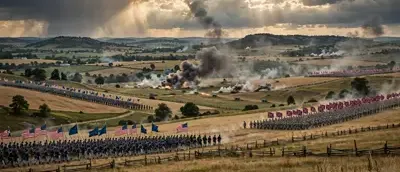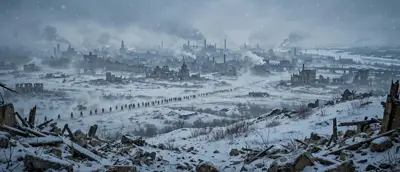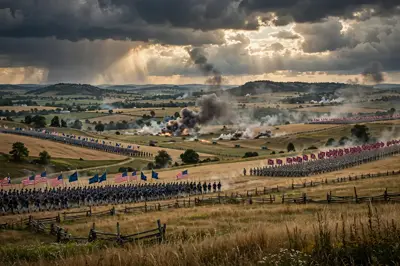
What was the bloodiest battle in history? Ask it at a dinner party and someone will say Gettysburg. Someone else will say the Somme — closer, but still only half the toll.
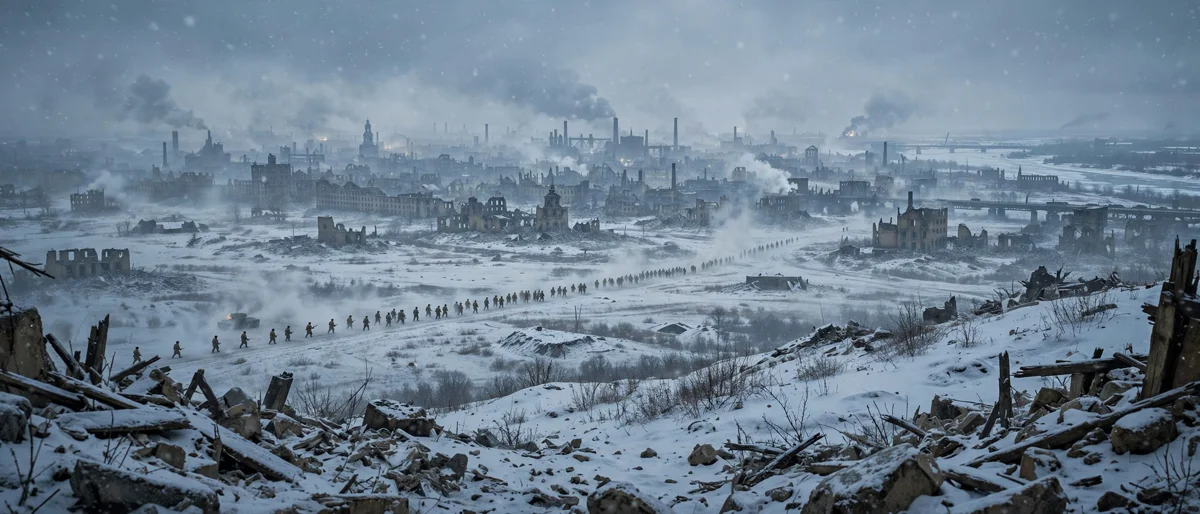
The short answer to what was the bloodiest battle in history is Stalingrad: August 23, 1942 to February 2, 1943, on the banks of the Volga River in southern Russia, where Nazi Germany and the Soviet Union fed roughly two million soldiers and civilians into 163 days of city fighting. Close to a million of them never came home. No battle before or since has touched that number.
But historians will tell you something else over drinks, after giving the official answer: the question is rigged. What counts as a "battle"? Do sieges count? Do you measure deaths, or casualties — the dead plus the wounded plus the captured? Change the ruler and the crown can change hands. So let's answer it properly: the short version, the full ranking, and why the honest answer comes with an asterisk.
First, How Do You Measure "Bloodiest"?
Most rankings use "casualties" — military shorthand for killed plus wounded plus missing plus captured. That's the only fair way to compare battles across centuries, because the wounded were usually the majority. At Stalingrad, roughly two-thirds of the Soviet military toll were wounded or sick men, not dead ones.
Keep two buckets in your head as you read:
- Casualties (killed + wounded + captured) — the military measure.
- Deaths — the human measure. A battle can top one list and lose the other.
And one more wrinkle: sieges. The Siege of Leningrad killed more people than almost every battle on this list — but it lasted 872 days and most of the dead were civilians who starved. Is a siege a battle? Some historians say yes. The conventional answer says no. That distinction is the whole argument, and we'll settle it below.
The Answer: Stalingrad, 1942–43
The Road to the Volga
After failing to take Moscow in the winter of 1941, Hitler rewrote his 1942 plan. Forget the Soviet capital — the real prize was oil. The Caucasus oil fields fueled the entire Soviet war machine, and Hitler's new offensive, Operation Blue, was built to seize them. Along the way, the German spearhead would secure its flank by taking a city on the Volga: Stalingrad.
The city had a second value that had nothing to do with oil. It was named after Joseph Stalin. Taking it would be a propaganda hammer blow; holding it would be a point of pride. Both dictators decided the city was worth any price. That decision — made in Berlin and Moscow, not by any general at the front — is what made Stalingrad into Stalingrad.
163 Days in a Burning City
On August 23, 1942, the Luftwaffe arrived over Stalingrad and turned the city into an inferno in a single day. Somewhere between 25,000 and 40,000 civilians died in that first week of bombing. Wooden buildings burned like kindling, and the Volga ran black with oil from ruptured storage tanks.
What followed was the kind of fighting German soldiers called Rattenkrieg — the war of the rats. The bombing had created a defender's paradise: mountains of rubble where every collapsed building became a fortress and every sewer a supply route. General Vasily Chuikov, commanding the Soviet 62nd Army inside the city, gave his men one standing order: stay as close to the Germans as possible. Hug them. If you're close enough, their artillery can't hit you without hitting their own men. It worked — and it turned the battle into room-by-room, floor-by-floor butchery.
The stories from those months are almost too strange to believe. A single apartment building — Pavlov's House — was held by a few dozen Soviet soldiers for about two months, and the Germans marked it on their maps as a fortress. A hill called Mamayev Kurgan changed hands so many times that the soil was said to be dark with iron from the shrapnel buried in it. Soviet reinforcements crossed the Volga at night under fire, and a newly arrived soldier's life expectancy in the city was measured in hours, not days.
Meanwhile the Germans had a problem they refused to see. Their 6th Army under General Friedrich Paulus was strong in the city — but its flanks, stretching along the Don River, were held by Romanian, Italian, and Hungarian troops with thin anti-tank weapons and thinner morale. The Soviets saw it. Stalin's generals, Georgy Zhukov and Aleksandr Vasilevsky, spent the autumn quietly massing over a million men for the counterstroke.
On November 19, 1942, it fell: Operation Uranus. Soviet armor smashed through the Romanian lines on both flanks, swung behind the city, and four days later the pincers met. The entire German 6th Army — around 300,000 men — was trapped in a pocket the Germans called the Kessel, the cauldron.
Hitler forbade a breakout. He promised the trapped army would be supplied by air — a promise Hermann Göring's Luftwaffe could never keep. Through December and January the pocket shrank. Men froze, starved, and died of wounds in cellars while the temperature sat far below zero. General Erich von Manstein's relief force fought to within about 30 miles of the trapped army and was thrown back.
On February 2, 1943, what was left of the 6th Army surrendered. About 91,000 men marched into captivity. Roughly 5,000 of them ever saw Germany again.
The final count: the Soviets lost 1,129,619 men killed, wounded, or missing — 478,741 of them dead. The Axis lost somewhere between 750,000 and 870,000. Add 40,000 to 100,000 civilians, and the generally accepted total sits near two million casualties. Close to half of them died.
If you want the battle itself in full detail — the personalities, the street-by-street fighting, the turning points — our full account of Stalingrad covers it end to end.
Why Stalingrad Broke the War Open
Stalingrad was the first time Nazi Germany lost an entire field army — not a division, an army — and it never recovered the strategic initiative. After February 1943, Germany spent the rest of the war reacting to Soviet moves. The myth of German invincibility, which had carried Hitler from Poland to the gates of Moscow, died in the rubble on the Volga. That's why historians call Stalingrad the turning point of the entire war, not just the Eastern Front.
The Runners-Up: 6 Battles That Nearly Took the Crown
Stalingrad wins. But "bloodiest" has a deep bench. Here are the six strongest contenders, ranked by the best available figures.
#2 — The Siege of Leningrad (1941–44): ~1 to 1.5 million dead. For 872 days, German and Finnish armies sealed off Leningrad and tried to starve it into surrender. They nearly succeeded. At least 750,000 civilians starved to death — one in every three or four residents — with total deaths from all causes estimated above a million. If you count deaths alone, Leningrad may beat Stalingrad. If you count battles instead of sieges, it doesn't qualify. This is the asterisk the whole ranking hangs on.
#3 — The Battle of Berlin (1945): ~1.3 million casualties. The war's last great battle was also one of its costliest: two weeks of street fighting as some 2.5 million Soviet troops closed on the German capital, storming the Seelow Heights and then block by block through the suburbs. Over a million people died — soldiers on both sides and tens of thousands of civilians caught in between — before the red flag went up over the Reichstag and the guns finally stopped.
#4 — The Battle of the Somme (1916): over 1 million casualties. The Western Front offensive that became the symbol of World War I's futility — the battle people mean when they talk about lions led by donkeys. Its opening day gets its own category below.
#5 — The Battle of Moscow (1941–42): ~1 million casualties. The Wehrmacht's first great defeat: the drive on the Soviet capital stalled in the snow, then shattered under the Soviet winter counteroffensive. Six months of fighting across a 600-mile front, in a winter so cold that General Winter did nearly as much of the killing as the guns.
#6 — The Battle of Verdun (1916): 700,000 to 900,000 casualties. Ten months of grinding attrition that the German chief of staff, Falkenhayn, reportedly designed to "bleed France white." France bled — but so did Germany, in roughly equal measure, which is the grim joke of Verdun. Nobody won; everybody lost.
#7 — The Battle of Kursk (1943): ~250,000 to 300,000 casualties. The largest tank battle in history doesn't crack the top five for blood — which tells you something about the scale of the Eastern Front. Read our full account of Kursk for the armor story.
Notice something? Five of the seven involve the Soviet Union. The Eastern Front of World War II was, by an enormous margin, the deadliest theater of the deadliest war in human history. Nothing else comes close.
The Bloodiest Single Day
Battles are marathons; days are sprints. The record for the worst single day belongs to July 1, 1916 — the opening of the Somme — when the British Army suffered 57,470 casualties in one day, about 19,240 of them killed. British officers had promised the men a walkover after a week of artillery bombardment. The German wire was uncut, the dugouts intact, and the machine guns waiting. It remains the bloodiest day in the British Army's history.
For Americans, the record is Antietam — September 17, 1862: 22,727 casualties in twelve hours of fighting along a Maryland creek. Our full Antietam summary covers how one day of battle produced the Emancipation Proclamation five days later.
Stalingrad vs Leningrad: Why the Answer Depends on How You Count
So which is it — Stalingrad or Leningrad? Here's the breakdown, because this is where most articles wave their hands.
By military casualties — killed plus wounded plus captured in combat — Stalingrad wins outright: roughly 2 million against Leningrad's largely civilian toll. By deaths, it's genuinely close. Leningrad's starvation dead may exceed Stalingrad's military dead, depending on which estimates you trust, and Leningrad's numbers are far less certain than Stalingrad's.
But there's a second question hiding inside the first: is a siege a battle? A battle is armies fighting. A siege is an army surrounding a city and waiting — at Leningrad, most of the dying happened in apartments, not on battlefields, and the weapon was hunger. Historians who rank "battles" in the conventional sense exclude sieges, which is why Stalingrad is the standard answer you'll find in encyclopedias.
So the final answer to what was the bloodiest battle in history comes with a clean distinction, not a fudge: Stalingrad is the bloodiest battle. Leningrad is the deadliest siege. Both titles are earned, and neither city's grief needs to share a ranking table.
What the Sources Tell Us
A quick honesty box, because casualty numbers are slippery things:
- "Casualties" and "deaths" are not the same. A battle with 2 million casualties and about 1 million dead (Stalingrad) is a different event than a battle with 2 million dead. Always check which number a source is quoting.
- Ancient figures are chronicles, not archives. China's Battle of Changping (260 BC) is sometimes listed with 400,000-plus dead — but that number comes from the historian Sima Qian, writing a century later, describing an enemy army allegedly executed after surrendering. Treat ancient death tolls as stories with numbers in them, not data.
- Even WWII figures are ranges. Soviet archives give us Stalingrad's 1,129,619 with unusual precision; German records for the same battle are fragmentary, which is why Axis losses are quoted as a range (750,000–870,000). Any article that gives you one exact number for both sides is smoothing over uncertainty.
- Definitions decide rankings. Include sieges and Leningrad challenges Stalingrad. Include multi-month campaigns and 1944's Operation Bagration (over a million casualties) enters the conversation. This list uses the conventional definition: one battle, one place, one continuous operation.
3 Lessons for Today
Knowing the body count is trivia. Knowing why these seven battles all rhyme with each other — that's the part that matters, because the same mistakes keep getting made with new technology and the same old excuses.
1. Cities eat armies. Stalingrad taught every general since that urban warfare is uniquely ruinous: the defender's rubble becomes his fortress, armor is useless, and every block costs blood. Modern commanders planning for city fighting — from Fallujah to Bakhmut — still study Chuikov's playbook: get close, stay close, make the enemy's firepower irrelevant.
2. Supply decides everything before the first shot. The 6th Army didn't die because it was outfought in the streets — it died because it was encircled and the airlift failed. Leningrad's million dead died of hunger, not bullets. In nearly every battle on this list, the side that lost its supply lines lost everything else shortly after. Amateurs study tactics; the dead of Stalingrad suggest studying logistics.
3. Leaders who forbid retreat multiply the dying. Hitler's "stand fast" order trapped 300,000 men in the Kessel. Stalin's Order No. 227 — "Not one step back" — had retreating Soviet soldiers shot. Both dictators treated their armies as inexhaustible, and both turned winnable battles into killing grounds. The generals this war ended up respecting were the ones who knew when to bend.
FAQ
What was the bloodiest battle in history?
The Battle of Stalingrad (August 23, 1942 – February 2, 1943): roughly 2 million soldiers and civilians killed, wounded, or captured across 163 days of fighting — the highest toll of any single battle ever recorded.
How many people died at the Battle of Stalingrad?
Close to a million: about 478,000 Soviet soldiers killed or missing, more than 300,000 Axis troops, and 40,000 to 100,000 civilians — out of roughly 2 million total casualties.
Was the Siege of Leningrad deadlier than Stalingrad?
In raw deaths, possibly: around 1 to 1.5 million people died at Leningrad, most of them civilians starved over 872 days. But a siege is not a battle — and by military casualties, Stalingrad's roughly 2 million stands alone as the standard answer.
What was the bloodiest single day in military history?
For the British Army, July 1, 1916 — the Somme's opening day: 57,470 casualties, about 19,240 killed. For Americans, Antietam on September 17, 1862: 22,727 casualties in twelve hours.
Sources
- Antony Beevor, Stalingrad (Viking, 1998) — the definitive narrative history of the battle.
- William Craig, Enemy at the Gates: The Battle for Stalingrad (Reader's Digest Press, 1973) — built from survivor interviews on both sides.
- David M. Glantz, When Titans Clashed: How the Red Army Stopped Hitler (University Press of Kansas, 1995) — the operational and archival backbone.
- Casualty tables (https://en.wikipedia.org/wiki/List_of_battles_by_casualties).
- Contender analysis (https://history.howstuffworks.com/historical-events/deadliest-battle-in-history.htm).
- WWII battle rankings (https://www.warhistoryonline.com/war-articles/top-10-bloodiest-battlefields-of-wwii.html).
- Stalingrad figures (https://simple.wikipedia.org/wiki/Battle_of_Stalingrad).