What happened at the Battle of Teutoburg Forest? In September of 9 AD, three Roman legions — roughly 20,000 soldiers, plus their families, merchants, and supply wagons — marched into the forests of northern Germany and never came out. Over three days, a coalition of Germanic tribes led by a man Rome had personally trained ambushed the column, broke it apart, and destroyed it. The legions' commander, Publius Quinctilius Varus, fell on his sword. The eagles of three legions were captured. And Rome, which had been methodically absorbing Germania into the empire, abandoned the entire project. The Rhine became the edge of the Roman world for the next four centuries. Browse more Ancient Warfare battles for the full picture of Rome's rise and limits.
That is the short version. The strange part is that Rome's worst defeat in Germany wasn't really decided in the forest at all — it was decided months earlier, at a banquet, by a man who saw the trap coming and was laughed off.
> ### ⚡ TL;DR — The Battle of Teutoburg Forest in 30 Seconds
> - In September 9 AD, Arminius — a Cherusci chieftain who was a Roman citizen, knight, and former auxiliary officer — led three Roman legions into a prepared ambush in northern Germany.
> - The column (Legions XVII, XVIII, XIX, ~14,000–22,000 combatants per modern estimates) was strung out for miles through forest and storm; the Germans attacked in waves over roughly three days.
> - According to historian Powell's estimates, between 16,000 and 20,000 Romans were killed; Varus fell on his sword when the battle was lost; the legions' numbers were never issued again.
> - The disaster ended Rome's conquest of Germania east of the Rhine; the river became the empire's frontier for about 400 years.
The Battle of Teutoburg Forest was an ambush fought in September 9 AD near modern Kalkriese, Germany, in which an alliance of Germanic tribes led by Arminius destroyed three Roman legions (XVII, XVIII, XIX) commanded by Publius Quinctilius Varus. The disaster — the worst defeat of Rome's Germanic wars — ended the empire's attempt to conquer Germania east of the Rhine and redrew the map of Europe.
The Road to Teutoburg: Why Rome Was Marching Into Germania
By 9 AD, Rome had been winning for a long time. Augustus had built an empire that ran from Britain's edge to Egypt, and Germania — the vast, forested lands east of the Rhine — was supposed to be next on the list. His stepsons Drusus and Tiberius had spent the years 12 BC to 9 BC pushing Roman armies deep into German territory, winning battles, building forts like Aliso on the Lippe River, and planting the Roman flag in places no legion had ever reached.
Rome wasn't just conquering Germania. It was administering it. By 7 AD, the region east of the Rhine was being treated as a province-in-waiting, and Augustus sent Publius Quinctilius Varus to govern it. Varus was a respected senator who had run Syria and Africa — a tax collector and courtroom man, not a field general. He did what Roman governors did: he took censuses, imposed taxes, and applied Roman law to tribal disputes. The Germans, who had never paid taxes to anyone, hated it.
Modern historians like Adrian Murdoch have pointed out that Varus wasn't incompetent in the administrative sense — he was doing exactly the job Augustus gave him. His mistake was believing the war was already over. Germania looked pacified. The legions had beaten every army sent against them. Varus treated the province like Syria: settled, taxable, safe. It was none of those things.
The Traitor Rome Trained: Arminius and the Warning Varus Ignored
Arminius was the son of Segimer, a chief of the Cherusci tribe. As a young man he had been taken to Rome — the standard Roman method of holding tribal royalty as hostages and, ideally, turning them into allies. Rome turned Arminius into something more dangerous: according to the ancient sources, he became a Roman citizen, received the rank of equestrian (knight), and served as an officer commanding Germanic auxiliaries. He had fought alongside Roman legions. He knew their signals, their marching order, their battle drill, and their weaknesses. The Romans, in effect, handed their own playbook to the man who would use it against them.
Arminius's plan was simple and patient. Word reached Varus's summer camp of a revolt among tribes to the west — a revolt Arminius himself had arranged. Arminius volunteered to scout ahead, asked Varus to detach his Germanic auxiliaries (who would never return), and offered to guide the Roman column through unfamiliar country on the way to the reported uprising. Varus, who trusted Arminius completely, agreed. He diverted three legions off their route to the Rhine winter quarters and marched them straight into a trap Arminius had been building for months: a coalition of Cherusci, Marsi, Chatti, Bructeri, and other tribes, perhaps 18,000 to 30,000 men, waiting in the forests.
And here is the detail that stings: Varus was warned. Segestes, Arminius's own father-in-law and a pro-Roman chief, told Varus at a banquet that Arminius was plotting a revolt and urged him to arrest Arminius and the other conspirators on the spot. Varus refused. He trusted Arminius and suspected Segestes of nursing a family grudge. The ancient writers record the scene as a tragedy of arrogance; honestly, it reads just as well as a tragedy of confirmation bias. Varus had already decided Germania was safe, so the man telling him otherwise had to be wrong.
What Happened at the Battle of Teutoburg Forest: September 9 AD
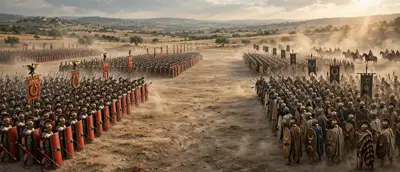
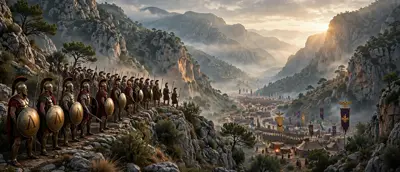
The Roman column that marched into the trap was a small city on the move: Legions XVII, XVIII, and XIX, six auxiliary cohorts, three cavalry squadrons, plus thousands of camp followers — soldiers' families, merchants, slaves, and a long train of wagons. Modern estimates (Powell) put the combat strength at roughly 14,000 to 22,752 men. Strung out along narrow forest tracks, in heavy rain, the column stretched for miles — the vanguard couldn't see the rear, and the rear couldn't help the vanguard.
The Germans struck on the first day from the tree line: javelins and stones rained onto the column, warriors hitting the wagons and the stretched-out marching line, then melting back into the forest. The Romans did what Romans did — they fought back in good order, and when night fell they threw up a fortified camp with ditch and palisade. But a legion camped in hostile forest is a legion under siege, not a legion marching home.
Day two was a grinding push. The column fought its way forward through repeated ambushes, discipline holding in patches and collapsing in others. The storm kept the ground soft and the shields heavy. Varus was steering for Aliso, the Roman fort on the Lippe, but Aliso was a long way off.
The end came at a place we now call Kalkriese, near modern Osnabrück. The land there squeezes into a narrow corridor between a hillside and a bog — and the archaeology shows that Arminius had prepared it. Excavators have found a zigzagging wall of peat turf and packed sand, some 400 meters long, built before the battle. Battle debris — thousands of Roman artifacts — lies in front of it and almost none behind it, meaning the Romans never broke through. The corridor sealed shut. The column, already exhausted and strung out, broke apart. Legionaries who couldn't form ranks were cut down in the mud. According to the Roman accounts, Varus fell on his sword when he saw the battle was lost, and several of his officers followed him. The eagles of three legions — the sacred standards — were captured. A handful of men escaped to Aliso; some survivors were enslaved or sacrificed; the rest died in the forest.
Three days. Three legions. Gone.
---
> ### ⚔️ A New Epic Battle Every Day
> Love military history? Subscribe to Echoes of Battle on YouTube (@EchoesOfBattleHistory) — a new epic battle every day, cinematic and free.
> Next up: Rome's other great annihilation — Battle of Cannae 216 BC: Hannibal's Perfect Trap — how Hannibal destroyed 50,000 Romans in a single day, and why Rome survived it.
---
Turning Points: Three Moments That Decided It
1. The banquet where Varus didn't listen. Segestes gave Varus the whole plot on a plate: arrest Arminius, and the conspiracy dies tonight. Varus's refusal wasn't stupidity — it was trust in his own judgment over inconvenient information. Every intelligence failure in history has this shape. The warning existed. It was ignored.
2. The first storm-soaked ambush. The Germanic tribes never tried to fight the legions in the open. Their plan depended on the column being stretched, wet, and unable to form ranks — and the weather cooperated. Once the Romans lost their formation, they lost the only advantage they had. Arminius knew, because Rome had taught him, that a legion is a machine that only works in formation.
3. The Kalkriese narrows. This is the part the archaeology proved: the final killing ground was engineered. A 400-meter turf rampart, a bog on the other side, and a corridor with no exit. It wasn't a battle at this point. It was a door closing.
Aftermath & Legacy: The Rhine Became the End of the World
News reached Rome weeks later, and Augustus — the man who had conquered the Mediterranean world — came apart. The ancient biographer Suetonius reports that the emperor beat his head against the palace doors, crying out, "Quinctilius Varus, give me back my legions!" He grew his beard and hair long in mourning, declared days of public grief, and doubled the watch in Rome for fear the Germans might march on Italy. A third of the Rhine army had vanished in a week.
The three legions' numbers — XVII, XVIII, XIX — were never issued again in all of Roman history, as though the digits themselves were cursed. Tiberius took command on the Rhine and spent the next two years stabilizing the frontier. Then, from 14 to 16 AD, Germanicus — Tiberius's nephew — led retaliatory campaigns deep into Germania. They were successful in battle: Germanicus recovered two of the three lost eagles, and Tacitus describes his men finding the Teutoburg battlefield six years later, the bones of their comrades still lying where they fell, and giving them burial. But the campaigns changed nothing about the policy. Rome would fight across the Rhine, punish tribes, take hostages — and come home. Germania east of the Rhine was never again treated as a province-to-be.
Arminius himself didn't get to enjoy the victory long. His tribal coalition broke apart — the Germans had united to expel Rome, not to be ruled by one chieftain — and in 21 AD he was murdered by rival chiefs from his own people. Tacitus, who is never generous to anyone, wrote that Arminius was "without doubt the liberator of Germany" and praised him as a challenger of Rome at the height of its power. That's about as close to a compliment as Tacitus ever gave a barbarian.
The deeper legacy is the map. The Rhine became the empire's northern frontier for roughly 400 years, until the Western Empire's decline. The Germanic tribes beyond it developed on their own terms — and centuries later, their descendants would overrun the Western Empire itself. Modern historians argue endlessly about how much of this to pin on Teutoburg alone. But the direction of the argument is consistent: before 9 AD, Germania was being absorbed; after 9 AD, it wasn't.
And the battlefield itself hid for nearly 2,000 years. The exact location was debated for centuries — the giant Hermannsdenkmal monument to Arminius was even raised in 1875 on a hill that later turned out to be nowhere near the real site. Then in 1987, a British amateur archaeologist named Major Tony Clunn, sweeping a field near the village of Kalkriese with a metal detector, found Roman coins and lead sling bullets. Systematic excavations led by archaeologist Wolfgang Schlüter uncovered the rest: a 24-kilometer-by-1.6-kilometer corridor of battle debris, the zigzag turf rampart, coins stamped with Varus's own countermark, an officer's silver-plated face mask, mass graves. The Museum und Park Kalkriese now stands on the site. The forest kept its secret for two millennia. A man with a metal detector solved it in an afternoon.
My Take: What's Overrated and What's Underrated About the Legend
The most overrated part of the Teutoburg story is the famous Augustus quote. It has become the whole narrative: the grieving emperor, the personal tragedy, the empire turned aside by one man's loss. It's a great scene. But scenes aren't causes. The popular version makes it sound as if Rome abandoned Germania because Augustus was heartbroken — as if a different, tougher emperor would have marched straight back in.
The underrated part is the arithmetic that followed the grief. Germania was poor. It had no great cities to tax, no grain surplus to feed legions, no harbor networks to control — just forest, bogs, and tribes that refused to pay for the privilege of being ruled. Rome's empire was, at bottom, a tax machine; a province that costs more to garrison than it yields in revenue is a bad investment, and Germania was the worst investment on the map. Augustus himself, according to Tacitus, advised Tiberius on his deathbed to keep the empire within its existing bounds. Teutoburg didn't teach Rome that Germania was expensive — Rome already suspected it. The disaster just gave Augustus the political cover to act on it, with a grieving father-of-the-empire story to explain a cold financial decision. The quote is what people remember. The balance sheet is what mattered.
Cannae vs Teutoburg: Rome's Two Great Annihilations
Teutoburg is often compared to Cannae — Rome's other famous catastrophe — and the comparison is instructive, but not for the reason people think. In 216 BC, Hannibal destroyed a Roman army of some 50,000 men in a single day at Cannae. It was a bigger slaughter than Teutoburg by a wide margin. And Rome shrugged it off: within months new legions were in the field, and fourteen years later Scipio finished Hannibal at Zama. Cannae destroyed an army. Rome replaced armies the way a factory replaces inventory.
Teutoburg destroyed something Rome chose not to replace — a policy. Rome could easily have raised three new legions in 10 AD; it simply refused to reissue the numbers XVII, XVIII, and XIX, and refused to pay for a permanent occupation of the German forests. That's the real contrast: Cannae proved Rome could survive the loss of 50,000 men because its manpower machine was bottomless. Teutoburg proved that the scarcer resource was never soldiers — it was willingness to spend them on land that wouldn't pay back. Cannae was the worse battle. Teutoburg was the worse defeat, because it's the one Rome didn't undo.
What If Varus Had Listened? A Counterfactual
Here's the alternate history worth playing with: what if Varus, at that banquet, had believed Segestes and arrested Arminius on the spot?
The immediate conspiracy probably collapses. Without its Roman-trained architect, the tribal coalition loses its coordination; Varus's three legions march through to the Rhine winter quarters intact; the planned revolt becomes a footnote about a foiled plot. Rome's slow machinery of client kingdoms, forts, and taxation grinds on, and a formal province of Germania Magna might be declared by the 20s AD.
And then? This is where I have to be honest about counterfactuals: the optimistic version has a Latin-speaking Germany, Roman cities on the Elbe, and a European map unrecognizable to us. But the economics don't change. Germania in 20 AD would still be a forest with no tax base, still requiring a permanent, expensive garrison surrounded by hostile tribes. Rome would have had to hold it at full cost, forever, for no revenue. My suspicion — and it's only a suspicion — is that the "what if" ends at the same Rhine, just later and with fewer skeletons at Kalkriese. The tribes didn't beat Rome's army that September. They beat Rome's spreadsheet. And spreadsheets are much harder to ambush.
What We Know and What We Don't
This battle is unusually well-documented for the ancient world — and the documents are all Roman. Cassius Dio, Velleius Paterculus, Tacitus, and Suetonius wrote the accounts we have, all of them decades after the fact, and no Germanic written record exists. That means every detail of Arminius's motives and the tribal coalition's size comes to us through Roman eyes, which had every reason to make Varus look naive and the Germans look treacherous.
The exact date is an educated convention, not a carved fact: sources place the fighting in a September window, with Wikipedia's infobox giving 8–9 September and some accounts stretching to the 11th. The Germanic numbers are unknowable — modern figures of 18,000 to 30,000 are estimates built on tribal muster guesses. Roman strength is estimated too: Powell's 14,000–22,752 and McNally's ~21,000 are modern calculations, not headcounts. The famous Augustus quote comes from Suetonius, writing about 120 years later; the outburst may be polished anecdote, but the months of public mourning and the permanent policy shift are well documented. And while Kalkriese is now accepted as the battle's location, some scholars still debate whether the corridor holds the entire battle or one of its phases.
FAQ
Who won the Battle of Teutoburg Forest?
Arminius and his Germanic alliance, decisively. Over roughly three days in September 9 AD, the tribal coalition ambushed and annihilated three Roman legions — XVII, XVIII, and XIX — killing an estimated 16,000 to 20,000 Romans. It was one of the worst defeats in all of Roman history.
What happened to Varus at Teutoburg Forest?
According to the Roman accounts, Varus fell on his sword when he saw the battle was lost. Cassius Dio and Velleius Paterculus record that he and several officers took their own lives rather than be captured. Roman tradition adds that Varus's head was sent to Augustus, who buried it in the family tomb. The sources are all Roman and written decades later, so the details come with the usual caveats.
Why did Rome never conquer Germany after Teutoburg?
Because the cost was too high and the prize too poor. Germania east of the Rhine had no great cities to tax and no grain surplus to feed an occupying army. After the disaster, Augustus ordered the Rhine held as the permanent frontier — and Tacitus reports that Augustus advised Tiberius to keep the empire within its existing bounds. Rome could have raised new legions; it chose not to spend them on a forest.
Where exactly was the Battle of Teutoburg Forest?
Most likely near the village of Kalkriese in Lower Saxony, Germany. For centuries the location was unknown, until amateur archaeologist Tony Clunn found Roman coins there in 1987. Excavations revealed a 24 km × 1.6 km corridor of battle debris — including coins stamped with Varus's own countermark — plus a pre-built Germanic turf rampart. The Museum und Park Kalkriese now stands on the site.
Sources
- Cassius Dio, Roman History, Book LVI — the most detailed ancient account of the Varus disaster
- Tacitus, Annals, Book I — Germanicus's campaigns and the rediscovery of the battlefield (15–16 AD)
- Suetonius, Life of Augustus, ch. 23 — Augustus's reaction to the news
- Velleius Paterculus, Roman History, Book II — contemporary Roman account of Varus and Arminius
- Wikipedia, "Battle of the Teutoburg Forest" — modern synthesis of dates, forces, and casualties
- TheCollector, "The Battle of the Teutoburg Forest: Give Me Back My Legions!" — narrative history with aftermath detail
- National Museum of Denmark, "The Battle of the Teutoburg Forest" — museum overview of the battle and site
- Museum und Park Kalkriese — archaeological findings from the Kalkriese excavations