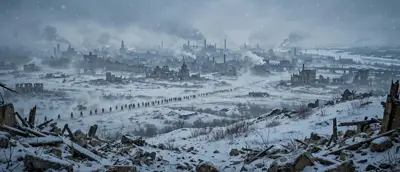
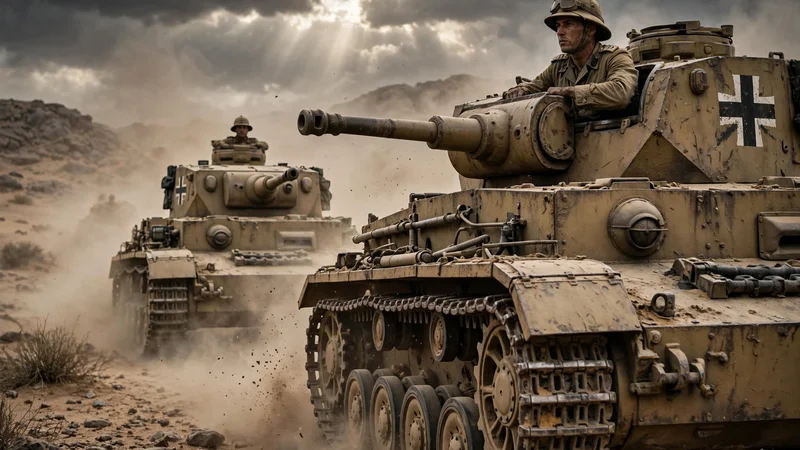
At 5:30 on a freezing morning, December 16, 1944, the quietest stretch of the Western Front exploded. German artillery opened up along an 80-mile front in the Ardennes forest, and out of the snow and fog came tanks. A lot of tanks. The Americans holding that sector were mostly green replacements and exhausted divisions resting after hard fighting. They were about to face the last great German offensive of the war, and for three weeks nobody in Washington or London knew whether the line would hold.
Germany's Last Throw of the Dice
By late 1944 the war looked decided. The Allies had landed in Normandy, liberated Paris, and pushed Germany back to its own borders. Hitler's generals mostly wanted to conserve strength for defense. Hitler had other ideas. He ordered a massive counteroffensive through the Ardennes, the same forest his panzers had sliced through in 1940, aimed at driving to the port of Antwerp and splitting the American and British armies apart.
It was audacious on paper and desperate in reality. Germany scraped together about 200,000 men, including some of its best remaining armored units, plus new jet aircraft and V-2 rockets. Fuel was the nightmare. The plan counted on capturing American fuel dumps to keep the tanks moving. If the advance stalled, the whole thing would run out of gas, literally.
And here is the thing most people miss: the plan almost made sense as a gamble. If it had worked, it might have delayed the war by months and forced a negotiated peace. Hitler was not trying to win outright anymore. He was trying to buy time, hoping the Allied coalition would crack. It was a long shot. He took it anyway.
December 16: The Forest Erupts
The attack achieved total surprise, which tells you something about Allied intelligence failures that winter. American commanders had written off the Ardennes as a quiet sector. Ultra intercepts hinted at a buildup, but the Germans moved at night, kept radio silence, and used the bad weather as cover. When the barrage hit, some American units were overrun in hours.
The first days were chaos. German spearheads pushed deep, and American units fought desperate delaying actions at road junctions with names that became legend: St. Vith, Clervaux, Hosingen. Small groups of engineers, clerks, and cooks held bridges and crossroads for hours or days, buying time for the line to stiffen. One of the ugliest episodes came on December 17 at Malmedy, where SS troops murdered about 84 American prisoners of war. Word spread fast, and it hardened American resolve. Nobody was surrendering to that.
The weather was Germany's best ally. Thick fog and snow grounded Allied aircraft for days, which was the whole point of the timing. Without air power, the Americans had to stop tanks with bazookas, artillery, and raw stubbornness. Somehow, mostly, they did.
Bastogne: The Town That Would Not Surrender
Every great battle has a hinge, and the Bulge's hinge was Bastogne, a road junction town in Belgium. The Germans needed its roads. The Americans put the 101st Airborne Division there, rushed in by truck, and told them to hold. By December 21 the town was completely surrounded.
What happened next is the stuff of legend, but the legend is true. The paratroopers, short on everything from ammunition to winter coats, dug in and refused to budge. German attacks came day after day. The 101st, plus stragglers from a dozen shattered units who attached themselves to the defense, threw every one of them back. Bastogne became a symbol: as long as it held, the German timetable was wrecked.
You have probably wondered what it takes to hold a surrounded town in a blizzard with no supplies. The answer, at Bastogne, was medics working in cellars, artillerymen firing over open sights at tanks, and a division that simply decided it was not going to be the one that broke.
NUTS: The Most Famous Word of the War
On December 22 the Germans sent a surrender demand under a white flag. It was addressed to the American commander at Bastogne and promised honorable treatment. Brigadier General Anthony McAuliffe, the acting division commander, read it and, according to the men with him, laughed and said, "Nuts." His staff had to figure out how to put that in an official reply. They sent back a typed message:
To the German Commander:
NUTS!
The American Commander
The German officers who received it genuinely did not understand. They asked whether it meant yes or no. An American colonel explained it meant no, in the plainest possible terms. The story flew around the world, and "NUTS" became the battle cry of the Bulge. It was perfect. One word, no posturing, and completely unambiguous once translated.
Patton Turns North
While Bastogne held, George Patton was doing something his fellow generals thought was close to impossible. His Third Army was facing east, deep in the Saar region. Eisenhower needed it facing north, attacking into the flank of the German bulge, and he needed it fast. Patton had actually prepared for this in advance, drawing up contingency plans before the meeting where Eisenhower gave the order, which is either brilliant foresight or Patton being Patton.
His staff turned an entire army 90 degrees in the middle of winter and started moving within 48 hours. Military historians still study it as one of the great feats of staff work. On December 26, the 4th Armored Division broke through to Bastogne and the siege was over. Patton's drive did not end the battle, but it ended any German hope of taking the town, and with it the hope of reaching Antwerp.
Honestly, Patton gets a lot of the glory here, and he earned a share of it. But the men who made his relief possible were the ones who held Bastogne for five days with almost nothing. Relief only matters if there is something left to relieve.
The Sky Clears: The Tide Turns
On December 23 the weather finally broke, and the sky filled with Allied aircraft. Fighter-bombers went after German columns stuck on icy roads with no fuel and no air cover. It was, in the words of one pilot, like shooting fish in a barrel, except the fish were tanks. From that point the German offensive was living on borrowed time.
The counterattack built through early January. Montgomery's forces pushed from the north, Patton from the south, and the bulge was squeezed flat. By January 25 the lines were roughly where they had been on December 16. Six weeks of the most brutal winter fighting of the war, and the map looked almost unchanged. Almost. Because what had changed was that Germany had spent its last reserves.
The Cost: America's Bloodiest Battle
The numbers are staggering, and they deserve to be stated plainly. American casualties in the Bulge were roughly 80,000, including about 19,000 killed. That makes it the bloodiest single battle American forces fought in World War II, worse than D-Day, worse than Iwo Jima. German casualties were around 100,000, including irreplaceable panzer crews and experienced infantry.
Those figures hit different when you remember this was supposed to be a quiet sector in a war that was supposed to be nearly over. Thousands of families got telegrams in January 1945 for a battle most Americans had never heard of before it started. The Ardennes in winter is beautiful and merciless, and the men who fought there in 1944 earned every bit of the legend that followed them.
Why the Bulge Mattered
Here is the uncomfortable truth: Germany's gamble failed so completely that it shortened the war. The offensive burned through the fuel, tanks, and trained men Germany needed to defend the Rhine. When the Allies crossed into Germany proper in March 1945, they faced a hollowed-out army. The Bulge did not just fail. It actively made the final defeat worse.
For the Americans, the battle was a forge. Green divisions that broke in December fought like veterans by January. The lesson the US Army took from the Ardennes, about flexibility, about junior leaders taking initiative when the plan collapses, shaped American military thinking for a generation.
And Bastogne? Every December, the town still remembers. The people of Bastogne never forgot who held the line in their streets, and the 101st never forgot Bastogne. Some debts between soldiers and civilians do not expire. This one certainly has not.
Voices from the Bulge
Statistics tell you the scale. Voices tell you the cold. A medic with the 101st later wrote about working in a Bastogne cellar while shells shook dust from the ceiling, deciding which wounded men could wait and which could not. An infantryman from the 99th Division remembered the pine trees exploding above his foxhole, wood splinters as deadly as shrapnel, and the strange quiet between barrages when you could hear the snow falling.
One story sticks with me. A young lieutenant, separated from his unit in the first days, spent three days moving at night and hiding by day, living on snow and a single chocolate bar. When he finally reached American lines, his first question was whether his men had made it out. They had not. He went back to the front anyway. That was the Bulge in miniature: nobody had a grand plan, everybody just kept going.
Frequently Asked Questions
What was the Battle of the Bulge in simple terms?
From December 16, 1944 to January 25, 1945, Germany launched a surprise offensive through the Ardennes forest in Belgium and Luxembourg, trying to split the Allied armies. American forces, especially the surrounded 101st Airborne at Bastogne, held on until Patton's Third Army broke through. It was Germany's last major offensive in the west.
Why is it called the Battle of the Bulge?
The German attack pushed a deep salient, a bulge, into the Allied lines on situation maps. The name comes from the shape of that bulge on the maps in Allied headquarters.
What does NUTS mean in the Battle of the Bulge?
On December 22, 1944, the Germans demanded the surrender of the surrounded American troops at Bastogne. Brigadier General Anthony McAuliffe, acting commander of the 101st Airborne, replied with a single word: NUTS. The Germans had to ask what it meant. It meant no.
How many Americans died in the Battle of the Bulge?
American casualties were roughly 80,000, including about 19,000 killed. It was the bloodiest single battle American forces fought in World War II. German casualties were around 100,000.
Sources
- Britannica: https://www.britannica.com/event/Battle-of-the-Bulge
- National WWII Museum: https://www.nationalww2museum.org/war/articles/battle-bulge
- Wikipedia: https://en.wikipedia.org/wiki/Battle_of_the_Bulge