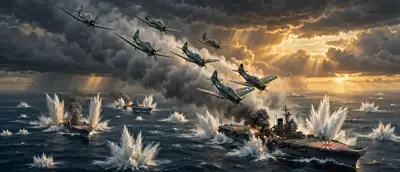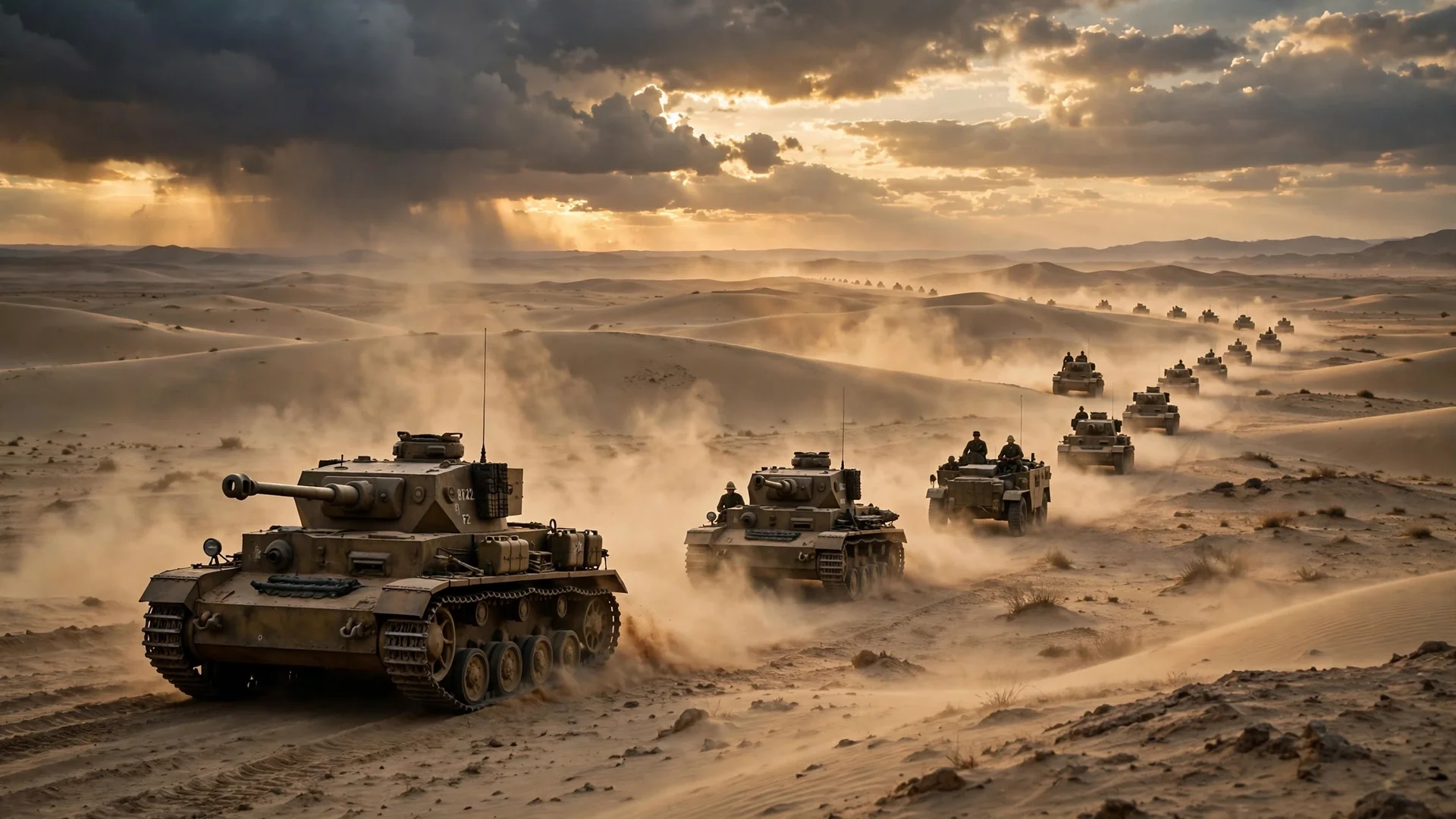
There's a railway halt in the Egyptian desert, sixty miles west of Alexandria, called El Alamein. Nothing about it looks historic — flat sand, a few buildings, the Mediterranean glittering to the north. But in the autumn of 1942, this patch of nothing became the hinge of the Second World War. Two armies collided here. One of them never recovered.
On one side stood Erwin Rommel, the Desert Fox, the most famous German general of the war — a man who'd spent two years humiliating the British across North Africa. On the other, a prickly, beret-wearing Englishman named Bernard Montgomery, who'd just taken command and told his men, in so many words, that the retreating was over. What followed was twelve days of the most methodical, grinding battle of the desert war. No genius maneuvers. No sweeping flanking moves. Just arithmetic — applied with a thousand guns at a time.
The Fox at the Gates: Summer 1942
To feel the weight of El Alamein, you have to feel the summer that came before it. Rommel had been running riot. In June he'd taken Tobruk — a fortress the British had held for months — in a single day, capturing 33,000 men. Churchill, hearing the news in Washington, was physically shaken. Rommel chased the retreating British Eighth Army across Egypt to the very edge of Alexandria, stopping only at a narrow bottleneck between the sea and the impassable Qattara Depression. That bottleneck was El Alamein.
By July, Rommel was sixty miles from Alexandria and the Nile Delta. Beyond lay the Suez Canal — Britain's lifeline to India and the East — and beyond that, the oil fields of the Middle East. If Egypt fell, the strategic map of the war would be redrawn. London understood this perfectly, which is why Churchill sacked his Middle East commander and his Eighth Army commander in one brutal afternoon in August and sent out replacements with a single order: win.
The new team was Harold Alexander upstairs and Bernard Montgomery on the ground. Monty arrived on August 13, looked at an army that had been retreating for months, and did something no British general in the desert had done in two years: he told his men they were going to stand, fight, and win. Then he set about making it true.
Montgomery's Method: Boring on Purpose
Montgomery is one of those generals historians love to argue about, but nobody argues about his method. It was the opposite of Rommel's. Where Rommel improvised, gambled, and struck like lightning, Montgomery planned, stockpiled, and attacked like a steamroller. He'd watched the British lose in the desert for two years by fighting Rommel's kind of battle — fast, fluid, improvisational — and he'd concluded the answer was to refuse to play that game at all.
So for two months, the Eighth Army did something deeply unglamorous: it accumulated. Tanks — hundreds of them, including the new American Shermans, which for the first time gave the British armor that could stand up to German panzers. Guns — nearly a thousand artillery pieces. Ammunition, fuel, food, water: mountains of it, stockpiled behind the Alamein line. Montgomery wouldn't attack until he had overwhelming superiority in everything. His staff called it 'the colossal crack' — a phrase Monty loved. Hit them with everything, all at once, and keep hitting.
Rommel, meanwhile, was withering. His supply line stretched 1,400 miles back across Libya, harassed by British aircraft and submarines operating from Malta. Fuel was so short his tanks sometimes couldn't maneuver. He was also sick — genuinely ill, flown back to Germany in September — leaving his deputy Georg Stumme in command. When Montgomery finally moved, Rommel would have to rush back to a battle already lost.
There's a lesson hiding in those two months that has nothing to do with 1942: the unsexy work usually decides things before the shooting starts. Montgomery won El Alamein in the supply dumps of September. The battle itself was just the receipt.
October 23: A Thousand Guns Speak at Once
The attack began at 9:40 p.m. on October 23, 1942, and it began with sound. Nearly a thousand artillery pieces opened fire simultaneously along the front — the heaviest British bombardment of the war to that point. Men who were there said the desert itself seemed to catch fire: the horizon lit orange, the ground shaking, the roar physical, like standing inside a drum.
Under that barrage, the infantry went forward on a narrow front in the north, where Montgomery had chosen to make his main effort. The plan was pure Monty: punch a corridor through the Axis minefields and defenses, get the armor through, and then — this was the unglamorous part — grind. No breakout dash for the coast. Just systematic destruction of the Axis army, division by division, in a battle of attrition the British were guaranteed to win because they'd stacked the arithmetic in advance.
The first night went well. Sappers cleared lanes through minefields under fire — some of the bravest, least celebrated work of the war — and the infantry took their objectives. But the minefields were deeper than expected, the lanes narrower, and by dawn the armor was still bunched up behind the infantry, unable to deploy. The 'colossal crack' had cracked, but not shattered. What followed was not the swift victory Montgomery had promised Churchill. It was a grind.
And on that first day, in a strange footnote, the acting Axis commander Georg Stumme suffered a heart attack and died while touring the front. Command passed to Rommel's chief of staff until Rommel himself, sick and exhausted, flew back from Germany to take over a battle that was already going wrong.
Twelve Days of Grinding: The Battle Eats Both Armies
Here's what the next week and a half looked like: attack, counterattack, dust, and death, repeated daily. Montgomery fed divisions into the northern corridor, trying to wear down the Axis armor. Rommel, back in command by October 25, threw his panzers at the British salient in a series of furious counterattacks — exactly the kind of fluid, aggressive fighting he was brilliant at, and exactly what Montgomery's plan was designed to absorb.
The fighting has a rhythm you can almost feel reading the accounts. Each morning the British artillery would open up — thousands of guns, a weight of fire the Axis had never experienced. Each day the infantry would inch forward. Each evening Rommel's tanks would counterattack, and each evening they'd come back fewer. Fuel was the silent killer: German tanks burned precious petrol just moving to the threatened sector, and there was no more coming. By the end of October, Rommel's armor was down to a fraction of its strength, and his men were fighting on empty stomachs as well as empty tanks.
The Australians deserve a special mention here. The 9th Australian Division, holding the northern coastal sector, spent days drawing the full weight of Axis counterattacks onto itself — a deliberate sacrifice play in Montgomery's design. Churchill later said their drive toward the coast 'swung the whole battle.' It cost them nearly 2,700 casualties. They'd earned the right to go home after this; the division left North Africa in early 1943 and never came back.
Through it all, Montgomery stayed maddeningly calm — and maddeningly slow, to his critics. He refused to be hurried. He regrouped, stockpiled, and waited until he was ready. On the night of November 1–2, he was.
Operation Supercharge: The Breakout
The breakout had a codename — Operation Supercharge — and it opened the way all of Montgomery's attacks opened: with artillery. At 1:05 a.m. on November 2, the guns spoke again, and this time the infantry attack was followed by massed armor driving for the open desert beyond the Axis line. This was the moment the whole battle had been building toward.
Rommel's remaining tanks fought desperately. For a day, the outcome hung in the balance — German anti-tank guns and the last panzers exacted a heavy toll. But there is only so long an army can fight without fuel, and Rommel had reached the end of his. On the evening of November 2, he gave the order to retreat.
Then came one of the strangest episodes of the battle. Hitler, following events from far away, directly countermanded Rommel: no retreat. Stand and fight. Rommel, the loyal soldier, obeyed for a day — a day that cost his army men and tanks it couldn't spare — before the military reality became undeniable and he resumed the withdrawal on the night of November 3–4. By November 5, the British were through. The Axis army was streaming westward, abandoning equipment by the roadside, and the pursuit was on.
The numbers tell the aftermath plainly. The Allies had lost about 13,500 men. The Axis had lost somewhere between 30,000 and 70,000 — killed, wounded, and captured — plus around 500 tanks and most of their artillery. Rommel's Panzer Army, the force that had terrified the British for two years, had effectively ceased to exist as a fighting formation.
1,400 Miles: The Long Retreat
What happened next is often forgotten, but it matters. Rommel conducted one of the great retreats of the war — 1,400 miles from Egypt across Libya to Tunisia, keeping his remaining force together while Montgomery pursued with infuriating caution. Monty's critics have never forgiven him for the slowness of the pursuit: with the Axis army broken, a bolder commander might have cut it off and destroyed it entirely. Montgomery, true to form, refused to outrun his supplies. He'd won his way, and he wasn't about to improvise now.
The retreat ended in Tunisia, where Rommel's remnants linked up with Axis forces arriving from Europe. The North African campaign would drag on until May 1943. But the strategic verdict was already in: the Axis would never threaten Egypt again. The Suez Canal was safe. The Middle Eastern oil was safe. And the initiative in the Mediterranean had changed hands for good.
Eight days after Alamein ended, Anglo-American forces landed in Morocco and Algeria — Operation Torch. Rommel now faced enemies on two sides. The desert war he'd dominated for two years was over; all that remained was the long, slow collapse.
Why Alamein Mattered: The Turning of the Tide
Churchill's famous line about Alamein — 'Before Alamein we never had a victory. After Alamein, we never had a defeat' — is an exaggeration, as Churchill's lines usually were. But it captured something real: the psychological moment when the Allies started believing they could win.
Think about where Britain stood in the autumn of 1942. Singapore had fallen. Tobruk had fallen. The U-boats were sinking ships faster than they could be built. The Soviet Union was reeling at Stalingrad. For three years, the British public had watched their army lose, retreat, and lose again. El Alamein was the first unambiguous, large-scale land victory over the German army of the entire war. The church bells rang across Britain — Churchill ordered it — and for the first time in years, people celebrated instead of endured.
Strategically, the stakes were exactly as high as they looked. Had Rommel broken through to the Suez Canal, Britain's position in the Middle East and India would have been gravely threatened, and the oil of the region — the fuel of modern war — might have fallen into Axis hands. Alamein didn't just win a battle; it secured a theater. From November 1942 on, the Allies were advancing on every front that mattered. The tide, as everyone sensed at the time, had turned.
The Argument: Was Montgomery Too Slow?
No Montgomery article is complete without the argument, so here it is: was he too cautious? Did his methodical, grinding, arithmetic-first approach waste opportunities that a bolder general would have seized — above all, the chance to destroy Rommel's army entirely during the pursuit?
The critics have a point. The pursuit across Libya was painfully slow. Rommel himself, with grudging admiration, noted that Montgomery never took a risk — which meant he never made the kind of mistake that loses armies, but also never the kind of gamble that ends wars early. A more aggressive pursuit in November 1942 might have trapped the Axis in Libya and shortened the North African campaign by months.
The defenders answer with the record. Montgomery took command of a beaten army and never lost a battle. His method — overwhelming force, meticulous planning, no improvisation — was perfectly adapted to the British army he actually had: brave, well-equipped, but not built for Rommel-style dash. And in the desert, against Rommel, dash had lost for two straight years. Montgomery's boring, grinding, infuriating caution was the specific medicine the situation required.
Here's my take: the criticism mistakes style for substance. Montgomery understood something his critics don't — that in modern war, logistics beats genius. He won because he refused to fight the battle Rommel wanted and insisted on fighting the battle he'd prepared. That's not caution. That's clarity. And clarity, applied with a thousand guns, looks a lot like victory.
What El Alamein Still Teaches
Strip away the tanks and the desert, and El Alamein is a story about preparation beating talent. Rommel was the more gifted tactician — almost everyone agrees, including Montgomery's own staff. It didn't matter. Montgomery spent two months building an advantage so overwhelming that talent couldn't overcome it, then spent twelve days cashing it in. The lesson isn't that genius is worthless. It's that genius is fragile, and systems are durable.
Second lesson: morale is a weapon, and Montgomery wielded it deliberately. He understood that his army needed to believe it could win before it actually could — so he told them so, loudly, repeatedly, and then arranged for them to be right. The beret, the swagger, the famous orders of the day: theater, yes, but theater with a purpose. An army that expects victory fights differently than one that expects retreat.
And third: know what kind of war you're fighting. Rommel fought a war of movement in a theater where movement depended on fuel he didn't have. Montgomery fought a war of attrition in a theater where attrition favored the side with the supply line. The desert didn't care who was the better general. It cared who had the petrol. It always does.
Wondering where El Alamein sits among the war's deadliest fights? See our ranking of the bloodiest battles of WW2 — and for clashes decided even more lopsidedly, the most one-sided battles in history.
Sources
- Niall Barr — Pendulum of War: The Three Battles of El Alamein (Jonathan Cape, 2004).
- Jonathan Dimbleby — Destiny in the Desert: The Road to El Alamein (Profile Books, 2012).
- Encyclopaedia Britannica — “Battles of El-Alamein” (britannica.com).
- WW2DB — Second Battle of El Alamein (ww2db.com).