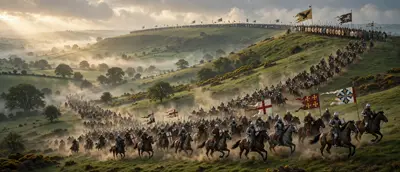
For a thousand years, the walls of Constantinople had held. Goths, Persians, Arabs, Bulgars, Rus, all had thrown themselves at the greatest fortifications on earth and broken against them. The city’s people had a saying: as long as the walls stand, the empire stands. In the spring of 1453, a 21-year-old sultan named Mehmed II brought something the walls had never faced. Not just an army of 80,000 men. A cannon so large it took sixty oxen to move it. For fifty-three days the guns pounded the ancient stones. On the morning of May 29, the walls gave way, and with them an empire that had outlasted Rome itself by a thousand years. This is the story of the siege that changed the map of three continents.
What Was the Siege of Constantinople?
By 1453 the Byzantine Empire, the eastern half of old Rome, was a ghost of itself. It held Constantinople, a few scraps of Greece, and little else. The Ottoman Turks, a rising Muslim power, surrounded it on every side. The young Sultan Mehmed II, who had taken the throne at nineteen, decided the time had come to take the city his predecessors had tried and failed to capture. He was twenty-one years old. He had been planning this since childhood.
What followed was one of the great sieges in history: fifty-three days of bombardment, assault, engineering, and endurance, ending in a single morning of storming that killed the last Roman emperor and made Constantinople the capital of a new empire. Historians often use 1453 as the date the Middle Ages ended. That is arguable, but it tells you how much weight this one siege carries.
A note on tone before we go on, because it matters. This was a war between a Muslim empire and a Christian one, and it is easy to tell the story as a clash of faiths. The people who lived it certainly saw religion in it. But the siege itself was decided by cannons, walls, ships, and leadership, and both sides fought with extraordinary courage. This article treats both with respect. History deserves better than cheerleading.
The Walls: A Thousand Years of "Impossible"
To understand 1453, you have to understand the Theodosian Walls. Built in the 400s, they were a triple system: a moat, an outer wall, and a massive inner wall studded with towers, stretching across the landward side of the city. For a millennium they were the most formidable fortifications in the world. Armies that could take any other city in weeks broke against Constantinople and went home.
The walls had one weakness, and everyone knew it. They were built for an age of catapults and battering rams, not gunpowder. By 1453, cannon existed, but nobody had ever built guns big enough to smash walls like these. Mehmed found the man who could: a Hungarian engineer named Orban, who had first offered his services to the Byzantines. They could not afford him. Mehmed could, and he asked Orban a simple question: can you build me a cannon that will break the walls of Constantinople? Orban said yes.
The result was a bronze monster nearly 27 feet long that fired stone balls weighing some 1,200 pounds. Moving it from the foundry to the siege lines took sixty oxen and weeks of labor. When it fired, the sound was heard for miles. It was slow, it cracked, it had to be cooled and reloaded at a crawl. But it hit the same section of wall, day after day, for weeks. Stone that had stood for a thousand years began to crumble.
The Defenders: 7,000 Against 80,000
Constantine XI, the last Byzantine emperor, knew exactly what was coming and prepared like a man with nothing to lose, because he had nothing to lose. He repaired the walls, stockpiled food, and sent desperate appeals west for help. What arrived was a trickle: a few hundred Genoese under a brilliant soldier named Giovanni Giustiniani, some Venetians, a handful of others. All told, the city’s defenders numbered around 7,000 against Mehmed’s roughly 80,000.
Read those numbers again. Eleven to one. And yet the siege lasted fifty-three days. That is not an accident. Giustiniani was a superb defensive commander, the walls were still the walls, and the defenders, Greek and Latin alike, fought with the desperation of people defending their homes. Whatever you think of empires, that kind of stand commands respect.
Constantine himself refused every offer to slip away. When his counselors begged him to flee and continue the fight from exile, he answered that he would not leave the city. He meant it. You will see how this ends.
The Ships Over the Hill: Mehmed’s Boldest Move
Constantinople’s great natural defense, besides the walls, was the Golden Horn, the inlet guarding the city’s northern side. The Byzantines had stretched a massive chain across its mouth, blocking the Ottoman fleet. For weeks the siege stalled on that chain.
Then Mehmed did something his enemies thought was impossible. He had his engineers build a greased wooden roadway over the hills behind Galata, and on the night of April 22, Ottoman ships were hauled overland, on rollers, right into the Golden Horn behind the chain. The defenders woke to find enemy ships inside their harbor. It is one of the great engineering feats in military history, and it broke the stalemate at sea. The city was now besieged on all sides.
If you are keeping score on leadership, this is the moment that separates Mehmed from a merely competent commander. Competent commanders accept the chain. Mehmed moved the ships over a hill.
May 29, 1453: The Morning the Walls Fell
By late May the great cannon had done its work. Stretches of the outer wall were rubble. Assaults had probed the defenses and been thrown back, but each one taught the Ottomans something. On May 26, Mehmed called a council of war. Attack now, or settle in for a long blockade? He chose attack. The final assault was set for the early hours of May 29.
It came in waves. First the irregulars, then the Anatolian troops, then at dawn the Janissaries, the sultan’s elite infantry, in a concentrated assault on the weakened section near the St. Romanus Gate. And then the accident that decided everything: Giustiniani, the Genoese commander holding the land walls, was wounded and carried from his post. His men, seeing their leader gone, wavered. At that exact moment the Ottomans found a small postern gate, the Kerkoporta, left unlocked or forced, and poured through.
The defense collapsed in hours. Constantine XI, the last emperor of Rome’s eastern line, threw off his imperial insignia and charged into the street fighting with his men. He was killed in the crush near the walls. His body was never definitively identified. He was about forty-nine years old, and he had ruled for four years. He died the way he said he would: with the city.
Aftermath: A New Capital for a New Empire
Mehmed entered the city that afternoon and rode to the Hagia Sophia, the great cathedral that had been the heart of Eastern Christianity for nine centuries. What happened next is often told crudely, so let us be precise. There was looting, as there was after every stormed city in this era; the customs of war in 1453 were brutal on all sides. But Mehmed also moved quickly to make Constantinople his capital. He had the Hagia Sophia converted into a mosque, which it remained for nearly five hundred years. He repopulated the city, restored its trade, and made it the seat of an empire that would last until 1922.
For the Christian world, the shock was enormous. The "second Rome" had fallen to a Muslim sultan. Refugees carried Greek manuscripts west, and some historians credit that exodus with feeding the Renaissance. Whether or not you buy that grand claim, the symbolism was real: an age had ended.
And for the Ottoman state, 1453 was the founding moment of empire. Mehmed, twenty-one years old, took the title Kayser-i Rum, Caesar of Rome, claiming the imperial inheritance. He would be called Fatih, the Conqueror, for the rest of history. Whatever else one says about conquest, taking Constantinople at twenty-one is one of the great achievements in the history of warfare and statecraft.
Why 1453 Still Matters
Three reasons, stated plainly. First, it ended the Byzantine Empire, the continuous eastern half of Rome, after more than a thousand years. That is not a footnote. That is the close of the longest-lived state the Western tradition had ever known.
Second, it made the Ottoman Empire a world power. From Constantinople, renamed Istanbul, the Ottomans would expand across the Balkans, the Middle East, and North Africa, shaping the politics of three continents for centuries. The modern map of southeastern Europe and the Middle East still carries the lines drawn in the centuries after 1453.
Third, it changed how wars were fought. The great cannon at Constantinople announced that medieval walls were finished. Every fortress in Europe would have to be redesigned for the age of gunpowder. Military architecture changed because Orban’s bronze monster worked.
Honestly, the deepest lesson is about complacency. The Byzantines trusted walls that had held for a thousand years, and for a thousand years they were right, until the one year they were wrong. No defense, however proven, survives a change in the underlying technology. That is as true of stone walls as it is of anything else.
What the Sources Say: A Note on the Numbers
The figures for 1453 come mainly from contemporary accounts on both sides: the Greek chronicler Doukas, the Venetian Nicolo Barbaro, and Ottoman sources. Modern historians generally accept roughly 80,000 Ottoman troops and about 7,000 defenders, though both numbers are estimates and you will see variations. The 53-day duration, April 6 to May 29, is firm. Where sources conflict on details, such as the exact size of Orban’s cannon, I have used the commonly cited figures.
Frequently Asked Questions
Who conquered Constantinople in 1453?
Sultan Mehmed II of the Ottoman Empire, who was just 21 years old. After a 53-day siege, his forces broke through the Theodosian Walls on May 29, 1453, and took the city.
What happened to Constantine XI?
The last Byzantine emperor died fighting in the final assault on May 29, 1453. He had refused to flee the city, threw off his imperial insignia, and charged into the street fighting near the walls. His body was never definitively identified.
How did the Ottomans break through the walls?
Weeks of bombardment by giant cannons, especially the great bronze gun built by the engineer Orban, reduced sections of the ancient walls to rubble. In the final assault, the wounding of the Genoese commander Giustiniani and the forcing of a small gate called the Kerkoporta collapsed the defense.
Why is the fall of Constantinople important?
It ended the Byzantine Empire after more than a thousand years, made Constantinople (Istanbul) the Ottoman capital, and is often used as the date the Middle Ages ended. It also proved that gunpowder artillery had made medieval walls obsolete.