Battle of Alesia 52 BC: How Caesar Got Besieged While Besieging, and Won Anyway
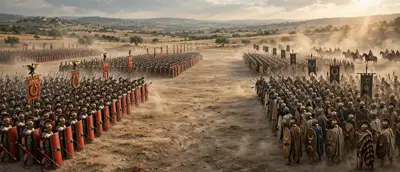
Here's an image that should stop you cold. Julius Caesar is standing on a hill in France with about 60,000 men, and he's in the middle of a siege. That's normal enough. Except Caesar then orders his engineers to dig a SECOND set of walls. This one faces outward.
His men are building defenses against an enemy that hasn't arrived yet, while the enemy they're actually besieging watches from the walls of Alesia and waits for its rescue to come. Nobody had ever tried anything like it. Plenty of Roman officers thought it was madness. And it worked.
That, in one strange snapshot, is the Battle of Alesia, fought over September and October of 52 BC. It was the last great battle of Caesar's conquest of Gaul: a double siege in which one Roman army held off two Gallic armies at once, one in front and one behind. The Gauls lost, Vercingetorix surrendered in person, and within a few years Caesar used the glory of that victory to march on Rome itself and end the Roman Republic.
Who was Vercingetorix, and why was everyone terrified of Caesar by 52 BC?
Let's set the stage, because Alesia doesn't make sense without the mess that came before it.
By early 52 BC, Julius Caesar had spent six years conquering Gaul. Most of the tribes were beaten, taxed, or bought off. But the conquest was built on sand. The Gauls hated the tribute, they hated the Roman garrisons in their towns, and they'd noticed something else: Caesar's legions were exhausted and his money was running out.
Enter Vercingetorix. He was a young Arvernian noble, barely in his thirties, and he'd done the impossible: talked the fiercely independent Gallic tribes into a single coalition. That's like herding cats if the cats had spears and ancestral grudges going back generations. But he pulled it off.
And Vercingetorix was smart. He knew he couldn't beat Caesar in a straight fight. Nobody could. So he changed the game entirely. He ordered a scorched-earth campaign: burn the crops, poison the wells, torch the towns, deny the Romans everything. A Roman legion marched on its stomach, and Vercingetorix intended to empty every stomach in Gaul.
It nearly worked. That spring, Caesar's army nearly starved. At the hill fort of Gergovia, Vercingetorix handed Caesar one of his few outright defeats: the Romans stormed the walls without orders, got cut up, and Caesar had to admit in his own memoirs that he lost 700 men and 46 centurions. For Caesar, that was a disaster. For Gaul, it was proof the man could be beaten.
But Caesar also did something ugly that same year, and you need to know this because it explains what came later. At Avaricum, modern Bourges, the Romans stormed a town that had refused to burn itself. What followed was a massacre. Caesar himself writes that his men killed 40,000 people, men, women, and children, sparing almost nobody. That's Caesar's number, from his own book. Modern historians argue about it, but the fact stands: Gaul learned what resistance cost.
So by September 52 BC, Vercingetorix made a choice. His cavalry had been mauled by Caesar's newly arrived German horsemen. His army was tired. And he decided to pull everything back to a fortress his grandfather's generation had used: Alesia, a flat-topped hill ringed by steep slopes and two rivers, in what is now Burgundy, France.
What was so special about the fortress of Alesia?
Alesia sat on top of Mont Auxois, a hill with sheer drops on most sides, flanked by the Rabutin and Rebie rivers. It was the stronghold of the Mandubii, allies of Vercingetorix. To Caesar's engineers, it must have looked like a gift: a hill you couldn't take by storm, which meant the Gauls inside felt safe enough to stay put.
Vercingetorix moved his whole force inside, around 80,000 warriors by Caesar's count, plus families and baggage. Then he did something clever: he sent his cavalry OUT, riding through the night before the Romans closed the ring, with orders to every tribe in Gaul. Raise the relief army. Every tribe. All of them. Come break this siege or lose Gaul forever.
The messengers got through. Some Roman patrols missed them, some Gauls bribed their way past. One way or another, the call went out across all of Gaul, and Gaul answered. Which meant Caesar, when he finished digging in, would find himself caught between the fortress he was besieging and the biggest army Gaul had ever assembled, coming up behind him.
Caesar's answer: two walls, one impossible idea
Here's where Caesar did the thing nobody else in antiquity would even attempt. He ordered his men to build fortifications in BOTH directions.
First, the contravallation: a line of ditches, palisades, and towers facing INWARD, ringing Alesia at roughly 15 kilometers, or about 10 Roman miles, of works. That's the siege wall. Nobody gets out.
Then, behind it, the circumvallation: a second, bigger ring facing OUTWARD, roughly 21 kilometers long, around 14 Roman miles. That's the defense wall. Nobody gets in.
Honestly, the scale of this is hard to get your head around. These are Caesar's own figures from his Commentaries, and even if he exaggerated, archaeologists have dug up stretches of these ditches at Alise-Sainte-Reine in the 1860s and found them more or less where he said they'd be. So take the numbers seriously, even if you shave off a little for bragging.
But wait, it gets better. Caesar didn't just build walls. He built the most paranoid defensive system in ancient history.
Along the rings, his engineers dug a trench twenty feet wide. Behind it they raised a twelve-foot palisade studded with stakes, with towers every 80 Roman feet, roughly 24 meters apart. And in front of everything, five rows of booby traps, each with a sinister Latin name: the cippi, sharpened branches sunk into five-foot pits; the lilia, lily-shaped pits with hidden spikes at the bottom, camouflaged with brush; and the stimuli, foot-long barbed stakes driven into the ground. Picture sprinting toward that at night, in the rain, with Roman javelins coming down on your head. You'd turn around.
If sieges are your thing, our ranking of the longest sieges in history puts Alesia's weeks-long stranglehold in context.
The whole system took Caesar's engineers about three weeks. Three weeks of nonstop digging, in a war zone, with Gauls harassing the work parties. It was either genius or suicide. The Gauls watched it go up and did nothing, because Vercingetorix wanted the relief army to arrive before committing.
That was probably his biggest mistake.
How big was the Gallic relief army, really?
This is where you have to put on your skeptical hat, because our main source is Caesar himself, and Caesar was writing his memoirs to make himself look magnificent for voters back in Rome.
Caesar claims the relief force numbered 250,000 infantry and 8,000 cavalry, raised from every tribe in Gaul under four commanders: Commius the Atrebate, Vercassivellaunus (Vercingetorix's cousin), and the Aeduans Eporedorix and Viridomarus. That's an enormous number. For context, it would have been one of the largest armies ever fielded in the ancient world.
Modern historians don't buy it. Most estimates cut Caesar's figure sharply, suggesting the relief army was perhaps 100,000 to 200,000 men, still vastly outnumbering Caesar's roughly 50,000 to 60,000 Romans and auxiliaries, but not the cartoonish horde Caesar describes.
But here's the thing. The exact number doesn't matter all that much. What matters is the ratio and the geometry. Caesar's army was outnumbered at least two to one, defending a ring roughly 36 kilometers around, against coordinated attacks from inside and outside. On paper, he should have been crushed. Every conventional military doctrine of the ancient world said a besieging army caught between a fortress and a relief force was finished.
And honestly? That's what makes Alesia worth studying 2,078 years later. Caesar won it anyway.
The battle: a month of hunger, then three days of hell
The relief army arrived, and the siege of Alesia turned into a war on two fronts. Caesar had to split his attention, shifting cohorts between the inner and outer walls as pressure shifted. For days, the Gauls probed both rings, looking for the weak point.
Inside Alesia, things were going wrong fast. The 80,000 warriors and their families were eating through the food stores. Vercingetorix made a brutal, pragmatic decision: the non-combatants had to go. The Mandubii women, children, and old people were sent out of the fortress to beg the Romans for passage, or at least mercy.
Caesar refused. He wouldn't let them through his lines, and Vercingetorix wouldn't take them back. They starved to death in the open ground between the walls, in sight of both armies.
I want to be straight with you about this, because some histories gloss over it. This was a war crime by any modern standard, and it was deliberate. Caesar's whole strategy depended on Alesia starving fast, before the relief army broke through. He didn't cause the famine alone, Vercingetorix expelled them knowing what would happen, but Caesar chose not to let them live. One honest downside of the genius at Alesia: the victory was built, in part, on letting civilians die where everyone could watch.
Then came the final assaults. The Gauls attacked both rings in waves. The fighting at the inner wall was savage, with the defenders' families watching from the ramparts of Alesia, but the outer ring was where it would be decided.
The relief army found the weak spot: the northwest sector, where the terrain made the circumvallation hardest to build and where the works were thinnest. Vercassivellaunus led 60,000 picked warriors, the best troops in the relief army, in a night attack on that point. At the same time, Vercingetorix's men inside Alesia hurled themselves at the inner wall, filling the ditches with hurdles and fascines, trying to break out and join the attack.
For a while, it was working. The outer wall buckled. The Romans stationed there were running out of missiles, and the Gallic wedge was pushing through the towers. Caesar's officer Labienus, his best lieutenant, was holding the sector with everything he had, and it wasn't going to be enough.
So Caesar did the thing only Caesar seemed to do. He grabbed reserves, four cohorts and some cavalry, and rode into the fight himself, in his famous red cloak, where everyone could see him. Then, at the critical moment, he sent his cavalry, led by his officer Antony, on a wide sweep around the Gauls' rear. When the German and Roman horsemen hit the relief army from behind, the Gauls broke. A rout at the rear turned into a rout everywhere. The relief army fled.
Rome would learn that same lesson from the other side two centuries earlier: at Cannae, Hannibal's double envelopment did to a Roman army what Caesar had just done to the Gauls here.
The men inside Alesia, watching their rescue dissolve, went back inside their fortress and waited for the end.Why did Vercingetorix surrender? And what happened to him?
The morning after the great assault failed, Vercingetorix made his decision. The relief army was gone. The food was gone. There was no third army coming.
Caesar tells it simply: Vercingetorix put on his finest armor, rode out of the fortress, circled Caesar's tribunal, dismounted, laid his weapons at Caesar's feet, and sat there motionless until he was taken away. Plutarch, writing over a century later, adds the theatrical detail that he removed his armor piece by piece and knelt in silence. The Roman historian Dio Cassius says he fell to his knees and begged. We don't know which version is truest. All three agree on the substance: the leader of free Gaul submitted in person.
What happened next was cold. Vercingetorix was shipped to Rome as a prisoner and held for six years, reportedly in chains in the Tullianum prison. In 46 BC, Caesar celebrated his quadruple triumph, the victory parade to end all victory parades, and Vercingetorix was dragged through the streets in the procession. After the parade, he was strangled, the traditional end for a triumph's captive.
That's the ugly truth about ancient glory. The man who'd held Caesar at bay for a year, who'd united Gaul and nearly starved a Roman army to death, died as a prop in someone else's parade.
So what? Why does Alesia still matter?
You've probably wondered why one siege in France still gets this much attention. Here's the thing: Alesia was the hinge of Western history, and that's not an exaggeration.
First, it ended the Gallic Wars. After Alesia, organized Gallic resistance collapsed. Within a year or two, Gaul was Rome's, eventually organized as Roman provinces that would be Latinized, urbanized, and taxed for five centuries. The France of today speaks a Romance language, builds on Roman law, and lives in cities whose street grids the Romans laid out, because of Alesia. Lose that battle and Gaul stays free, and the entire map of Europe's culture and language looks different.
Second, it made Caesar untouchable. The glory of Alesia, he claimed a million Gauls killed and a million enslaved across the whole war, numbers as inflated as his army counts, gave him an army loyal to him personally and a legend no Roman politician could match. When the Senate ordered him to disband his legions, he didn't. He crossed the Rubicon in January 49 BC, marched on Rome, and within a few years the Roman Republic, 500 years old, was dead. Augustus built the Empire on the foundation Caesar poured at Alesia. It took another generation of civil war to finish the job, a story that ends at Actium.
And third, and this is the uncomfortable one, Alesia became a founding myth twice over. The French made Vercingetorix a national hero. In 1865, Napoleon III commissioned a giant bronze statue of him, sculpted by Aimé Millet, on the hill at Alise-Sainte-Reine, with an inscription calling him the first to fight for French national unity. Think about that: the losing general, executed as a criminal, standing 6.6 meters tall as the symbol of France. Victors write history, except when the losers need a hero more.
So what should you actually do with all this? If you want to go deeper, read Caesar's Commentarii de Bello Gallico, Book 7, the last book, which covers Alesia in Caesar's own voice, and then read it the way a detective reads a suspect's statement: looking for what he's leaving out. Then look up the excavations at Alise-Sainte-Reine, because the ditches are still there, and standing in front of them makes the whole story stop feeling like a legend and start feeling like work done by exhausted men with shovels.
Frequently Asked Questions
Straight answers, no hedging.
The short definition: the Battle of Alesia (September to October 52 BC) was the decisive engagement of the Gallic Wars, in which Julius Caesar's outnumbered Roman army besieged the Gallic chieftain Vercingetorix on the hill fortress of Alesia, built a second ring of fortifications to hold off the Gallic relief army, defeated both, and forced Gaul's surrender.
That's 55 words, and if you remember nothing else, remember that.
Who won the Battle of Alesia?
Julius Caesar's Romans won decisively. After defeating the Gallic relief army at the outer fortifications, Caesar starved the fortress of Alesia into submission. Vercingetorix surrendered in person, organized Gallic resistance collapsed within a year, and Gaul became Roman territory, a province Rome would hold for five centuries.
How big were the armies at Alesia?
Caesar claims he had about 10 to 11 legions, roughly 50,000 to 60,000 men with auxiliaries. Inside Alesia were about 80,000 Gallic warriors under Vercingetorix. The relief army Caesar says numbered 250,000 infantry and 8,000 cavalry, though modern historians sharply discount that figure, estimating perhaps 100,000 to 200,000. Either way, Caesar was heavily outnumbered.
What were the contravallation and circumvallation?
Two rings of Roman fortifications. The contravallation, about 15 kilometers long, faced inward to trap Vercingetorix inside Alesia. The circumvallation, about 21 kilometers long, faced outward to stop the Gallic relief army. Both had 20-foot ditches, 12-foot palisades, towers every 24 meters, and five rows of camouflaged traps like the spiked lilia pits and stimuli stakes.
What happened to Vercingetorix after Alesia?
He was taken to Rome as a prisoner and held for six years, reportedly in chains. In 46 BC Caesar paraded him through the streets during his triumph, the great victory parade. After the parade, Vercingetorix was strangled in the traditional execution of a triumph's captive. Nearly two thousand years later, France made him a national hero with a giant statue on the hill of Alesia.
Related Battles
Hungry for more? These are worth your time: