For two years, the two greatest navies on earth had circled each other without fighting. Britain's Grand Fleet — the most powerful concentration of naval force in history — sat at Scapa Flow, blockading Germany. Germany's High Seas Fleet sat at Wilhelmshaven, waiting for a chance to even the odds. Hundreds of thousands of tons of steel, tens of thousands of men, billions in treasure — and not a single shot fired in anger between the battle fleets.
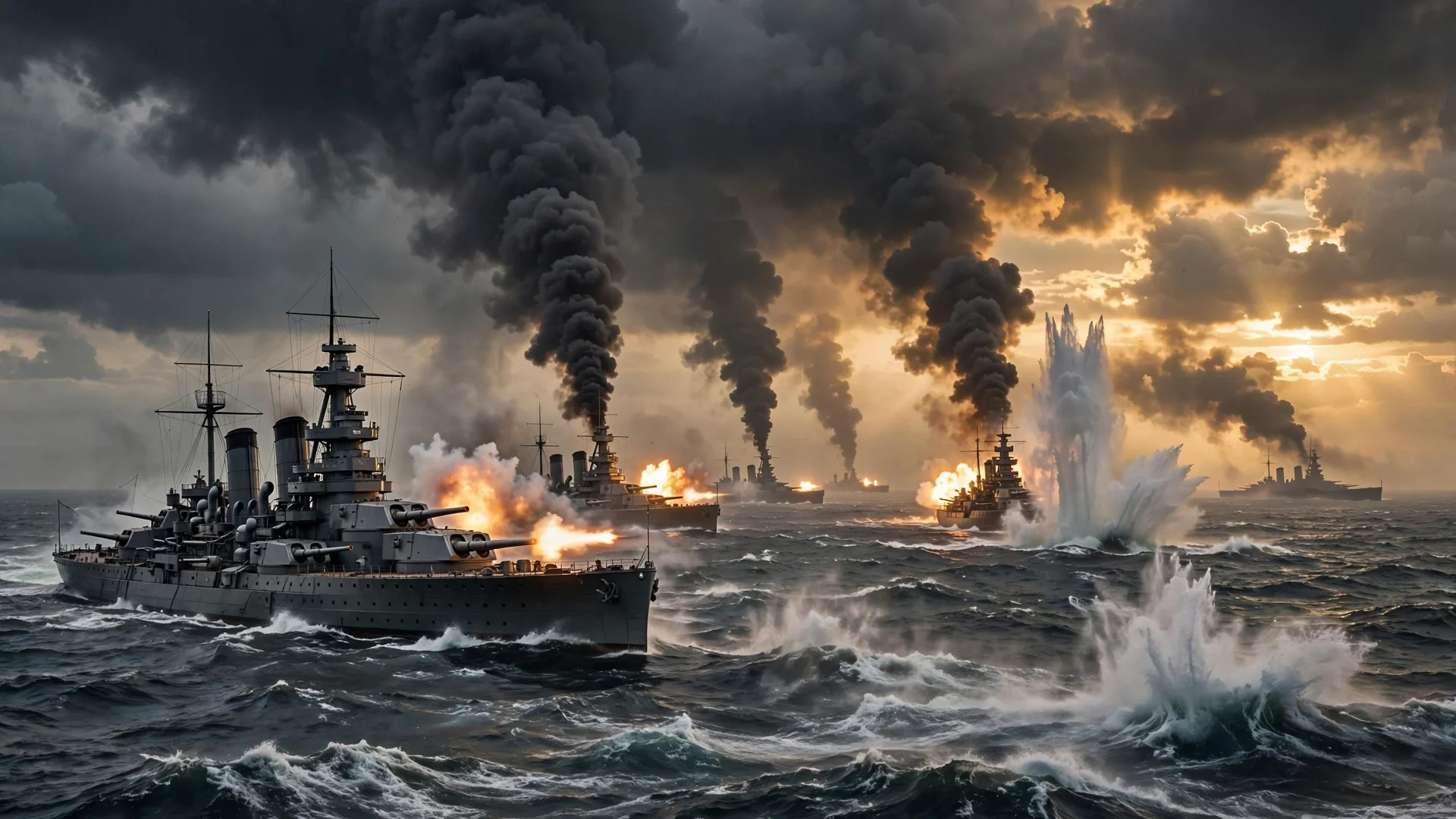
Then, on the last day of May 1916, both fleets put to sea on the same tide, neither quite knowing the other was coming. What followed over the next 36 hours was the largest naval battle in history to that point: 250 ships, 100,000 men, and a day of explosions so violent that sailors miles away felt them through the hulls of their ships. When it ended, the Germans claimed victory — and they had a case. But the British had won something better than the day. They'd won the war at sea.
Two Years of Staring: Why the Fleets Had Never Fought
To understand Jutland you have to understand the strange naval war that preceded it. Britain's strategy was simple: don't risk the fleet. The Grand Fleet was Britain's ultimate insurance policy — as long as it existed and was stronger than Germany's, the blockade held, and the blockade was slowly strangling the German economy. Losing it in one bad afternoon would be a catastrophe no victory could justify. So the British waited.
Germany's strategy was the mirror image: risk the fleet, but only on favorable terms. The High Seas Fleet couldn't beat the whole Grand Fleet — it was outnumbered roughly three to two in dreadnoughts — but it might beat part of it. The German plan, refined through 1915 and early 1916, was to lure a detached British squadron into a trap and destroy it, whittling down the British advantage piece by piece until the odds were even.
This is the essential tension of Jutland, and it's worth sitting with: both sides wanted a battle, but only on their own terms. The Germans wanted a small battle. The British wanted a big one. On May 31, 1916, each side set out to impose its version — and for a few hours, both got what they wanted. That's what made the day so chaotic, and so bloody.
There's a human detail that captures the mood. British sailors had spent two years drilling for a battle that never came. German sailors had spent two years knowing they were outnumbered and waiting for their chance. When the fleets finally sighted each other on that gray afternoon, the reaction on both sides was reportedly the same: at last.
Scheer's Trap: Lure, Ambush, Destroy
Vice-Admiral Reinhard Scheer, who'd taken command of the High Seas Fleet in January 1916, was an aggressive man with a clever plan. He would send Vice-Admiral Franz Hipper's fast battlecruisers — five of Germany's best ships — up the Danish coast toward the Skagerrak, the strait between Denmark and Norway. British battlecruisers under Vice-Admiral Sir David Beatty would come out to intercept, as they always did. And waiting over the horizon, invisible, would be Scheer's entire battle fleet: sixteen dreadnoughts ready to annihilate Beatty's detached force before the main British fleet could intervene.
It was a good plan. It nearly worked. What Scheer didn't know — couldn't know — was that the British were reading his mail. Room 40, the Admiralty's codebreaking unit, had the German naval codes, and British intelligence knew the High Seas Fleet was putting to sea. Admiral Sir John Jellicoe sortied the entire Grand Fleet: 28 dreadnoughts and a screen of cruisers and destroyers, steaming to cut off whatever the Germans were up to. So when Hipper sailed north on May 31 expecting to meet only Beatty, he was sailing into a trap of his own — with the whole Grand Fleet waiting beyond the horizon.
The result was one of history's great ironies: both admirals thought they were springing an ambush, and both were walking into one. The stage was set for the confused, violent, magnificent mess that followed.
Afternoon, May 31: Beatty Meets Hipper
The battle opened at around 3:48 p.m. with the two battlecruiser forces sighting each other. What followed was the 'Run to the South' — Hipper's five battlecruisers steaming south with Beatty's six in pursuit, both sides firing at extreme range, shells falling like slow rain. And here the Germans showed their quality: their gunnery was superb, their rangefinding excellent, and within minutes British ships were being hit hard.
Then came the disasters. At about 4:02 p.m., the British battlecruiser HMS Indefatigable — hit by shells from the German Von der Tann — exploded. Not damaged: exploded. A magazine detonation tore the ship apart, and she sank with nearly all of her crew of over 1,000 men. Twenty-three minutes later, HMS Queen Mary suffered the same fate, hit by the Derfflinger and Seydlitz: a towering column of smoke and flame, the ship breaking in two, 1,266 men dead. A handful survived.
It was at this moment that Beatty — watching two of his ships vanish in fireballs — turned to his flag captain and uttered the most famous line of the battle: 'There seems to be something wrong with our bloody ships today.' Dry understatement from a man watching a thousand sailors die. But Beatty kept chasing, and Hipper kept running south — straight toward Scheer's waiting dreadnoughts, exactly as the German plan intended.
The Trap Springs — Then Springs Shut
At around 4:40 p.m., Beatty's lookouts spotted the impossible: masts and funnels on the horizon, rank after rank of them. The entire German High Seas Fleet, sixteen dreadnoughts strong, emerging from the haze. Beatty had chased Hipper directly into Scheer's arms. In seconds, the hunter became the hunted, and Beatty ordered the 'Run to the North' — a 180-degree turn, executed under fire, to lure the Germans back toward Jellicoe's approaching Grand Fleet.
Now it was Scheer's turn to be lured. Chasing Beatty north, the Germans steamed directly into the worst position a fleet can face: Jellicoe had deployed his 28 dreadnoughts across their path in a single long line, 'crossing the T' — the classic naval maneuver where your whole line can fire broadsides while the enemy, in column, can only reply with forward guns. For a few terrible minutes, the German fleet sailed into a wall of British shellfire. Ships were hit repeatedly. The leading German dreadnoughts were smashed. Scheer, realizing he was about to lose his fleet, ordered the most famous maneuver of the battle: the Gefechtskehrtwendung, the battle turn — all his ships turning 180 degrees in succession, under fire, disappearing back into the mist they'd come from.
It was brilliantly executed — German seamanship at its finest — and it saved the High Seas Fleet from annihilation. But the pattern was set: every time the Germans advanced, they ran into the full weight of the Grand Fleet, and every time they turned away. The initiative had passed to Jellicoe, and he never gave it back.
Night: Destroyers in the Dark
As darkness fell, the great ships disengaged — dreadnoughts couldn't fight effectively at night in 1916 — but the battle wasn't over. The night of May 31 belonged to the destroyers and torpedo boats: dozens of small, fast ships probing through the dark, launching torpedoes at shadows, colliding with friend and foe alike. It was chaotic, terrifying, and largely indecisive — flashes of gunfire on the horizon, explosions, ships maneuvering blind.
Scheer used the night to do what he had to: run. His fleet steamed for home, hoping to slip past the British in the dark. Jellicoe, cautious as ever, declined to pursue aggressively — he feared mines and torpedoes in the night, and he would not risk the Grand Fleet, Britain's ultimate asset, in a blind brawl. By dawn on June 1, the Germans were gone, racing for Wilhelmshaven. The British searched empty sea. The battle was over.
The butcher's bill: Britain had lost 14 ships — including three battlecruisers and three armored cruisers — and 6,094 men killed. Germany had lost 11 ships and 2,551 men. By the crude arithmetic of ships sunk and men killed, Germany had won. The German press said so, loudly. The British press, at first, agreed — and Britain, which had expected a second Trafalgar, was plunged into gloom.
Who Really Won? The Argument of the Century
Here's the thing about Jutland: the Germans were right about the day, and the British were right about the war. Germany sank more tonnage and killed more sailors. Their ships and guns had performed superbly — German shells, armor, and damage control were all better than Britain's, a fact the exploding battlecruisers demonstrated in the most terrible way possible. Tactically, it was a German victory. No honest historian denies it.
But wars aren't won by tactics; they're won by strategy. And strategically, Jutland changed nothing for Germany and everything confirmed for Britain. The High Seas Fleet had failed in its mission — it hadn't broken the blockade, hadn't reduced British superiority, hadn't changed the naval balance by a single dreadnought. Worse, Scheer himself drew the only conclusion that mattered: on July 4, 1916, he reported to the Kaiser that the fleet could not win a surface action and that Germany's only hope at sea lay with the U-boats. The High Seas Fleet never again seriously challenged the Grand Fleet. It spent the rest of the war in port, its sailors growing mutinous, until they finally did mutiny in 1918.
Meanwhile the blockade — the whole reason the Grand Fleet existed — continued uninterrupted, slowly starving Germany of food and raw materials. Jellicoe, the cautious admiral who'd refused to risk everything for a spectacular victory, had preserved the instrument that was winning the war at sea. As Churchill later put it, Jellicoe was 'the only man on either side who could lose the war in an afternoon.' He didn't. That's his victory, and it's enough.
Why the Battlecruisers Blew Up
One question haunts Jutland more than any other: why did three British battlecruisers explode so catastrophically while German ships, hit just as hard, survived? The answer is a story of doctrine, design, and fatal shortcuts.
British battlecruisers were built for speed and firepower, with thinner armor than battleships — that was the design tradeoff, and everyone understood it. But the real killer was procedure. To achieve rapid fire, British gun crews had stacked cordite charges — the propellant — outside the protective magazines, with anti-flash doors propped open for speed. When a German shell penetrated a turret, the flash traveled straight down the open hoist into the magazine. The result wasn't a fire. It was a detonation that vaporized the ship.
The Germans had learned this lesson the hard way at Dogger Bank in 1915, when the Seydlitz nearly blew up the same way — and they'd fixed it, adding anti-flash precautions. The British hadn't learned, because their near-miss hadn't been quite near enough. After Jutland, the Royal Navy changed its procedures overnight. But for the 3,000+ men who died in those three explosions, the lesson came too late. It's one of the starkest examples in military history of how a small procedural choice — doors open for speed — can kill thousands.
What Jutland Still Teaches
Jutland is the great 'what if' of naval history, but its real lessons are quieter. First: preserve your decisive asset. Jellicoe understood that the Grand Fleet's existence was more valuable than any single victory it might win — a paradox that takes real discipline to live by. Leaders in every field face Jellicoe's choice: risk everything for the spectacular win, or protect the thing that guarantees you'll still be standing tomorrow.
Second: tactics serve strategy, not the other way around. The Germans won the gunnery duel and lost the naval war in the same 36 hours. If your tactical victories don't change the strategic picture, they're just expensive fireworks.
And third, the battlecruiser lesson: speed is not armor. In ship design as in life, the things you sacrifice for performance have a way of billing you later — all at once, catastrophically, in front of everyone. The men of the Indefatigable, the Queen Mary, and the Invincible paid that bill. The least we can do is remember why.
Jutland's lopsided butcher's bill — 6,094 British dead to 2,551 German — earns it a place in any discussion of uneven fights: see the most one-sided battles in history.
Sources
- Andrew Gordon — The Rules of the Game: Jutland and British Naval Command (John Murray, 1996) — the definitive modern account.
- John Brooks — The Battle of Jutland (Cambridge University Press, 2016).
- Forces War Records — “Remembering the Battle of Jutland” (blog.forceswarrecords.com).
- HISTORY — “Battle of Jutland, greatest naval battle of WWI, begins” (history.com).