Battle of Yarmouk 636: Six Days That Ended Roman Rule in Syria
Six days. That's all it took to end seven hundred years of Roman rule in Syria.
In August of 636, the Byzantine Empire marched the largest army it had assembled in a generation into a river valley on the edge of the Golan Heights. Waiting for them was a Muslim army from Arabia, outnumbered and far from home, led by a general his own caliph had just demoted. When the dust settled, the Byzantine army was gone. Not beaten. Gone.
This is the Battle of Yarmouk, fought from the 15th to the 20th of August, 636, near the Yarmouk River where Syria, Jordan, and the Golan Heights meet today. It decided the Muslim conquest of Syria in a single stroke, and historians rank it among the most decisive battles ever fought, because the loser never recovered.
Wait, Rome was still running Syria in 636?
Yes. And that's the first thing people get wrong. The "fall of Rome" you learned in school was the western half. The eastern half, the one historians call Byzantine, was very much alive in 636, and Syria had been Roman for roughly seven centuries, since Pompey arrived in 64 BC.
But Rome was running on fumes. Emperor Heraclius had just finished a brutal 26-year war with Persia, the superpower rivalry of the age. He'd won it brilliantly in 627 at Nineveh, marched deep into Persian territory, and brought his army home. The cost was ruinous. The treasury was empty, the provinces were bled dry, plague kept sweeping through, and the army that had beaten Persia was exhausted.
Meanwhile, something new was happening in Arabia. The Prophet Muhammad had died in 632, and under the first caliph, Abu Bakr, the Arab tribes had been united into a single community for the first time in their history. Abu Bakr's successor, Umar ibn al-Khattab, pointed that new unity outward. By 634 Muslim armies were pushing into Byzantine Syria, and that same year they beat a Byzantine force at Ajnadayn. In September 635, after a long siege, Damascus opened its gates. One of the great cities of the Roman east, gone.
Heraclius watched from Antioch. He'd had enough. In 636 he scraped together everything the empire had left: regular troops from Anatolia, Armenian contingents under Prince Vahan, Arab Christian allies under the Ghassanid king Jabalah ibn al-Ayham, even Persian defectors under Niketas, son of the old Persian general Shahrbaraz. The old Arabic chronicles say 100,000 to 200,000 men. One Roman source says 140,000. Modern historians cut those numbers hard: something like 15,000 to 40,000 effectives. Even at the low end, the biggest force Byzantium could put in the field. And it clearly outnumbered the Muslims.
The Muslims, about 24,000 to 40,000 men by the Arabic sources' own count, did the smart thing. On Khalid's advice, Abu Ubaydah pulled the Muslim garrisons out of Damascus and Emesa and concentrated everything in one defensible position: the broken country south of the Yarmouk River, with ravines at their back. They would fight one battle, all in, winner takes Syria.
The general who got fired, then won the battle anyway
Here's the part that still amazes me. Right in the middle of this campaign, the caliph Umar dismissed Khalid ibn al-Walid from supreme command and gave the army to Abu Ubaydah ibn al-Jarrah.
Think about what that takes. Khalid was the most famous general in the Muslim world, the man the Prophet himself had called the Sword of Allah, undefeated in dozens of engagements. And he stepped aside without a whisper of protest and took command of the cavalry instead. No coup. No sulking. No split in the army. If you're looking for the real reason the Muslims won at Yarmouk, you could stop reading here. An army that can change commanders on the eve of battle and not fall apart is an army that is going to be very hard to beat.
Now look at the other camp. The Byzantines had no single commander. The Armenian prince Vahan led one wing, the imperial treasurer Theodore Trithyrius held the emperor's authority, and the two men openly quarreled about strategy. The allies had their own agendas. Heraclius stayed in Antioch, far from the field, which meant nobody could overrule anybody else.
Honestly? Yarmouk was half decided before a sword was drawn. One army had unity of command. The other had a committee.
Six days in the valley: what actually happened at the Battle of Yarmouk
The armies faced each other across the plain south of the Yarmouk for weeks, skirmishing and negotiating, before the real fighting started on the 15th of August. What follows comes mostly from the Arabic chronicles, written a century or more after the fact, so treat the day-by-day detail the way you'd treat a veteran's war stories: the shape is true even where the edges are polished.
Day one was champions and probes. Single combats between famous warriors, the ritual showing-off both armies did before the real thing, then Vahan sent his infantry forward to test the Muslim lines. The lines held. Both sides took each other's measure.
Day two was the Byzantine high-water mark, and it nearly ended the battle. Vahan launched a full assault across the front. His heavy infantry pinned the Muslim center while his cavalry smashed into the Muslim right wing and broke it. The wing crumpled. Men ran for the camp.
And this is where the sources give us one of the great scenes of early Islamic history. The Muslim camp followers, women and servants, grabbed tent poles and camel sticks and stood in the path of the fleeing soldiers, shouting them back into the line. It worked. The men turned around. Khalid, meanwhile, had kept his elite mobile guard in reserve, and he threw it at the breakthrough like a fire brigade. The line was restored by nightfall. If the Byzantines had pressed that advantage instead of pulling back to their camp, the story might have a different ending.
Days three and four were grinding attrition, attack and counterattack under arrow storms thick enough that the sources still remember them. Ikrima ibn Amr, a companion of the Prophet who had once fought against the Muslims and spent years trying to atone for it, took an oath with about 400 men to fight to the death rather than retreat. The Arabic sources say he kept it. Whether the number is exact or not, Muslim losses were real and heavy: around 4,000 dead by their own count, which on an army that size is a wound you feel.
On the fifth day, Vahan asked for a truce of a few days to let fresh troops arrive. Khalid refused. He'd been watching the Byzantine attacks lose steam, and he made the call that won the battle: stop defending. That night he reorganized his cavalry into a single striking force, some 8,000 horsemen with his mobile guard as the core, and planned an attack for the morning.
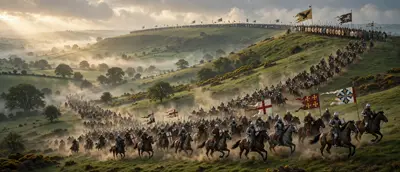
The sixth day, the 20th of August, is Khalid's masterpiece. He opened with a general assault along the whole Byzantine front to fix them in place. Then the cavalry went wide. Around the Byzantine left flank, into their side and rear. The Byzantine left collapsed inward onto its own center. Vahan tried to rally his horsemen. Too slow. Khalid's riders were already among them.
Then the trap closed. The Byzantines were driven westward toward the Wadi-ur-Raqqad, a ravine system some 200 meters deep with almost no crossings. The one bridge that mattered was gone. Ayn Dhakar, in Muslim hands. With their cavalry gone and their retreat cut, the Byzantine infantry had nowhere to go. Thousands died in the ravines. The Arabic chronicles put Byzantine dead at 70,000 to 120,000, which is almost certainly inflated, but modern estimates still say 50,000 or more, a catastrophic loss. A dust storm blew across the field on that final day, straight into Byzantine faces. Or so the sources say. When the sun went down, the imperial army of the East was gone.
How does the smaller army keep winning like this?
You've probably wondered this by now, because the pattern repeats everywhere Khalid fought. Here's the thing: Yarmouk wasn't won by courage, both sides had plenty. It was won by three unglamorous advantages.
First, ground. Khalid picked a battlefield with ravines guarding his own position and then used those same ravines as a killing ground for the enemy's retreat. The Byzantines attacked uphill into prepared lines for five days and had a cliff at their backs on the sixth.
Second, the reserve. The mobile guard, Khalid's elite cavalry, was the only real reserve on the field. Every time the Byzantines broke through, and they broke through more than once, the guard plugged the hole. On day six it became the hammer. The Byzantines, with their divided command, never managed the same trick.
Third, the uncomfortable truth for anyone who loves an underdog story. The numbers lie. The old chronicles' 100,000-plus Byzantine host is almost certainly fantasy. Modern historians put the real odds far closer. Two to one at most. Still an advantage, but not the cartoon mismatch of legend. Khalid didn't beat ten-to-one odds. He beat a bigger, clumsier, divided army on ground he'd chosen. That's more impressive, not less.
And one more thing worth saying plainly: the Ghassanid defection hurt. Jabalah's Arab allies, Christians fighting for a Christian emperor against fellow Arabs, melted away during the battle. Some sources say whole contingents deserted. An army is only as loyal as its cause, and the cause wasn't holding.
Why should you care about a battle from 636?
Because the map you live with was drawn that week.
Within a year of Yarmouk, there was no Byzantine Syria left to defend. The cities opened their gates one by one. In 637 Jerusalem surrendered, and the caliph Umar traveled from Medina in person to accept it, signing a pact with the Patriarch Sophronius that guaranteed the city's Christians their lives, their churches, and their property. Read that pact sometime. For the seventh century, it's a remarkable document.
Then Egypt fell, between 639 and 642, and North Africa followed. Heraclius, the emperor who had saved the empire from Persia, died in 641, broken, having watched his life's work undone in five years. His reported farewell as he left Syria for the last time, "Peace be upon thee, O Syria," is one of the saddest lines in all of history. He knew he was never coming back, and he was right.
Think about the scale of it. Syria had been Roman since Pompey arrived in 64 BC, seven centuries of Greek-speaking cities and Christian faith. After Yarmouk, the Levant's future would be Arabic and Islamic, and it still is, nearly fourteen hundred years later. Very few battles get to claim they redirected a civilization. This one can.
That's why military historians put Yarmouk on the shortest of short lists, next to Tours and Manzikert. Lose at Yarmouk and the Muslim expansion probably stalls at the desert's edge. Win, and the whole eastern Mediterranean changes hands.
The honest downside: what we don't actually know
I want to be straight with you, because this article would be dishonest without it. Almost everything you just read comes from one side.
The detailed narrative, the six days, the tent poles, the bridge at Ayn Dhakar, comes from Arabic chronicles written a hundred years or more after the battle, by scholars working from oral tradition. The Byzantine sources barely mention Yarmouk at all, which tells its own story about how traumatic the defeat was, but it leaves us with no independent check. The troop numbers are inflated on both sides. The speeches are reconstructed. And the day-by-day choreography may be tidier than the chaos it describes.
The outline is solid: date, place, commanders, outcome. Historians who spent careers on this accept the core. But if anyone tells you they know exactly what Khalid said on the morning of the 20th, they're selling you something.
And one more honest note. For the Christians of Syria, Yarmouk was a catastrophe. Their cities ended in that valley. Their churches. Their whole Roman world. The conquest that followed was, by the standards of the age, restrained. Umar's pact with Jerusalem proves it. But "restrained for the seventh century" still meant an empire falling on people's heads. History's turning points are always someone's disaster. Worth remembering.
So what do you do with a battle like this? Start with the ground. Pull up a satellite map of the Yarmouk River valley, find the deep cut of the Wadi-ur-Raqqad west of the battlefield, and look at the one bridge at Ayn Dhakar. Then imagine 8,000 horsemen coming around your flank with that ravine at your back. You'll understand Yarmouk faster than any book can teach it.
If you want the book anyway, Walter Kaegi's Byzantium and the Early Islamic Conquests is the serious one, dense but fair to both sides. And if you want to see what happened the next time Byzantium faced an eastern army it couldn't stop, read our guide to Manzikert, 1071, where the empire lost Anatolia the way it lost Syria here.
Frequently Asked Questions
Straight answers, no hedging.
The short definition: the Battle of Yarmouk (15 to 20 August 636) was a six-day battle near the Yarmouk River in which Khalid ibn al-Walid's Rashidun army destroyed the Byzantine Empire's field army, ending seven centuries of Roman rule in Syria and opening the Levant to the Muslim conquests.
That's 44 words, and if you remember nothing else, remember that.
Who won the Battle of Yarmouk?
The Rashidun Caliphate, decisively. Over six days in August 636, Khalid ibn al-Walid's army broke the Byzantine field army near the Yarmouk River and destroyed it in the ravines of the Wadi-ur-Raqqad. Byzantine Syria, held by Rome for seven centuries, fell within the year. The Muslim dead numbered about 4,000 by Arabic counts; Byzantine losses were catastrophic, with modern estimates at 50,000 or more.
How big were the armies at Yarmouk?
The old Arabic chronicles claim the Byzantines fielded 100,000 to 200,000 men against 24,000 to 40,000 Muslims. Modern historians sharply discount both figures, estimating roughly 15,000 to 40,000 on each side, with the Byzantines still holding the larger force. Either way, Khalid was outnumbered. He still chose to give battle on ground of his own picking.
Who was Khalid ibn al-Walid?
The Muslim field commander at Yarmouk, called the Sword of Allah by the Prophet Muhammad himself. He had fought against the Muslims before his conversion, then never lost a battle afterward, in dozens of engagements across Arabia, Persia, and Syria. At Yarmouk he served under Abu Ubaydah after the caliph Umar reassigned supreme command, accepted the demotion without protest, and still directed the battle through his elite mobile guard. He died in 642, and tradition says his only regret was dying in bed instead of on a battlefield.
Why is Yarmouk called one of history's most decisive battles?
Because the loser never came back. Byzantium lost its entire field army. Within a few years, Syria and Palestine, then Egypt, provinces held for centuries, were gone too. The victory opened the Levant to fourteen centuries of Islamic civilization. Unlike most great battles, Yarmouk didn't just move a border; it changed the Middle East's religion and culture permanently.
Related Battles
Hungry for more? These are worth your time: