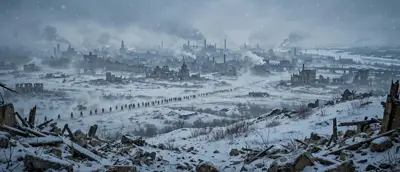
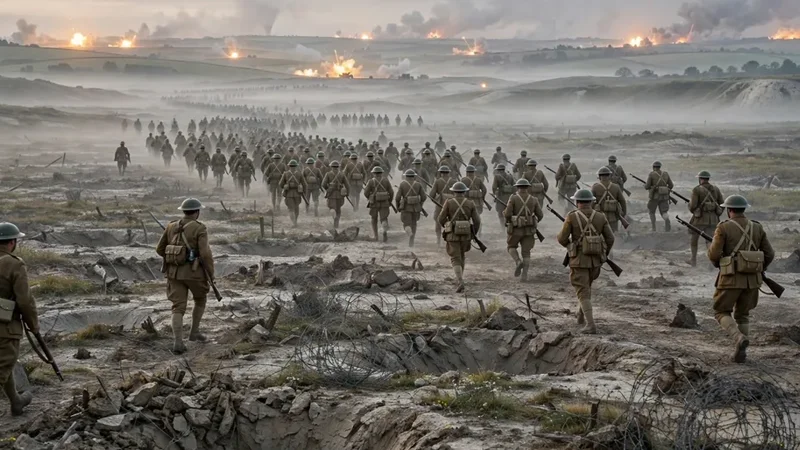
Two million people. That is the casualty count for a single battle, Stalingrad, fought over five months in 1942 and 1943. It is a number so large it stops meaning anything, until you realize it represents more deaths than many countries suffered in the entire war. This list ranks the 15 bloodiest battles in human history by total casualties, from a Civil War cornfield to the frozen streets of Berlin. Every entry links to a deeper guide where one exists on this site.
How This List Was Made
A quick honesty check before the ranking. Casualty figures for battles are estimates, and historians argue about them constantly. Ancient numbers are the shakiest. Even modern ones vary because armies counted differently, records were destroyed, and civilian deaths blur into battle deaths during sieges. I have used the most widely cited ranges and noted where the uncertainty is largest. The order is by total casualties, killed plus wounded plus missing, both sides combined.
One more thing. This list skews modern, and that is not an accident. Industrial weapons killed on a scale that swords and spears never could. A single day of artillery in 1916 could do what took ancient armies a whole campaign. Keep that in mind as the numbers climb.
15. The Battle of Antietam, 1862 , ~23,000 casualties
September 17, 1862, remains the bloodiest single day in American history. In about twelve hours of fighting around Sharpsburg, Maryland, roughly 23,000 men were killed or wounded. For perspective, that is more than twice the American dead on D-Day, in a single day, in a single county. Read the full Antietam guide here. The cornfield changed hands six times. By nightfall, the dead lay in rows where the wheat had stood that morning, and Lincoln used the narrow Union victory to issue the Emancipation Proclamation five days later.
14. Iwo Jima, 1945 , ~28,000 casualties
Thirty-six days for eight square miles of volcanic rock. The US Marines lost 6,821 killed, the Japanese garrison of about 21,000 was virtually wiped out. The flag-raising on Mount Suribachi became the most reproduced image of the Pacific War. Read the full Iwo Jima guide here. Of the 21,000 Japanese defenders, only about 200 were taken prisoner. Twenty-seven Medals of Honor were awarded for Iwo Jima, more than for any other single battle in American history.
13. Gettysburg, 1863 , ~51,000 casualties
Three days in Pennsylvania that decided the American Civil War. Pickett's Charge alone cost the Confederacy over 6,000 men in under an hour. Lee's army never fully recovered. Read the full Gettysburg guide here. The town's population was 2,400. The casualties were twenty times that. Farmers spent months burying the dead in shallow graves, and the stench, survivors wrote, never fully left their memory.
12. Cannae, 216 BC , ~70,000 casualties
The ancient entry, and pound for pound the most lopsided. Hannibal's double envelopment annihilated a Roman army of 80,000 in a single afternoon. Rome lost a fifth of its military-age men in hours and kept fighting anyway, which tells you something about Rome. Read the full Cannae guide here. The Roman dead were so numerous that, according to Livy, Hannibal's men collected the gold rings of fallen Roman nobles by the bushel. Rome refused to ransom prisoners or negotiate, and simply raised new legions.
11. The Bulge, 1944-45 , ~180,000 casualties
Hitler's last gamble in the Ardennes cost America 80,000 casualties, its bloodiest battle of World War II, and Germany about 100,000 it could not replace. Bastogne held. The offensive died in the snow. Read the full Bulge guide here. The fighting happened in the worst winter Europe had seen in decades, with frostbite rivaling bullets as a killer. Entire units disappeared into the snow and were not found for weeks.
10. Passchendaele, 1917 , ~500,000 casualties
Three months of fighting in a drowned Flemish swamp for a few miles of mud. The name became shorthand for futility. British and German casualties each ran into the hundreds of thousands. Read the full Passchendaele guide here. The battlefield's drainage systems were destroyed by shelling, turning Flanders clay into a swamp that swallowed men, horses, and tanks whole. Some soldiers drowned in mud.
9. Verdun, 1916 , ~700,000 casualties
The German plan was explicit: bleed France white by attacking a position it could not abandon. Ten months of artillery turned the battlefield into a moonscape. France held, at a price that scarred a generation. Read the full Verdun guide here. The French rotated units through Verdun so the horror would be shared, a policy that meant nearly every French soldier in the war served there. The ossuary at Douaumont holds the bones of 130,000 unidentified dead.
8. Kursk, 1943 , ~800,000 casualties
The largest tank battle in history and Germany's last strategic offensive in the east. The Soviets knew it was coming, built defenses in depth, and broke the Wehrmacht's armored spearhead. After Kursk, Germany never attacked in the east again. Read the full Kursk guide here. At Prokhorovka on July 12, hundreds of tanks fought at point-blank range in a swirling melee often called the largest tank battle ever. The Germans lost the strategic initiative in the east permanently.
7. The Somme, 1916 , ~1,000,000 casualties
The first day alone, July 1, 1916, cost Britain 57,470 casualties, the worst day in British military history. The battle ground on for four and a half months. A million men for six miles of ground. Read the full Somme guide here. The British Army's volunteer battalions, pals who had enlisted together from the same towns and factories, were wiped out as units. Whole streets in northern England lost a generation in a morning.
6. Berlin, 1945 , ~1,000,000 casualties
The final act: Soviet armies storming the German capital street by street while Hitler killed himself in a bunker below. Military and civilian dead together approached a million. The war in Europe ended in the rubble. Soviet artillery fired over a million shells in the opening barrage alone. In the ruins, teenage Hitler Youth and old men of the Volkssturm fought Soviet veterans street by street.
5. Leningrad, 1941-44 , ~1,000,000+ casualties
An 872-day siege, one of the longest in history. The Germans tried to starve the city out. Perhaps a million civilians died of hunger and cold, a toll that dwarfs the military fighting. Leningrad never surrendered. During the worst winter, the daily bread ration fell to 125 grams, mostly sawdust. People ate wallpaper paste, leather, and, in the darkest cases, each other. The city held.
4. Moscow, 1941-42 , ~1,000,000 casualties
Germany's drive on the Soviet capital stalled in the mud, then the snow, then a Soviet counteroffensive. It was the first time the Wehrmacht had been stopped cold, and the myth of German invincibility died in the Russian winter. German soldiers, still in summer uniforms, froze in their foxholes as temperatures hit minus 40. The Soviet counterattack on December 5 used fresh Siberian divisions trained for exactly this weather.
3. The Brusilov Offensive, 1916 , ~1,500,000 casualties
The most successful Allied offensive of World War I and one of the least remembered in the West. Russia's Brusilov shattered Austro-Hungarian armies across a broad front. The cost was staggering on both sides, and it broke Russia's army as a fighting force, helping trigger revolution the next year. Brusilov's innovation was attacking along a broad front instead of one point, which the Austrians could not reinforce everywhere at once. It worked brilliantly and broke his own army doing it.
2. Operation Bagration, 1944 , ~1,000,000 casualties
Timed to coincide with D-Day, the Soviet summer offensive of 1944 destroyed an entire German army group, Army Group Centre, in weeks. Germany lost more men in Bagration than at Stalingrad. In the West we remember Normandy. In the East, this was the hammer blow. The Germans were so convinced the main Soviet blow would fall in Ukraine that they ignored the buildup in Belarus entirely. When Bagration hit, Army Group Centre simply ceased to exist.
1. Stalingrad, 1942-43 , ~2,000,000 casualties
The deadliest battle in human history. Five months of urban combat, building by building, room by room, in a ruined city on the Volga. The German Sixth Army was encircled and destroyed. Roughly two million soldiers and civilians were killed, wounded, or captured. It broke the back of the German army in the east, and nothing after it was ever the same. Read the full Stalingrad guide here. At the Barrikady factory, the front line ran through the building itself, Germans on one floor, Soviets on another. When the Sixth Army surrendered in February 1943, 91,000 starving men marched into captivity. Fewer than 6,000 ever saw Germany again.
Why Ancient Battles Look Smaller (But Weren't)
You might have noticed something odd about this list. Cannae, the ancient entry, sits at number 12 with 70,000 dead, while industrial battles run into the millions. Does that mean ancient warfare was less deadly? Not exactly. It means ancient armies were smaller.
At Cannae, Rome lost perhaps a fifth of its entire military-age male population in a single afternoon. Scale that to a modern nation and the equivalent would be millions. The ancient world could not field million-man armies, but it could absolutely destroy the ones it had. When historians call Cannae one of the worst military disasters ever, they mean it proportionally. Rome survived because its system for raising new armies was unmatched, not because the loss was small.
The same logic applies in reverse to the modern entries. The Somme's million casualties came from armies of millions, sustained by railways, factories, and entire economies mobilized for war. Industrial warfare did not just kill more efficiently. It made killing sustainable, month after month, which is arguably worse. A battle that ends in a day, however bloody, at least ends.
What the Bloodiest Battles Have in Common
Look at the list and a pattern jumps out. The deadliest battles were not decided by genius. They were decided by attrition, by two sides feeding men into a meat grinder neither could afford to leave. Stalingrad, Verdun, the Somme, Passchendaele: all of them were battles where the strategic prize was questionable and the human price was certain.
The second pattern is technology outrunning tactics. The Somme's generals ordered men to walk at German machine guns because that was how wars had always been fought. It took years for tactics to catch up with industrial firepower, and the tuition was paid in lives.
Honestly, the deepest lesson is the simplest. Every one of these battles was avoidable in hindsight and seemed unavoidable at the time. That gap, between what leaders believed and what was true, is where the millions died. Remembering these battles is not about glorifying them. It is about understanding exactly how the worst days in human history happen, so we can recognize the pattern before the next one starts.
Frequently Asked Questions
What was the bloodiest battle in history?
The Battle of Stalingrad (1942-1943) is generally considered the bloodiest battle in history, with around 2 million total casualties including soldiers and civilians. It was the turning point of World War II on the Eastern Front.
What was the bloodiest battle in one day?
The Battle of Antietam on September 17, 1862, was the bloodiest single day in American history with about 23,000 casualties. In ancient history, Cannae in 216 BC saw perhaps 70,000 Romans killed in a single day.
Was Stalingrad bloodier than the Somme?
Yes, by a wide margin. Stalingrad cost roughly 2 million casualties over five months, while the Somme cost about 1 million over four and a half months. Both were catastrophes, but Stalingrad's urban fighting and civilian toll put it in a class of its own.
Why were World War I battles so bloody?
Industrial firepower, machine guns, artillery, and poison gas, met 19th-century tactics: massed infantry attacks against prepared defenses. Generals kept ordering frontal assaults long after the technology made them suicidal. The Somme, Verdun, and Passchendaele were the result.
Sources
- Britannica: https://www.britannica.com/topic/list-of-battles
- Wikipedia: https://en.wikipedia.org/wiki/List_of_battles_by_casualties
- National WWII Museum: https://www.nationalww2museum.org/