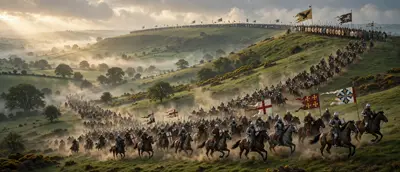
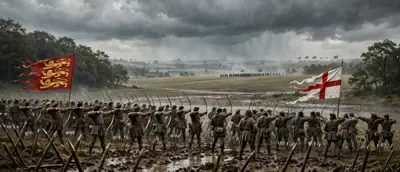
Why was the Battle of Hastings important? Because it was the day England got a new everything: a new king, a new ruling class, a new language, a new legal order — and it all came down to nine hours on a muddy hill in Sussex on October 14, 1066. One battle doesn't usually rewrite a country. This one did, because William of Normandy didn't just win a fight. He stayed. He counted every pig in the kingdom (literally — the Domesday Book logged livestock), taxed it, fortified it, and married it to France. Nine hundred and sixty years later, you're still speaking his French every time you order beef. Browse more Medieval Warfare battles to see how the age unfolded.
> ### ⚡ TL;DR — Why Hastings Still Matters, in 30 Seconds
> - On October 14, 1066, William of Normandy killed Harold II and ended Anglo-Saxon England in a single day of battle.
> - According to Wikipedia's summary of the Norman Conquest, William confiscated the lands of the resisting English elite, handed them to his Norman barons, and built castles — including the White Tower of the Tower of London — to hold the country down.
> - The French of William's court fused with Old English and became Middle English — the ancestor of the English you're reading right now.
> - The Domesday survey of 1086, ordered by William, recorded nearly every settlement, field, and animal in the kingdom — medieval history's most thorough census.
> - It was the last time England was successfully invaded. Ever.
The Battle of Hastings was the Norman Conquest's decisive battle, fought on October 14, 1066, on Senlac Hill near Hastings, England. William, Duke of Normandy defeated and killed Harold II, the last Anglo-Saxon king. William's victory ended 600 years of Anglo-Saxon rule and launched a transformation of England's government, language, land ownership, and architecture that lasted for centuries.
The Road to Hastings: Three Claimants, One Empty Throne
January 1066. Edward the Confessor — the childless king of England — dies. Within days, the Witenagemot, the council of England's nobles, crowns Harold Godwinson, the most powerful earl in the land. Problem: two other men think the throne is theirs.
First, William, Duke of Normandy. William claimed Edward had promised him the throne years earlier — and that Harold himself had sworn on holy relics to back William's claim. The Bayeux Tapestry shows that oath scene in needlework: Harold with his hands on the reliquaries. Was the oath real, or Norman storytelling after the fact? Historians still argue. What nobody argues is that William treated it as a broken sacred promise — and a broken promise to a pope-backed duke was a cause for invasion. Pope Alexander II even gave William a papal banner, which turned a land grab into something that looked like a holy mission.
Second, Harald Hardrada of Norway — the last great Viking warlord, a man who had fought from Byzantium to Sicily and lived to spend the loot. He landed in the north in September with around 200 ships, smashed the English northern army at Fulford on September 20, and occupied York.
Harold had about three weeks to save his kingdom twice. He force-marched his army 190 miles north in four days — a pace that would have broken most medieval armies — and on September 25 caught the Norwegians off guard at Stamford Bridge. Hardrada died there. Harold's brother Tostig, who had invited the Norwegians in, died there too. One rescue down, one to go.
Then Harold got the news every commander dreads: William had landed at Pevensey on September 28, unopposed, because the English fleet had been driven off by storms. So Harold turned around and marched south — roughly 240 miles in about twelve days, per the historian's accounting at historytools.org — gathering what men he could along the way, leaving a third of his strength in the north to watch the coast. He arrived at Senlac Hill on October 13 with an army that had just fought one battle, marched the length of the country twice, and hadn't properly rested in three weeks.
October 14, 1066: Nine Hours on Senlac Hill
Dawn on Senlac Hill: two armies of roughly equal size — modern estimates put both somewhere between 7,000 and 8,000 men, though the chroniclers all disagreed and we'll never have exact numbers. But "equal size" is where the equality ended.
Harold's English were almost entirely infantry. The backbone was the housecarls — professional household warriors with the long Danish axe, a weapon that could take a man's head or a horse's leg in one swing — stiffened by the fyrd, the county levies: farmers and townsmen with spears and shields, brave but part-time. Harold had almost no archers and no cavalry to speak of.
William's force was the combined-arms army of the future: archers to soften, heavy infantry to grind, and armored cavalry — the Norman knights — to strike. About 2,200 cavalry, 1,700 archers, and 4,500 infantry, per the commonly cited breakdown.
Harold took the high ground — Senlac Hill — and locked his men into a shield wall: shields overlapping, spears out, a hedge of wood and iron that cavalry couldn't break head-on. And for hours, it worked. The battle ran from about 9 in the morning to dusk, and the Normans kept throwing themselves at the wall and bouncing off. At one point a rumor spread that William was dead; William had to ride bareheaded along his lines, shouting that he was alive, to stop a rout. That's how close it was.
Then came the moments that decided it.
Turning Points: Three Moments That Decided Hastings
1. The feigned retreats. When the frontal assaults failed, Norman units began wheeling away in apparent panic — and the English line broke discipline and chased them downhill. Once the shield wall opened gaps, the Norman cavalry turned and cut the pursuers down. Was every retreat a deliberate trick, or did some start as real panics that turned into opportunities? The sources suggest a bit of both. Either way, it was the only move that worked against the wall, and Harold's less-disciplined fyrd paid for the lesson in blood.
2. The afternoon arrow storm. With the wall thinning, William ordered his archers to shoot high, dropping arrows down onto the packed English ranks from above the shield line. It's the kind of adjustment that looks obvious in hindsight and was brutally effective in the moment.
3. The death of Harold. Late in the day, Harold was killed. How? The Bayeux Tapestry's most famous panel shows a figure with an arrow in his eye beneath the words about Harold being slain — and for 900 years that's been the story: the king felled by a stray arrow. But the needlework may have been altered later (some art historians think the arrow is a later addition), and a near-contemporary account says Norman knights hacked Harold down and mutilated the body. Here's the honest answer: we'll never know exactly which weapon ended him. What we know is that when the king fell, the shield wall fell with him. The English broke. William held the field at dusk.
---
> ### ⚔️ A New Epic Battle Every Day
> Love military history? Subscribe to Echoes of Battle on YouTube (@EchoesOfBattleHistory) — a new epic battle every day, cinematic and free.
> Want the blow-by-blow battle narrative? Read our companion piece: Battle of Hastings 1066 Summary: How William Conquered England in One Day.
---
Why the Battle of Hastings Was Important: 5 Ways 1066 Remade England
So why was the Battle of Hastings important? Here's the plain answer: most battles change who sits on the throne. Hastings changed what the throne sat on.
1. It killed Anglo-Saxon England — the whole ruling class, not just the king.
When William took the crown on Christmas Day 1066, he didn't just replace Harold. He replaced the aristocracy. The lands of the English elite who resisted were confiscated and handed to Norman barons — men with French names who owed William everything. Within a generation, England's landowners spoke French, prayed in Norman-built churches, and answered to a king across the Channel. The Anglo-Saxons didn't vanish — the farmers, the craftsmen, the language on the street survived — but they stopped ruling anything. That's why historians treat 1066 as a hard line through English history, not a footnote.
2. It rewired the English language — the one you're reading.
Before 1066, English was a Germanic tongue: Beowulf, not Shakespeare. After Hastings, the court, the law, and the church spoke French, and roughly 10,000 French words seeped into English over the following centuries — court, justice, government, beauty, beef. (That last one is my favorite illustration: the English peasant raised the cow; the Norman lord ate the beef — boeuf. Two words for one animal, split by class.) Old English plus Norman French became Middle English, the language of Chaucer — and the reason modern English has the biggest vocabulary of any language on earth. You literally cannot talk about law, war, food, or fashion in English without speaking Norman French.
3. It built the first bureaucratic superpower in Western Europe.
Twenty years after Hastings, William ordered the Great Survey — the Domesday Book, completed in 1086. Royal commissioners fanned out across the kingdom and recorded nearly every settlement: who held what land, how many ploughs, how many pigs, what it was worth. No medieval ruler had ever counted his kingdom like this. It was a taxman's dream and a peasant's nightmare — and it's the single most detailed snapshot of any medieval society we have. Hastings made England governable in a way it had never been.
4. It gave England castles, cathedrals — and a king with a foot in France.
The Normans were builders the way the Anglo-Saxons never were. To hold a conquered country with a small occupying elite, William planted castles on every strategic hill: the Tower of London's White Tower, begun under William, is still standing. Norman Romanesque cathedrals — Durham, the rebuilt Canterbury — stamped a new architectural order on the land. And because William remained Duke of Normandy, England was suddenly yoked to the Continent: English kings would spend the next 400 years fighting, marrying, and scheming in France. Before 1066, England had looked north, toward Scandinavia. After, it looked south — toward Europe, and eventually toward empire. If you want the medieval chapter of that story on the battlefield, our Battle of Agincourt 1415 summary picks up the thread 350 years later.
5. It was the last successful invasion of England. Full stop.
No foreign army has conquered England since 1066. The Spanish Armada failed. Napoleon never crossed. Hitler's invasion barges rusted in French ports. There's a straight argument — made by military historians James Lacey and Williamson Murray in Moment of Battle — that Hastings flipped England's strategic direction: "from the time of the Conquest, English armies were far more likely to tread on the Continent than the other way around." The country that got invaded became the country that did the invading. That's not a small legacy for one day's fighting.
What If Harold Had Won?
Here's the counterfactual worth taking seriously. What if the shield wall had held until dusk and William's army — hungry, far from its ships — had broken?
First, a dose of cold water: Harold would have had to win a THIRD battle in three weeks. His army was exhausted, his housecarls dead in large numbers, and William still had reinforcements waiting in Normandy. A Harold victory at Hastings probably wouldn't have ended the war — it would have paused it.
But suppose Harold pulls it off and dies of old age as Harold II. England stays Anglo-Saxon: Germanic language unmixed, no Norman castles, no Domesday Book, no French-speaking aristocracy. The English crown stays oriented toward Scandinavia, not France. And here's the deeper what-if: without the Norman administrative machine — the centralized, counting, taxing state William built — does England develop the bureaucratic muscle that later funded the Royal Navy and the empire? Maybe a Saxon England stays a rich, insular, second-tier kingdom, like a bigger Denmark. The modern world — English as the global language, common law in half the world's courtrooms — runs through Norman institutions. It's the ultimate proof of why the Battle of Hastings was important: remove it, and the modern world looks different.
What's Overrated — and What's Underrated — About Hastings
Every famous battle gets a mythology. Here's my honest audit.
Overrated: Hastings as a military masterclass. Strip away the romance and the Normans simply had the better army — combined arms beats a shield wall the way a toolbox beats a hammer. William didn't out-general Harold so much as out-resource him. The real military miracle of 1066 was Harold's: marching 190 miles north, destroying Hardrada at Stamford Bridge, then marching 240 miles south to fight again. If you want the genius campaign of 1066, look at the loser.
Underrated: Hastings as an administrative revolution. Nobody makes a movie about the Domesday Book. But that survey — the counting, the recording, the centralization — is what turned a battlefield victory into a thousand years of consequences. Battles are won by armies; countries are won by clerks. William understood both, and it's the clerks we underestimate.
Also underrated: how close it was. A rumor of William's death nearly collapsed the Norman army mid-battle. If that rumor had stuck — if William hadn't dramatically pulled off his helmet and ridden the line — we'd be writing a very different article today.
Hastings vs. Manzikert: The Same Five Years, Opposite Fates
Here's a comparison you won't find in the standard Hastings explainers. Five years after Hastings, in 1071, the Byzantine Empire lost the Battle of Manzikert to the Seljuk Turks. Two battles, five years apart, both epochal — but in opposite directions.
At Hastings, the loser died and his state was absorbed by the winner's machine. The conquest was total because William had a plan for the day after: castles, clerks, coronation. At Manzikert, the Byzantine emperor Romanos IV was captured, not killed — and then his own people blinded and deposed him. The defeat became a catastrophe not because of the battlefield losses but because the empire tore itself apart afterward.
The comparison reveals the real lesson: battles don't change history. What the winners do the morning after changes history. William woke up on October 15 and started building a state. The Byzantines woke up after Manzikert and started a civil war. Same five years, opposite fates — decided not by tactics but by follow-through. This is the deeper reason why the Battle of Hastings was important: not the nine hours of fighting, but the centuries of administration that followed.
What the Sources Tell Us (and What They Don't)
Honesty box, because 1066 is a hall of mirrors. Almost everything we know comes from people with an agenda. The Bayeux Tapestry — 68 meters of embroidered storytelling, 626 figures, 202 horses, even Halley's comet — was commissioned by William's half-brother Odo of Bayeux. It's Norman propaganda in wool, magnificent and suspect in equal measure. William of Poitiers, William's chaplain, wrote the official Latin history — from Normandy, without having been at the battle.
The English side left almost nothing contemporary — the Anglo-Saxon Chronicle's entries for 1066 are terse, written by the defeated. Force sizes? Every number you've read is an educated guess; the chroniclers disagreed and modern historians still do. Harold's death by arrow? Possibly true, possibly a later embellishment on the Bayeux Tapestry. What we have is a story told almost entirely by the winners, embroidered — literally — by the winners' needleworkers. Keep that in mind, and 1066 gets more interesting, not less.
Frequently Asked Questions
Why was the Battle of Hastings important?
Because it ended Anglo-Saxon England and launched the Norman Conquest — the last successful invasion of England. In its wake came a Norman king, a French-speaking aristocracy, the feudal land system, castles and cathedrals, the Domesday survey, and a French-English hybrid language. No single day in English history changed more.
How did the Battle of Hastings change England?
It replaced the entire ruling class with Norman barons, introduced the feudal system of landholding, made French the language of court and law (fusing with Old English into Middle English), centralized royal administration (culminating in the Domesday Book of 1086), dotted the country with castles, and permanently tied England to continental Europe.
Who won the Battle of Hastings, and how did Harold die?
William, Duke of Normandy won — decisively. Harold II, the last Anglo-Saxon king, was killed late in the day. Tradition, following the Bayeux Tapestry, says an arrow struck him in the eye; some historians note the arrow may have been added to the embroidery later, and a near-contemporary account describes him being cut down by Norman knights. Either way, his death broke the English line.
When was the Battle of Hastings, and when was William crowned?
The battle was fought on October 14, 1066, on Senlac Hill near Hastings in Sussex. After securing London, William was crowned King of England on Christmas Day — December 25, 1066 — at Westminster Abbey, though rebellions against his rule continued for several years.
Sources
- The Bayeux Tapestry (Musée de la Tapisserie de Bayeux) — the near-contemporary embroidered narrative of 1066
- James Lacey & Williamson Murray, Moment of Battle: The Twenty Clashes That Changed the World (2013)
- Marc Morris, The Norman Conquest (2012)
- The Anglo-Saxon Chronicle — contemporary English annals for the year 1066
- Encyclopaedia Britannica, "Battle of Hastings" and "Norman Conquest"