Why was the Battle of Saratoga important? Here is the short answer: in October 1777, the Continental Army forced an entire British army — over five thousand men, with all its guns — to surrender in upstate New York. It was the first time that had ever happened. And it changed everything, because that single piece of news is what finally convinced France to join the American Revolution. French money, French soldiers, and above all the French navy poured into the fight, turning a shaky colonial rebellion into a world war that Britain could not win.
Ask yourself why the Battle of Saratoga was important and you get more than a trivia answer. You get the story of a British plan that looked brilliant on paper, an American general who was brilliant in spite of himself, and a hero of the hour who would later become the most hated name in American history. Let's tell it properly.
The Plan: Cut America in Half
By the summer of 1777, the British war machine had a problem. It had beaten George Washington's army repeatedly around New York, but beating an army isn't the same as winning a war — not when the enemy keeps melting back into the countryside and reappearing. London wanted a single, clean stroke that would end the rebellion. General John Burgoyne — "Gentleman Johnny," a playwright, a gambler, a cavalryman who believed in theater on and off the stage — volunteered a plan as elegant as a stage play.
He would sail south from Canada with an army of regulars and German mercenaries, capture Albany, and seize the Hudson River Valley. That river was the only north-south highway through the colonies. Take it, and you cut New England — the hotbed of the rebellion — off from the rest of the colonies like a knife slicing a loaf. Meanwhile a second British force under General William Howe would push north from New York City to meet him, and a smaller column under Barry St. Leger would come from the west. Three pincers, one American army trapped between them. Curtain down. War over.
It was a lovely plan. The trouble with lovely plans is that they depend on other people showing up.
Howe never showed up. He decided capturing Philadelphia — the rebel capital — would be the bigger prize, and sailed his army off in the opposite direction. St. Leger got stopped cold in the New York wilderness and turned back. Burgoyne marched on anyway, deeper into enemy country, with his supply line stretching thinner behind him with every mile.
And the Americans were waiting for him — not under Washington, but under a general whose name history has treated far less kindly: Horatio Gates. Gates took command of the northern army in August 1777, replacing Philip Schuyler, and promptly did one very smart thing. He dug in on Bemis Heights, a ridge overlooking the Hudson about nine miles south of Saratoga, and let a Polish volunteer engineer named Thaddeus Kosciuszko build fortifications on it. Then he waited, and watched his army grow as militia poured in from New England. Burgoyne's men, meanwhile, were running out of food, and their Native American scouts were deserting by the day.
Freeman's Farm: The "Victory" That Killed an Army
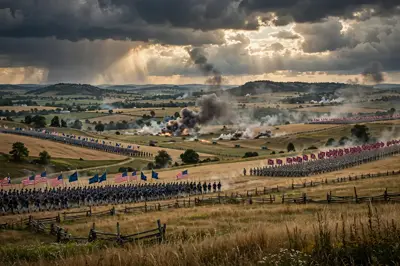
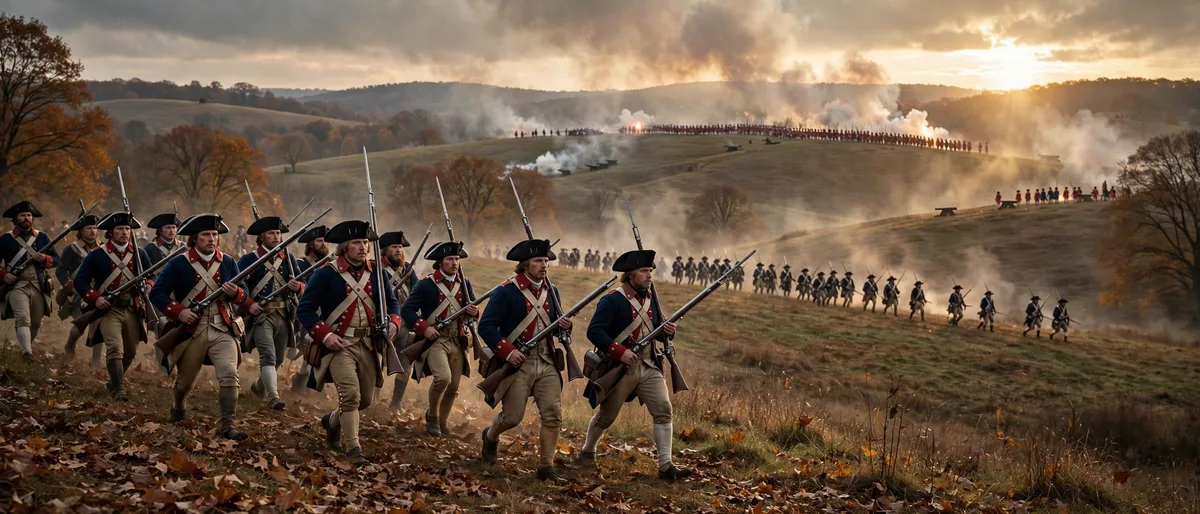
On September 19, 1777, Burgoyne moved. He sent three columns toward the American position, hoping to flank it. The fighting erupted around a clearing called Freeman's Farm — a rough, wooded country where neither side could see more than a few dozen yards in any direction.
This was Benedict Arnold's day, and it was Daniel Morgan's riflemen who made it count. Morgan's men — Virginia marksmen with long rifles that could kill at ranges the British muskets couldn't touch — slipped through the trees and did something deliberate and terrifying: they shot officers. British officers, in bright uniforms, making themselves targets. Within hours the British line was bleeding commanders, and confusion spread like smoke through the woods.
Arnold, furious and aggressive, kept throwing more men into the fight, refusing to let the British settle. The battle surged back and forth for hours. Momentum changed hands again and again. By evening, Burgoyne's men held the farm — a tactical victory, technically, the British said so — but it had cost them roughly 600 casualties, twice the American losses. Worse, Burgoyne's army could replace nothing and no one. Every man lost was lost forever. The Americans could lose and learn; the British could only lose.
Here's the thing about "victories" like Freeman's Farm: they spend the army. Burgoyne had won the field and spent a chunk of his war doing it. Gates's army sat behind its fortifications, growing stronger by the day. From that afternoon on, the question wasn't whether Burgoyne could reach Albany. It was whether his army would survive the trip back to Canada.
The Long Wait: A General Running Out of Everything
For three weeks, Burgoyne sat in his camp and did nothing — which, for a gambler, is its own kind of misery. His rations were shrinking. His horses were dying. He wrote hopeful letters to General Henry Clinton in New York, begging for a relief force. Clinton, as it happened, did march up the Hudson and captured two American forts in early October — a diversion meant to scare the Americans into lifting their siege. It came too late and aimed too far south to matter. It was, in every sense, a gesture.
Inside the American camp, a different war was going on. Gates and Arnold hated each other, and the hate had a history. Arnold believed he deserved the credit for Freeman's Farm; Gates believed Arnold was a hothead who'd nearly ruined his careful plan. Gates stripped Arnold of his command. Arnold fumed in his tent. The army that was about to win the biggest victory of the war was, at the top, barely on speaking terms with itself.
That feud is worth remembering, because it explains a lot about what happened next — and about why the sources we have disagree with each other so loudly. Gates's friends wrote the official history. Arnold's friends wrote the other one.
Bemis Heights: The Day Arnold Stole the Battle
By October 7, Burgoyne was out of options and almost out of food. He decided on what he called a "reconnaissance in force" — a grand name for walking 1,500 men at the American left flank and hoping for a miracle. The Americans saw it coming. Gates sent Daniel Morgan and the light infantry out to meet them.
And then Benedict Arnold did something astonishing. Removed from command, confined to camp by his commanding officer, Arnold threw his leg over a horse and rode straight into the battle — orders be damned. He rallied the American troops, directed attacks with the fury of a man settling a personal score, and led the assault on a German redoubt held by Colonel Heinrich von Breymann. When the Americans stormed it, the British position collapsed.
The British lost General Simon Fraser that day — shot through the body, dying the next morning — and roughly half the force Burgoyne had sent out was killed, wounded, or captured. Arnold himself was hit in the leg by a musket ball: the same leg that had been shot during the invasion of Quebec two years earlier. A story has it that when Gates's aide asked where he was hit, Arnold answered, "In the same leg," and added, "I wish it had been my heart."
Rain fell as Burgoyne's broken army stumbled north through the dark. Within days Gates's men had surrounded it completely. Burgoyne asked for terms. On October 17, 1777, he surrendered his entire army — about 5,752 men, 42 cannons, and some 7,000 muskets — to Horatio Gates. The two generals, famously, dined together that evening and drank to each other's leaders.
Think about that for a moment. An entire British army, surrendering. It had never happened before. Nobody in America — and nobody in Europe — had ever seen the British lion lose a whole army to colonists.
So Why Was the Battle of Saratoga Important? Because Paris Was Watching
The muskets had barely cooled before the news crossed the Atlantic — and in Paris, it landed like a thunderclap. France had been watching the American rebellion for years with a mixture of sympathy and caution. Louis XVI's ministers hated Britain with a deep, old, French passion, and helping the Americans hurt Britain was irresistible in principle. But no one in Versailles wanted to back a losing rebellion. What would it profit France to ally with farmers who couldn't beat a real army?
Saratoga answered that question. It proved the Americans could beat a real army — a whole British army, surrendered on the field. In February 1778, France signed the Treaty of Alliance with the United States, pledging open military support for American independence. French loans and French gunpowder had already been flowing quietly; now French soldiers, French officers, and — most importantly — the French navy entered the war. Spain and the Dutch Republic followed into the fight against Britain. A colonial rebellion had become a global war, and Britain suddenly had to defend an empire instead of just crushing a revolt.
That is the headline answer to why the Battle of Saratoga was important: it was the audition, and America passed. Without French sea power, the victory at Yorktown four years later — where a French fleet sealed the British in and a combined Franco-American army starved them out — would have been flatly impossible.
The effects ran closer to home, too. American morale, which had been leaking away after defeat after defeat, surged. Militia enlistments rose. British strategy had to shift south, conceding that the northern colonies were lost. And Gates — Gates became a national hero overnight, a man whose name was suddenly whispered as a replacement for the losing general Washington. That whisper would grow into the Conway Cabal, the little political conspiracy that nearly toppled Washington that winter. Gates got the glory, Arnold got the wound, and Washington — who hadn't been within a hundred miles of Saratoga — got the politics.
What the Sources Tell Us
A few honest caveats, because the history here is messier than the story.
The numbers you read vary from source to source. The National Park Service says the British lost about 1,500 men across both battles and the Americans about 800; other accounts break it down to 90 Americans killed and 240 wounded against 440 British killed, 695 wounded, and over 6,000 captured. Exact 18th-century headcounts are rough — armies inflated their strength and hid their losses, and the American ranks were swelling daily with militia who came and went. Treat every figure as approximate.
The Arnold-Gates feud also poisons the well. Gates wrote the official reports and took the official credit. Arnold's supporters — and Arnold was genuinely the engine of the October 7 fighting — wrote theirs. Every account you read leans one way or the other. The fairest reading: Gates's strategy (dig in, wait, let the militia come) set the trap; Arnold's aggression (at Freeman's Farm and, unauthorized, at Bemis Heights) sprang it.
And some historians argue the "turning point" label gets more credit than it deserves. Britain still held New York City, Washington's army was nearly starving at Valley Forge that same winter, and the war dragged on for six more years. Saratoga didn't win the war. What it did was make winning the war thinkable — and, in Paris, fundable.
What If Burgoyne Had Won at Saratoga?
This is the question the history books rarely ask, and it's worth asking, because the answer shows how thin the thread was.
If Burgoyne had taken Albany in the fall of 1777 — if he'd held Freeman's Farm cheaply, or if Gates's army had broken at Bemis Heights — New England would likely have been severed from the middle colonies. The rebellion's heartland would have been isolated, its harbors and supply lines cut. Washington's army, already reeling from defeats around Philadelphia, would have faced the prospect of fighting alone against a Britain that now looked unbeatable.
Would France still have intervened? Almost certainly not — or not in time. The whole point of the French alliance was that Saratoga proved America could win. A British victory would have proved the opposite, and Versailles would have kept its purse shut. Without France, there is no Yorktown, no French fleet sealing Chesapeake Bay, no negotiated peace in 1783. The most likely outcome: a grinding war of attrition the colonies couldn't afford, ending in some negotiated settlement far short of independence — or independence delayed by a generation.
And Benedict Arnold? He'd have gone down as the tragic hero who almost saved the cause, rather than the man who tried to sell West Point to the British. His name would be on the monument at Saratoga instead of just his leg. Funny how history turns on which side of a musket ball you're standing on.
Frequently Asked Questions
Was Saratoga the turning point of the American Revolution?
Yes. Historians widely describe Saratoga as the turning point of the American Revolution because it persuaded France to enter the war as America's ally. Without French money, troops, and the French navy, American independence would have been nearly impossible to achieve.
Who won the Battle of Saratoga?
The Americans won. British General John Burgoyne surrendered his entire army — about 5,752 men, plus 42 cannons and some 7,000 muskets — to American General Horatio Gates on October 17, 1777. It was the first time a whole British army had surrendered.
Why did France join the war after Saratoga?
Because Saratoga proved the Americans could defeat a British army in the field. France signed the Treaty of Alliance in February 1778, committing French troops, loans, gunpowder, and the navy to the American cause. The rebellion became a global war against Britain — Spain and the Dutch Republic followed France into the conflict.
What happened to Benedict Arnold at Saratoga?
He was the hero of the second battle. Despite being stripped of his command by Gates, Arnold rode onto the field at Bemis Heights, led the assault that broke the British lines, and was shot in the leg. The wound was honored at Saratoga by the famous "Boot Monument," which depicts a leg but names no one. Arnold betrayed the American cause three years later, in 1780.
Sources
- Richard M. Ketchum, Saratoga: Turning Point of America's Revolutionary War (Henry Holt, 1997) — the standard modern history of the campaign.
- John S. Pancake, 1777: The Year of the Hangman (University of Alabama Press, 1977) — the broader strategic picture of the war's decisive year.
- Edmund S. Morgan, The Birth of the Republic — on Saratoga as the moment France's help became "the last element needed for victory."
- American Battlefield Trust — battle summaries and campaign maps for Freeman's Farm and Bemis Heights.
- National Park Service, Saratoga National Historical Park (nps.gov/sara) — official casualty figures and FAQ.