What was the Battle of Vicksburg? What was the Battle of Vicksburg? The Battle of Vicksburg — more accurately, the Siege of Vicksburg — was a 47-day Union siege of the Confederate fortress city of Vicksburg, Mississippi, from May 18 to July 4, 1863. Ulysses S. Grant's victory split the Confederacy in two and, together with Gettysburg, turned the tide of the American Civil War.
Before the daring march, Grant tried everything else first. Through the winter and early spring of 1863 he ordered a canal cut across De Soto Point, expeditions through Lake Providence and Yazoo Pass, and Admiral Porter’s gunboats up Steele’s Bayou — and every attempt failed in the flooded Mississippi bottomland. The failures mattered: they proved the fortress could not be taken from the north, and pushed Grant toward the bold downriver crossing that made the campaign famous.
Ask most people to name the turning point of the American Civil War and they will say Gettysburg. They are only half right. On July 4, 1863 — one day after Lee's army broke against Cemetery Ridge in Pennsylvania — another Confederate army, an entire army, laid down its weapons in Mississippi. The fall of Vicksburg handed the Union the Mississippi River, cut the Confederacy in half, and made Ulysses S. Grant the most important general of the war. Here are the ten facts that explain why.
1. It wasn't one battle — it was a 47-day siege at the end of a three-month campaign
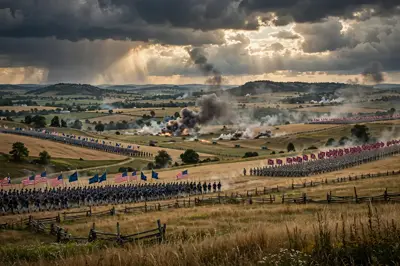
Calling it the "Battle" of Vicksburg is a habit, not an accurate description. What happened at Vicksburg between May 18 and July 4, 1863 — 47 days — was a siege: Grant's army surrounded the city, dug trenches, and starved it out. The real fighting happened earlier, during Grant's Vicksburg Campaign (late March to July 1863), when his army marched through Mississippi winning five pitched battles in eighteen days to trap the Confederates inside the city. The siege was the payoff, not the contest.
2. Grant pulled off one of the boldest gambles in military history to get there
To reach Vicksburg, Grant marched his army down the west bank of the Mississippi, crossed the river south of the city, and then deliberately cut himself off from his own supply lines — living off the land in hostile territory. In just over two weeks his men fought and won at Port Gibson, Raymond, Jackson, Champion Hill, and Big Black River Bridge, driving Pemberton's army back into Vicksburg's fortifications. Military academies still study the campaign as a masterpiece of speed, deception, and maneuver.
3. Vicksburg was the "Gibraltar of the Confederacy"
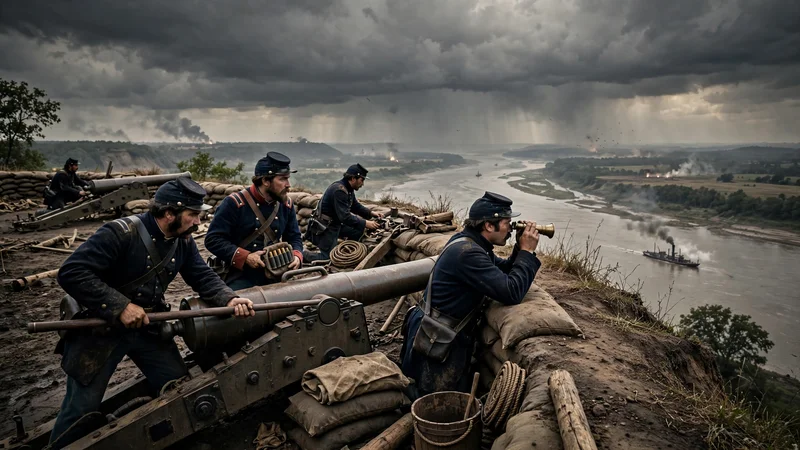
Vicksburg sat on high bluffs above a hairpin bend in the Mississippi River, bristling with artillery that could sink any ship attempting to pass. It was the last Confederate stronghold on the river — and Abraham Lincoln understood exactly what that meant. "Vicksburg is the key," he said. "The war can never be brought to a close until that key is in our pocket." Whoever held Vicksburg held the Mississippi, and whoever held the Mississippi held the continent's great dividing line.
4. Grant tried to storm the city twice — and paid for it
Grant didn't want a siege; sieges are slow. On May 19 and again on May 22, 1863, he hurled his men at Vicksburg's fortifications in full frontal assaults. Both attacks were bloodily repulsed — the May 22 assault alone cost the Union more than 3,000 casualties in a single day. Grant learned his lesson the hard way: the city's defenses were too strong to take by force. He settled in, ordered his men to dig, and decided to starve Pemberton out instead.
5. Civilians lived in caves while the city starved
The siege wasn't just a military event — it was a civilian catastrophe. As Union artillery pounded the city day and night, the people of Vicksburg dug some 500 caves into the clay hillsides and moved underground for weeks. Food ran out completely. Residents ate mules, dogs, and rats; one newspaper advertised "mule meat" for sale. By late June, soldiers and civilians alike were gaunt, sick, and surviving on handfuls of peas and cornmeal. Pemberton's army was melting away from hunger and disease.
6. The surrender came on July 4 — and the city refused to celebrate the Fourth for 82 years
On July 3, with his men starving and Union sappers tunneling mines under his lines, Pemberton asked Grant for surrender terms. Grant first demanded unconditional surrender, then — in a gesture of calculated generosity — agreed to parole the entire garrison instead of taking them prisoner. On July 4, 1863, some 29,500 Confederate soldiers stacked their arms: the largest single surrender of the entire Civil War. The humiliation cut so deep that Vicksburg did not officially celebrate Independence Day again until 1945.
7. Gettysburg and Vicksburg together broke the Confederacy
The timing is what makes Vicksburg legendary. Lee's defeat at Gettysburg ended on July 3, 1863; Pemberton's surrender came on July 4. News of both disasters reached the North almost simultaneously — a one-two punch from which the Confederacy never recovered. Historians treat the pair as the war's turning point: after the first week of July 1863, the South never again launched a major invasion of the North, and never again held the initiative in the West.
8. The Mississippi River ran free — and the Confederacy was cut in half
The strategic prize was the river itself. With Vicksburg (and Port Hudson, which fell days later) in Union hands, the entire Mississippi flowed, in Lincoln's phrase, "unvexed to the sea." The Confederacy was severed: Texas, Arkansas, and Louisiana were cut off from the eastern states, unable to send men, food, or supplies across the great river. The Union's Anaconda Plan — strangling the South by controlling its waterways — was finally complete.
9. The butcher's bill: roughly 37,000 casualties on both sides
The numbers tell the scale of it. Union losses for the campaign and siege totaled about 10,000 men; in the siege itself the Union suffered 4,835 casualties — 766 killed, 3,793 wounded, 276 captured or missing. Confederate losses were catastrophic: about 3,200 killed, wounded, or missing, plus 29,495 surrendered — roughly 32,700 in all — along with 172 captured cannons. No other single operation of the war removed an entire Confederate field army from the board.
10. Vicksburg made Ulysses S. Grant
Before Vicksburg, Grant was a successful but still regional commander with powerful enemies in Washington whispering about his drinking. After Vicksburg, he was untouchable — the general who had taken an "impregnable" fortress and delivered the Mississippi. Lincoln promoted him to lieutenant general in March 1864 and gave him command of all Union armies. A year later, Grant accepted Lee's surrender at Appomattox. The road to Appomattox ran straight through Vicksburg.
Frequently Asked Questions
When was the Battle of Vicksburg?
The siege of Vicksburg ran from May 18 to July 4, 1863 — 47 days. Grant's full Vicksburg Campaign, including the march through Mississippi and the five preliminary battles, ran from late March to July 4, 1863.
Who won the Battle of Vicksburg?
The Union won decisively. Ulysses S. Grant forced Confederate General John C. Pemberton to surrender the city and its ~30,000-man garrison on July 4, 1863.
Why was Vicksburg so important?
Vicksburg was the last Confederate fortress on the Mississippi River. Its fall gave the Union complete control of the river, split the Confederacy in two, and — coming one day after Gettysburg — marked the turning point of the Civil War.
How many soldiers died at Vicksburg?
Union casualties in the siege were about 4,835 (766 killed). Confederate losses were about 3,200 killed, wounded, or missing — plus 29,495 men who surrendered and were paroled rather than killed.
Was Vicksburg a battle or a siege?
Technically a siege: 47 days of encirclement, bombardment, and starvation. "Battle of Vicksburg" is the common name, but the actual pitched battles of the campaign — Champion Hill, Big Black River Bridge, and others — were fought in the weeks before the siege began.
Sources
- Siege of Vicksburg — Wikipedia: https://en.wikipedia.org/wiki/Siege_of_Vicksburg
- Vicksburg Campaign — Wikipedia: https://en.wikipedia.org/wiki/Vicksburg_Campaign
- The Siege of Vicksburg: The Battle that Decided the Civil War — HistoryTools.org: https://www.historytools.org/stories/the-siege-of-vicksburg-the-battle-that-decided-the-civil-war
- The siege and surrender of Vicksburg — Curtis Jerry Smothers: https://www.cjsmothers.com/_files/ugd/a70894_df2371bb3d0e415c953554445b6d8ddf.pdf