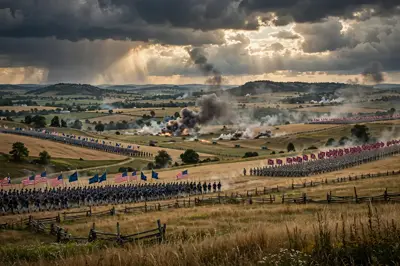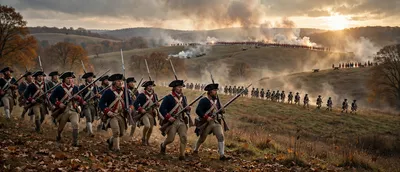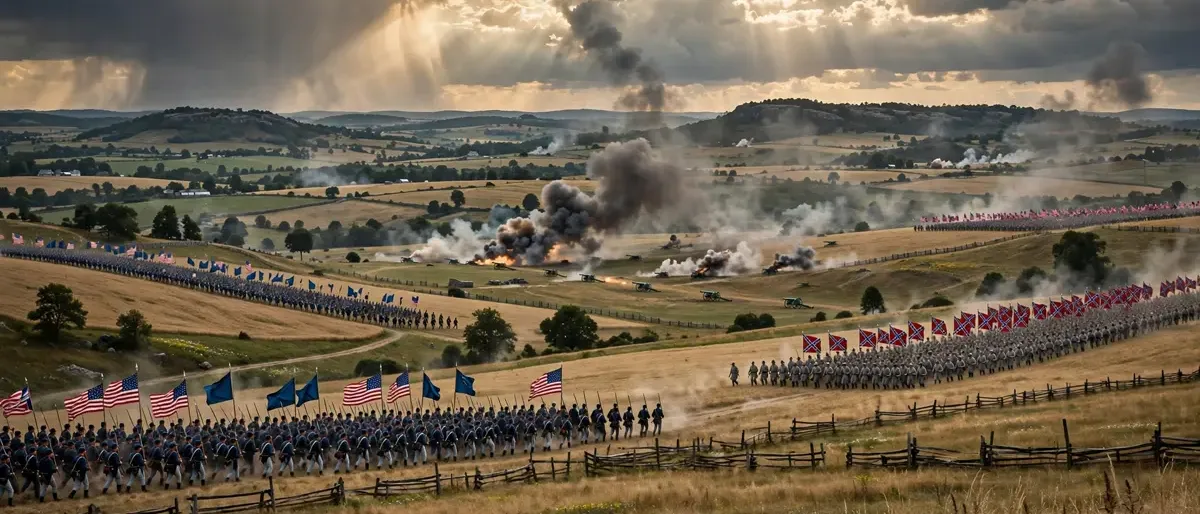
Here is a battle of Antietam summary in one sentence: on September 17, 1862, two armies tore each other apart along a creek in Maryland for twelve hours, leaving 22,700 men killed, wounded, or missing — the deadliest single day in American history — and five days later Abraham Lincoln turned the slaughter into a political weapon that changed the meaning of the Civil War. The Union didn't exactly win. But the Confederacy lost something it never got back: its last real chance at foreign recognition, and with it, its best path to independence.
That is the short version. Now let me tell you how it actually happened — the lost cigars, the general who couldn't make up his mind, and the bridge that took an entire army corps four hours to cross.
The Road to Sharpsburg: A Gambler's Invasion
The summer of 1862 had been a disaster for the Union in the East. Robert E. Lee had spent the spring and summer humiliating every Federal general sent against him — the Seven Days Battles, then Second Bull Run in late August, where he wrecked John Pope's army and sent it fleeing back toward Washington. Lee was 55 years old, riding a wave of confidence that bordered on intoxication, and he decided the time had come to take the war north.
His plan had three gears turning at once. First, Maryland was a slave state that had stayed in the Union; Lee hoped a Confederate army marching through it would trigger a popular uprising and deliver the state — and its manpower — to the South. Second, a victory on Northern soil might persuade the midterm voters to throw Lincoln's Republicans out of Congress. Third, and biggest: Britain and France were watching. Both were considering recognizing the Confederacy as a nation, which would have meant loans, trade, and quite possibly naval help. A smashing victory in the North could tip them.
So in early September, Lee marched roughly 38,000 men — barefoot, hungry, sunburnt, many of them literally shoeless — across the Potomac and into Maryland. It was an audacious move for an army that small: invasion with an army of beggars.
And then, on September 9, Lee did something breathtakingly bold and breathtakingly careless at the same time. He issued Special Order 191, which split his already-small army into pieces scattered across some thirty miles of Maryland countryside. Stonewall Jackson would peel off to capture the Union garrison at Harpers Ferry; the rest would screen the mountain passes. If it worked, it was genius. If the enemy found out, it was suicide.
The enemy found out. On the morning of September 13, two Union soldiers of the 27th Indiana — Corporal Barton W. Mitchell and Sergeant John Bloss — were resting in an abandoned Confederate camp near Frederick, Maryland, when Mitchell spotted three cigars lying in the grass, wrapped in a piece of paper. He picked them up, unwrapped the paper, and realized what he was holding: a copy of Lee's entire campaign plan, addressed to Confederate General D.H. Hill.
The paper raced up the chain of command and landed on the desk of Union General George B. McClellan. McClellan reportedly waved it in the air and crowed, "Here is a paper with which, if I cannot whip Bobby Lee, I will be willing to go home." A historian later observed that no general in the war was ever handed so fair a chance to destroy the opposing army one piece at a time.
What did McClellan do with this once-in-a-war gift? He waited eighteen hours before moving. Lincoln would later call this habit of his "the slows." While McClellan inched forward, Jackson stormed Harpers Ferry on September 15 — capturing its garrison of 12,000 men, the largest surrender of Union troops in the war — and Lee scrambled his scattered army back together at a little town called Sharpsburg, with Antietam Creek in front of him and the Potomac River behind him.
Lee had fewer than 40,000 men, his back to a river, outnumbered nearly two to one, against an enemy who knew his entire plan. Any other general would have run. Lee stayed.
Dawn: The Cornfield
The battle began at first light on September 17, when Union General Joseph Hooker sent his corps crashing into Lee's left flank across a 30-acre field of tall corn on the farm of David R. Miller. What happened in Miller's Cornfield over the next four hours is hard to describe without sounding like an exaggeration, so let me put it the way the soldiers who were there put it: men said you could have walked across the field on the bodies and never touched the ground.
Lines advanced, fired, and were shredded; fresh regiments walked into the corn and came out as handfuls. The Confederate 1st Texas went in and was nearly wiped out — one of the highest casualty rates any regiment ever suffered. John Bell Hood's Texans counterattacked without having eaten breakfast that morning. Union General John Gibbon's Iron Brigade — men in tall black hats, famous for holding their ground — fought at ranges so close the men could see each other's faces. Control of the field changed hands something like fifteen times. By 10 in the morning, the corn was flat as a pancake and thousands of men lay in it.
Fighting spread through the woods around the little white Dunker Church nearby. Confederate artillery on high ground shredded Union formations as they came. Lee was committing everything — by day's end he would throw literally his entire army into the fight, every last regiment, holding nothing back. It was the kind of gamble you only take when you have no other cards.
Midday: Bloody Lane
With the morning fight grinding to a bloody standstill on the left, the battle's center of gravity shifted to the middle of the field, where a sunken farm road cut into the ground like a trench. Confederates under D.H. Hill had packed into the road three and four deep, turning it into a natural rifle pit. For hours, Union brigades advanced up the slope into what one soldier called a perfect storm of musketry.
Then a Union officer spotted a seam — a gap in the Confederate line where a regiment had angled its position — and Federal troops poured through it. The Sunken Road, which had been a fortress at noon, became a trap by 1 p.m. The Confederates broke and ran for Sharpsburg, and the road behind them earned its new name: Bloody Lane. Some 5,500 men fell along that stretch of dirt. To this day it's called Bloody Lane on every park map, and standing in it, you can still see why it was such a perfect place to die.
But the Union advantage, as so often at Antietam, wasn't followed up. The men who broke the line were exhausted and unsupported. The Confederate center bent nearly to breaking — and held.
Afternoon: The Bridge
While all of this unfolded, Union General Ambrose Burnside was having the worst day of his life on the southern end of the field. His IX Corps — some 12,000 men — was ordered across Antietam Creek to roll up Lee's right flank. Between him and his objective stood a narrow stone bridge, only twelve feet wide, with the creek running fast beneath it. On the bluff above it, some 450 Georgia sharpshooters had settled in behind trees and boulders with a perfect field of fire.
What followed was almost comic in its futility, except that men were dying. Burnside sent his men at the bridge again and again. They were driven back. He tried fording the creek elsewhere — too deep, too slow. It took three separate assaults and roughly four hours before Union troops finally fought their way across. By then Lee had used the borrowed time to shuffle reinforcements to his right flank.
Burnside's men finally crossed around 1 p.m. and pushed toward Sharpsburg itself. Lee's line was stretched thinner than gauze. Sharpsburg was nearly in Union hands. The Confederacy's entire army was one push away from being pinned against the Potomac and destroyed.
And then, at about 4:30 in the afternoon, the miracle arrived — for the South. A.P. Hill's division, which had marched seventeen miles from Harpers Ferry under a brutal September sun, came crashing into Burnside's flank in a surprise counterattack. Burnside's exhausted men, who had spent the day bleeding for a bridge and a town, were driven back to the creek. The battle sputtered to a close as the light failed.
McClellan, with tens of thousands of fresh troops still uncommitted — he had sent less than three-quarters of his army into the fight — watched the sun go down and did nothing.
The Turning Points: Three Decisions That Mattered
If you want a deeper battle of Antietam summary than just who shot whom where, it comes down to three decisions.
First: McClellan's caution. He had Lee's plan. He had nearly double Lee's numbers. He had eighteen hours' head start from the Lost Orders, and still he attacked piecemeal — corps by corps, in sequence instead of together — letting Lee shift his thin line from crisis to crisis like a man plugging holes in a sinking boat with his fingers. And when Burnside's attack stalled and A.P. Hill arrived, McClellan kept his reserves — some 30,000 fresh men — standing in the fields, unused. Lincoln, reading the reports, was furious. He would strip McClellan of command on November 5, effectively ending the man's military career.
Second: A.P. Hill's march. Seventeen miles, in the heat, after days of campaigning — and Hill's men arrived in time to save the Confederate army. It's one of the great forced marches of the war, and it turned what might have been the destruction of Lee's army into a draw.
Third: Lincoln's decision. Here's the part of this battle of Antietam summary that actually changed the world. Lincoln had been sitting on a draft of the Emancipation Proclamation for months. His cabinet had told him to wait for a victory — issuing it from weakness would look like desperation. Antietam, bloodbath though it was, gave him that victory, or at least something he could call one. Five days after the battle, on September 22, 1862, he issued the preliminary Emancipation Proclamation, declaring that on January 1, 1863, all enslaved people in Confederate-held territory would be free.
That one document reframed the entire war. It was no longer just about preserving the Union; it was about ending slavery. And in doing so, it killed the Confederacy's foreign hopes. Britain and France, both of which had already abolished slavery, could not recognize a slaveholding rebellion after the Union had made abolition a war aim. Lee's invasion had failed at its deepest purpose.
Aftermath & Legacy
The night of September 18, Lee held his position — daring McClellan to attack again, the man apparently incapable of fear — and then slipped his battered army back across the Potomac under cover of darkness. McClellan, astonishingly, did not pursue for weeks. Lee got away, and the war would grind on for two and a half more years.
The butcher's bill, when it was counted, was 22,720 men killed, wounded, or missing in a single day — 12,400 in blue, 10,320 in gray, roughly 3,650 of them dead outright. More Americans fell on September 17, 1862, than on D-Day. Antietam remains, by any honest count, the bloodiest single day in American military history.
Two things grew out of the wreckage that history remembers well. First, the battle gave the photographer Alexander Gardner — working for Matthew Brady's studio — the chance to do something no one had ever done: he photographed the dead where they fell and exhibited the images in New York. For the first time, civilians saw what a battlefield looked like after the shooting stopped. The New York Times wrote that Brady had "done something to bring home to us the terrible reality and earnestness of war."
Second, a young nurse named Clara Barton arrived at Antietam with a wagonload of medical supplies she had gathered herself, working in the field hospitals under fire. She would later found the American Red Cross — an organization that exists, in a real sense, because of what she saw at Antietam.
And strategically, Antietam did what Saratoga had done for the Revolution eighty-five years earlier: it was the victory that changed what the war was about. Saratoga won France for America; Antietam won freedom as the Union's cause. Two battles, two wars, the same pattern — a single day of fighting that rewrote the terms of everything after.
What the Sources Tell Us
An honest caveat before you go: the numbers above are approximate, and any article that gives them to four significant figures is bluffing. The American Battlefield Trust says about 22,700 total casualties; Wikipedia's article says 22,726; the Congressional Record's table breaks it down to 22,720. Strength estimates swing even wider — Union figures range from 87,000 to 114,000 depending on whether you count everyone present or only those engaged. Treat every figure as a well-informed estimate, because that's what it is.
The standard modern history is James M. McPherson's Crossroads of Freedom: Antietam, and it's where the serious reader should start. McPherson's judgment on the battle is worth quoting, as he summed it up this way: Antietam "redefined the purpose of the war," making emancipation its central aim. One day, one creek, one proclamation — and the war's meaning changed.
3 Lessons Antietam Teaches Today
Most history articles stop at what happened. But there's a reason this battle still gets studied in staff colleges, and it's not the tactics. It's the decisions — and three of them apply far beyond 1862.
1. Perfect intelligence is worthless without the nerve to use it. McClellan had Lee's entire plan in his hands. He knew where every Confederate unit was, where it was going, and when. And it still wasn't enough, because he wouldn't act on it decisively. In any field — business, politics, life — information you don't act on is just trivia you're hoarding. The Lost Orders are the most famous unused advantage in military history, and they prove that knowing isn't the hard part. Moving is.
2. Half-won victories have a price. McClellan called Antietam a victory, and Lincoln let him — but Lee's army escaped, intact enough to fight for two more years at Chancellorsville and Gettysburg. Every Gettysburg casualty in the summer of 1863 is, in some sense, a debt owed to McClellan's caution on September 17, 1862. A job half finished doesn't stay half finished; it comes back, bigger.
3. One day can reframe everything. Before September 17, the Civil War was a war to preserve the Union. After September 22, it was a war to end slavery. The fighting didn't change the cause; the meaning assigned to the fighting did. Organizations, movements, and people get to decide what their hardest days mean — and that decision, made quickly and publicly, can matter more than the day itself.
Frequently Asked Questions
How many soldiers died at the Battle of Antietam?
About 22,720 soldiers were killed, wounded, or missing in a single day — roughly 12,400 Union and 10,320 Confederate, with about 3,650 killed outright. It remains the bloodiest single day in American history, with more casualties than D-Day.
Who won the Battle of Antietam?
Strategically, the Union. Lee's invasion of the North failed and his army retreated to Virginia, which gave Lincoln the victory he needed to issue the Emancipation Proclamation. Tactically, though, the battle was a draw — Lee held his ground on the 18th and McClellan never followed up.
Why was the Battle of Antietam so important?
It ended Lee's first invasion of the North, gave Lincoln the political cover to issue the preliminary Emancipation Proclamation on September 22, 1862, reframed the war around ending slavery, and convinced Britain and France to stay out of the war.
How did the Union find Lee's battle plan before Antietam?
Two soldiers of the 27th Indiana — Corporal Barton W. Mitchell and Sergeant John Bloss — found a copy of Lee's Special Order 191 wrapped around three cigars in an abandoned Confederate camp near Frederick, Maryland, on September 13, 1862. McClellan moved too slowly to fully exploit it.
Sources
- James M. McPherson, Crossroads of Freedom: Antietam (Oxford University Press, 2002) — the standard modern study of the battle and its meaning.
- American Battlefield Trust — Antietam battle facts and campaign summaries.
- National Park Service, Antietam National Battlefield (nps.gov/anti) — official casualty figures and battlefield history.
- U.S. Congressional Record, Vol. 149 — official casualty breakdown table for September 17, 1862.
- HISTORY — "Union troops discover Rebels' Antietam battle plan" (September 13, 1862).