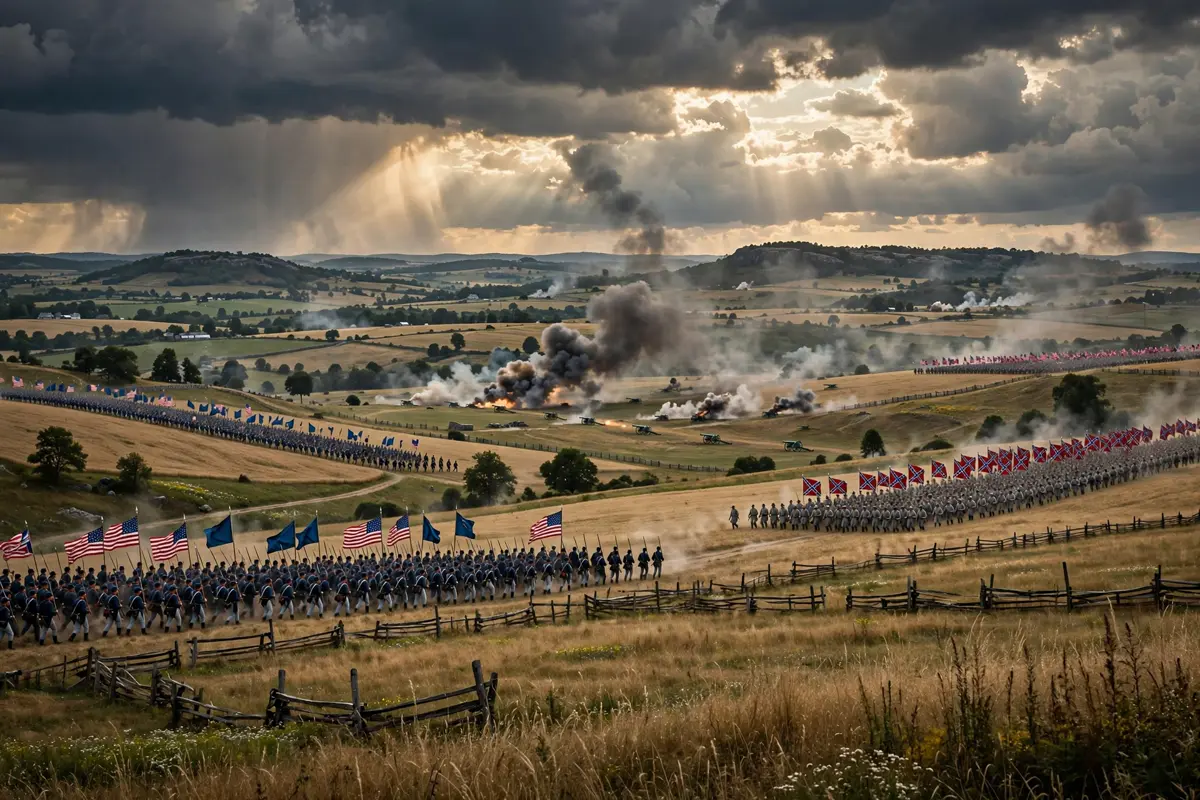
Three moments turned three brutal days into the hinge of the American Civil War. The high ground. Little Round Top. And Pickett's Charge. Everything else is detail.
By Echoes of BattlePublished October 4, 2026
If you searched for the battle of gettysburg turning points explained plainly, here's the short version before the long one. Gettysburg, fought July 1-3, 1863, in and around a small Pennsylvania town, was the hinge of the American Civil War. Call it the Stalingrad of the 1860s: the battle that broke an invader. In three brutal days, Robert E. Lee threw the Army of Northern Virginia at George Meade's Union army and walked away with nothing but casualties. Three moments decided it, as sharply as Midway decided the Pacific War. Day 1: the Union army grabbed the high ground south of town and never let go. Day 2: Little Round Top held by the width of a bayonet charge, literally, because the ammunition ran out. Day 3: Pickett's Charge broke against the Union center, and with it broke the Confederacy's last real chance to win the war on Northern soil. The short version never does it justice, though. The full story is weirder than the legend, closer-run, and far more human.
The Road to Gettysburg
By the summer of 1863, Robert E. Lee was the most feared commander in America. He'd just crushed a Union army twice his size at Chancellorsville, and he'd convinced himself the Confederacy could win independence not by conquering the North, but by scaring it into quitting. So on June 3, 1863, he marched some 75,000 men north into Pennsylvania, his second invasion of Northern territory. The goal? A decisive victory above the Mason-Dixon line that would shatter Northern morale and maybe, just maybe, win the Confederacy recognition from Britain or France.
The plan had a logic to it. Pennsylvania farms would feed his hungry army. A big win in the North might relieve pressure on Vicksburg, where Ulysses S. Grant was strangling the Confederacy's Mississippi lifeline. And Lee's men were confident. Maybe too confident. Chancellorsville had convinced a lot of them that Lee simply couldn't be beaten.
Here's the part people forget. The Union commander at Gettysburg had been in the job for three days. George Gordon Meade took command of the Army of the Potomac on June 28, after Lincoln sacked Joseph Hooker. Picture it: you're handed 93,000 men, an army that has lost repeatedly under its previous commanders, and three days later you're expected to stop Robert E. Lee. No honeymoon. No staff shake-up. No grand strategy sessions. He got the job because he was standing there.
And Lee had a problem nobody talks about enough: he was blind. His cavalry chief, Jeb Stuart, the army's eyes, had ridden off on a glory-seeking raid around the Union army and lost contact. So for the most important battle of his life, Lee had almost no scouts telling him where the enemy was. Both armies basically stumbled into each other at a crossroads town neither had planned to fight over. Wars have been decided by dumber accidents. Few have been decided by one this famous.
The Battle: Three Days That Shook America
Picture it: late June, 1863. Two armies, roughly 160,000 men between them, marching through Pennsylvania farm country, each mostly guessing where the other is. Nobody wanted to fight at Gettysburg. It was a market town of 2,400 people with ten roads running through it. But ten roads means ten ways to get there. And on the morning of July 1, the two armies found each other the way strangers collide in a dark hallway.
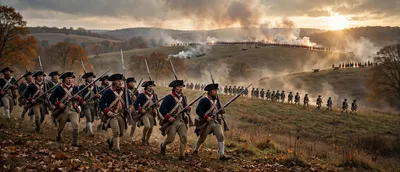
Day 1. July 1: The accident. Confederate infantry under Henry Heth pushed toward Gettysburg and ran straight into Union cavalry under John Buford, who dismounted his men and held the ridges west of town long enough for Union infantry to arrive. The fighting was savage and confused. Union general John Reynolds, one of the army's best, was killed within the first hour. By afternoon, the Confederates had the numbers and drove the Union troops back through the streets of Gettysburg.
But here's what mattered: the Union retreat wasn't a rout. Winfield Scott Hancock, whom Meade sent ahead with full authority, rallied the broken regiments on the high ground south of town, Cemetery Hill and Cemetery Ridge. Then he made the call that shaped everything after: the Union would fight from those hills. Lee, arriving on the field, ordered his subordinate Richard Ewell to take Cemetery Hill "if practicable." Ewell hesitated. The hill stayed in Union hands. Historians have been arguing about that hesitation for 160 years. They'll argue about it for 160 more.
Day 2. July 2: The flanks. Convinced the Union position was too strong head-on, Lee ordered his trusted lieutenant James Longstreet to crush the Union left flank. Longstreet didn't love the plan. He wanted to swing around the Union army and fight on ground of his own choosing. Lee overruled him. What followed was some of the most savage close-quarters fighting of the entire war. At the Wheatfield, a nineteen-acre patch of ripening wheat got trampled into blood-soaked mud as it changed hands six times in a single afternoon. Six times. At Devil's Den, men fought boulder to boulder, and Confederate attacks came within minutes of breaking through. At the far end of the line, on a rocky hill called Little Round Top, the 20th Maine made its famous stand. On the Union right, Confederates nearly seized Culp's Hill. When the sun went down, the Union line had bent everywhere. Broken nowhere.
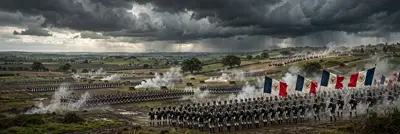
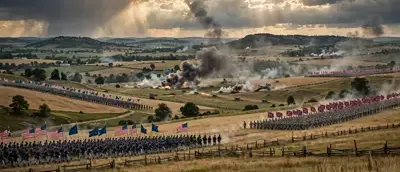
Day 3. July 3: The gamble. Lee decided the Union center must be the weak point. After nearly two hours of bombardment, one of the largest artillery duels of the war, he sent roughly 12,500 men, Pickett's, Pettigrew's, and Trimble's divisions, marching across nearly a mile of open ground straight at the Union center on Cemetery Ridge. Pickett's Charge: 12,500 men in parade-ground formation, drums beating, battle flags flying, walking into a storm of iron. Confederate artillery had overshot its targets. Union guns waited, then ripped the advancing lines with canister shot at close range. In under an hour the assault was destroyed. The farthest point the Confederates reached, a low stone wall the soldiers called the Angle, is remembered as the "High Water Mark of the Confederacy," the closest the South ever came to winning. Lee rode out to meet the survivors and took the blame on himself. On July 4, the Army of Northern Virginia began its long retreat south. Related: largest battles in history.
Turning Point #1: The High Ground (Day 1)
Most explanations of the battle of gettysburg turning points found elsewhere start with Pickett's Charge, because it's dramatic. I'd argue the battle was really decided on Day 1. Almost nobody teaches it that way.
Here's the geographic fact everything else flows from: the Union army ended up holding a fishhook-shaped ridge of high ground, and the Confederates spent two days attacking uphill. Cemetery Hill, Cemetery Ridge, Little Round Top, Culp's Hill. Once Hancock planted the flag there on the afternoon of July 1, Meade had interior lines. Translation: he could shift reinforcements along his short inner arc faster than Lee could move attackers around the long outer one. Not glamorous. But wars are won by whoever moves reinforcements fastest, and for three days that was Meade.
Could Lee have taken the hills on Day 1? Maybe. His men had just routed two Union corps and were full of momentum. Ewell's corps was fresh. But "maybe" is doing a lot of work in that sentence. The troops were disorganized, it was late, and Ewell genuinely didn't know what was waiting on those hills. Still, you have to wonder: if Lee's order to Ewell had said "take it" instead of "take it if practicable," does the battle even happen the same way? The boldest what-if of the whole war might be hiding inside one qualifying word. One word.
Turning Point #2: Little Round Top and the Last Bayonet Charge (Day 2)
If the Union had one truly fragile moment, it was the afternoon of July 2 on Little Round Top, a bald, rocky hill anchoring the far left of the Union line. Had the Confederates seized it, they could have dragged artillery up and fired down the length of the entire Union position. The whole fishhook unravels.
The regiment holding it was the 20th Maine, commanded by a former college professor named Joshua Lawrence Chamberlain. Let that sink in: a man who taught rhetoric at Bowdoin College was personally responsible for the left flank of the Army of the Potomac. The Confederates attacked again and again, uphill. The Mainers bent but held, until they ran out of ammunition. No bullets. Another attack coming. So Chamberlain did something that sounds insane when you write it down: he ordered a downhill bayonet charge with empty rifles. The 20th Maine fixed bayonets, swung down the slope like a door, and shattered the Confederate assault. The flank held. Unbelievable? It happened.
Chamberlain later won the Medal of Honor for it. But here's the uncomfortable truth historians keep circling: if any one of a dozen small things had gone differently on that hill, if Chamberlain's nerve had failed, if one Confederate regiment had flanked a minute earlier, the Union left collapses and Day 3 might have been a Confederate victory parade. The margin between "decisive Union triumph" and "disaster" was one exhausted professor and 300 men with empty guns.
Turning Point #3: Pickett's Charge. The High Water Mark (Day 3)
The phases tell you what happened on July 3. But Pickett's Charge needs its own section, because everything about the Confederacy's war effort pivoted in that single hour, and the charge itself was so brazen that people are still trying to make sense of it.
Why did Lee do it? That's the question that has haunted this battle for a century and a half. His artillery chief believed the Union guns on Cemetery Ridge had been silenced. They had not. The Confederate shells had mostly overshot, and the Union batteries were waiting. Longstreet had to order the attack. He reportedly could barely give the command. Lee believed his men could do anything if he asked it of them, and on July 3, 1863, that belief met its limit. Related: Siege of Vicksburg.
Here's my honest take on why the battle of gettysburg turning points in textbooks always end here: this is the moment the Confederacy's strategic initiative died. Lee would never again invade the North. He would never again have an army strong enough to try. The South fought on for nearly two more years, but after Gettysburg it was fighting to avoid losing, not to win. That is the difference between a battle and a turning point.
What If Lee Had Won?
It's the question every history fan asks, so let's answer it honestly. Say Pickett's Charge breaks the Union center and Meade's army falls back in disorder. Lee wins the field at Gettysburg. Does the Confederacy win the war?
Probably not, and this is where I'll part company with the romantic version. Vicksburg surrendered to Grant on July 4, the very day Lee started his retreat, and no Gettysburg victory changes that. The Union's industrial and manpower advantages were structural, not tactical. Lincoln had shown zero willingness to negotiate. And Lee, deep in Pennsylvania with a wrecked supply line and 28,000 fresh casualties of his own, couldn't have marched on Washington. What a Confederate Gettysburg might have bought was time. Maybe a year. And a louder Northern peace movement. But the war's deep currents were flowing against the South long before July 1863. Gettysburg didn't decide THAT the Union would win. It decided the war would end with the Confederacy ground down rather than negotiated out, and there's a difference. It mattered enormously to everyone who lived through the next two years.
3 Lessons from Gettysburg for Today
History that doesn't teach you anything is just trivia with casualties. Here's what Gettysburg still has to say, 163 years later:
1. Win the position before the fight starts. Meade didn't outfight Lee at Gettysburg so much as out-position him. The fishhook, the interior lines, the high ground: the battle was half-decided the moment Hancock dug in on Cemetery Ridge. In business, in negotiation, in life, the person who picks the ground usually picks the winner. Fighting uphill is a choice. Don't choose it.
2. Never bet everything on one throw. Lee's entire campaign came down to a single hour on July 3: one charge, across one field, against one ridge. The same kind of single throw Napoleon lost at Waterloo. It was the gambler's ruin dressed up as courage. When your whole strategy depends on one thing going perfectly, you don't have a strategy. You have a lottery ticket. Spread your bets and keep something in reserve. Lee had done exactly that for two years. At Gettysburg, he forgot.
3. The person nobody expected decides everything. A college professor held the Union's left flank. A cavalryman named Buford, buying time with dismounted troopers on Day 1, made the high ground possible. The famous names, Lee, Meade, Longstreet, got the statues. But the battle kept turning on people nobody had heard of that morning. When the moment comes, it rarely asks for your resume.
Aftermath & Legacy
When people search for the battle of gettysburg turning points, this is the part they really want answered: why did this battle matter more than all the others? Start with the butcher's bill. Roughly 51,000 casualties in three days, about 23,000 Union and 28,000 Confederate, by the American Battlefield Trust's widely cited figures. Gettysburg remains the bloodiest single battle of the Civil War, and one of the bloodiest in American history. Lee's army limped back to Virginia, and Meade, to Lincoln's fury, failed to pursue aggressively enough to trap it. "We had only to stretch forth our hands and they were ours," Lincoln lamented. The war ground on for two more years.
But something else happened at Gettysburg that outlived the tactics. In November 1863, Lincoln traveled to dedicate the soldiers' cemetery there, and delivered 272 words that redefined what the war was about: not just preserving the Union, but proving that a nation "conceived in liberty" could survive. The Gettysburg Address is arguably the most famous speech in American history. And it exists because of this battle. Today the field is preserved as Gettysburg National Military Park, and millions of visitors walk the same ridges every year. Stand at the Angle on Cemetery Ridge. Look across that open mile toward Seminary Ridge. The turning points stop being paragraphs in a textbook, and become a question you ask yourself: would I have walked?
See where Gettysburg ranks among the most decisive battles in history.
What the Sources Tell Us
A few honest caveats, because good history admits what it doesn't know. The casualty figures above follow the American Battlefield Trust's widely published compilations. Confederate records are patchy, and historians still argue about details, from Ewell's hesitation to the exact timing of Longstreet's assault. What no one disputes is the outcome: three days in Pennsylvania broke the Confederacy's last invasion of the North.
Sources
- National Park Service. Gettysburg National Military Park, nps.gov
- Encyclopaedia Britannica, "Battle of Gettysburg", britannica.com
- American Battlefield Trust. Battle of Gettysburg, battlefields.org
- Stephen W. Sears, Gettysburg (2003)