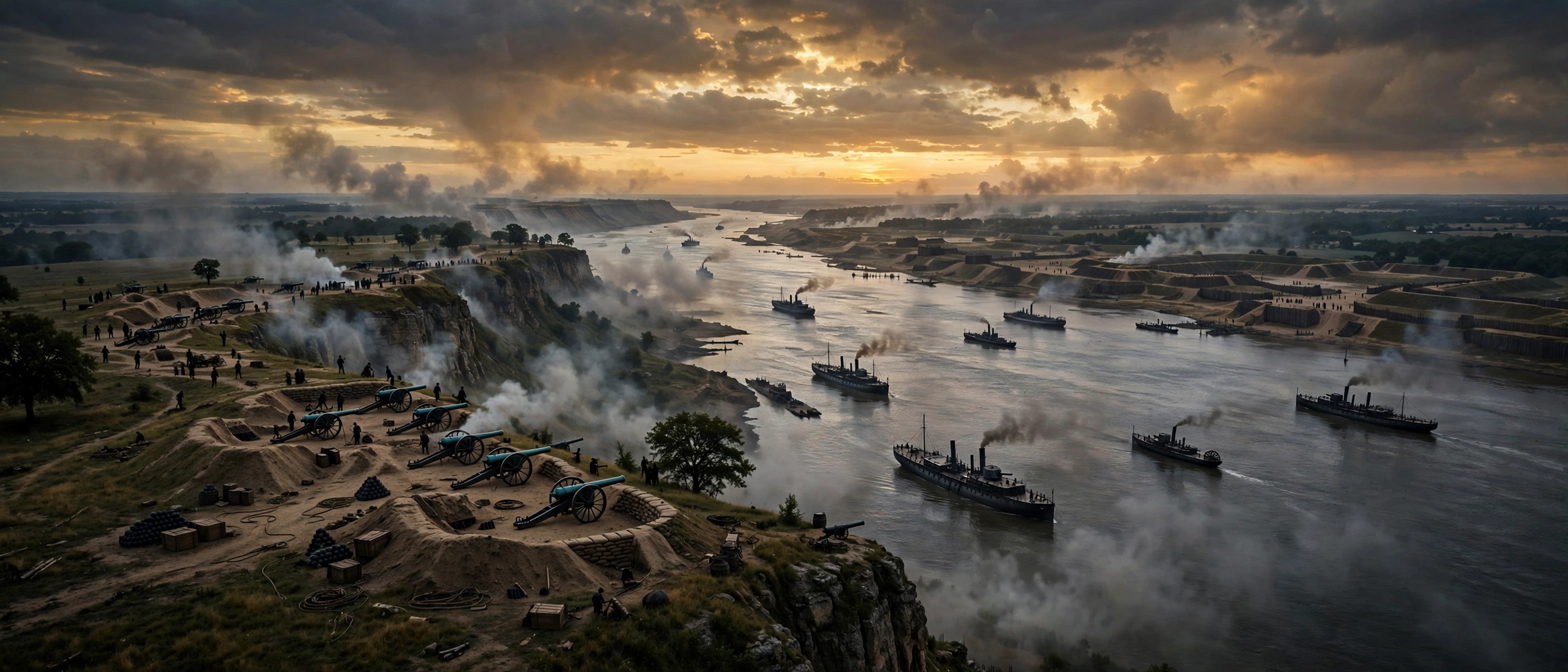
Picture this: a city on a bluff, two hundred feet above the Mississippi, guns staring down at every boat that dares pass. For two years that city — Vicksburg — had been the cork in the bottle. As long as the Confederacy held it, the great river stayed split, and Abraham Lincoln's plan to strangle the South stayed a dream. Then Ulysses S. Grant did something no one expected. He marched his army down the wrong side of the river, cut himself off from supplies, won five battles in seventeen days — and then settled in to starve the place out. Forty-seven days later, on the Fourth of July, an entire Confederate army stacked its rifles and quit.
This is the story of the Battle of Vicksburg, explained plainly: the dates, the suffering, the gamble, and why historians put it beside Gettysburg as the moment the Civil War turned.
The River: Why Vicksburg Mattered
Start with the map. The Mississippi River runs like a spine down the middle of America, and in 1863 it was the single most valuable piece of geography in the war. Whoever held the whole river could move troops and supplies north and south at will. Whoever held only half of it was cut in two.
By the spring of 1863, the Union held the river from its source down to just below Vicksburg, and from the Gulf of Mexico up to Port Hudson, Louisiana. Two Confederate fortresses — Vicksburg and Port Hudson — sat in between like two fists holding the river shut. Vicksburg was the bigger fist. Perched on high bluffs, its artillery commanded a hairpin bend in the river. Admiral David Farragut had tried running past those guns with his warships in 1862. The batteries chewed his fleet up and sent it back.
Lincoln understood the stakes better than anyone. "Vicksburg is the key," he said. "The war can never be brought to a close until that key is in our pocket." Grant — the Union's rising star in the West, fresh off victories at Fort Donelson and Shiloh — was the man handed the job of taking it. He'd been trying for over a year. Canals dug to bypass the city failed. A direct overland march failed. By April 1863, Washington was losing patience, and more than a few people in the capital were whispering that Grant drank too much to be trusted with an army.
Grant answered the whispers with the boldest move of his career.
Grant's Gamble: The Campaign
Here's what Grant did, and when you lay it out on a map it still looks slightly insane. Instead of attacking Vicksburg from the north, where the defenses were strongest, he marched his army down the west bank of the Mississippi, crossed to the east side at Bruinsburg on April 30, and then — this is the part that made his own officers nervous — cut loose from his supply lines and lived off the Mississippi countryside.
An army that size, marching without a supply line, was a gamble that could have ended in disaster. If Pemberton had concentrated his forces and hit Grant early, the whole campaign might have collapsed. But Pemberton was getting contradictory orders — his superior, Joseph E. Johnston, told him to abandon the city and save his army; the Confederate government in Richmond told him to hold Vicksburg at all costs. Caught between two masters, Pemberton did neither well.
What followed was one of the most brilliant campaigns in American military history. In seventeen days, Grant's men fought and won five battles — Port Gibson, Raymond, Jackson, Champion Hill, and Big Black River Bridge — marching over 180 miles, living off the land, and driving Pemberton's army back into the Vicksburg defenses. At Champion Hill on May 16, the biggest battle of the campaign, Grant smashed the Confederate field army and sent it reeling. Pemberton had no choice left. He pulled his men inside the city's fortifications and waited.
Grant arrived outside Vicksburg on May 18, confident and impatient. He'd been winning for three weeks straight. Why stop now?
May 19 and 22: The Assaults Fail
Victory disease is real, and Grant caught a dose of it. On May 19, the day after arriving, he ordered a direct assault on the Vicksburg defenses — nine miles of trenches, rifle pits, and artillery redoubts dug into rugged, ravine-cut ground. It failed. On May 22 he tried again, bigger this time, with the whole army. It failed worse.
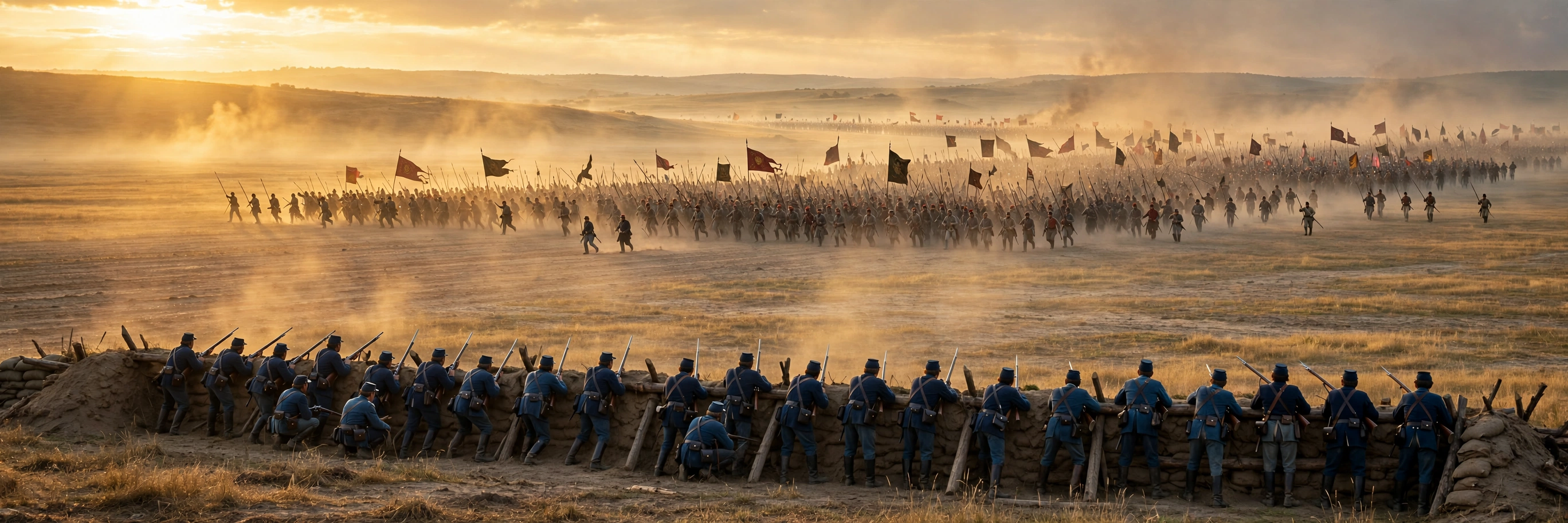
The May 22 assault is worth pausing on, because it shows what Civil War frontal attacks cost. Union soldiers charged across broken ground into interlocking fields of fire. In one sector, General John McClernand's men briefly broke into the Confederate works — then were thrown back. When the smoke cleared, Grant had lost about 3,200 men in a single day and gained nothing but a longer casualty list.
Grant was a fast learner. Two failed assaults told him what he needed to know: Vicksburg couldn't be stormed. It would have to be starved.
Grant's real genius wasn't stubbornness. It was knowing when to stop attacking — and start waiting.
The Siege: 47 Days Underground
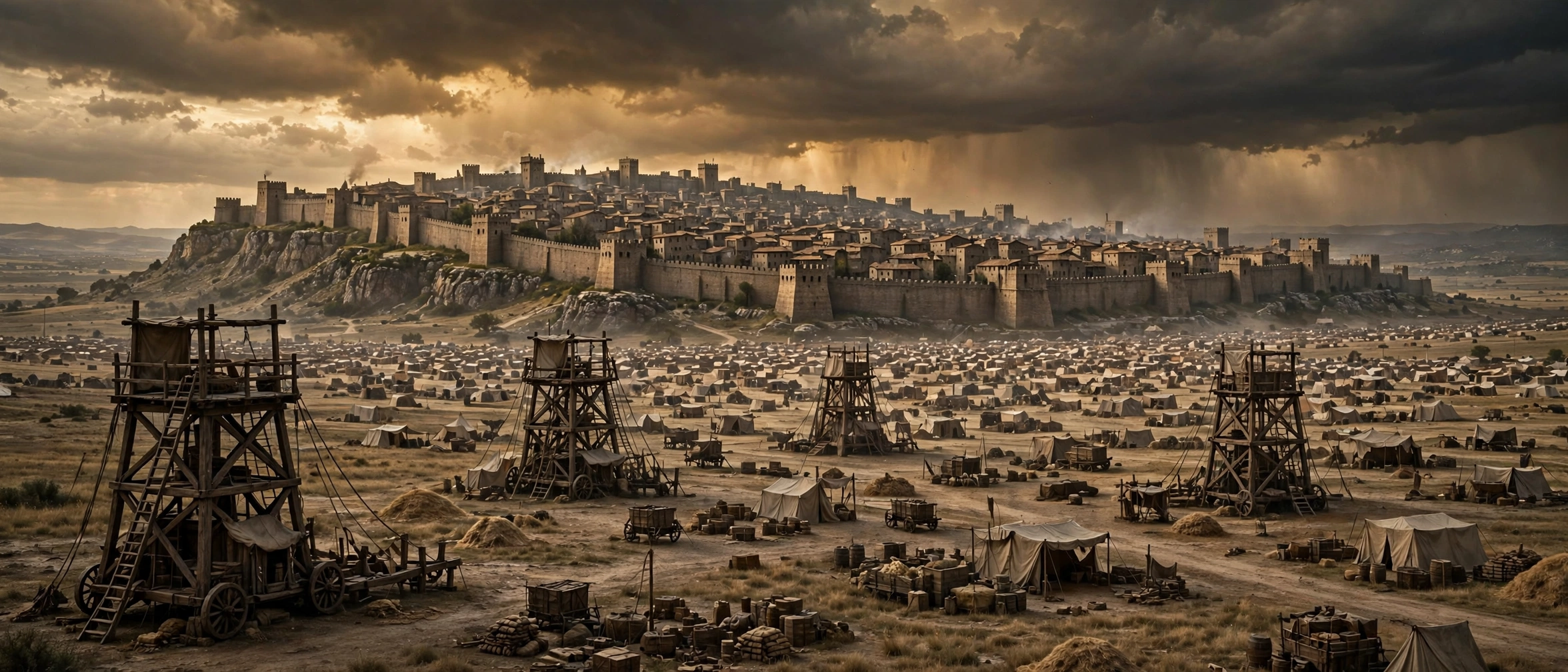
And so began the siege — 47 days that turned a proud river city into a burrow. Grant's engineers dug thirteen separate approaches: zigzag trenches creeping toward the Confederate lines, saps and parallels in the classic style, mines packed with black powder under the enemy's forts. Union artillery — over 200 guns, plus the navy gunboats on the river — pounded the city day and night. More than 20,000 artillery rounds fell on Vicksburg.
Inside, it got medieval fast. Civilians dug caves into the clay hillsides — hundreds of them — and moved underground to escape the shelling. Food ran out in stages, each worse than the last. First the fresh meat went, then the flour, then the mules. By late June, soldiers and townspeople were eating mule meat and, by some accounts, rats. A Confederate soldier's diary from those weeks reads like a slow-motion disaster: the bread shrinking, the coffee gone, the bombardment never stopping.
Pemberton kept hoping for rescue. Joseph E. Johnston was gathering a relief force to the east — but Johnston moved slowly, Grant posted Sherman with a strong force to block him, and the relief never came. On July 1, Johnston's men reached the Big Black River, within striking distance. Then Johnston hesitated, decided the odds were bad, and fell back. Inside Vicksburg, no one knew how close help had come.
By early July, Pemberton's men were too weak from hunger to man the trenches properly. Desertion was rising. The city's civilians were hollow-eyed. There was nothing left to do but the one thing a 19th-century general dreaded most: surrender an entire army.
July 4: Surrender
The negotiations had a strange, almost gentlemanly quality. Pemberton first proposed surrender terms; Grant demanded unconditional surrender — his famous formula. Pemberton balked. Then Grant, showing the political sense people rarely credit him with, softened: the Confederate soldiers would be paroled rather than shipped to prison camps. They'd sign a pledge not to fight again and go home. Pemberton accepted.
On July 4, 1863 — Independence Day — 29,495 Confederate soldiers marched out of their works, stacked their rifles, and surrendered. It was the largest surrender of an American army until Bataan in World War II. One hundred seventy-two cannons changed hands. Union losses for the whole siege: 4,835. Confederate: 32,697, most of them prisoners.
Here's the detail that tells you what Vicksburg meant to the people who lived it: the city did not celebrate the Fourth of July again until 1945. Eighty-two years of silence, because the day still tasted like defeat.
And the timing — Grant could not have scripted it better. The surrender came one day after Robert E. Lee's army began its retreat from Gettysburg, three days' march into Pennsylvania. July 3: Lee loses in the East. July 4: Pemberton surrenders in the West. Five days later, Port Hudson — the other fist on the river — gave up too. The Mississippi, as Lincoln put it, now ran "unvexed to the sea."
Why Vicksburg Decided the War
So why do historians rank Vicksburg beside Gettysburg as the war's turning point? Three reasons, each concrete.
First, geography. The Confederacy was now two countries that couldn't reach each other. Texas, Arkansas, and Louisiana — the South's breadbasket and its source of manpower west of the river — were cut off from Richmond. No more Texas beef for Lee's army. No more Louisiana sugar. The strategic map had been redrawn with a single surrender.
Second, Grant. Vicksburg made him. Before the campaign, he was a promising western general with enemies in Washington. After it, he was the man who'd taken the Gibraltar of the Confederacy — and Lincoln had found his general. Within a year, Grant commanded all Union armies, and the war's endgame began.
Third, the math of the thing. The Confederacy lost an entire field army — 30,000 men it could not replace — while the Union lost under 5,000. In a war the South was always going to lose on manpower, Vicksburg was the kind of exchange it couldn't survive repeating.
There's a final irony worth savoring. Pemberton, the Confederate commander, was a Pennsylvanian by birth — a Northerner who'd married a Southern woman and chosen the Confederacy. He surrendered on the Fourth of July, the holiday of the country he'd left. History doesn't always do symbolism this neatly. At Vicksburg, it did.
FAQ
Why was the Battle of Vicksburg important?
It gave the Union full control of the Mississippi River, splitting the Confederacy in two and cutting off Texas, Arkansas, and Louisiana from the eastern South. Coming a day after Gettysburg, it marks the war’s turning point.
How long did the Siege of Vicksburg last?
Forty-seven days — from May 18 to July 4, 1863. Grant tried two direct assaults first; when both failed with heavy losses, he settled in to starve the city out.
Who won the Battle of Vicksburg?
The Union. Confederate General John C. Pemberton surrendered about 29,000 men on July 4, 1863 — one of the largest surrenders of the war — and the victory made Ulysses S. Grant a national hero.
What happened to civilians during the Siege of Vicksburg?
They dug caves into the hillsides to escape the shelling and slowly starved — eating mules, dogs, and rats. Diarist Mary Loughborough’s account remains the most famous civilian record of the siege.
Was Vicksburg more important than Gettysburg?
Historians usually rank them together as the twin turning points of 1863. Gettysburg ended Lee’s invasion of the North; Vicksburg split the Confederacy geographically. Lincoln himself said the Mississippi would soon “go unvexed to the sea.”
Can you visit the Vicksburg battlefield today?
Yes — Vicksburg National Military Park preserves over 1,800 acres of the siege lines, with monuments, reconstructed earthworks, and the USS Cairo, one of the Union ironclads that served on the river.
Vicksburg was a siege as much as a battle — our ranking of the longest sieges in history puts its 47 days in sobering perspective. For the Civil War’s other 1863 turning point, see our Gettysburg guide — and for how later wars produced their own hinge moments, the Battle of El Alamein and Passchendaele.
Sources
- U.S. National Park Service — Vicksburg National Military Park: siege history and casualty figures.
- Shelby Foote, The Civil War: A Narrative, Vol. 2 — Fredericksburg to Meridian (Random House, 1963) — the classic campaign narrative.
- Michael B. Ballard, Vicksburg: The Campaign That Opened the Mississippi (University of North Carolina Press, 2004).
- American Battlefield Trust — Siege of Vicksburg battle summary and maps.