Battle of Borodino 1812: Napoleon's Bloodiest Day
Ten hours. A quarter of a million men. Seventy thousand casualties. And at the end of it, Napoleon Bonaparte held a patch of Russian farmland that won him nothing.
This is the Battle of Borodino, fought on September 7, 1812, on the road to Moscow. It was the largest and bloodiest single-day battle of the Napoleonic Wars, and one of the strangest. The French won it. The Russians lost it. And the Russians were the ones who walked away with the campaign. If that sounds backwards, keep reading. Borodino is the battle that proves winning and winning aren't the same thing.
Why did Napoleon march into Russia at all?
In June 1812, Napoleon was the master of Europe in a way nobody had managed since Charlemagne. Spain was bleeding him in a guerrilla war he couldn't end. Britain sat across the Channel, defiant and untouchable. But on land, his word was law from Lisbon to Warsaw. So what does a man like that do? He goes after the one great power he hasn't broken: Russia.
Russia's crime was buying British goods. Napoleon's whole grand strategy rested on the Continental System, a Europe-wide blockade meant to strangle Britain's trade until London begged for peace. Tsar Alexander I had signed on in 1807, then quietly let Russian merchants keep trading with Britain anyway. Money talks louder than treaties. By 1811, Napoleon had decided the Tsar needed a lesson, and when Napoleon taught lessons, he used the largest army Europe had ever assembled.
Before dawn on June 24, 1812, the Grande Armée began crossing the Niemen River into Russia. More than 600,000 men. Frenchmen, Poles, Italians, Germans, Croats, Swiss, Dutch. An army bigger than the entire population of Paris. The plan was simple, and very Napoleon. March in, smash the Russian army in one great battle near the border, take Moscow, and force Alexander to the negotiating table.
The Russians refused to play along. The main Russian army, under General Michael Andreas Barclay de Tolly, kept pulling back. Burned crops. Empty villages. Poisoned wells, sometimes. Scorched earth all the way east. For two months Napoleon chased a ghost across 800 kilometers of Russian summer, and his army dissolved around him. Typhus. Dysentery. Desertion. By mid-August, tens of thousands of his men were already gone, and he hadn't fought a single major battle.
Then Russian politics did what the French army couldn't. Barclay de Tolly was a fine strategist and a hopeless politician: Baltic German, spoke Russian with an accent, blamed by every aristocrat in St. Petersburg for every kilometer of the retreat. So at the end of August, Tsar Alexander replaced him. The replacement was a man the soldiers loved. The 67-year-old Prince Mikhail Kutuzov, one-eyed veteran of half a century of wars against Turks, Poles, and Frenchmen. Kutuzov understood Barclay's strategy perfectly. Russia would win by retreating. But he also understood something Barclay had missed. The army, the court, and the Tsar all needed one stand-up fight before Moscow. So he picked his ground. A village on the old Smolensk road. Borodino.
Who stood on the Borodino field?
The position Kutuzov chose ran about five kilometers along low ridges west of Moscow. His right flank sat on the village of Borodino itself and the marshy Kolocha River, a natural moat. His center held the high ground around a half-finished earthwork called the Great Redoubt, soon named for General Nikolay Raevsky. His left stretched toward the village of Semyonovskoye. There, engineers had thrown up three arrow-shaped earthworks pointing south, the flèches, held by Prince Bagration's Second Army.
The short definition: the Battle of Borodino was the largest and bloodiest single-day battle of the Napoleonic Wars, fought on September 7, 1812, between Napoleon's invading Grande Armée and the Russian army under Kutuzov. Over 250,000 men and 1,200 guns fought for ten hours near Moscow, leaving at least 70,000 dead and wounded.
That's 50 words, and everything else in this article is the detail. Now the numbers, because you asked. The modern consensus, the synthesis most English-language histories follow, puts roughly 109,500 French and allied troops actually engaged, out of about 130,000 present. The Russians engaged about 122,200 out of roughly 150,000 present, militia and Cossacks included. Guns: around 587 French, around 640 Russian. On paper, Russia had the edge. In training and experience, France did. Ten hours of fighting would prove the difference was smaller than anyone expected.
The men in charge deserve more than a roster. Napoleon, 43, at the height of his powers and the start of their end. Joachim Murat, King of Naples, commanded the cavalry: all gold braid and reckless personal courage, the kind of man who rode into cannon fire for the drama of it. Michel Ney, the bravest of the brave, spent the day exactly where the fire was hottest, because that was the only place Ney ever wanted to be. Louis-Nicolas Davout, the cold professional, had never lost a battle he commanded and wasn't planning to start. On the Russian side: Kutuzov, old, heavy, half-blind, and smarter than every French marshal on the field that day. Pyotr Bagration, the fiery Georgian prince commanding the Second Army on the left, the idol of the Russian soldiers. And Barclay de Tolly, still there, still serving, commanding the right wing after being stripped of supreme command. A proud man doing his duty in silence. Remember him. He matters.
The fight before the fight: Shevardino, September 5
Borodino's dress rehearsal came two days early, and it cost about 12,000 men. The French vanguard ran into the Shevardino Redoubt, a Russian strongpoint covering the left flank. General Andrei Gorchakov held it with roughly 11,000 men and a few guns. Napoleon threw about 40,000 men and 186 guns at it.
They fought all afternoon and into the dusk. The French took the redoubt. The Russians took it back. The French took it again. When darkness ended it, each side had lost around 6,000 men, and Kutuzov ordered Gorchakov back to the main position overnight. So what did the French actually win? A pile of dirt. And a warning. The Russians would die hard for every earthwork on this field.
September 6 was strangely quiet. Both armies spent the day in full view of each other, deploying, digging, waiting. Napoleon rode the lines. Kutuzov attended a church service. Neither man slept well that night. You wouldn't either.
September 7, 1812: Borodino hour by hour
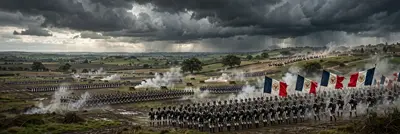
Before 6 AM: the guns open the day. Napoleon massed more than a hundred cannon against the Russian center and left and opened a bombardment so heavy that men who were there said the ground shook like a drumhead. Then Eugène de Beauharnais's corps struck the village of Borodino on the Russian right, took it, and was thrown out by a Russian counterattack. First blood to the defenders. But the village was only half the story. Napoleon's real blow was aimed at the left.
Morning: the flèches. Davout, Ney, and Murat hurled everything at Bagration's three arrow-shaped earthworks south of Semyonovskoye. The fighting here was the worst of the day, and that's saying a great deal. The flèches changed hands over and over. French columns would storm one, and then Russian counterattacks, often led by Bagration himself with a sword in his hand, would throw them back out. Around 9 or 10 in the morning, Bagration went down. A shell fragment shattered his leg. He refused to leave at first, then collapsed from blood loss. Gangrene set in. He died on September 24, twelve days later. The Russian left lost its commander and its soul in the same hour.
Midday: the Great Redoubt. While the left burned, Eugène's infantry and cavalry battered the Russian center. The redoubt fell to a French assault, then the Russians took it back in a furious counterstroke led by General Aleksey Yermolov. French troops caught in the open during the Russian counterattack were cut down in rows. The earthwork changed hands twice more. Around 2 PM, General Auguste de Caulaincourt, younger brother of Napoleon's famous diplomat, led a massed cuirassier charge straight at the redoubt. Heavy cavalry in steel breastplates, at full gallop, into massed artillery. It worked. The redoubt fell for good. Caulaincourt was killed inside the earthwork he had just taken, shot dead at the moment of victory. The French now held the key to the Russian center.
Afternoon: the moment that never came. By about 3 PM the Russian line was bent badly but unbroken. Ney and Murat both begged Napoleon to release the Imperial Guard, some 18,000 to 19,000 of the finest soldiers in Europe, sitting untouched in reserve. One push, they argued, and the Russian army would break apart. Napoleon refused. The Guard, he said, was too far from Paris to risk. Historians have argued about that sentence for two centuries. Was it caution? Illness? Napoleon was suffering from a heavy cold and a painful bladder condition that day, and several accounts describe him as oddly passive, directing the battle from his command post instead of riding the lines the way he used to.
Evening: the guns fell silent around 6 PM. The French held the flèches, the village of Semyonovskoye, and the Great Redoubt. They held the field. The Russian army, torn apart in places but still an army, formed up on the heights behind the battlefield and marched off in the night in good order. Napoleon had won the ground. He had not destroyed the enemy. And an enemy that survives a day like Borodino is an enemy that fights again.
Three moments that decided Borodino
1. The refusal of the Guard. Everything else flows from this one decision. With the Guard thrown in at 3 PM, the French might have smashed the Russian center completely and turned a bloody tactical win into the annihilation Napoleon needed. Without it, the Russians kept their army intact. Napoleon said he could not risk the Guard so far from France. Maybe. But generals who won't risk their reserves don't win campaigns. They win battlefields.
2. Bagration's wounding. When Bagration fell, the Russian left lost the one commander whose personal courage had been holding it together all morning. And yet, and this is the part the French never expected, the left didn't collapse. Barclay de Tolly rode down from the right, took charge, and the line held. An army that can lose its most beloved general at 10 in the morning and still be fighting at 6 in the evening has something deeper than leadership going for it.
3. Kutuzov's decision to leave. That night Kutuzov did the hardest thing a general can do. He looked at his shattered army and chose not to fight a second day. He withdrew toward Moscow. A week later, after the council of war at Fili on September 13, he abandoned Moscow itself. People called him a coward. He was trading space for time, and time was Russia's best general. He was right.
Borodino casualties: the bill for one day
So who won the Battle of Borodino? France. Tactically, completely, on paper. The French held every key position by nightfall, and Napoleon renamed the battle after the Moskva River and made Ney the Prince of the Moskva. But here's the bill.
French losses ran about 30,000 to 35,000 killed and wounded by most modern estimates, with some counts higher. Roughly 50 French generals were killed or wounded. The Russians lost around 40,000 to 45,000 men, with some estimates above 50,000. Twenty-nine Russian generals fell. Combined, at least 70,000 casualties in roughly ten hours. That's about 7,000 men per hour. More than a hundred per minute. It remains the bloodiest single day of the entire Napoleonic Wars, and one of the bloodiest days in all of recorded warfare. Our ranking of the bloodiest battles in history puts it in grim company.
And here's the honest downside nobody on the French side wanted to face. The Russians could replace their losses. The French could not. Every French casualty at Borodino was gone for good, 800 kilometers from home with winter coming on. Every Russian casualty was mourned in a country that was only getting started. Kutuzov lost the battle. He kept the war. That was the trade, and he made it deliberately.
Why Borodino actually mattered (nobody won this battle)
The Battle of Borodino mattered because it won nothing and decided everything.
A week after Borodino, Napoleon marched into Moscow. The great prize. And found it empty. The population had fled. Then the fires began, and over four days most of the wooden city burned to the ground. Who set them is still argued, but they were set deliberately, and Napoleon's army sat in the ashes for five weeks waiting for a peace offer from Tsar Alexander that never came. No supplies. No winter clothing. No plan.
On October 19, Napoleon began the retreat. What followed was one of the great catastrophes in military history. Cold, hunger, Cossack raids, and the Russian winter destroyed the Grande Armée on the road home. Of the more than 600,000 men who had crossed the Niemen in June, only a remnant staggered back out. Napoleon had conquered Moscow and lost his army. Our Battle of Waterloo summary picks up his story three years later, when the empire he broke in Russia finally fell for good.
Honestly, Borodino is the most overrated French victory of the Napoleonic Wars. It looks magnificent on a map. It changed nothing except the casualty lists. The real winner of September 7, 1812, was the Russian strategy. Trade space for time. Trade a battle for a campaign. Let winter do what no general could. Napoleon beat Kutuzov's army. He couldn't beat Kutuzov's calendar.
The honest downside: what we can't be sure about
Fair warning before you quote this article at a dinner party. Borodino's numbers are soft around the edges, and anyone who tells you otherwise is guessing. Strength figures vary because historians count differently. Some count every man present. Some count only those engaged. The Russian militia and Cossack numbers weren't recorded properly. The engaged figures used here, about 109,500 French and 122,200 Russians, come from the modern synthesis most English-language histories use. Why such wide ranges? Because 19th-century armies were terrible at counting their own dead, and both sides shaded the numbers afterward.
The French called it the Battle of the Moskva, after the river, which is why French sources say Bataille de la Moskova. The date is September 7 in the Western calendar, August 26 in the Russian calendar of the time. Napoleon's remark at St. Helena, that of his fifty battles the one before Moscow was the most terrible, comes from his exile memoirs and may have been polished by the men who wrote them down. The losses need no polishing. Nobody disputes those.
3 lessons from Borodino
Borodino is a battle, but it is also a warning. Three lessons worth keeping.
1. Winning the battle isn't winning the war. Napoleon took every objective on the field and lost the campaign. If your plan needs the enemy to behave the way you want, you don't have a plan. You have a wish. Kutuzov understood this. Napoleon, for exactly one campaign, forgot it.
2. Reserves are for using. The Imperial Guard sat idle while the battle hung in the balance, because Napoleon was saving it for a future that never came. Caution with your best troops is just another way of losing them later, which is precisely what happened on the retreat. When the moment is real, spend the reserve.
3. Logistics beat tactics. The French won every tactical fight that mattered on September 7. It didn't matter. They were 800 kilometers from their supplies, the Russians had burned everything behind them, and winter was six weeks away. No battlefield brilliance fixes an empty supply wagon. There is an old military saying that amateurs study tactics while professionals study supply lines. Borodino is the proof.
If this one grabbed you, read our Battle of Waterloo summary for the end of Napoleon's story, or our Battle of Austerlitz explained for the peak of it. Borodino sits exactly between them: the day the greatest army in Europe won a battle and started losing everything.
Frequently Asked Questions
Straight answers, no hedging.
The short definition: the Battle of Borodino (7 September 1812) was a ten-hour battle near Moscow in which Napoleon's Grande Armée defeated Kutuzov's Russian army at a cost of at least 70,000 casualties, the bloodiest single day of the Napoleonic Wars, yet failed to destroy the Russian army.
That's 50 words, and the rest of the article is the detail.
Who won the Battle of Borodino?
France won the battle; Russia won what mattered. On September 7, 1812, Napoleon's army took every key position on the field after ten hours of fighting. But Kutuzov withdrew his army in good order that night, and a month later the French were retreating from a burned, empty Moscow into the Russian winter. Tactical French victory. Strategic dead end.
How many died at the Battle of Borodino?
At least 70,000 men were killed or wounded in about ten hours, which makes Borodino the bloodiest single day of the Napoleonic Wars. French losses ran roughly 30,000 to 35,000. Russian losses ran roughly 40,000 to 45,000, with some estimates higher. Around 50 French generals and 29 Russian generals were killed or wounded.
Why is Borodino also called the Battle of the Moskva?
The French named their victories, and Napoleon named this one after the Moskva River, which flows near the battlefield. In French histories it is the Bataille de la Moskova. Napoleon even created Michel Ney "Prince of the Moskva" for his conduct in the battle. Russians have always called it Borodino, after the village.
Why didn't Napoleon commit the Imperial Guard?
Ney and Murat begged him to release the Guard, about 18,000 to 19,000 elite troops held in reserve, for one final push around 3 PM. Napoleon refused, saying the Guard was too far from France to risk. Historians still argue about it. He was also ill that day, with a heavy cold. The decision likely cost him his only chance to destroy the Russian army.
Related Battles
Hungry for more? These are worth your time: