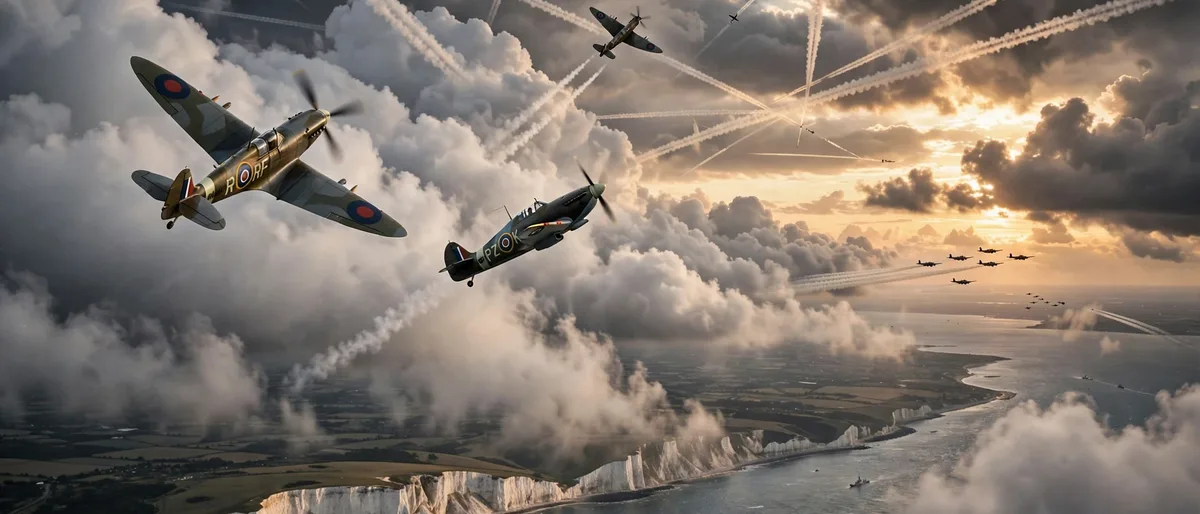
This battle of Britain 1940 summary covers the first major military campaign in history fought entirely in the air — and the first major defeat of Nazi Germany in World War II. From July 10 to October 31, 1940, the German Luftwaffe tried to destroy Britain's Royal Air Force as a prelude to invasion. They failed. Outnumbered and exhausted, RAF Fighter Command — "the Few" — held the skies over southern England through the summer and autumn of 1940, and in doing so, they saved Britain from invasion and changed the course of the war. This is the story of how it happened.
Background: Britain Alone
To understand this battle of Britain 1940 summary, you have to grasp how desperate Britain's situation was in the summer of 1940.
France had fallen. In six weeks — May to June 1940 — the German blitzkrieg had shattered the French army, the finest in Europe, and driven the British Expeditionary Force into the sea at Dunkirk. Britain had rescued its soldiers but abandoned almost all its heavy weapons on the beaches. The British army was essentially disarmed.
Across the Channel stood a Germany at the peak of its power, having conquered Poland, Denmark, Norway, Holland, Belgium, and France in ten months. Hitler expected Britain to negotiate. When Winston Churchill — Prime Minister since May 10 — made clear that Britain would fight on, Hitler ordered preparations for Operation Sea Lion: the invasion of England.
But invasion required air superiority. The Luftwaffe, under Hermann Göring, had to destroy the RAF's Fighter Command first. Göring promised Hitler it would take weeks. He was wrong.
Britain's defense rested on a remarkable system built by Air Chief Marshal Hugh Dowding, head of Fighter Command. The "Dowding System" was the world's first integrated air defense network: radar stations along the coast (Chain Home) detected incoming raids; an underground operations room at Bentley Priory filtered the information; and fighter squadrons were scrambled by radio-telephone to intercept. It was revolutionary — the first time in history that defenders could see attackers coming and meet them with exactly the right force. Without it, Britain's few hundred fighters could never have defended the entire south coast.
Against them: the Luftwaffe could deploy roughly 2,600 aircraft, including formidable Messerschmitt Bf 109 fighters and fleets of Heinkel, Dornier, and Junkers bombers. Fighter Command had about 650 serviceable fighters — Hurricanes and Spitfires — and roughly 1,400 pilots. Many were barely trained. The average age of an RAF fighter pilot in 1940 was 20. The youngest was 18.
Phase One: The Channel Battles (July–August)
The battle opened on July 10, 1940, with attacks on British shipping in the English Channel — the Kanalkampf, or "Channel battles." The Luftwaffe tried to lure RAF fighters into combat over the water, where downed British pilots would drown and downed Germans might be rescued.
Dowding refused to take the bait on a large scale. He husbanded his forces, engaging only when necessary. This restraint — frustrating to aggressive squadron commanders — was strategically brilliant. Every pilot and plane saved in July would be desperately needed in August.
On August 13 came Adlerangriff — "Eagle Attack," the Luftwaffe's all-out assault on Fighter Command. Göring threw everything at the RAF's airfields and radar stations. For two weeks, the Luftwaffe pounded coastal airfields, then pushed inland toward the vital sector stations — the underground operations rooms that controlled Fighter Command's squadrons.
The fighting was ferocious. On August 18 — "the Hardest Day" — both sides suffered their heaviest losses of the battle to that point. But a critical German error was emerging: their intelligence was terrible. They consistently overestimated RAF losses and underestimated British fighter production. British factories were actually producing more fighters than were being lost — around 400 per month. The Luftwaffe thought Fighter Command was on its last legs. It wasn't.
Phase Two: The Critical Weeks (Late August–Early September)
The battle's decisive phase ran from August 24 to September 6. The Luftwaffe concentrated on destroying Fighter Command's airfields and sector stations in southeast England — the heart of Britain's air defense.
This was Dowding's nightmare fortnight. Airfields were cratered. Operations rooms were bombed — one direct hit could have blinded an entire sector. Pilots were flying four or five sorties a day, landing, refueling, and going straight back up. Exhaustion was killing as many pilots as Germans were. On August 31, Fighter Command suffered its worst day of the battle.
And yet the system held. Damaged airfields were repaired overnight. The radar chain, though battered, kept functioning. New pilots — many of them Polish, Czech, Canadian, Australian, and New Zealand volunteers whose skill and aggression astonished everyone — kept arriving. The Polish 303 Squadron, flying Hurricanes, became the highest-scoring squadron in Fighter Command during the battle.
The Luftwaffe was closer to winning than they knew — and further than they thought. German intelligence insisted the RAF was down to its last 200 fighters. In reality, Fighter Command was bruised but intact, and British production was replacing losses.
Then the Germans made the mistake that lost them the battle.
The Blitz Begins: September 7
On the night of August 24, a German bomber crew, lost and off course, accidentally dropped bombs on central London — the first bombs to fall on the capital. Churchill ordered immediate retaliation: RAF bombers struck Berlin. It was militarily insignificant but psychologically enormous. Hitler was enraged. He had promised the German people that no enemy bomber would ever reach Berlin.
On September 7, Göring shifted the Luftwaffe's entire weight from RAF airfields to London. Nearly 1,000 German aircraft attacked the capital in daylight — the first day of what became known as the Blitz. The docks burned. The East End suffered terribly. But the strategic effect was exactly the opposite of what Germany intended: the pressure came off Fighter Command's shattered airfields at the critical moment. The exhausted squadrons got breathing room. Damaged sector stations were repaired. Dowding's system recovered.
It was, as historians have called it, the Luftwaffe's fatal blunder — born of rage rather than strategy.
September 15: Battle of Britain Day
The climax came on September 15, 1940 — now commemorated as Battle of Britain Day.
The Luftwaffe launched its largest daylight assault of the entire battle: two massive waves totaling around 1,500 aircraft aimed at London, intended to force Fighter Command into a final battle of annihilation. Göring believed one more great push would break the RAF.
Instead, Fighter Command met the raids with everything it had. Squadron after squadron was scrambled. The skies over London and the Thames Estuary filled with hundreds of aircraft in swirling dogfights visible to millions on the ground. By day's end, the Luftwaffe had lost 58 aircraft destroyed — against 29 RAF fighters. The German formations were broken up, their bombing scattered and ineffective.
Two days later, on September 17, Hitler indefinitely postponed Operation Sea Lion. The invasion of Britain was dead. Daylight bombing continued into October but at unsustainable cost, and by the end of the month the Luftwaffe had effectively given up the daylight campaign. The battle is officially dated as ending on October 31, 1940.
The Few
On August 20, 1940, in the middle of the battle, Winston Churchill paid tribute to Fighter Command in words that have echoed ever since: "Never in the field of human conflict was so much owed by so many to so few."
The numbers behind the tribute: some 2,936 aircrew flew with Fighter Command during the battle. Of these, 544 were killed — roughly one in five. The average squadron lost a third of its pilots. They came from Britain, Poland, Czechoslovakia, Canada, Australia, New Zealand, South Africa, Ireland, and a dozen other nations. They were, most of them, barely out of school.
Their victory was narrow. Had the Luftwaffe continued attacking airfields for two more weeks instead of switching to London, Fighter Command might have broken. Had German intelligence been accurate, Göring might have persisted. The margin between survival and defeat was measured in days.
Aftermath and Why It Matters
The Battle of Britain was the first major German defeat of World War II — and its consequences were enormous.
First, it kept Britain in the war. Had Fighter Command been destroyed and Sea Lion launched, Britain might have been invaded, occupied, or forced to negotiate. Instead, Britain survived as the unsinkable aircraft carrier from which the liberation of Europe would eventually be launched. Without the Battle of Britain, there is no D-Day.
Second, it was the first proof that Hitler could be stopped. Until the summer of 1940, the German war machine had seemed invincible — Poland in weeks, France in six weeks. The RAF's victory shattered the myth of invincibility and gave hope to every occupied nation in Europe. It proved that air power alone could not win wars, and that a well-organized defense could defeat a stronger attacker.
Third, it pioneered modern air warfare. The Dowding System — radar, centralized command, controlled interception — became the template for air defense worldwide. The battle demonstrated the decisive importance of intelligence, logistics, and industrial production in air warfare. The Spitfire became a legend; the Hurricane, which actually shot down more German aircraft, became the quiet workhorse of victory.
For Dowding himself, the reward was dismissal. In November 1940, partly due to internal RAF politics over fighter tactics (the "Big Wing" controversy), Dowding was removed from command. It remains one of the shabbiest episodes in British military history — the architect of victory sacked months after winning. History has been kinder to him than his superiors were.
The battle's human cost is remembered every September 15. The 544 aircrew who died — their average age just 20 — bought with their lives the survival of their nation. Churchill's tribute stands as their epitaph: never was so much owed by so many to so few.
Sources
- Battle of Britain — Wikipedia (https://en.wikipedia.org/wiki/Battle_of_Britain)
- Imperial War Museums — Battle of Britain (https://www.iwm.org.uk/history/second-world-war/battle-of-britain/things-you-need-to-know)