Shortly after midnight on June 6, 1944, the sky over Normandy filled with airplanes — thousands of them — and young men began jumping out into the dark. By dawn, the greatest armada ever assembled was spread across the English Channel: nearly 7,000 vessels carrying more than 150,000 soldiers toward five stretches of French beach. What happened over the next 24 hours would become the most famous single day of the Second World War.
This is the American story of that day, because two of the five beaches were America's — and one of them, Omaha, became a byword for courage under fire. But D-Day belongs to everyone who was there: the British and Canadians on Gold, Juno, and Sword; the paratroopers who dropped behind the lines in the dark; the sailors, airmen, and French civilians caught in the middle. Here's how the longest day unfolded.
Why June 6: Weather, Tides, and a General's Gamble
D-Day was supposed to be June 5. Then the weather turned — low clouds, high winds, rough seas in the Channel — and General Dwight D. Eisenhower, the Supreme Allied Commander, made one of the loneliest decisions in military history: postpone 24 hours. The armada was already loaded. Men were already seasick in landing craft. Turning back meant chaos; going ahead meant disaster.
Eisenhower's meteorologists spotted a brief break in the weather for June 6. It wasn't good — just barely good enough. The tides had to be right (low tide at dawn, to expose the beach obstacles), the moon had to be up (for the airborne drops the night before), and all three had to coincide. June 6 was the last workable day for weeks. Eisenhower polled his commanders in a tense meeting, listened, and said simply: 'OK, let's go.'
He also did something few commanders do: he wrote a second statement, in case the invasion failed — taking full personal blame. He put it in his wallet and never needed it. But the fact that he wrote it tells you what June 6 felt like from the inside: not inevitable triumph, but a gamble with 150,000 lives as the stake.
Fortitude: The Greatest Lie of the War
Here's a secret that saved thousands of lives on D-Day: the Germans were looking the wrong way. For months, the Allies had run Operation Fortitude — an elaborate deception convincing German intelligence that the real invasion would come at Pas-de-Calais, the narrowest point of the Channel, not Normandy. Fake armies (complete with inflatable tanks and dummy landing craft), double agents feeding false reports, fake radio traffic — the whole theater.
It worked beautifully. On June 6, Hitler remained convinced Normandy was a feint, a diversion before the 'real' attack at Calais. He refused to release the panzer reserves near Paris. Rommel — the one German commander who'd correctly guessed Normandy and frantically fortified it — was away in Germany for his wife's birthday, and by the time he rushed back, the beaches were lost. The Atlantic Wall, his great coastal fortress, would have to hold without its architect and without its reserves.
Deception doesn't win battles by itself. But on D-Day, it meant the men hitting those beaches faced a fraction of the force Germany could have brought against them. Fortitude may be the single most cost-effective operation of the war: a lie, told well, that saved lives by the thousand.
After Midnight: The Paratroopers Drop Into Darkness
Hours before the first landing craft touched sand, the invasion had already begun — from the sky. Around 1:30 a.m., American paratroopers of the 82nd and 101st Airborne Divisions began jumping over the Cotentin Peninsula behind Utah Beach; British 6th Airborne dropped east of the Orne River. Their missions: seize bridges and road junctions, silence gun batteries, and sow chaos in the German rear.
It did not go as planned — nothing on D-Day quite did. Low clouds scattered the transport planes; paratroopers landed miles from their drop zones, alone or in small groups, in flooded fields and Norman hedgerows. Some drowned in the marshes, weighed down by equipment. But here's the strange alchemy of airborne operations: the very scattering that ruined the plan also ruined the German response. Small groups of paratroopers were everywhere, attacking from every direction, and German commanders — getting fragmentary reports of landings across the whole peninsula — concluded they faced a far larger force than existed.
By dawn, key bridges were held, a vital gun battery at Brécourt Manor had been silenced by a handful of men from the 101st, and the Germans behind Utah Beach were thoroughly confused. The paratroopers had paid a heavy price for it. But they'd bought the beaches time — and time, on June 6, was everything.
6:30 AM: The Ramps Drop
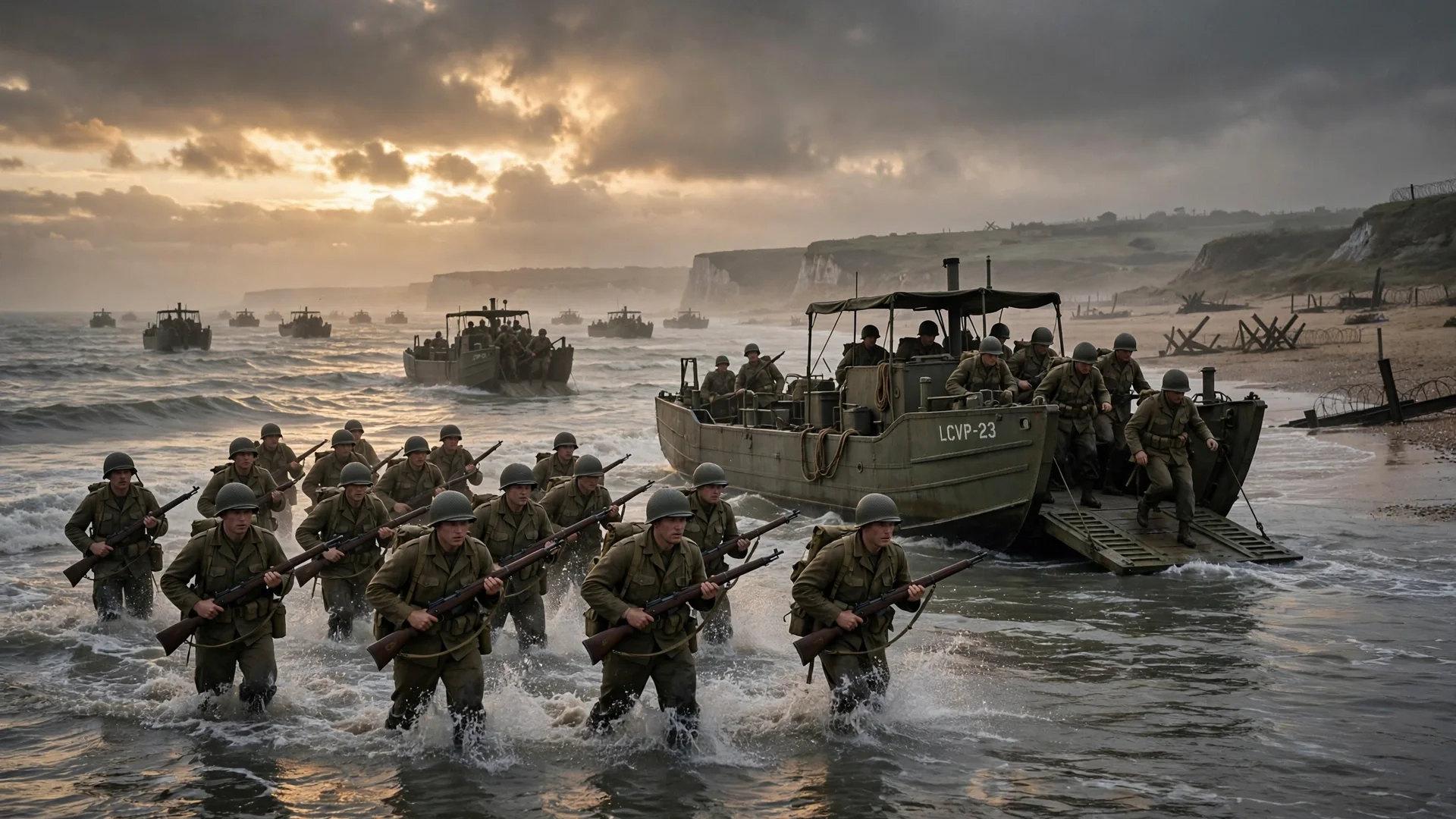
At 6:30 a.m., the naval bombardment lifted, the landing craft ground onto the sand, and the ramps dropped. What the men saw when those ramps fell depended entirely on which beach they'd drawn.
Utah Beach — the westernmost, American — was the luckiest. Strong currents had pushed the landing craft nearly a mile south of their target, to a less-defended stretch. The 4th Infantry Division waded ashore against light opposition, took fewer than 600 casualties all day, and pushed inland fast. Brigadier General Theodore Roosevelt Jr. — 56 years old, arthritic, walking with a cane — landed with the first wave, personally reconnoitered the beach under fire, and calmly redirected follow-on waves. He'd earn the Medal of Honor and die of a heart attack a month later. Utah was, by D-Day standards, a triumph.
Gold, Juno, and Sword — the British and Canadian beaches to the east — were harder fought but successful. British troops took Gold with around 1,000 casualties; Canadians at Juno suffered over 1,000, including 370 killed; the British 3rd Division at Sword took about 1,300. By evening, all three beachheads were secure and pushing inland, though none had reached their ambitious first-day objectives.
And then there was Omaha.
Omaha: The Beach That Almost Broke
Omaha Beach was the bloodiest ground of D-Day, and the reasons were a cascade of bad luck and German competence. The pre-invasion bombing — supposed to crater the defenses — had missed almost entirely, the bombers dropping late to avoid hitting their own troops. The amphibious DD tanks, meant to swim ashore and support the infantry, were launched too far out in heavy seas: of 29, only 2 made it to the beach under their own power. The rest sank with their crews.
Worst of all, intelligence had missed something critical: the beach wasn't held by the second-rate static division expected, but by the veteran German 352nd Infantry Division — battle-hardened men in superbly sited positions on the bluffs above the beach, with interlocking fields of fire covering every yard of sand.
So when the ramps dropped at Omaha, the 1st and 29th Infantry Divisions walked into a killing zone. Machine guns, mortars, and artillery scythed the first waves. Men drowned under the weight of their packs before reaching the sand; those who made it found no cover on the open beach, the obstacles still intact, the engineers meant to clear them dead or pinned down. For hours, the landing teetered on the edge of catastrophe — some officers considered evacuating.
What saved Omaha was the oldest thing in war: small groups of men refusing to quit. Survivors — leaderless, mixed from shattered units — began improvising assaults up the bluffs between the strongpoints, scaling cliffs under fire, outflanking pillboxes one by one. Destroyers, seeing the crisis, ran dangerously close inshore and poured naval gunfire directly onto the German positions. By late afternoon, two fragile footholds existed. By nightfall, 34,000 Americans were ashore. The cost: around 2,400 casualties — the highest of any beach, and every one of them earned in the most literal sense.
By Nightfall: Five Footholds in France
When the sun set on June 6, the Allies held five separate beachheads along fifty miles of Normandy coast — not yet joined up, not yet secure, but there. About 156,000 men had landed. The Germans had been pushed back everywhere, though nowhere broken. It was, by any measure, a staggering achievement: the largest amphibious operation in history, executed against a fortified coast, had succeeded on its first day.
The price was staggering too. More than 4,400 Allied troops were confirmed dead — the single costliest day for the Western Allies in the war's European theater — with total casualties above 10,000. German losses were comparable. And behind the beaches, French civilians were dying under the Allied bombing meant to isolate the battlefield; their suffering is the part of D-Day least remembered and least forgivable.
But the foothold held. Within a week, 326,000 men were ashore. By month's end, 850,000. The Atlantic Wall — the fortress Hitler had boasted would repel any invasion — had been breached in a day. What remained was the long, grinding campaign across Normandy's hedgerows, but the strategic question was settled on June 6: the Allies were in France to stay, and Germany now faced a two-front war it could not win.
Why D-Day Worked: Five Reasons
First, deception. Fortitude kept German armor away from Normandy on the one day it mattered most. Second, air and sea supremacy: 14,000+ Allied aircraft flew that day against almost no German opposition, and 7,000 vessels delivered the army unopposed. No invasion in history had enjoyed such overwhelming superiority in every supporting arm.
Third, the Germans' command paralysis. Hitler's insistence on personally controlling the panzer reserves — combined with his conviction that Normandy was a feint — meant the one force that could have crushed the beachheads sat idle while the Allies consolidated. Rommel's absence compounded it. An army commanded by committee, against an enemy with a single clear plan, is an army already half-beaten.
Fourth, Allied flexibility under fire. Nothing went according to plan — not the drops, not the beaches, not the timings — and at every level, from Roosevelt on Utah to the anonymous sergeants on Omaha, men adapted. The plan got them ashore; improvisation got them off the beaches.
And fifth, the simplest reason: sheer weight. 156,000 men, 7,000 ships, 14,000 aircraft, years of preparation. D-Day worked because the Allies brought more of everything than the Germans could match, and applied it all on a single day. There's nothing elegant about that explanation. It's just true.
The Cost and the Meaning
Visit Normandy today and the scale of it is still overwhelming. The American cemetery above Omaha Beach holds 9,388 graves — row on row of white crosses and Stars of David facing west, toward home. The British, Canadian, and German cemeteries tell their own versions. Every June 6, old men — fewer each year — return to those beaches, and the world remembers for a day what they did.
What did it mean? In the narrow sense, D-Day opened the Western Front and doomed Nazi Germany to a two-front war. In the wider sense, it was the moment the liberation of Western Europe became inevitable — the beginning of the end, eleven months before Berlin fell.
But there's a harder meaning too, and it's worth sitting with. D-Day was a triumph of planning, courage, and industrial power — and it was also a day when thousands of young men died in the surf for objectives measured in yards, when French civilians died under 'friendly' bombs, when the sea ran red at Omaha. The glory and the horror aren't separable. They're the same day. Remembering D-Day honestly means holding both at once: the greatest amphibious victory in history, and the price tag, written in lives, that came with it.
How does D-Day's cost compare with the Eastern Front's meat grinders? Our ranking of the bloodiest battles of WW2 puts June 6, 1944 in sobering perspective.
Sources
- HISTORY — “D-Day: Normandy Beaches Invasion” (history.com).
- Commonwealth War Graves Commission — “D-Day casualties in numbers” (cwgc.org).
- Stephen E. Ambrose — D-Day: June 6, 1944: The Climactic Battle of World War II (Simon & Schuster, 1994).
- Cornelius Ryan — The Longest Day (Simon & Schuster, 1959).