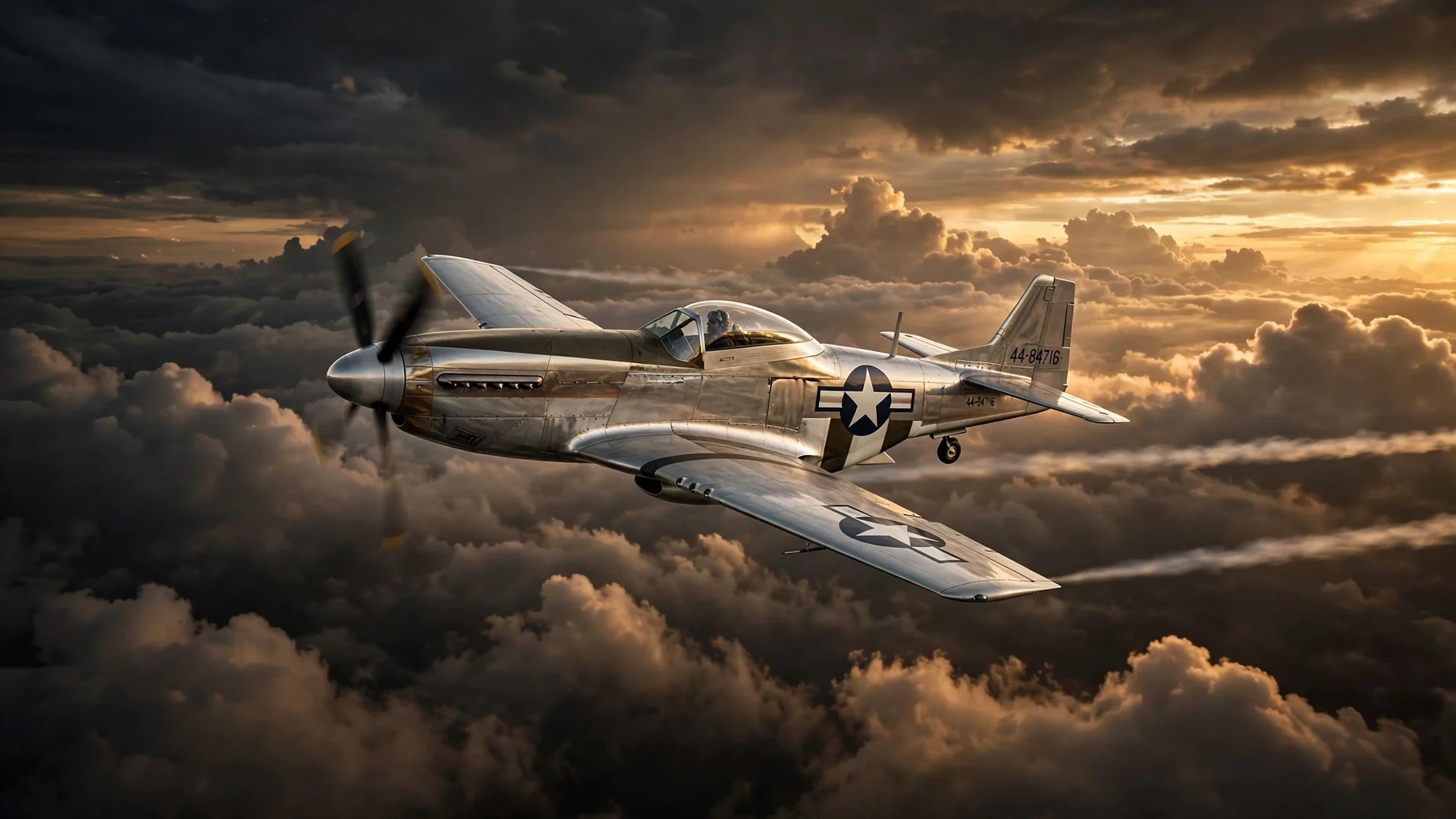
Ask ten aviation historians to name the best fighter plane of World War II and you'll get at least six different answers — delivered with feeling. The Spitfire people will talk about the summer of 1940 with misty eyes. The Mustang crowd will point at Berlin. Someone will bring up the Zero, and someone else will get genuinely angry about the Fw 190. They're all half right, which is what makes this question worth asking properly.
So let's do it honestly: five legendary fighters, real specifications, what each one did best — and why the only truthful answer to "which was the best" starts with "it depends."
How Do You Judge a Fighter?
A fighter isn't fast or slow in a vacuum — it's fast or slow at a job. The fair measures: speed (who dictates the fight), range (can it get to the fight), firepower (can it finish the fight), maneuverability (can it win the turning battle), and the two things spec sheets hide — numbers built and how forgiving it was to average pilots. A brilliant plane that only aces could fly was worth less than a good plane anyone could fight in.
Keep that scorecard in mind. Every contender below aced some categories and flunked others.
5. Focke-Wulf Fw 190 — The Butcher Bird
Top speed: ~408 mph | Range: ~500 miles | Armament: 2×20mm cannon, 2×13mm + 2×7.92mm machine guns
When the Fw 190 appeared over France in late 1941, the RAF got a nasty shock. Here was a German fighter that could out-roll the Spitfire V, out-gun it, and out-dive it — all at once. British pilots who'd grown comfortable tangling with Bf 109s suddenly found themselves outclassed, and stayed that way until the Spitfire IX arrived to even the odds.
German pilots adored it — they called it the Würger, the Butcher Bird. It was rugged, stable as a gun platform, and its wide-track landing gear made it far easier to handle on the ground than the twitchy Bf 109. Kurt Tank's design stayed competitive right to 1945, which is remarkable for an airframe born in 1939. Its weakness? At very high altitude the early BMW radial wheezed, and by 1944 Germany was short of the experienced pilots who could exploit what the 190 did best: the slashing, high-speed attack.
4. Mitsubishi A6M Zero — The Long-Range Dancer
Top speed: 331 mph | Range: 1,929 miles | Armament: 2×20mm cannon, 2×7.7mm machine guns
Read that range figure again: 1,929 miles — on internal fuel, in 1940. Nothing else in the world came close. The Zero could escort bombers from carriers hundreds of miles out, appear where no fighter had any right to be, and then out-turn anything it met. From Pearl Harbor through the first half of 1942, it owned the Pacific sky, and Allied pilots were under strict orders not to dogfight it.
But Jiro Horikoshi bought that agility and range with a terrible bargain: no armor around the pilot, no self-sealing fuel tanks. A few hits and the Zero became a torch. Once the Americans captured an intact Zero in the Aleutians in 1942 and learned exactly how it flew, and once the Hellcat and Corsair arrived with speed and protection, the Zero's day ended. Over 10,900 were built — brave men flew them to the end — but by 1944 it was an obsolescent plane in a war that had moved on.
3. Messerschmitt Bf 109 — The Relentless Workhorse
Top speed: ~413 mph (G model) | Range: ~400–528 miles | Armament: 1×20mm cannon + 2×13mm machine guns
Here is the most-produced fighter aircraft in history: around 35,000 Bf 109s, fighting from Spain in 1937 to the last days of 1945. It was there for all of it — the Battle of Britain, the Eastern Front, the defense of the Reich. German aces ran up scores in it that still look unreal: Erich Hartmann's 352 victories, all in 109s.
The 109 was a superb climber and diver, and in the right hands it remained deadly to the end. Its flaws were real, though. That short range — barely 400 miles — meant it could never escort bombers deep into England or Russia. The narrow landing gear killed trainee pilots by the hundred. And the cockpit was so cramped that larger pilots genuinely struggled. It was a 1935 design asked to fight a 1945 war, and the fact that it nearly managed is a tribute to the airframe — and to the men who flew it long past its prime.
2. Supermarine Spitfire — The Icon
Top speed: 369 mph (Mk V) | Range: ~470 miles | Armament: 8×.303 machine guns (or 2×20mm + 4×.303)
No plane is more loved. The Spitfire's elliptical wings are the most beautiful shape ever to go to war, and in the summer of 1940 it did the thing legends are made of: with the Hurricane, it broke the Luftwaffe over southern England and saved Britain from invasion. R.J. Mitchell, its designer, died of cancer in 1937 — he never saw what his creation became.
As a pure flying machine, pilots consistently rated the Spitfire the sweetest-handling fighter of the war — light on the controls, a dream in a turning fight. It evolved brilliantly through the war, from the Mk I to the Griffon-engined Mk XIVs that could chase V-1 flying bombs. Its limits were range (it was a short-legged home-defense interceptor at heart) and firepower early on — those eight little .303s sometimes just annoyed a bomber. But ask a pilot, then or now, which plane they'd choose for the sheer joy of flight, and the answer is almost always the Spitfire.
1. North American P-51 Mustang — The Complete Package
Top speed: 437 mph | Range: ~1,650 miles with drop tanks | Armament: 6×.50-caliber machine guns
And here is the one that changed the war. The Mustang's story is almost accidental: North American built it for Britain in 1940, the Allison engine it came with was mediocre at altitude, and it might have faded into obscurity — until someone had the bright idea of fitting the Rolls-Royce Merlin. The result was electric: 437 mph, the fastest of our five, married to range that nobody else could dream of.
That range was the whole war in Europe. Before the Mustang, American bombers flew into Germany with no escort past the French coast — and died in droves. (Schweinfurt, October 1943: 60 bombers lost in one day.) With drop tanks, the P-51 could fly from England to Berlin and back, staying with the bombers the whole way. In the first half of 1944, Mustangs ripped the heart out of the Luftwaffe's fighter force. The German fighter arm never recovered.
It wasn't perfect — the liquid-cooled Merlin was vulnerable to a single bullet in the cooling system, and it couldn't turn with a Spitfire or a Zero. But it was fast, long-legged, well-armed, built in huge numbers (~15,000+), and forgiving enough that ordinary pilots flew it brilliantly. The complete package.
Every contender won its own war. Only one of them won the war that mattered most.
The Verdict
So — best fighter plane of WW2? Here's the honest scorecard:
- Best turn-fighter: Spitfire (early war) / Zero (Pacific, 1941–42)
- Best interceptor: Fw 190 — the complete surprise of 1941
- Most enduring: Bf 109 — eight years at the front, 35,000 built
- Most strategically decisive: P-51 Mustang — its range broke the Luftwaffe
If you forced every historian at gunpoint to pick one, the Mustang wins the vote — not because it was the best at everything, but because it was very good at everything that decided the air war: speed, range, firepower, numbers, and pilot-friendliness, all in one airframe. The Spitfire won the Battle of Britain. The Mustang won the war over Germany. There's the difference.
And a footnote for the romantics: the pilots who flew all of them tend to say the same thing. The Spitfire was the one they loved. The Mustang was the one that brought them home.
One last thing worth saying, because spec tables don't capture it: these planes were flown by nineteen- and twenty-year-olds, often with a few hundred hours in their logbooks, in freezing cockpits at 25,000 feet, with people trying to kill them. The Mustang's real edge — the one that doesn't show up in any table — was that it was honest. It told an average pilot exactly what it was doing, never surprised him, and let him concentrate on the enemy instead of the airplane. In a war fought mostly by ordinary young men rather than aces, that quality mattered as much as 437 miles per hour.
FAQ
What was the best fighter plane of WW2?
There was no single best — each top fighter dominated its own role. But if forced to pick one complete package, most historians name the P-51D Mustang: 437 mph, six .50-caliber guns, and the range to escort bombers all the way to Berlin and back. No other fighter combined speed, range, and numbers like it.
Was the Spitfire better than the Mustang?
As a pure dogfighter over southern England in 1940, the Spitfire was superb — lighter, tighter-turning, beloved by its pilots. But it couldn't reach Berlin. The Mustang's genius was range: it took the air war to Germany. Different jobs, different winners.
How fast was the P-51 Mustang?
The P-51D topped out at 437 mph (703 km/h) — among the fastest piston-engine fighters of the war. With drop tanks it could fly over 1,600 miles, a range no other top-line fighter could touch.
Why was the Japanese Zero so feared early in the war?
In 1941–42 the A6M Zero out-turned everything the Allies had and flew 1,929 miles on internal fuel — an astonishing range. But it had no armor and no self-sealing fuel tanks, so once Allied pilots learned its weaknesses (and got faster planes), its day was done.
Was the German Bf 109 better than the Spitfire?
They were closely matched rivals through the whole war — the 109 was faster in a dive and climbed well, the Spitfire turned tighter. With some 35,000 built, the Bf 109 was the most-produced fighter in history, which counts for a lot.
What made the Fw 190 special?
When it appeared in 1941, the Fw 190 shocked the RAF — it out-rolled and out-gunned the Spitfire V at low and medium altitude. German pilots called it the 'Butcher Bird.' It stayed competitive until war's end.
The Mustang earned its fame over Europe — including the skies above D-Day and the great air battles covered in our Midway and Jutland guides to war in other domains.
Sources
- ww2aircraft.net — head-to-head specification tables (P-51D vs Bf 109G-10, Fw 190 comparisons).
- ThoughtCo — "Mitsubishi A6M Zero Fighter of World War II" (specifications).
- Aviators Database — A6M2 Type 0 Model 21 data sheet (speed, range, armament).
- Century of Flight — A6M2/A6M5 specification comparison table.