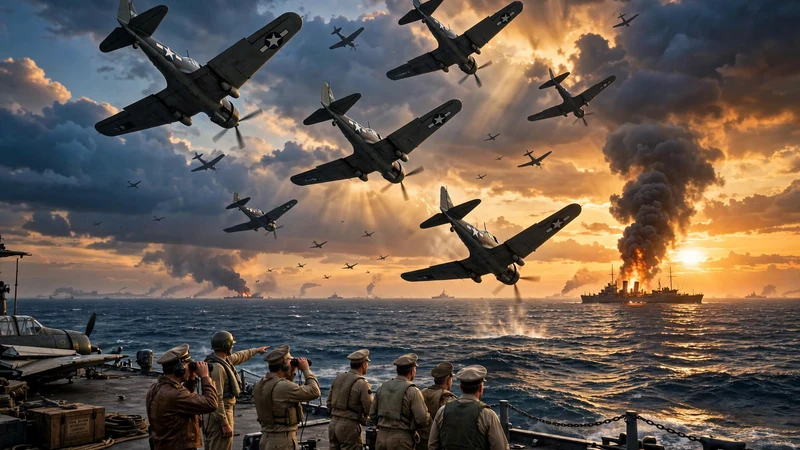
In the summer of 1940, Germany looked unbeatable. France had fallen in six weeks. Britain stood alone, bombed nightly, with an army that had left its equipment on the beaches of Dunkirk. The German war machine — panzers, Stukas, the best-trained officer corps in Europe — seemed destined to redraw the map for a thousand years. Five years later, that same machine lay in ruins, its capital a smoking wreck, its leader dead in a bunker. What happened in between is one of the most studied questions in all of history: why did Germany lose World War II?
The short answer is that there is no single answer. Ask ten historians and you will get ten different "main" reasons — the oil, Stalingrad, Hitler himself, American factories. The honest answer is the pile-up: seven disasters, each survivable on its own, that landed on Germany at the same time. Here they are, one by one.
The Oil War: Germany Ran Dry
Start with the one resource no army can fight without: fuel. Germany entered the war with almost no domestic oil, so it built the world's largest synthetic-fuel industry — chemistry on an industrial scale, turning coal into gasoline through hydrogenation and the Fischer-Tropsch process. By early 1944 these plants were producing fuel at a rate of nearly four million tons a year. It was an engineering marvel. It was also a house of cards.
The Allies figured this out, and from May 1944 they went after the fuel plants systematically. The numbers are a collapse: German refined-oil production fell from 316,000 tons in April 1944 to 107,000 in June and just 17,000 in September — a 95 percent wipeout. Aviation gasoline, the lifeblood of the Luftwaffe, dropped from 175,000 tons a month to 30,000, then to 5,000. An air force cannot fly on five thousand tons of fuel.
What does a fuel famine look like in practice? The Luftwaffe shortened its pilot training programs, sending up young pilots with a fraction of the hours their Allied opponents had — and then watched those novices get cut down by veterans. German armor units found themselves rationing movement; during the Ardennes offensive of December 1944, panzer divisions literally ground to a halt when their tanks ran dry. And here is the cruel detail: German factories kept building tanks and aircraft through 1944 — which then sat useless for want of fuel.
Germany also leaned hard on the oilfields of Ploesti in Romania, its biggest natural source. American bombers hit Ploesti in Operation Tidal Wave in August 1943, but the refineries were back up within two months. What finally killed Ploesti was not bombs but the Red Army, which overran Romania in August 1944 and took the fields intact. After that, the synthetic plants were all Germany had left. And the bombers were already waiting.
The Eastern Front Meat-Grinder
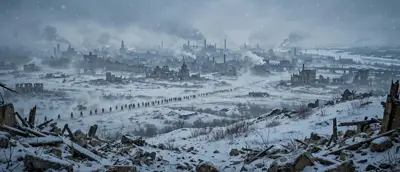
If the oil war was the slow strangulation, the Eastern Front was the open wound. This is where Germany lost the war — not in France, not in the Atlantic, but in the snow and mud of Russia. The figures are almost beyond comprehension: the great majority of German military deaths in the entire war happened on the Eastern Front.
It began with the gamble of June 1941: the invasion of the Soviet Union while Britain was still undefeated. The war in the East swallowed divisions the way the ocean swallows ships.
Then came Stalingrad. The battle ran from the summer of 1942 to February 2, 1943, when the last remnants of Germany's 6th Army surrendered in the frozen ruins of the city. The cost: roughly two million casualties on both sides — the deadliest battle in human history. Ninety-one thousand Germans marched into captivity, including 24 generals. Their commander, Friedrich Paulus, had been promoted to field marshal by Hitler days before the surrender — because no German field marshal had ever surrendered. Paulus surrendered anyway. An entire field army, the finest Germany had, was simply gone. Read our full Battle of Stalingrad summary for the whole story of how it happened.
Germany tried once more to seize the initiative. In July 1943 it launched Operation Citadel against the Kursk salient — the largest tank battle in history, nearly 3,000 German tanks against more than 5,000 Soviet ones. For two weeks the greatest armored clash ever fought raged across the steppe. Germany lost around 200,000 men and hundreds of irreplaceable tanks. Hitler then pulled forces out of the battle to deal with the Allied landing in Sicily — and never again launched a major offensive in the East. From Kursk onward, the Wehrmacht in Russia did only one thing: retreat.
After the summer of 1943, Germany — which had conquered Europe in months — spent nearly two years fighting backward across a thousand miles, losing men and machines it could never replace, against an enemy that grew stronger every month. It is why most historians rank the battles of the Eastern Front among the greatest battles of WW2 — and among the most decisive.
A war of attrition is a war of arithmetic. Germany picked a fight with the one enemy whose arithmetic it could never beat.
Bombed from the Skies
While the Red Army bled Germany on the ground, the British and American air forces came for its cities and factories. The strategic bombing campaign is the most debated weapon of the war — but on one point the evidence is clear: by 1944, Germany had lost the air war.
The raids were devastating in human terms. In late July 1943, Operation Gomorrah set Hamburg ablaze in a firestorm that killed around 37,000 people in a single week. In February 1945, Dresden was bombed over three days; up to 25,000 died. Dozens of German cities were hit, night after night, month after month.
Yet bombing alone did not break Germany's war economy. German arms production actually peaked in 1944, in the middle of the heaviest raids. If you judge the bombing campaign by whether it stopped German industry, it failed.
But judge it by the fuel campaign — the subject of our first section — and it succeeded brilliantly. And there is a second, quieter victory: the air war over Germany itself bled the Luftwaffe white. Forced to rise and defend the Reich against thousand-bomber raids, Germany's fighter arm was ground down in exactly the kind of attrition battle it could not win. By the summer of 1944, the Allies owned the skies over Europe — which meant Allied armies could move by day, in the open, while German armies could only move by night, under cover. That is what losing the air war costs you: the sun itself becomes the enemy's weapon.
Hitler's Own Mistakes
Every discussion of Germany's defeat eventually arrives at the man in charge — and for good reason. Hitler was a gambler of genius in 1939 and 1940, and a disaster as a war leader after that. His errors were not small tactical slips. They were strategic, repeated, and frequently made against the desperate advice of his own generals.
The first great blunder came early. On the evening of May 24, 1940, with German panzers poised to close the trap on the Allied armies at Dunkirk, Hitler backed a halt order that froze the tanks in place — over the furious objections of the army's high command. The order lasted only a few days, lifted on May 26. But those days were enough: Britain's entire expeditionary army slipped across the Channel. Historians still argue about how much it mattered — some say closing the pocket would not have ended the war — but no one disputes that Hitler handed his enemy a reprieve.
The pattern repeated, worse, in Russia. At Stalingrad, Hitler forbade the 6th Army to break out when escape was still possible, then forbade retreat, then promoted its commander to field marshal as a hint to die fighting. The army died anyway. Throughout the war he meddled in operations down to the divisional level, split his forces against his generals' advice during the 1942 summer offensive, delayed the Kursk attack until Soviet defenses were impregnable, and then drained it to save Italy. By 1944 he was moving phantom divisions on maps while the real ones ceased to exist.
One caution, though. After the war, Germany's surviving generals wrote memoirs blaming everything on Hitler — it was convenient, and it sold books. The truth is messier. Hitler made catastrophic errors, but Germany also faced enemies with more oil, more steel, more people, and more factories. A perfect German commander still loses a war of attrition against those odds. Hitler's blunders did not create the hole. They just made sure Germany kept digging.
The Arsenal of Democracy
In December 1940, President Roosevelt promised that America would become "the Arsenal of Democracy." Nobody — least of all the German leadership — understood what that meant until the numbers started arriving. They arrived like a flood.
During the war, the United States built nearly 300,000 aircraft. Germany built 94,622. America built 108,410 tanks and self-propelled guns; Germany built 67,429. Zoom out to the whole alliance and the gap becomes a chasm: the Allies produced 4.4 million tanks, trucks, and armored vehicles against the Axis total of 670,000; 637,000 aircraft against 229,000; 55,000 ships against 1,700. In crude oil — the fuel of modern war — the Allies produced over a billion tons. The Axis managed 66 million.
It was not just American factories. The Soviet Union alone built more tanks than Germany — nearly 120,000. And American Lend-Lease kept both allies in the fight: trucks by the hundred thousand for the Red Army, food, fuel, raw materials, and ships for Britain. Germany, meanwhile, never fully mobilized its own economy for total war until far too late. German women were never drafted into factories the way Soviet, British, and American women were. Consumer goods kept rolling off German lines while the war was being lost. Only in July 1944 — with the Reich visibly collapsing — did Goebbels finally get his "total war" powers.
William Knudsen, the General Motors executive who ran America's production miracle, summed it up after the war: America won by burying the enemy under a volume of production he had never seen and could never have imagined. The German soldier of 1944 was often better trained and better led than his opponent. It did not matter. He was fighting the factories of three continents.
The War of Shadows
There is a war you cannot see in any photograph: the war of signals, codes, and secrets. Germany fought much of World War II believing its Enigma-encrypted radio traffic was unbreakable. It was not.
At Bletchley Park in England, building on brilliant early work by Polish cryptologists, British mathematicians led by Alan Turing built the Bombe machines that cracked Enigma daily. The intelligence that flowed from those decrypts — codenamed Ultra — gave Allied commanders something no general in history had ever possessed: a daily read of the enemy's intentions. U-boat positions in the Atlantic let convoys be routed around the wolf packs. German dispositions before major battles were known in advance. Churchill, who read the raw decrypts himself, called the Battle of the Atlantic the dominating factor of the entire war — and Ultra was one of the weapons that won it, a struggle that played out across the largest naval battles in history.
How much did it shorten the war? Historians split, and you deserve the straight story. Harry Hinsley, Bletchley veteran and official historian of British intelligence, estimated Ultra cut two to four years off the conflict. Other scholars are far more cautious — one careful estimate puts it at months, not years, and some argue the true figure can never be calculated at all. What nobody disputes is the direction: without Ultra, the Atlantic lifeline to Britain would have been in far greater danger, D-Day planning would have been blind, and the war would have been longer and bloodier. In a war decided by arithmetic, even a few months of foreknowledge was worth divisions.
Caught Between Two Fronts
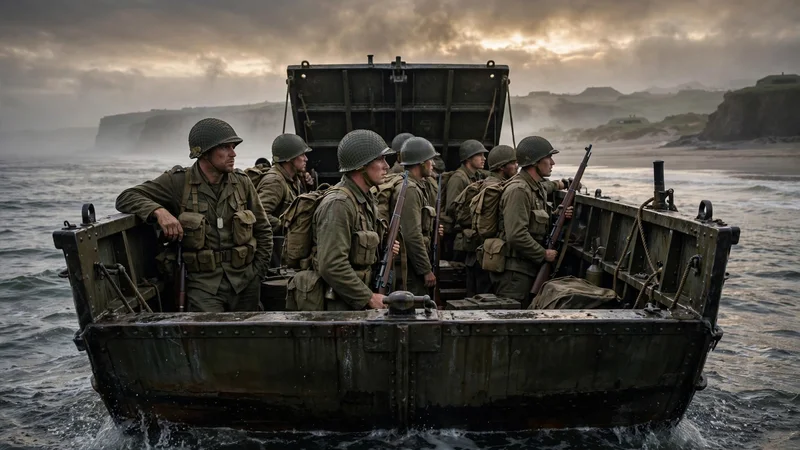
Everything we have described — the oil famine, the Eastern bloodbath, the bombing, the production gap — was already breaking Germany by 1943. Then, on June 6, 1944, the Allies opened a second full-scale land front in the West. D-Day did not start Germany's defeat. It finished it.
Consider Germany's position in the summer of 1944. In the East, the Red Army — now three million men strong and growing — was tearing through Army Group Center in Operation Bagration, the largest defeat the German army ever suffered. In the West, Eisenhower was landing and building up millions of men in Normandy. Read our D-Day Normandy landings summary for how the invasion unfolded. Germany's forces were split between two fronts, its fuel was gone, its skies belonged to the enemy, and its factories — what was left of them — could not replace a fraction of the losses.
This was the nightmare German strategy had always feared: the two-front war. Germany had gambled everything on knocking enemies out one at a time — France first, then Russia, with Britain neutralized in between. The gamble failed at every step. Britain survived 1940. Russia survived 1941. America entered the war in December 1941 and brought the one thing Germany could never match: limitless industrial depth. Even the Mediterranean bled Germany white — the long North African campaign, decided at El Alamein in late 1942, and then Italy, drained divisions Germany desperately needed elsewhere.
After D-Day, Germany fought on with desperate skill for eleven more months. The Ardennes offensive of December 1944 — the Battle of the Bulge — was its last throw: a surprise attack that achieved total surprise and still failed, because the panzers ran out of fuel and the skies cleared for Allied aircraft. By April 1945, Soviet guns were shelling Berlin. On May 8, Germany surrendered unconditionally.
So why did Germany lose WW2? Not for one reason, but for seven — and they all connect. Invading Russia created the Eastern Front that devoured the army. That hunger for fuel exposed the oil crisis. The oil crisis made the bombing campaign decisive. The bombing needed the air superiority that Allied production bought. That production was guided, in part, by Ultra. And D-Day turned the slow grind into a two-front collapse. Pull any one thread and the story changes. Pull them all, and you get May 1945: a ruined capital, a dead dictator, and the largest military defeat in human history.
For the battles that decided the Pacific half of the war, see our guide to the best Pacific War battles — where the same arithmetic of production and attrition crushed Japan.
FAQ
Was Germany's defeat in WW2 inevitable?
Historians genuinely disagree. One camp argues the numbers — oil, industry, manpower — made defeat near-certain once the Soviet Union and the United States both entered the war. The other camp says nothing in history is automatic: a different German strategy in 1942, or a negotiated peace with Stalin, might have stretched the war for years. What most agree on is that Germany had no realistic path to victory after the failure at Stalingrad in February 1943.
Could Germany have won WW2?
Winning was possible only if Germany avoided fighting all of its enemies at once — defeating Britain or the Soviet Union before the other two great powers fully mobilized. Once the United States entered the war and the Soviet Union survived 1941, Germany was outmatched in every resource that mattered: oil, steel, manpower, and productive capacity. Historians rank a German victory after 1942 as close to impossible.
What mattered more to Germany's defeat — Stalingrad or D-Day?
Stalingrad, and it is not really close. Stalingrad destroyed an entire German field army in February 1943 and broke Germany's strategic initiative in the East — the decisive theater, where most German divisions fought and died. D-Day in June 1944 opened the second front and accelerated the collapse, but Germany was already being driven backward in the East a full year before the first Allied boot hit Normandy.
Did the atomic bomb help defeat Germany?
No. Germany surrendered unconditionally on May 8, 1945. The first atomic bomb was not even tested until July 16, 1945, and the bombs were dropped on Hiroshima and Nagasaki in August 1945 — months after the war in Europe ended. The atomic bomb ended the war against Japan, not Germany.
Was it the Eastern Front or the Allied bombing that broke Germany?
The Eastern Front did the heaviest lifting — the vast majority of German ground casualties happened there. Strategic bombing hurt Germany but did not stop its war production, which actually peaked in 1944. The exception was the oil campaign of 1944: bombing the synthetic-fuel plants starved the Luftwaffe and the panzers of fuel, and that may have been the bombing campaign's single most decisive achievement.
What was Germany's single biggest mistake of the war?
Most historians answer the same way: invading the Soviet Union in June 1941 while Britain was still undefeated. It guaranteed a grinding two-front war against an enemy with far more people, land, and oil. Everything else on this list — the fuel crisis, Stalingrad, the production gap — flows directly from that one decision to fight a war of attrition Germany could not afford.
Sources
- U.S. Air Force, Maxwell AFB — "WWII Allied 'Oil Plan' Devastates German POL Production": 651 attacks, 95% production collapse, aviation fuel figures. maxwell.af.mil
- Nature (1946) — "Production of Oil from Coal in Germany": synthetic output ~4M tons/yr early 1944, reduced to ~300,000 tons by late 1944. nature.com
- Warfare History Network — "World War II: A Campaign Against Oil? A Look at Ploesti" and "Battle of Stalingrad: German Sixth Army in the Cauldron." warfarehistorynetwork.com
- Military.com — "The Battle of Stalingrad: The Deadliest Battle in Human History" (Feb 2, 1943; ~2M casualties). military.com
- Wikipedia — "Battle of Kursk" (July 5 – Aug 23, 1943; force figures) and "Military production during World War II" (production tables). en.wikipedia.org/wiki/Battle_of_Kursk · en.wikipedia.org/wiki/Military_production_during_World_War_II
- Warfare History Network — "Uncle Sam's Aircraft Manufacturing Muscle Ensured Victory" (~300,000 US aircraft vs 94,622 German) and "Albert Speer: Chief Architect of the Third Reich." warfarehistorynetwork.com
- HistoryTools.org — "Uncovering the Enigma: Bletchley Park's Codebreaking Triumphs." historytools.org
- Wikipedia — "Ultra (cryptography)": Hinsley 2–4 year estimate and scholarly debate. en.wikipedia.org/wiki/Ultra_(cryptography)
- War History Online — "Hitler's Mistake at Dunkirk" (halt order, May 24, 1940). warhistoryonline.com
- Wikipedia — "Bombing of Dresden" (Feb 13–15, 1945; up to 25,000 deaths). en.wikipedia.org/wiki/Bombing_of_Dresden