This battle of the Somme 1916 summary covers one of the most infamous battles in military history — a five-month offensive on the Western Front that began with the single bloodiest day in the history of the British Army and ended with over a million casualties on both sides. From July 1 to November 18, 1916, British and French forces hammered German defenses along the River Somme in northern France, gaining roughly six miles of ground. The Somme has become the ultimate symbol of World War I futility — lions led by donkeys, brave men mown down by machine guns. But the real story is more complicated, and more important, than the myth.
Background: Why the Somme?
To understand this battle of the Somme 1916 summary, you need to know what 1916 looked like from the Allied side.
The war was going badly. At Verdun, the French army was being bled white by the German offensive that had begun in February. Russia was struggling in the East. The Allies needed a great offensive somewhere — and the British, who had spent the first two years of the war building a massive volunteer army, were finally ready to use it.
The plan was agreed at the Chantilly conference in December 1915: in the summer of 1916, Britain and France would launch a joint offensive where their lines met, along the River Somme in Picardy. The French would provide the main weight — but Verdun changed everything. France, desperate at Verdun, could only spare a fraction of the promised divisions. The Somme became overwhelmingly a British battle.
Command fell to General Douglas Haig, commander of the British Expeditionary Force. Haig was a cavalryman by training, a thorough planner, and a man of unshakeable religious faith in ultimate victory. His plan was straightforward: a week-long artillery bombardment would destroy the German trenches, cut the barbed wire, and kill or demoralize the defenders. Then the infantry would walk across no-man's-land and occupy the shattered German lines. It was the standard doctrine of 1916 — and it was based on a catastrophic misunderstanding of what artillery could actually do.
The British army of 1916 was not the professional force of 1914. That army had been destroyed in the war's first battles. The Somme army was Kitchener's New Army — hundreds of thousands of civilian volunteers who had answered Lord Kitchener's famous "Your Country Needs You" poster. Many served in "Pals battalions" — units recruited from the same town, factory, or football club, so that friends, brothers, and workmates fought side by side. It was wonderful for morale and recruiting. It would prove devastating for the communities they left behind.
July 1, 1916: The Worst Day
The bombardment began on June 24 — seven days of continuous shelling. Some 1.7 million shells were fired at the German lines. British commanders assured their men that nothing could survive it. The wire would be cut. The trenches would be obliterated. The Germans would be dead or cowering.
They were wrong about almost everything.
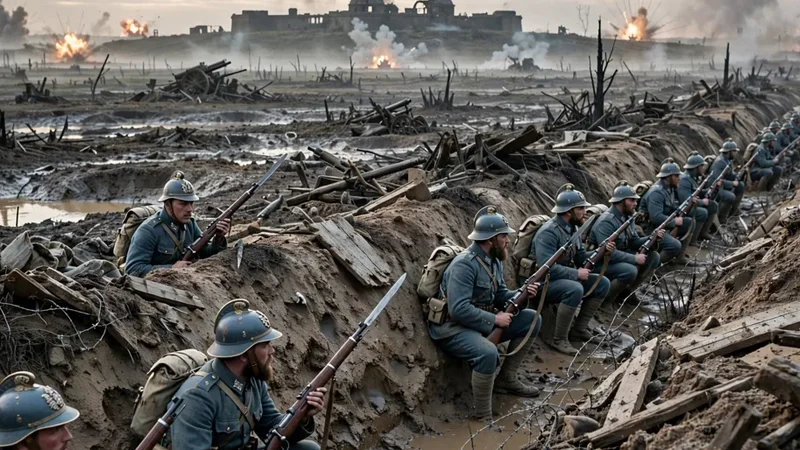
The German defenses on the Somme were the strongest on the Western Front. The Germans had spent two years digging deep dugouts — some 30 feet underground, proof against anything short of a direct hit. When the bombardment started, the German infantry simply went underground, taking their machine guns with them. The British shells, many of them shrapnel rather than high explosive, failed to cut the German barbed wire. And a huge proportion of shells were duds — faulty ammunition that never exploded.
At 7:20 AM on July 1, ten minutes before the infantry attack, the British detonated massive mines under the German lines — including the Hawthorn Ridge mine, packed with 40,000 pounds of explosives. The explosion was heard in London. It was supposed to obliterate the German strongpoint. In fact, the Germans had already abandoned that section, and the giant crater it created became an obstacle for the advancing British.
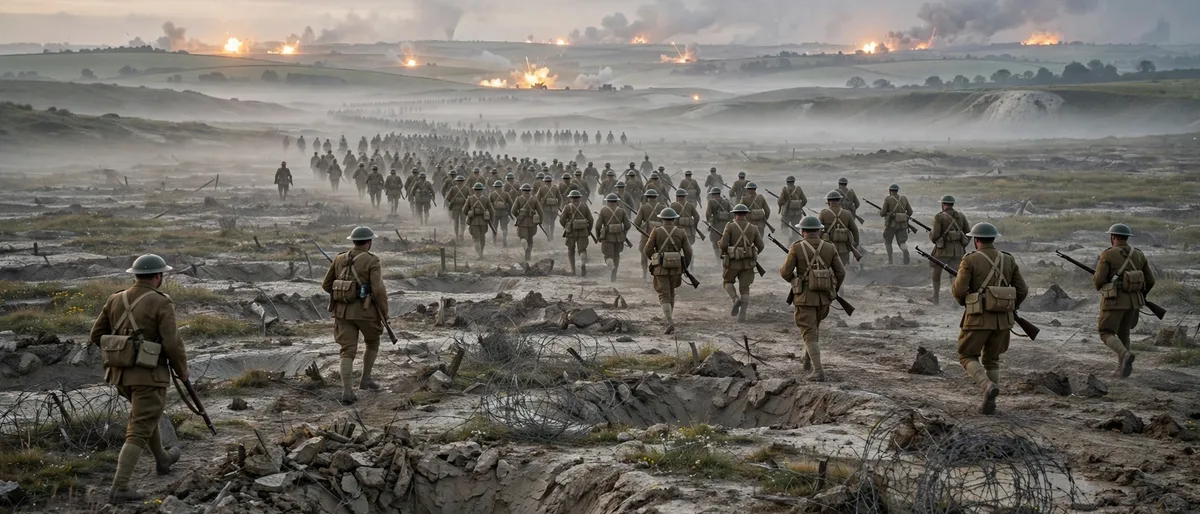
At 7:30 AM, whistles blew all along the 15-mile British front. Officers led their men "over the top." And here came the decision that made July 1 a catastrophe: the infantry were ordered to advance at a walk, in neat lines, carrying heavy packs. The theory was that the artillery had done the killing, and the infantry just needed to occupy the ground. Running would tire the men and break formation.
Instead, they walked into intact German machine guns.
The German soldiers emerged from their deep dugouts, set up their machine guns, and opened fire on the advancing lines of British infantry. The result was industrial slaughter. By the end of the first day, the British had suffered 57,470 casualties — including 19,240 killed. It remains the bloodiest single day in the history of the British Army. Some Pals battalions were effectively wiped out in minutes. The Accrington Pals, the Leeds Pals, the Sheffield City Battalion — entire communities lost a generation of young men before lunchtime.
The French, attacking south of the Somme with better artillery tactics, actually succeeded — but their success was overshadowed by the British disaster to the north.
The Grinding Summer: Attrition by Another Name
Haig did not stop. Despite the catastrophe of July 1, the offensive continued — and would continue for nearly five more months.
What followed was a grinding battle of attrition. The British attacked again and again, in a series of named sub-battles: Bazentin Ridge, Delville Wood, Guillemont, Flers-Courcelette, Morval, Thiepval, the Ancre Heights, and finally the Ancre. Each gained a little ground at enormous cost. The Germans, under superb defensive commanders, yielded ground slowly and made the British pay for every yard.
Two developments during the Somme changed warfare forever.
The first was the tank. On September 15, 1916, at Flers-Courcelette, the British deployed the tank in combat for the first time in history. The early Mark I tanks were slow, unreliable, and terrifying — to both sides. Of the 49 tanks committed, only about 25 actually reached the German lines, and most broke down. But where they worked, they crushed barbed wire, crossed trenches, and terrified German infantry who had never seen such machines. The tank's debut was a fiasco in practical terms but a revolution in concept. Within two years, tanks would be decisive weapons.
The second was tactical evolution. The British army learned — at terrible cost — how to fight a modern battle. By the autumn of 1916, British artillery had mastered the "creeping barrage," where shells advanced just ahead of the infantry in a coordinated wall of fire. Infantry-artillery coordination, air observation, and combined-arms tactics were all forged in the Somme's crucible. The clumsy mass infantry attacks of July gave way to sophisticated "bite and hold" operations. The British army that emerged from the Somme was a different, far more capable force than the one that had walked into machine-gun fire on July 1.
November 18: The End
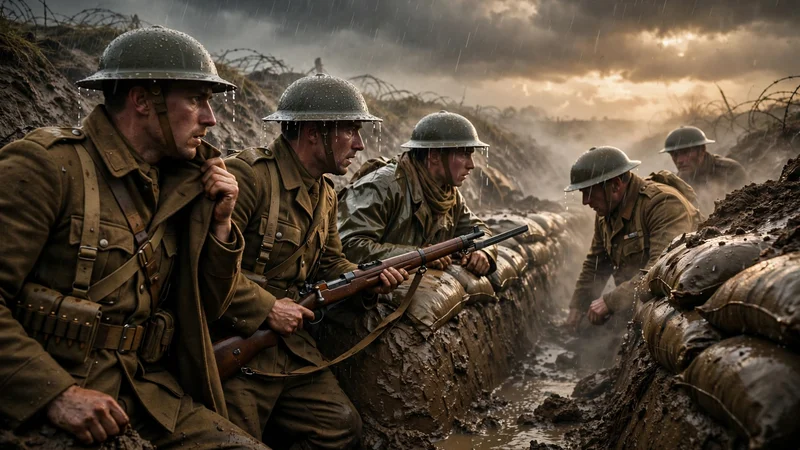
As autumn turned to winter, the battlefield became a sea of mud. Rain fell relentlessly. The chalk downland of Picardy, churned by millions of shells, turned into a clinging morass that swallowed men, horses, and guns. Soldiers drowned in shell craters. The fighting became as much a battle against the elements as against the Germans.
Haig launched his final attack on November 13 along the Ancre River. It achieved limited success. On November 18, 1916, with winter closing in and the ground impassable, Haig called off the offensive.
The battle had lasted 141 days.
Aftermath: Counting the Cost
The casualty figures of the Somme are almost beyond comprehension. British losses were approximately 420,000 killed, wounded, and missing. French losses were around 200,000. German losses are estimated at roughly 450,000 to 500,000. Total casualties on all sides exceeded one million men.
For all of that, the Allies had advanced about six miles — seven at most — along a 15-mile front. Thiepval, the great German fortress that dominated the battlefield, was not captured until late September. The breakthrough Haig had sought never came.
In Britain, the Somme became the defining trauma of the war — even more than Verdun was for France. July 1, 1916, is remembered as the day an entire generation of British manhood was sacrificed for nothing. The Pals battalions meant that small towns lost dozens or hundreds of their young men in a single morning. The social scar lasted for generations.
Why It Matters: Beyond the Myth
The traditional verdict on the Somme — futile slaughter ordered by incompetent generals — contains truth but misses the full picture. Modern historians argue about the Somme fiercely, and three points deserve attention.
First, the Somme did achieve its primary strategic purpose: it relieved Verdun. The German army, forced to divert men and guns to meet the British offensive, could no longer sustain its attack on Verdun. Without the Somme, France might have broken at Verdun. The two battles must be understood together — the Somme was the price of Verdun's survival.
Second, the Somme crippled the German army. German losses on the Somme — around half a million men — included a disproportionate number of experienced junior officers and NCOs, the backbone of any army. The German army never fully recovered its pre-Somme quality. One German officer called it "the muddy grave of the German field army." The Somme was where Germany began losing the war of attrition.
Third, the Somme created the modern British army. The citizen-soldiers of Kitchener's Army learned modern warfare in the hardest possible school. The artillery techniques, infantry tactics, and combined-arms doctrine developed on the Somme were the foundation of the victories of 1918, when the British army — alongside its allies — finally broke the German army in the Hundred Days Offensive. The Somme's lessons, purchased in blood, won the war two years later.
None of this comforts the mothers of the Accrington Pals. The Somme remains a monument to the gap between what generals imagined war to be and what industrial weapons had made it. But it was not meaningless. It was the anvil on which the German army was broken — and the school in which the British army learned to win.
Sources
- Battle of the Somme — Wikipedia (https://en.wikipedia.org/wiki/Battle_of_the_Somme)
- Imperial War Museums — Somme collections (https://www.iwm.org.uk)