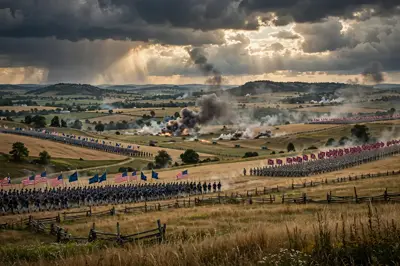
Ask anyone to name the largest tank battle in history and most will fumble. The answer is the Battle of Kursk: July 5 to August 23, 1943, on a giant bulge in the front line in western Russia, where roughly 6,000 tanks and assault guns, some two million men, and around 4,000 aircraft smashed into each other for seven weeks. Germany lost — and never attacked in the East again.
That's the short version. The real story is stranger than the legend: a battle the Germans lost before they started, a Soviet commander who nearly threw it away, a single day at a railway station called Prokhorovka that produced the most famous tank fight of the war while losing it on paper, and a dictator's obsession with shiny new toys that handed his enemy five extra months to prepare. Let me walk you through it.
The Salient: Why Kursk?
To understand Kursk you have to start six months earlier, at Stalingrad. When the German 6th Army surrendered in February 1943 — an entire army, 91,000 men marching into captivity — the Eastern Front broke open. The Soviets lunged west, retaking huge stretches of ground, including the city of Kursk. Then Field Marshal Erich von Manstein, the best operational mind the Germans had, did what great German commanders did: he counterattacked. In March his panzers smashed back into Kharkov, stabilizing the front.
When the dust settled, the map had a problem. The front line now bent around a vast bulge — the "Kursk Salient" — jutting some 150 miles from north to south and about 100 miles deep into German-held territory, with the city of Kursk sitting in the middle of it. To any general, a salient is an invitation. Cut it off at the base from both sides and you trap everything inside.
Hitler saw the invitation and wanted it badly. After Stalingrad his allies were getting nervous, his generals were arguing, and the Eastern Front was slipping. He needed a win — a big, clean, German-style victory to prove the war in the East wasn't lost. Kursk would be that win.
So the Germans planned Operation Citadel: a classic double envelopment. In the north, General Walter Model's Ninth Army would punch south from the Orel area. In the south, General Hermann Hoth's Fourth Panzer Army and General Werner Kempf's army detachment would punch north from Belgorod. The pincers would meet east of Kursk, sealing off the bulge with several Soviet armies inside.
There was just one catch, and it was enormous. The attack was originally planned for May. Hitler kept delaying it — until July — because he wanted to wait for his new super-tanks, the Panther and the Tiger. He'd fallen in love with the idea of quality beating quantity. While he waited, the Soviets watched the calendar tick and built the most elaborate defensive system of the entire war.
Operation Citadel: The Plan and the Trap
Here's the thing about Kursk that makes it almost unfair as a contest: the Soviets knew it was coming. Their intelligence — spies inside German planning, aerial reconnaissance, a captured German sapper who spilled the attack date — told Stalin's high command, the Stavka, exactly where the hammer would fall and roughly when. General Georgy Zhukov, the man who had saved Moscow and organized Stalingrad, made a call that shocked some of his colleagues: don't attack first. Let the Germans come. Bleed them on your defenses, then hit them with everything you've been saving.
So the Soviets built a trap across the whole salient — not one line of defense, but six to eight belts of them, one behind the other, packed with minefields, anti-tank guns, dug-in tanks, and trenches. When German soldiers later described advancing across ground where every step might find a mine, they weren't exaggerating. Millions of mines were laid. The plan was simple and brutal: the Germans would punch into defenses so deep that their tanks would run out of strength before they ran out of Russians.
Facing Model in the north stood the Central Front under General Konstantin Rokossovsky. Facing Hoth and Kempf in the south stood the Voronezh Front under General Nikolai Vatutin. And sitting quietly behind both, like a loaded gun on the table, was an entire fresh reserve — the Steppe Military District under General Ivan Konev, over half a million men the Germans didn't fully know existed.
The Germans attacked at dawn on July 5, 1943 — but Rokossovsky, acting on the captured sapper's information, jumped the gun. At about 2:20 that morning, Soviet artillery hammered the German assembly areas hours before the scheduled start. It didn't stop the attack. But it delivered a message: the enemy has our timetable.
July 5–11: The Grind
The northern attack went nowhere fast. Model's Ninth Army, attacking the most heavily defended sector of the whole salient, managed to grind forward about ten miles in a week of fighting and then simply stopped. Minefields, anti-tank guns, and Rokossovsky's counterpunching armor turned the advance into a crawl. Model was a defensive specialist, famously cautious, and he spent his tanks like a man paying with coins he couldn't replace — because he couldn't.
The south was different. Hoth's panzers had better tank country, weaker initial defenses, and the full weight of the German effort behind them. By July 11 his Fourth Panzer Army had clawed its way about thirty miles into the salient, grinding toward a railway junction called Prokhorovka that would soon become the most famous name of the battle. At the tip of the spear rode the SS divisions — Leibstandarte, Das Reich, and Totenkopf — the best-equipped units in the German army, the ones Hitler was counting on to break through where ordinary divisions couldn't.
But it was costing them. The new Panther tanks, rushed into battle half-tested because Hitler had insisted on waiting for them, broke down in embarrassing numbers — engines catching fire, transmissions failing before they ever met a Russian. Tigers were fearsome but few, and even they could be stopped by the sheer density of Soviet anti-tank guns and mines. Every mile the Germans advanced was measured in burning tanks.
And behind the fighting, the Soviets were feeding in reserves. The trap was doing exactly what Zhukov designed it to do: the German spearhead was getting thinner, longer, and more exhausted, while Soviet strength kept growing.
Prokhorovka: July 12, 1943
Then came the day that became legend. On July 12, at a small railway station 54 miles southeast of Kursk, the Soviet 5th Guards Tank Army under General Pavel Rotmistrov slammed head-on into the II SS-Panzer Corps. Around 1,100 to 1,200 tanks and assault guns fought each other at point-blank range — sometimes hull to hull — in a chaotic, smoke-choked melee.
Rotmistrov's plan was half brilliance, half suicide: drive straight at the Germans, get so close that their superior guns and optics stopped mattering, and turn the whole thing into a knife fight. His T-34s charged across open ground into prepared German positions. The result was a slaughter — of Soviet tanks. Rotmistrov lost about 340 tanks and self-propelled guns in a single day, burned or wrecked. German losses were a fraction of that, measured in the dozens of tanks destroyed.
And yet — and this is the paradox that makes Prokhorovka worth understanding — the Soviets still won what mattered. The SS-Panzer Corps, exhausted and depleted, stopped advancing. It had run out of road. The German offensive's southern spearhead, the one thing still moving, ground to a halt at Prokhorovka and never moved again.
Stalin was furious at Rotmistrov for the losses. Zhukov wanted him fired, maybe court-martialed. Other generals talked them down. But step back from the burning tanks and the verdict is clear: Rotmistrov had traded steel for time and space, and he'd stopped the last German advance in Russia. It was a tactical defeat bought at a strategic price the Germans couldn't afford to pay.
Here's a detail worth sitting with: the famous Soviet claim that 350 German tanks were destroyed at Prokhorovka on July 12 — repeated in textbooks for decades — doesn't survive the archives. Modern historians working from German and Russian records (Valeriy Zamulin's research is the benchmark) put German armored losses at a fraction of that. The legend was bigger than the truth — legends usually are. But the truth was still enough: the German offensive died at Prokhorovka, and with it died Germany's last chance to win the war in the East.
Why Germany Lost: The Turning Points
So how many tanks were at the Battle of Kursk in total? About 6,000 tanks and assault guns between the two sides — roughly 2,900 German against 5,100 Soviet — plus two million men and thousands of aircraft. Stare at those numbers long enough and the verdict writes itself: Germany didn't lose Kursk despite fighting well. It lost because it walked into the one battle its arithmetic couldn't survive.
Three things decided it. First, intelligence. The Soviets knew the German plan down to the hour and built defenses specifically for it — the rare case of a defender who gets to study the exam in advance. Second, the delay. Hitler's five-month wait for Panthers and Tigers gave the Soviets five months to dig in, and the wonder-weapons debuted as unreliable, fire-prone disappointments. Third, depth. The Germans attacked a defensive belt they could not exhaust, while an entire fresh Soviet front waited behind it. You cannot win a battle of attrition when the enemy arranged the attrition.
There was also bad luck, of a sort — the Allied landings in Sicily on July 10 forced Hitler to look west. On July 13 he called off Citadel. Manstein protested that the southern attack was on the verge of a breakthrough. Maybe it was; it doesn't matter. The same week, the Soviets launched their own offensives: Operation Kutuzov in the north and, on August 3, Operation Polkovodets Rumyantsev in the south.
Aftermath: The Red Army Never Looks Back
The counteroffensives rolled. Orel fell on August 5. Kharkov — the city Manstein had retaken in March — fell on August 23, and with it the battle ended. The Soviets didn't just win Kursk; they kept going, retaking territory along a front 2,000 kilometers wide. It was the first successful major Soviet summer offensive of the war.
Strip away the tank counts and Kursk's meaning is brutally simple: after July 1943, Germany never attacked in the East again. Not once. The initiative — the right to choose where and when the next battle happens — changed hands for good. From here the map only moved one direction: through Ukraine, across Poland, into Berlin. Two years of retreat began the week one offensive failed.
Casualties? Honestly, the exact numbers are disputed, as they always are on the Eastern Front. Hundreds of thousands of men died on both sides across the seven weeks. Some tallies put German losses in the Citadel phase around 54,000 men; Soviet losses were far heavier, perhaps 177,000 or more. The asymmetry is the point: the Soviets could afford their losses. The Germans couldn't afford theirs.
Kursk vs Stalingrad: Which Was the Real Turning Point?
Every history buff has an opinion on this one, so here's mine: they're both turning points, but they turned different things.
Stalingrad broke the German army's aura of invincibility and destroyed an entire field army. It proved Germany could be beaten. Kursk proved something colder and more final: that even at full strength, attacking exactly where it chose, with its best tanks and best generals, Germany could no longer win. Stalingrad was the moral turning point. Kursk was the mechanical one — the battle that converted a German defeat into a German condition.
There's a telling detail. At Stalingrad, the Germans were surrounded and destroyed because Hitler forbade retreat. At Kursk, the Germans attacked with everything, on ground of their choosing, against an enemy they understood — and still failed. That's a different kind of verdict. You can blame a disaster on one man's stubbornness. You can't blame arithmetic.
If you want to understand Stalingrad's side of the story, our article on the battle walks through the 200 days that made it a legend. But Kursk is where the legend met the ledger — and the ledger won.
What If Germany Had Won at Kursk?
Counterfactuals are a historian's guilty pleasure, and this one is worth a moment. Suppose Manstein's southern pincer had broken through, linked up with Model, and trapped the Soviet armies in the salient. What changes?
Honestly — less than German generals claimed after the war. Even a successful Citadel would have left the Germans holding a salient of their own, deep in Russia, with the same shortages of fuel, tanks, and men that plagued them all along. The Soviet Union's industrial output was now dwarfing Germany's; American Lend-Lease trucks were motorizing the Red Army; and the Allies were landing in Sicily and, soon, Normandy. A victory at Kursk buys Hitler time — months, maybe — not a different outcome.
But "maybe months" is doing a lot of work in that sentence. A delayed Soviet advance might have changed where the Iron Curtain fell, which cities were liberated by whom, and how many millions more died in the extra fighting. The war's end was probably fixed by 1943. Its shape wasn't. That's why Kursk matters beyond the tank counts: it set the map of the next forty years.
What the Sources Tell Us
Two honest caveats before you go, because this is where most articles wave their hands.
First, the numbers. The figures above — 780,900 German troops, 2,928 German tanks, 1.91 million Soviet troops, 5,128 Soviet tanks — come from the standard infobox tallies and are the most widely cited estimates. But Eastern Front numbers are a minefield. Soviet sources inflated German losses for propaganda; German sources understated their own for the same reason in reverse. The archives opened after the Cold War have revised both, and historians like Glantz, House, and Zamulin keep refining them. Any article that gives you Kursk's casualties to four significant figures is bluffing. Treat every figure as a well-informed estimate, because that's what it is.
Second, the asterisk. If you're the pedantic type — and history rewards pedants — you'll note that the June 1941 Battle of Dubno-Brody involved over 4,000 tanks across several days of fighting, which by raw vehicle count might edge out Kursk. It's a fair point. But Dubno was a sprawling, chaotic meeting engagement spread over a huge area and a week, and the Soviets were annihilated. Kursk was a single defined battle, the largest concentration of armor ever assembled for one operation, and it's the answer every historian gives when asked. The largest tank battle in history, by any sane measure, remains Kursk.
3 Lessons Kursk Still Teaches Today
Most articles stop at what happened. But Kursk is still studied in staff colleges, and the reasons reach past 1943.
1. Know the enemy's plan — and let him execute it. The Soviets didn't just defend; they defended with foreknowledge, shaping a battlefield specifically for the attack they knew was coming. Intelligence isn't about collecting secrets. It's about turning secrets into geometry — minefields laid where you know the tanks will roll.
2. New weapons don't win wars; working weapons do. Hitler delayed his entire summer offensive for Panthers and Tigers that caught fire on their way to the battle. The T-34, older, cruder, and outgunned one-on-one, won because there were thousands of them and they ran. Reliability is a weapon. Shine is not.
3. Depth beats brilliance. Manstein was probably the better general. It didn't matter. The Soviets built a defense with no single point of failure — belt after belt, reserves behind reserves — so that no German brilliance could unhinge it in one stroke. If your plan requires the enemy to run out of something before you do, make sure you're not the one who runs out first.
FAQ
What was the largest tank battle in history?
The Battle of Kursk (July 5 – August 23, 1943): about 6,000 tanks and assault guns fought on both sides combined, along with some 2 million men and 4,000 aircraft — the biggest concentration of armor ever assembled for a single battle.
How many tanks fought at the Battle of Kursk?
Roughly 6,000 tanks and assault guns on both sides combined — about 2,900 German against about 5,100 Soviet. The biggest single-day clash, at Prokhorovka on July 12, involved around 1,200 tanks fighting at close range.
Who won the Battle of Kursk?
The Soviet Union, decisively. Germany's last great offensive on the Eastern Front failed, and from Kursk onward the Red Army held the strategic initiative — the power to choose where the next battle happens — all the way to Berlin in 1945.
Was Prokhorovka really the largest tank battle ever?
Not quite — it's the most famous single day, but the crown belongs to Kursk as a whole. Soviet-era claims of 350 German tanks destroyed at Prokhorovka on July 12 don't survive the archives; modern estimates put Soviet losses near 340 tanks against German losses in the dozens. Yet the German advance was still stopped — which is why the day became legend.
Sources
- David M. Glantz & Jonathan House, The Battle of Kursk (University Press of Kansas, 1999) — the standard operational history in English.
- Dennis Showalter, Armor and Blood: The Battle of Kursk, the Turning Point of World War II (Random House, 2013).
- Valeriy Zamulin, Demolishing the Myth: The Tank Battle at Prokhorovka, Kursk, July 1943 (Helion, 2011) — the archival corrective on Prokhorovka's losses.
- Sky HISTORY — "The Battle of Kursk: the largest tank battle in history" (https://www.history.co.uk/article/the-battle-of-kursk-the-largest-tank-battle-in-history).
- U.S. Army Command and General Staff College thesis, "Analysis and Significance of the Battle of Kursk in July 1943" (https://ntrl.ntis.gov/NTRL/dashboard/searchResults/titleDetail/ADA299270.xhtml).