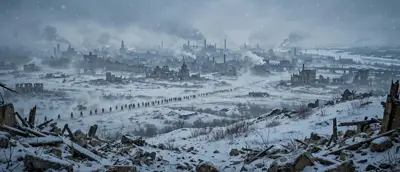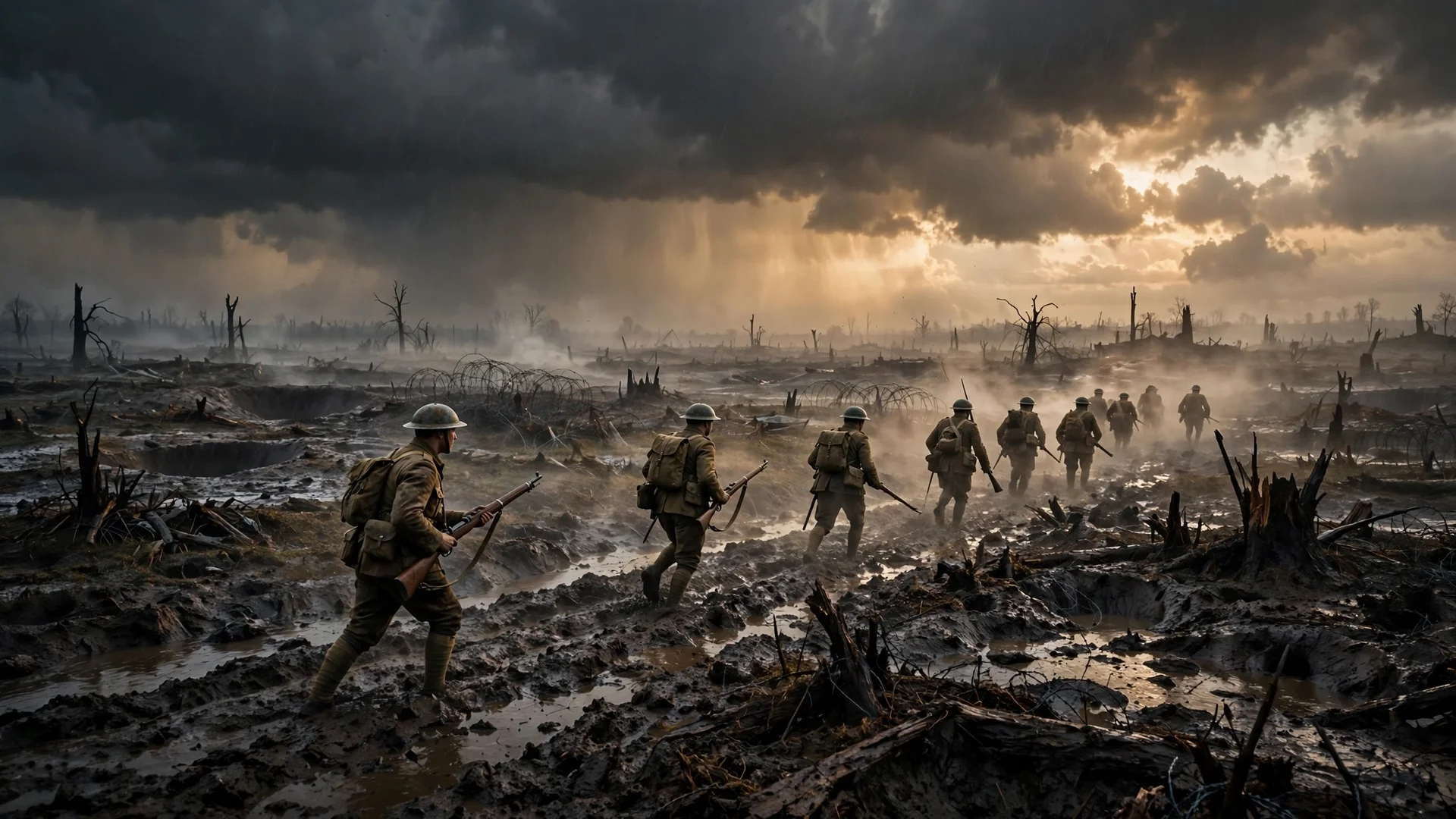
They called it Passchendaele. The name alone still makes historians wince. For a hundred days in the autumn of 1917, British, Canadian, Australian, and French soldiers attacked German positions around a small Belgian village — and the earth itself seemed to rise up and swallow them. Not metaphorically. The rains that August were the heaviest in thirty years, and the shell-torn ground of Flanders turned into a porridge of mud so deep that men, horses, and tanks simply disappeared into it.
By the time it ended on November 10, the Allies had advanced about five miles. Five miles. The cost is still argued about in books and lecture halls, but nobody disputes the shape of it: hundreds of thousands of men dead, wounded, or missing, for a patch of ruined Belgium the Germans took back five months later. So why did it happen? Who ordered young men to walk into that? And was any of it worth anything at all? That's what this is about.
Why Ypres? A Salient Nobody Would Give Up
To understand Passchendaele you have to picture the map. The town of Ypres sat inside a bulge — a salient — poking into German-held territory in Flanders. The British had been defending this miserable pocket since 1914, and they'd already bled for it twice. The ground around it was low, flat, and wet by nature; centuries of farmers had kept it dry with drainage ditches. Three years of artillery had smashed every ditch to pieces.
General Sir Douglas Haig, the British commander-in-chief, had a plan that looked sensible on paper. Break out of the Ypres salient, roll up the Belgian coast, and capture the German U-boat bases at Ostend and Zeebrugge. Those submarines were strangling Britain — sinking merchant ships faster than they could be replaced — and Haig believed a land offensive in Flanders could solve a naval problem. His government in London was skeptical. The French, exhausted after their own disastrous offensives, could offer little help. Haig went ahead anyway.
There's a detail that tells you everything about the confidence involved: the plan assumed the Germans would collapse. British intelligence genuinely believed one more big push would break an enemy already strained by years of war. It was the same assumption that had failed at the Somme a year earlier. Nobody in Haig's headquarters seems to have asked what they'd do if the Germans simply... didn't collapse.
July 31: Fifteen Thousand Guns Open Up
The attack began before dawn on July 31, 1917, with one of the heaviest bombardments of the war — some 3,000 guns firing over a million shells in the opening days. At 3:50 a.m. the infantry went over the top. And for a few hours, it worked. The British Fifth Army under General Hubert Gough pushed forward on a broad front, taking the German front line and in places the second.
Then the problems started, and they never really stopped. The bombardment that was supposed to crush the German defenses had also crushed the drainage system — what was left of it. Every shell crater became a pond. The German defenders, forewarned by the weeks of obvious preparation, had built their defenses in depth: concrete pillboxes, machine-gun nests arranged so each covered the next, and reserves ready to counterattack the moment the British slowed.
And slow they did. By the afternoon of the first day, the advance had stalled in most sectors. Gough had spread his attack too wide and too thin — a criticism historians still level at him — and his men were exhausted, soaked, and stuck. The great breakthrough Haig had promised London wasn't coming. What came instead was rain.
August: The Sky Falls and the Ground Gives Way
If you remember one thing about Passchendaele, make it this: the weather. August 1917 brought the heaviest rainfall the region had seen in three decades. It fell on ground that had been churned by millions of shells into something closer to soup than soil. Soldiers described wading through mud up to their waists. Duckboard tracks — narrow wooden walkways — became the only way to move, and stepping off one could mean sinking to your death. Men drowned in shell holes. Wounded men slipped off stretchers into the mire and were never found.
Tanks, the great hope of 1917, were useless. They bogged down within yards. Artillery couldn't be moved forward. Supply parties took hours to carry what should have taken minutes, staggering along duckboards under shellfire with ammunition and food. The wounded lay for days in the mud because stretcher-bearers couldn't reach them.
Here's the cruel part: Haig's headquarters, sitting in a comfortable chateau miles behind the lines, kept ordering attacks through it all. August became a month of small, grinding assaults that gained a few hundred yards here, a pillbox there — each one paid for in lives, each one dissolving into the mud. The men at the front started calling it what it was. One soldier's diary from the period reads like a man describing the end of the world, not a battle.
Plumer's Method: Bite and Hold
In September, Haig made a change that arguably saved the offensive from total failure: he shifted the main effort to General Herbert Plumer's Second Army in the south. Plumer was a different kind of general — careful, methodical, allergic to grand gestures. His method had an unglamorous name: 'bite and hold.'
The idea was simple. Instead of trying to break through the entire German line in one heroic lunge, Plumer would take small, limited objectives — a ridge here, a wood there — each one carefully chosen so his own artillery could protect it. Attack on a narrow front. Grab the ground. Dig in before the German counterattack arrives. Then do it again a few days later. No breakthroughs, no cavalry charges into the sunset. Just teeth, one bite at a time.
And it worked — after a fashion. Through late September and early October, Plumer's men took the Menin Road Ridge, Polygon Wood, and Broodseinde in a series of tidy, well-prepared attacks. For the first time in the battle, the British were consistently winning their small fights. German losses mounted. For a few weeks, it looked like the offensive might actually achieve something proportionate to its cost.
But bite and hold had a limit built into it: each bite was small. And in early October, when Haig pushed Plumer to keep attacking into deteriorating weather, the method broke down. The attacks of October 9 and October 12 — at Poelcappelle and the first attempt on Passchendaele itself — were disasters. The mud was back, the artillery couldn't support the infantry, and thousands of men died for nothing. An Australian division was shattered at Poelcappelle. New Zealand suffered its blackest day of the entire war on October 12.
The Canadians Are Sent In
By mid-October, the British Expeditionary Force was running out of fresh divisions. Haig turned to the one corps he had left that was still at full strength and full confidence: the Canadian Corps, under Lieutenant-General Arthur Currie. The Canadians had a fearsome reputation by 1917 — they'd taken Vimy Ridge in April, the single most celebrated Allied success of the year — and Currie was probably the best corps commander on the Allied side.
Currie didn't want the job. He looked at the ground, looked at the weather, and told Haig flatly that taking Passchendaele would cost him 16,000 men. Haig ordered him to do it anyway. Currie's estimate, as it turned out, was almost exactly right.
What followed was a masterclass in how to attack under impossible conditions. Currie insisted on time to prepare — proper artillery positions built on wooden platforms above the mud, roads corduroyed with logs, every detail planned. Then, starting October 26, the Canadians attacked in a series of staged assaults, each one leapfrogging forward a few hundred yards. It was bite and hold taken to its absolute limit, executed by the best troops in the British army.
The fighting was as bad as anything in the war. The ridge was a moonscape of water-filled craters. German pillboxes had to be taken one by one, often with grenades and bayonets at close range. But the Canadians kept moving. On October 30 they took their objectives. And on November 6, in driving rain, they walked into the ruins of Passchendaele village itself.
November 6: A Village of Rubble
There's a photograph from that morning, if you ever want your heart broken. Canadian soldiers standing in what used to be Passchendaele — and there is nothing there. No houses, no church tower, no streets. Just churned mud, splintered stumps, and the concrete teeth of German pillboxes poking through the slime. They'd captured a name on a map. The place itself had ceased to exist months earlier.
The battle officially ended on November 10, after a few final local attacks. The salient had been pushed forward about five miles at its deepest point. The Belgian coast — the actual objective, the U-boat bases — was as far away as ever. The great breakout Haig had promised had never come close.
And here's the detail that still stings: five months later, during the German spring offensive of 1918, the Germans walked back over almost all of it in a matter of days. The ground so expensively won was abandoned to shorten the line. Men who'd survived Passchendaele watched from new positions as the enemy reoccupied the ridge they'd bled for. You can imagine what that felt like.
Counting the Cost: Numbers Nobody Agrees On
How many men died at Passchendaele? Ask five historians, get five answers — and they're all honest. The British official history put Allied casualties around 275,000. Later research pushed estimates higher, some past 400,000. German losses are even murkier: somewhere between 200,000 and 400,000, with about 24,000 taken prisoner. The one figure everyone cites is the simplest and the saddest: roughly two inches of ground for every dead man, if you do the arithmetic on five miles and a quarter-million casualties.
Why the disagreement? Record-keeping in 1917 was imperfect, definitions of 'casualty' varied (killed? wounded? missing? sick?), and both sides had reasons to shade the numbers afterward. The Germans wanted to show they'd bled the British white; the British wanted to show the Germans had suffered equally. The archives don't settle it cleanly.
What isn't disputed is the proportion. Passchendaele consumed divisions the way a furnace consumes coal. The Canadian Corps — Currie's men, the ones who finished the job — lost over 15,000 men in two weeks, almost exactly what Currie had predicted. Australian, New Zealand, and British divisions were wrecked. On the German side, Ludendorff himself later wrote that the battle put his army through the wringer — the constant Allied pressure, he admitted, was wearing down German reserves at an alarming rate.
Was It Worth It? The Argument That Never Ends
Here's where historians start shouting at each other. Was Passchendaele worth it? The traditional verdict — the one you'll find in most popular histories — is no: a futile slaughter ordered by a general who didn't understand the conditions, for objectives that were never achieved. Haig as butcher, Passchendaele as his monument. It's a powerful story, and there's truth in it.
But the revisionists have a case too, and it's worth hearing. Their argument runs like this: by late 1917, Germany was being bled white across all fronts. The French army had mutinied in the spring and couldn't attack. Russia was collapsing. If Britain didn't keep pressure on Germany in Flanders, the Germans could shift divisions east, finish Russia, and turn west with everything they had. Passchendaele, in this reading, wasn't about taking the Belgian coast — it was about pinning German divisions in place and grinding them down. And by that measure, it worked: German reserves were exhausted, and Ludendorff said so himself.
There's also the uncomfortable fact that the alternative — doing nothing — had its own costs. An army that sits still in trenches still dies, just more slowly, of shells and snipers and disease. Haig believed attack was the only way to win the war. He was wrong about how, and wrong about where, but the underlying logic wasn't insane.
My own view? Both sides are half right. Passchendaele did wear down the German army — the evidence for that is solid. But the price was obscene, the stated objectives were fantasies, and a competent high command would have stopped the offensive in August when the rains came instead of feeding men into the mud for three more months. The tragedy of Passchendaele isn't that it achieved nothing. It's that what it achieved could have been had for far less — or that the same effort, applied differently, might have achieved far more.
What Passchendaele Still Teaches
Why should you care about a muddy field in Belgium, more than a century later? Because Passchendaele is the purest case study in military history of what happens when plans meet reality and nobody updates the plan.
Lesson one: the map is not the ground. Haig's headquarters planned the offensive from maps and aerial photos. The men who fought it lived in a swamp the maps didn't show. Any plan that doesn't survive contact with the actual terrain — the mud, the weather, the drainage — isn't a plan. It's a wish.
Lesson two: know when to stop. The hardest decision in war isn't when to attack; it's when to call off an attack that's failing. Haig couldn't do it. Every small gain became a reason to continue; every setback became a reason to try once more. There's a name for that in psychology — sunk-cost fallacy — and Passchendaele is its monument in blood.
Lesson three is the one the Canadians embodied: preparation matters more than courage. Courage was never in short supply at Passchendaele — men walked into machine-gun fire for months. What was in short supply was the unglamorous work Currie insisted on: gun platforms, corduroy roads, timetables, rehearsals. Bravery without preparation is just a faster way to die. The Canadians took the ridge because they prepared like engineers, not because they charged like heroes.
And maybe there's a fourth lesson, the quietest one. Stand on that ridge today — it's farmland again, peaceful, the craters long since filled — and try to square it with what happened there. You can't, quite. That's the point. Some things shouldn't be squared. They should just be remembered.
If siege warfare fascinates you, keep going: our rundown of the longest sieges in history puts Passchendaele's grinding attrition in a much older tradition — and the siege of Vicksburg shows what a siege looks like when it actually works.
Sources
- Imperial War Museums — “What happened at Passchendaele?” (iwm.org.uk).
- Canadian War Museum — Passchendaele 1917 (warmuseum.ca).
- Commonwealth War Graves Commission — Third Battle of Ypres (cwgc.org).
- Prior, Robin & Wilson, Trevor — Passchendaele: The Untold Story (Yale University Press).