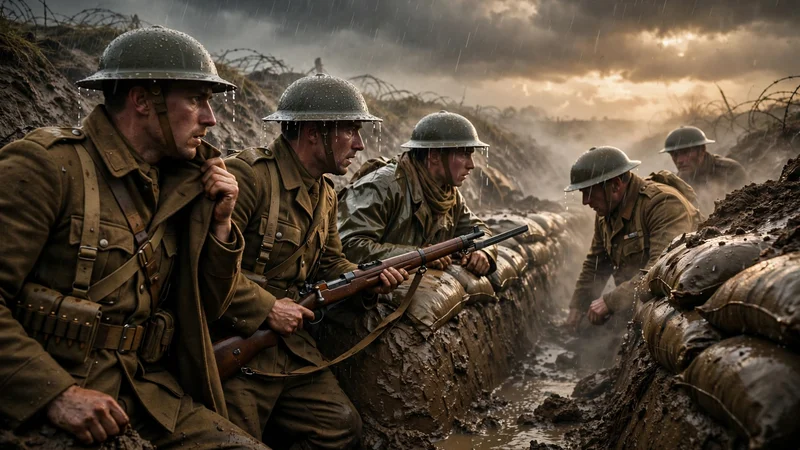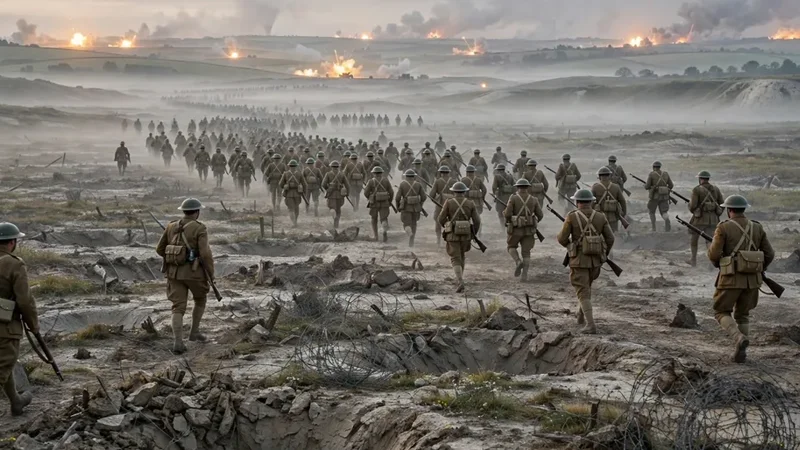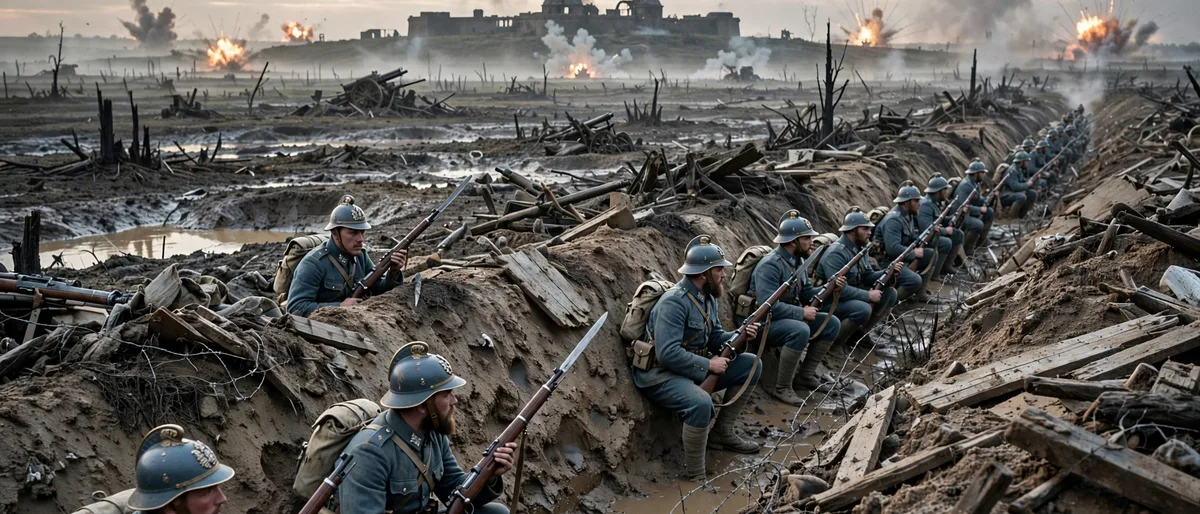
This battle of Verdun summary covers the longest single battle of World War I — 303 days of grinding, industrialized slaughter that cost roughly 700,000 men their lives, wounds, or freedom. From February 21 to December 18, 1916, the German and French armies tore each other apart over a patch of French earth barely eight square miles wide. The Germans came with a cold, calculated plan: not to take Verdun, but to bleed France white. The French, under Philippe Pétain, answered with two words that became legend: they shall not pass. What followed was the defining battle of French national memory — and a warning about what happens when war becomes pure attrition.
Background: Why Verdun?
To understand this battle of Verdun summary, you have to start with a German general named Erich von Falkenhayn and a problem he could not solve.
By early 1916, the Western Front had been frozen for over a year. Millions of men sat in trenches stretching from the Swiss border to the English Channel, and nobody was winning. Falkenhayn, the German Chief of Staff, believed Germany could not win a long war against the combined resources of Britain, France, and Russia. He needed to knock one enemy out of the fight.
His answer was what the Germans called Operation Gericht — "Judgment." The plan was brutally simple and historically unusual: Germany would attack a point so precious to France that the French would be forced to defend it at any cost — and then Germany would use superior artillery to slaughter them as they fed reinforcements into the meat grinder. The objective was not territory. It was casualties. Falkenhayn wrote that he intended to "bleed France white."
Verdun was the perfect bait. The town sat in a salient — a bulge in the French line — surrounded on three sides by German positions. It was ringed by a chain of powerful forts, including Fort Douaumont, the strongest fortress in France. And it carried enormous symbolic weight: Verdun had been French since the Treaty of Verdun in 843 AD, the treaty that essentially created France. Losing it would be a national humiliation no French government could survive.
There was another reason Verdun was vulnerable. The French high command, focused on planning its own great offensive for 1916 (what would become the Somme), had quietly stripped Verdun's defenses. General Joseph Joffre had removed most of the fortress artillery for use elsewhere. The forts were undermanned. The Germans knew it.
The Steel Hurricane: February 21, 1916
At 7:15 on the morning of February 21, 1916, the German bombardment began — and it was like nothing the world had ever seen.
In the first eight hours, German guns fired an estimated two million shells into the French positions around Verdun. The bombardment could be heard more than 100 miles away. Entire forests were shredded. Hills were flattened. Men were buried alive in their dugouts, driven insane by the concussion, or simply vaporized.
The German assault force was enormous: roughly 1,400 guns, including massive siege mortars, supported the attack of the German Fifth Army under Crown Prince Wilhelm, the Kaiser's son. Facing them were French troops who had been told Verdun was a quiet sector — a place to rest.
The French line cracked. Within days, the Germans had pushed several miles forward. And then came the shock that nearly broke French morale entirely: on February 25, just four days into the battle, Fort Douaumont — the greatest fortress in France, the anchor of the entire Verdun defensive system — fell to the Germans. A small German raiding party found the fort virtually undefended and simply walked in. The French garrison had been reduced to a skeleton crew. The mightiest fort in France was captured without a real fight.
Paris panicked. The government began preparing to evacuate. Defeatism spread through the French army. Verdun — the symbol of France — was about to fall.
Pétain Takes Command: "They Shall Not Pass"
On February 25, the same day Douaumont fell, General Philippe Pétain was given command of the French Second Army and ordered to save Verdun.
Pétain was 59 years old, a methodical, unglamorous general who believed in firepower, logistics, and the careful husbanding of men's lives. He was the opposite of the dashing offensive theorists who dominated French military thinking. At Verdun, his approach would save France.
Pétain did three things immediately. First, he issued his famous order: no retreat, no surrender of ground. The phrase "Ils ne passeront pas" — "They shall not pass" — became the battle cry of Verdun (though it was actually coined by General Robert Nivelle, Pétain's subordinate, it became forever associated with Pétain's defense).
Second, Pétain organized the defense in depth. Instead of packing men into the front-line trenches where German artillery could annihilate them, he held his main forces back and fed them forward only for counterattacks. This was revolutionary thinking in 1916, and it saved countless lives.
Third — and most critically — Pétain solved the supply problem. Verdun was connected to the rest of France by a single narrow road, the Voie Sacrée — the "Sacred Way." Pétain turned it into the most intensively used road in military history. Day and night, trucks ran in both directions — one carrying supplies forward, the other carrying wounded back. At peak, a truck passed every 14 seconds. Some 2,000 trucks kept Verdun alive. Without the Voie Sacrée, the French defense would have collapsed within weeks.
Pétain also introduced a rotation system — the "tourniquet." French divisions were rotated through Verdun quickly, spending only days at the front before being relieved. This kept units from being completely destroyed and spread the psychological burden across the entire French army. By the end of the battle, nearly every French division — some 70 out of 95 — had passed through the Verdun meat grinder.
The Grinding Months: Fort Vaux and the Hills
What followed was ten months of the most concentrated slaughter in human history to that point.
The Germans kept attacking, trying to take the key heights around Verdun: Le Mort Homme ("Dead Man's Hill"), Côte 304, and the forts. The French kept counterattacking. Ground changed hands again and again. Villages were erased so completely that nine of them were never rebuilt — they exist today only as memorials, designated "villages that died for France."
One episode captured the horror and heroism of Verdun: the defense of Fort Vaux. In June 1916, a French garrison of about 250 men under Major Sylvain-Eugène Raynal held the fort against overwhelming German forces for six days. They ran out of water. Men were licking moisture off the walls. They fought with grenades, bayonets, and bare hands in the fort's dark tunnels. When Raynal finally surrendered on June 7, the German commander saluted him and returned his sword — an extraordinary gesture of respect between enemies. The last message Raynal had sent by carrier pigeon read: "We are holding on, but we are undergoing a very dangerous gas and smoke attack. It is urgent to relieve us. Communicate to the troops. Vive la France."
The Germans never broke through. Falkenhayn's plan to "bleed France white" was bleeding Germany just as badly. The Crown Prince, hungry for a prestige victory, kept demanding new attacks, deviating from Falkenhayn's attrition strategy and throwing away German lives for ground that had no strategic value. The plan had become its own opposite: Germany was now feeding its own army into the grinder.
The Tide Turns: Summer and Autumn 1916
Two events in the summer of 1916 changed everything at Verdun.
First, on July 1, the British launched their great offensive on the Somme. The Somme offensive was partly designed to relieve pressure on Verdun — and it worked. Germany was forced to divert artillery, aircraft, and divisions away from Verdun to meet the British threat. The Somme became its own catastrophe, but it took weight off the French at Verdun.
Second, the French began their counteroffensives. In October, under General Robert Nivelle (who had replaced Pétain in May — Pétain was kicked upstairs, partly because the high command worried he was becoming too popular), the French launched a meticulously planned attack using new artillery tactics. On October 24, French troops recaptured Fort Douaumont. On November 2, they retook Fort Vaux. By mid-December, the French had pushed the Germans back to roughly their February starting positions.
On December 18, 1916, the battle ended. It had lasted 303 days.
Aftermath: The Butcher's Bill
The casualties at Verdun remain staggering and disputed. The most careful modern estimates put French losses at roughly 379,000 to 400,000 (including 148,000 to 160,000 killed) and German losses at roughly 336,000 to 355,000 (including 71,000 to 143,000 killed). Some estimates of total casualties on both sides reach 976,000. What is certain is that roughly 300,000 men died at Verdun — for eight square miles of ground that ended the battle in French hands, almost exactly where it had started.
Verdun became the central trauma of French national memory — France's equivalent of what the Somme became for Britain. The phrase "Verdun" entered the French language as shorthand for senseless suffering endured with courage. The Douaumont Ossuary, built after the war, holds the bones of 130,000 unidentified French and German soldiers. The battlefield itself remains dangerous: tons of unexploded ordnance still lie buried in the soil, and large areas are permanently off-limits.
For the commanders, Verdun was a career-maker and a career-breaker. Pétain became a national hero — "the Victor of Verdun" — a reputation that would later make his treason in World War II (as head of the Vichy regime) all the more shocking to France. Falkenhayn was dismissed in August 1916, replaced by Hindenburg and Ludendorff. Nivelle's success at Verdun won him command of the French army — and his disastrous 1917 offensive would destroy his reputation and trigger mutinies.
Why It Matters
The Battle of Verdun matters for three reasons that go beyond the casualty figures.
First, it proved that industrialized war had changed the nature of battle itself. Verdun was not decided by courage, maneuver, or generalship in the traditional sense. It was decided by artillery, logistics, and the capacity of nations to feed men and shells into a static front. Some 70 percent of casualties at Verdun were caused by artillery. The individual soldier — brave, terrified, enduring — had become a statistic in an equation of attrition. Verdun was the future of war, and it was terrifying.
Second, Verdun shaped the rest of the 20th century. The men who fought there included the future leaders of the next war: Charles de Gaulle was wounded and captured at Verdun; Philippe Pétain's reputation was made there; on the German side, a young officer named Erwin Rommel earned the Pour le Mérite elsewhere in 1917 but served in the shadow of Verdun's lessons. The French army's obsession with avoiding another Verdun directly produced the Maginot Line — the great fortification system that Germany simply walked around in 1940.
Third, Verdun remains the ultimate symbol of what nations ask of their soldiers — and what soldiers can endure. The French poilus (infantrymen) at Verdun fought in conditions that defy imagination: constant shelling, poison gas, flamethrowers, corpses underfoot, water gone, relief uncertain. And they held. "They shall not pass" was not propaganda. It was a fact, purchased at a price that still echoes through French memory a century later.
Verdun did not win the war. It did not even gain ground. But it proved that France would not break — and in 1916, that was enough.
Sources
- Battle of Verdun — Wikipedia (https://en.wikipedia.org/wiki/Battle_of_Verdun)
- Imperial War Museums — Verdun collections (https://www.iwm.org.uk)