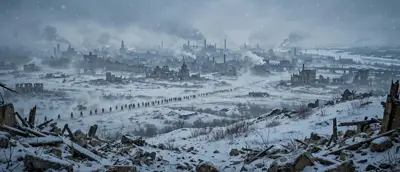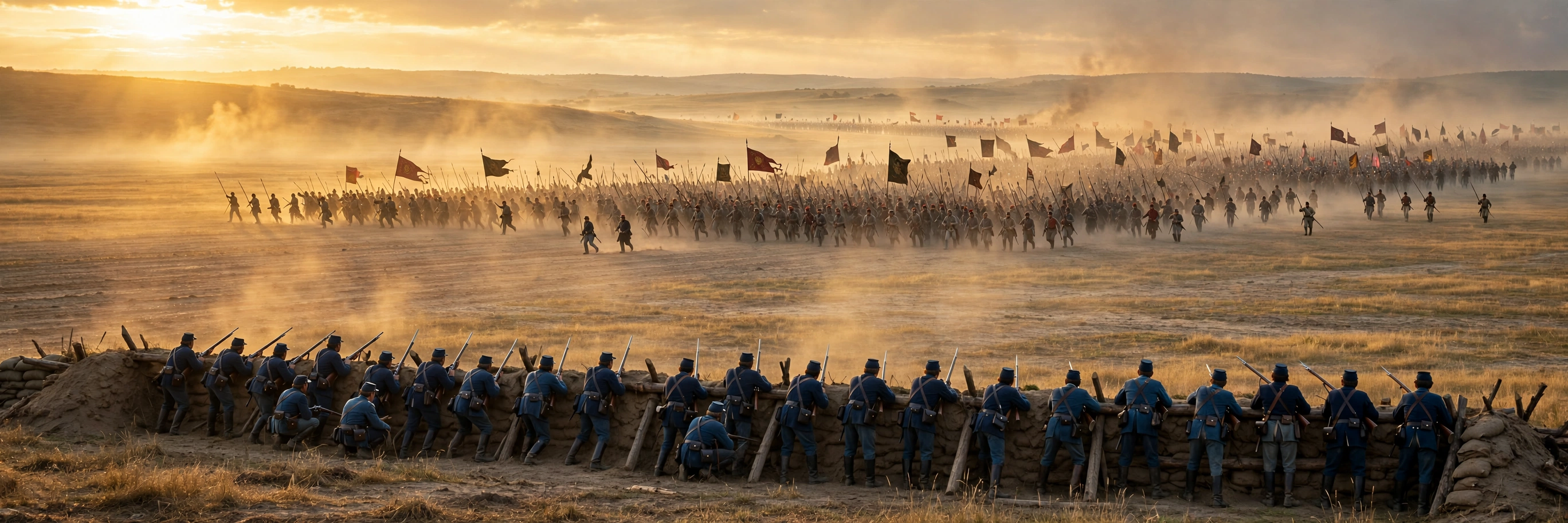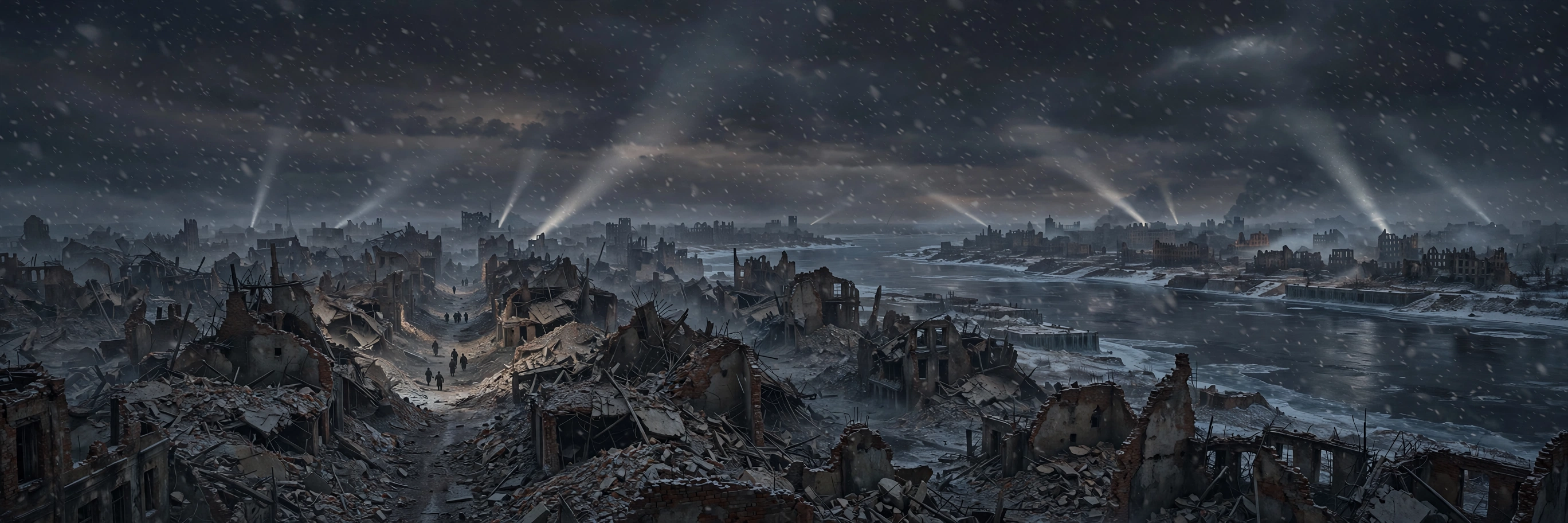
Two million. Sit with that number for a moment. Two million casualties — dead, wounded, missing — in a single battle, in a single city, over less than six months. That's Stalingrad, and nothing else in the history of warfare comes close. But Stalingrad wasn't alone. World War II's Eastern Front produced a cluster of battles so vast they break the scale most people use to think about war. Here are the bloodiest battles of WW2 ranked — with the honest warning up front that every figure below is contested, because the people counting were too busy dying to keep clean books.
A Note on the Numbers
Before the ranking: "casualties" means killed, wounded, missing, and captured — not just dead. And on the Eastern Front, the numbers are a swamp. Soviet records inflated German losses and hid their own; German records did the reverse; civilian deaths went uncounted for decades. Modern historians — Glantz, Krivosheev, Overy — have spent careers reconciling the archives, and they still argue. So treat every figure below as the best available estimate, not gospel. When sources disagree by hundreds of thousands, I'll say so.
1. Stalingrad (1942–43) — ~2,000,000
August 1942 to February 1943. The Volga River. A city named for Stalin, which meant neither side could afford to lose it.
The battle began with the Luftwaffe turning Stalingrad into rubble — which, perversely, made it harder to take, because rubble is perfect defensive terrain. What followed was five months of room-to-room fighting: Chuikov's Soviet 62nd Army clinging to a strip of the Volga's west bank sometimes only a few hundred yards deep, German assault groups grinding forward building by building. "The street is no longer measured in meters but in corpses," one German officer wrote. Snipers like Vasily Zaitsev became legends. Life expectancy for a newly arrived Soviet private was measured in hours.
Then, in November, the Soviets sprang Operation Uranus — a double envelopment that trapped the entire German 6th Army, some 300,000 men, in the ruins. Hitler forbade retreat. The airlift failed. On February 2, 1943, Field Marshal Paulus — promoted to field marshal the day before, because Hitler expected him to shoot himself rather than surrender — surrendered instead. About 91,000 Germans marched into captivity; barely 5,000 ever came home.
Total casualties, both sides, military and civilian: roughly two million. Stalingrad remains the deadliest battle in all of human history — not just of World War II. We've told the full story in our Stalingrad guide: the 200 days that broke the German army.
2. Moscow (1941–42) — ~1,500,000
Before Stalingrad, there was Moscow — the battle that first proved the Wehrmacht could be stopped. Operation Typhoon, launched in October 1941, drove German panzers to within sight of the Kremlin's spires. Then came two things the Germans hadn't planned for: the rasputitsa, the autumn mud season that swallowed roads whole, and then a winter so cold that engine oil froze and soldiers' breath turned to ice on their scarves.
On December 5, with the temperature at forty below, the Soviets counterattacked — fresh Siberian divisions, troops trained for exactly this weather, hitting an exhausted enemy. The Germans were driven back 100 to 250 kilometers. It was Hitler's first major defeat, and it ended any hope of a quick victory in the East.
Casualties: around 1.5 million total, some estimates pushing toward 1.9 million when civilian suffering is counted. Moscow doesn't get Stalingrad's fame, but strategically it mattered just as much — it was the moment Blitzkrieg died.
3. Leningrad (1941–44) — ~1,500,000
The siege, not a battle — but leaving it off this list would be dishonest. From September 1941 to January 1944, 872 days, Leningrad was encircled and starved on Hitler's explicit orders. The "Road of Life" across frozen Lake Ladoga kept a thread of supply moving, but never enough: at least 750,000 civilians starved to death, and total deaths from all causes exceeded a million — about four times the civilian dead of both atomic bombings combined.
Military casualties piled on top: the Germans lost roughly a million men in the fighting around the city; Soviet military dead and missing added another million, with over two million wounded. The combined toll lands near 1.5 million and possibly higher. Leningrad held. The price was beyond reckoning.
4. Kursk (1943) — ~1,200,000
July and August 1943: the largest tank battle in history, and the last German offensive in the East. Roughly 6,000 tanks, two million men, and 4,000 aircraft collided across the Kursk salient — and when it ended, Germany would never attack in the East again.
The casualty math: about 1.2 million total by most estimates, though the figure is among the most disputed on this list (Soviet sources inflated German losses for decades; the archives keep revising both sides). What isn't disputed is the outcome: the German spearheads broke against defenses six belts deep, the SS divisions bled out at Prokhorovka, and the Red Army seized the strategic initiative for the rest of the war.
Our full Kursk guide walks through all seven weeks — including the archival truth about what really happened at Prokhorovka.
5. Berlin (1945) — ~1,000,000
April 16 to May 2, 1945. The end of the world, fought street by street. Zhukov's and Konev's fronts — over two million Soviet troops, 6,000 tanks, 7,500 aircraft — closed on a city defended by a patchwork of Wehrmacht remnants, SS units, Hitler Youth teenagers, and old men of the Volkssturm.
It was never really a contest, but it was a slaughter anyway. Soviet casualties ran into the hundreds of thousands (some estimates: 300,000+). German military and civilian dead in the battle are estimated in the hundreds of thousands more. Total: around a million, possibly up to 1.3 million. On April 30, Hitler shot himself in the bunker. On May 2, General Weidling surrendered the city. Chuikov — the same general who'd held Stalingrad — personally accepted Berlin's surrender. History has a sense of symmetry.
6. Operation Bagration (1944) — ~1,000,000
The great forgotten offensive. Launched on June 22, 1944 — the third anniversary of Germany's invasion — Bagration was the Soviet destruction of Army Group Center in Belorussia. In two months, the Red Army advanced 600 kilometers, liberated Minsk, and reached the gates of Warsaw. German losses were catastrophic: around 381,000 German military dead alone, with total casualties on both sides approaching a million.
Why is it forgotten in the West? Because it happened while everyone was watching Normandy. But Bagration destroyed more German divisions than the entire Western campaign — 28 divisions wiped out. German generals called it a greater disaster than Stalingrad. The numbers agree with them.
7. Okinawa (1945) — ~120,000+
The Pacific war's bloodiest battle, and the one that convinced American planners that invading Japan itself would be a nightmare. April 1 to June 22, 1945: U.S. forces — Army and Marines — fought through 82 days of rain, mud, and suicidal Japanese resistance across the island.
The military toll: roughly 82,000–110,000 Japanese dead and 12,520 Americans killed, with tens of thousands more wounded on both sides. But Okinawa's true horror was civilian: caught between the armies, an estimated 100,000 or more Okinawan civilians died — some estimates run far higher. The kamikaze campaign offshore sank or damaged dozens of American ships.
Okinawa is seventh on this list by the numbers, but it changed history out of proportion to its rank: the casualty forecasts for invading Japan, extrapolated from Okinawa's math, were a major factor in the decision to use the atomic bombs. The Pacific war's turning point had come three years earlier at Midway — Okinawa was its terrible closing argument.
The Eastern Front wasn't a theater of World War II. It was World War II — everything else was fought in its shadow.
The Western Front in Perspective
If you're American or British, the war's bloodiest battles probably mean Normandy and the Bulge — and they were brutal. The Normandy campaign (June 6 to August 30, 1944) cost over 425,000 Allied and German casualties combined, with 209,000+ on the Allied side alone; D-Day itself killed 4,414 Allied troops, 2,501 of them American. The Battle of the Bulge, six months later, cost the Americans some 89,500 casualties — 19,000 killed — the bloodiest battle U.S. forces fought in the entire war. German losses there ran near 100,000.
Now set those numbers beside this list. The Bulge — America's hardest fight of the war — cost both sides combined roughly what Stalingrad burned through in a fortnight. Normandy's entire eleven-week campaign killed fewer men than Moscow lost in its first winter. This isn't to diminish the Western Front; the men who died at Omaha Beach and Bastogne paid the full price. It's to restore the proportions. The war in Europe was decided where the dying was done on a scale the West never saw — in the East, in the mud and snow, by the million.
FAQ
What was the bloodiest battle of World War II?
Stalingrad (1942–43), with roughly 2 million casualties — dead, wounded, missing, and captured on both sides. It is also the deadliest battle in all of human history.
How many people died at Stalingrad?
Total casualties ran to about 2 million, including well over a million dead. About 91,000 Germans marched into captivity when the 6th Army surrendered; barely 5,000 ever came home.
Was D-Day the bloodiest battle of World War II?
No — not close. The Normandy landings were costly, but the Eastern Front’s battles were an order of magnitude larger. Six of the seven bloodiest battles of the war were fought between Germany and the Soviet Union.
What was the bloodiest battle in the Pacific?
Okinawa (April–June 1945): over 12,500 Americans killed, 82,000–110,000 Japanese dead, and an estimated 100,000+ Okinawan civilians caught between the armies.
Why are Eastern Front casualty figures disputed?
Soviet records inflated German losses and hid their own; German records did the reverse; civilian deaths went uncounted for decades. Modern historians like Glantz, Krivosheev, and Overy have spent careers reconciling the archives — and still argue.
What was the deadliest siege of World War II?
Leningrad (1941–44): 872 days, at least 750,000 civilians starved to death, and total deaths from all causes above a million.
Two of the battles above were sieges in all but name — our longest sieges ranking puts Leningrad’s 872 days in even grimmer context. For the Great War’s own meat grinder, see Passchendaele; for the Western Allies’ costliest campaigns, D-Day and El Alamein.
Sources
- David M. Glantz & Jonathan House, When Titans Clashed (University Press of Kansas, 1995) — Eastern Front casualty analysis.
- Richard Overy, Russia's War (Penguin, 1997).
- Antony Beevor, Stalingrad and Berlin: The Downfall 1945.
- U.S. Army Center of Military History — Okinawa campaign records.