On the afternoon of October 3, 1993, about 160 American special operations soldiers — Army Rangers and Delta Force operators, the best-trained troops in the U.S. military — flew into the heart of Mogadishu, Somalia, on what was supposed to be a routine one-hour raid. Capture two men, fly home for dinner. It was the seventh such raid that summer. The others had gone smoothly.
This one didn't. Within an hour, two helicopters were down in hostile streets. Within hours, the raiders were surrounded. What followed was fifteen hours of the most intense urban combat Americans had seen since Vietnam — and when it ended, 18 Americans were dead, hundreds of Somalis were dead, and images beamed around the world would change how America thought about sending its soldiers abroad. This is what happened, as carefully and honestly as the record allows.
Why Was America in Somalia? A Mission of Mercy
In 1992, Somalia was starving. The country had collapsed into clan warfare after the fall of its dictator, and rival warlords were stealing international food aid while hundreds of thousands of civilians faced famine. Television images of starving children moved the world — and moved President George H.W. Bush, who in December 1992 sent U.S. Marines to protect food shipments. It was a humanitarian mission, and at first it worked: food got through, lives were saved.
But Somalia's warlords didn't disappear because food arrived. The most powerful, General Mohamed Farah Aidid, controlled much of Mogadishu and saw the foreign presence as a threat to his power. In June 1993, Aidid's men ambushed and killed 24 Pakistani UN peacekeepers — an atrocity that shocked the international community. In August, a bomb killed four American military policemen. The mission, which had begun with sacks of grain, was becoming something else entirely.
President Bill Clinton authorized a new phase: find Aidid and his commanders. A special unit — Task Force Ranger, built around elite Rangers and Delta Force operators — was sent to Mogadishu with a manhunt mission, codenamed Operation Gothic Serpent. The soldiers were told it would be quick. Capture the lieutenants, destabilize Aidid's network, go home. Through the summer of 1993, they ran six raids. All six worked. The seventh would be different.
A note before we go further, because it matters: this article tells the American side of the story in the most detail, because that's where the most complete records exist. But hundreds of Somalis died in those fifteen hours too — militiamen, and civilians caught in the crossfire of a battle fought through their neighborhoods. Their losses were real, their grief was real, and any honest account has to hold that alongside everything else.
October 3, 3:30 PM: The Raid Begins
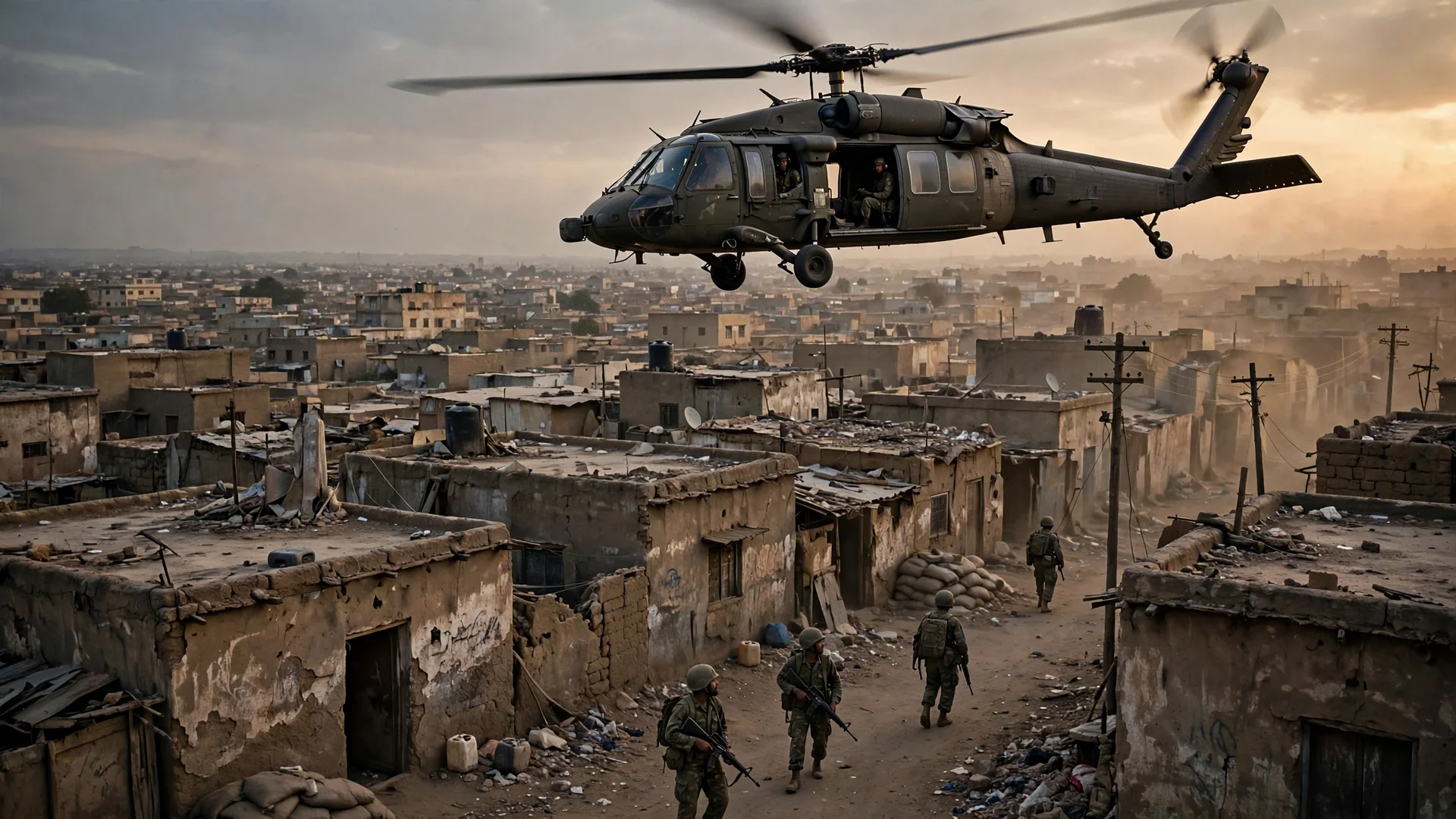
The plan was textbook. Intelligence placed two of Aidid's senior lieutenants at a meeting in a building near the Bakara Market — the densely packed heart of Mogadishu, Aidid's stronghold. At 3:32 p.m., MH-60 Black Hawk helicopters swept in low over the city. Rangers fast-roped onto the streets to seal the perimeter. Delta operators stormed the building. Within minutes, the targets were in custody — 24 prisoners, mission accomplished. The ground convoy of Humvees and trucks rolled in to extract everyone. It had taken less than half an hour. So far, so routine.
Then the Somalis responded — faster and more effectively than American intelligence had expected. Aidid's network had spotters across the city; within minutes of the helicopters' arrival, barricades of burning tires and wrecked vehicles were going up on the narrow streets, and thousands of armed militiamen were converging on the Bakara district. The Americans had planned for a neighborhood. They were about to fight a city.
What the planners had underestimated — fatally — was how the Somalis would fight back against helicopters. Rocket-propelled grenades, fired from rooftops and alleys at low-flying aircraft, are normally a low-percentage weapon. On October 3, in the hands of men who'd been practicing, they were enough.
Black Hawks Down
At about 4:20 p.m., an RPG struck Black Hawk Super 61, piloted by Chief Warrant Officer Cliff Wolcott. The helicopter crashed in an alley several blocks from the target building. Wolcott and his co-pilot were killed on impact. A small team — including two Delta snipers, Sergeant First Class Randy Shughart and Master Sergeant Gary Gordon, who volunteered to go in on foot to protect the crew — fought to reach the site. Both men would die there. Both would later receive the Medal of Honor, the first awarded since Vietnam.
Minutes later, a second helicopter — Super 64, piloted by Chief Warrant Officer Michael Durant — took an RPG to its tail rotor and went down about a mile away. Durant survived the crash with a broken leg and back, fought briefly alongside his crew, and was then captured by Somali militiamen after the rest of his crew was killed. He would spend eleven days as a prisoner before being released.
Two crash sites. Two pockets of Americans now cut off in hostile streets. The neat one-hour raid had become something else: a rescue mission. And the rescue would take all night.
The phrase 'Black Hawk Down' — the radio call made when each helicopter fell — became the name the world would remember. Journalist Mark Bowden would use it for his definitive 1999 book; director Ridley Scott for the 2001 film. But on October 3, 1993, it wasn't a title. It was a distress call, repeated twice, that changed everything.
The Long Night: Fifteen Hours in the Bakara
What followed is difficult to summarize without losing the human scale of it, so let's stay close to the ground. Across the Bakara district, small groups of Americans — Rangers at the first crash site, the survivors around Durant's wreck, the convoy troops trying to fight through barricaded streets — held positions through the afternoon, evening, and night, surrounded by thousands of Somali gunmen firing from windows, rooftops, and alleys.
The Americans had advantages: night vision, disciplined fire, air support from attack helicopters and an AC-130 gunship circling overhead. The Somalis had advantages too: numbers, knowledge of every alley, and a seemingly endless supply of fighters willing to press the attack. The fighting was house-to-house, street-to-street, at ranges measured in yards. Ammunition ran low. The wounded accumulated. Medics worked in the dark under fire.
Twice, ground convoys tried to reach the crash sites and were turned back by barricades — the narrow streets, choked with burning debris, were death traps for vehicles. It wasn't until late in the night that a proper rescue column could be assembled: American troops reinforced by Malaysian and Pakistani UN armored vehicles, which finally punched through to the trapped men in the early hours of October 4. By dawn, the last Americans were out. Fifteen hours after it began, the battle was over.
Among the rescuers' casualties: one Malaysian soldier killed and seven wounded, two Pakistani soldiers wounded — men whose contribution is too often forgotten when this battle is remembered as an American story alone.
Counting the Cost — On Both Sides
The American toll: 18 dead, 73 to 84 wounded (accounts vary slightly), one captured. For a force of 160 men, that's a casualty rate above fifty percent — the kind of losses units take once in a generation. The dead included some of the military's most elite soldiers. Their names are on memorials now. Their families' grief didn't end when the battle did.
The Somali toll is harder to fix, and honesty requires saying so. The International Committee of the Red Cross and Doctors Without Borders estimated around 200 killed and 700 wounded. Aidid's own organization claimed 315 killed. Other estimates — including the U.S. ambassador's — ran far higher, into the hundreds or more. What is certain is that many of the dead were not militiamen but civilians: men, women, and children killed in the crossfire of a battle fought with heavy weapons through densely populated neighborhoods. American helicopters fired thousands of rounds of cannon fire into the city that night. The Somalis who died had names and families too, and their losses — less documented, less memorialized — deserve the same plain acknowledgment.
This asymmetry of memory is worth pausing on. In America, October 3 is remembered through Bowden's book and Scott's film — through the American dead. In Somalia, it's remembered as the day foreign helicopters rained fire on Mogadishu's neighborhoods. Both memories are true. A complete history holds them together, even when it's uncomfortable.
The Photographs That Changed Policy
In the days after the battle, images circled the globe that seared themselves into the American consciousness: the bodies of dead American soldiers being dragged through Mogadishu's streets by celebrating crowds, broadcast on television into millions of living rooms. Whatever the tactical facts — and tactically, the raid had achieved its objectives — those images decided the strategic outcome.
President Clinton, facing a horrified public and a hostile Congress, announced within days that the U.S. mission in Somalia would end. Durant was released eleven days after his capture. By March 1994, American combat troops were gone. Aidid himself survived — he died in 1996 of wounds from a clan battle, not from any American operation.
The policy consequences rippled for a decade. The 'Mogadishu effect' — sometimes called the 'Somalia syndrome' — made American leaders deeply reluctant to intervene in foreign crises. When genocide unfolded in Rwanda six months later, in 1994, the shadow of Mogadishu hung over every meeting where intervention was discussed. Eight hundred thousand people died in Rwanda while the world watched. Historians still debate how much of that inaction traces back to October 3, 1993 — but no serious account puts the number at zero.
That's the heaviest legacy of Mogadishu: not the battle itself, but what the battle taught Washington to fear. A tactical success, a strategic withdrawal, and a lesson — don't intervene — that may have cost far more lives than the battle ever did.
What Mogadishu Teaches — Carefully
This is a recent battle, within living memory, and its lessons are still argued over by the people who fought it. So let's be careful and stick to what the record supports.
First: mission creep kills. The operation that began as famine relief became a manhunt without anyone quite deciding it had. Each step seemed logical — protect the food, stop the warlord stealing it, capture the warlord attacking peacekeepers — but the end state bore no resemblance to the beginning, and the force sent to do the final job was sized for a raid, not a war. When your mission changes, your plan has to change with it. In Mogadishu, it didn't, quite.
Second: underestimation is the constant enemy. American planners assumed technological superiority — night vision, airpower, elite troops — would dominate any engagement. It dominated the tactical fight; the Americans inflicted far heavier casualties than they took. But it couldn't dominate the strategic outcome, because the Somalis didn't need to win firefights. They needed to make the cost visible — and one afternoon of RPGs did that.
Third, and hardest: images are strategy now. The battle was lost not in the Bakara Market but on American television. In an age of instant global media, what the world sees can outweigh what actually happened. That's not a complaint about the media — the cameras showed something real. It's a fact about modern war that every planner since has had to reckon with: the audience is part of the battlefield.
And finally, the quietest lesson, the one this article has tried to honor throughout: count everyone. Eighteen Americans. Hundreds of Somalis. A Malaysian and Pakistani dead. Civilians in the crossfire. A battle's full cost is always larger than any one nation's memorial admits. Remembering honestly means remembering all of it.
The argued-over casualty counts at Mogadishu belong to a long tradition of lopsided tallies — explore more in the most one-sided battles in history.
Sources
- Mark Bowden — Black Hawk Down: A Story of Modern War (Atlantic Monthly Press, 1999) — the definitive narrative account.
- U.S. Army Center of Military History — Somalia operations records.
- Army Times — “The Battle of Mogadishu 25 years later” (armytimes.com).
- ThoughtCo — “The 1993 Battle of Mogadishu” (thoughtco.com).