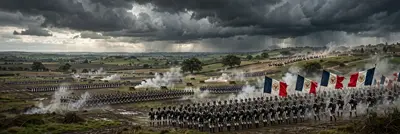
Nobody had ever beaten Napoleon like this. On October 16, 1813, the French emperor stood in the middle of Saxony with around 200,000 soldiers and faced something he had never faced before: an enemy he couldn't outnumber. More than 320,000 Russians, Prussians, Austrians, and Swedes were closing on the city of Leipzig from three sides, and more kept arriving. Four days later Napoleon's army was running for its life across a river with no bridge, and his own allies were shooting at him from the far bank. If you only remember one thing about Leipzig, make it this: Waterloo was the execution. Leipzig was the trial, the verdict, and the sentence.
So how did Napoleon end up fighting the whole of Europe at once?
Start a year earlier. In June 1812 Napoleon marched into Russia with the largest army Europe had ever seen, something like 600,000 men. Six months later he marched out with maybe 30,000 still standing in formation. The rest had died in the snow, starved, frozen, or been cut down on the retreat. It was the single worst disaster of his career, and it taught every ruler in Europe the same lesson at the same time: he could be beaten.
Prussia moved first. In March 1813, encouraged by the Russian victory, Prussia joined Russia against France. Napoleon, moving fast the way he always did, smashed the new allies at Lutzen in May and again at Bautzen later that month. And here's the thing. Both times he won the battle and lost the opportunity. He couldn't destroy the allied armies, and he couldn't run them down. His cavalry was gone. It had frozen to death in Russia.
So he made a deal. The armistice of Plaswitz in June 1813 paused the war, and Napoleon probably thought it would buy him time to rebuild. Instead it bought his enemies time to rebuild, and worse, it gave Austria time to pick a side. Austria picked the other side. By autumn the Sixth Coalition was complete: Russia, Prussia, Austria, and Sweden, with British money paying the bills. The allies had a plan with an ugly name and a simple idea. They called it the Trachenberg Plan: avoid fighting Napoleon himself, and beat his marshals instead.
It worked like a charm. While Napoleon won his last great victory at Dresden in late August, his marshals lost at Grossbeeren, the Katzbach, Kulm, and Dennewitz. And every one of those defeats cost him something he couldn't replace. Men. Guns. Horses. By October he was pulling back toward Leipzig with what was left of his strength, about 200,000 men, and four allied armies were closing on the same city. Nobody chose Leipzig as a battlefield. It chose itself.
What did the two armies actually look like?
Big. Bigger than anything Europe had seen. Historians count roughly 200,000 men under Napoleon's direct command at Leipzig, with about 700 guns. The coalition started with around 255,000 and kept adding armies until it had more than 320,000 men and roughly 1,500 guns. Add the two sides together and you get something like 600,000 soldiers in the field. Nothing in the Napoleonic Wars comes close. Nothing in European history had been that big before, and only the meat grinders of the First World War would beat it.
"The French had 200,000 men. The Allies brought over 320,000 to the field, with 1,500 guns. It was the largest battle of the Napoleonic Wars." Encyclopaedia Britannica, "Battle of Leipzig"
On paper the French commander was Napoleon, the best battlefield mind of his generation. In practice he was a man stretched past his limit. He'd spent the campaign riding between armies, plugging holes, trying to be everywhere at once. The coalition's supreme commander was the Austrian field marshal Karl Philipp, Prince of Schwarzenberg. Honestly, Schwarzenberg was not in Napoleon's class as a tactician. He didn't need to be. He had far more men and a simple plan: squeeze.
The real characters were the allied army commanders. Blucher, the 71-year-old Prussian, was pure aggression. His nickname was Marshal Forward, and he'd earned it. Bernadotte, the Crown Prince of Sweden, had been one of Napoleon's own marshals before switching sides. Imagine that. Napoleon was about to fight a man he'd promoted. And the Russians brought Barclay de Tolly, Wittgenstein, and Tsar Alexander I himself, watching from the allied headquarters. Four armies, four proud nations, one enemy.
October 16: Napoleon tries to win it the way he always wins
The fighting started on October 16, and Napoleon's opening was pure Napoleon. South of Leipzig, at the villages of Wachau and Liebertwolkwitz, he threw his men at Schwarzenberg's Army of Bohemia, trying to smash one allied army before the others could arrive. If it had worked, it would have been Austerlitz all over again. Our Battle of Austerlitz explained guide shows what that looked like when it worked. But this time the numbers just weren't there.
The most dramatic moment of the day belonged to Joachim Murat, Napoleon's cavalry commander. Late in the afternoon, Murat launched one of the largest cavalry charges of the entire Napoleonic Wars, something like 8,000 to 10,000 horsemen, straight at the Allied center. They broke through the Russian lines. They rode so far that for a few minutes the allied commanders, including the Tsar, could see French horsemen bearing down on them.
And then it stopped. The Russian Lifeguard Cossacks and reserve cavalry counterattacked, the charge ran out of steam, and Murat's horsemen rode back. That's the thing about Leipzig. Even Napoleon's best day at Leipzig was only ever a stalemate. The battle ended on October 16 with both sides bloodied and nothing decided. Napoleon had thrown his best punch and hit air.
Here's what I'd argue: October 16 was Napoleon's last chance. If he'd won that day, he might have peeled one army away and survived. He didn't. And the coalition armies he'd been waiting for were already marching in.
October 17: the strangest day of the battle
Almost nothing happened. And that nothing mattered more than the fighting.
Both armies used October 17 to rest, resupply, and bring up reinforcements. For Napoleon that meant a few thousand tired replacements. For the coalition it meant two entire fresh armies marching into position: Bernadotte's Army of the North and more Austrian troops. The trap kept closing. Napoleon offered an armistice on the 17th. The allies ignored him. They knew what was coming. He probably did too.
October 18: the day Napoleon's own allies started shooting at him
On October 18 the Allies attacked from every direction at once, and this is where the battle turns into a nightmare. The coalition closed on Leipzig in a ring, and Napoleon pulled his army back into the city, fighting street to street in places. And then, in the middle of the battle, 5,400 Saxon soldiers, men who had been fighting for Napoleon that morning, walked across the field, turned their guns around, and opened fire on the French.
Let that sink in. Imagine you're a French soldier on October 18. You're holding a line against the Russians. You look left, and the Saxon regiment next to you is marching away. You look again, and they're shooting at you. It wasn't just the Saxons. Wurttemberg cavalry defected the same day. Napoleon's German allies, the ones he'd treated as junior partners for years, had finally had enough. The Confederation of the Rhine, his whole system of German satellite states, collapsed in an afternoon.
"On October 18, 5,400 Saxon troops deserted to the Allies in the middle of the battle. The French position at Leipzig became untenable, and Napoleon ordered a retreat." Encyclopaedia Britannica, "Battle of Leipzig"
Napoleon ordered a retreat west, toward the Lindenau bridge over the Elster river. The battle was over. What followed was the disaster.
October 19: one bridge, one mistake, one drowned marshal
The French retreat ran through a single bridge over the Elster. One bridge, for 200,000 men, guns, and wagons, with the entire coalition closing in behind them. It was always going to be chaos. And then somebody made it infinitely worse.
A French corporal, panicking as the Allies pressed in, set off the bridge's demolition charges too early. The Lindenau bridge went up while tens of thousands of French soldiers were still on the far bank. They were trapped between the river and the enemy. What happened next was a massacre. Men tried to swim the Elster and drowned in their hundreds. Others surrendered by the thousands.
The most famous death was Prince Jozef Poniatowski, the Polish commander. Three days earlier Napoleon had made him a Marshal of France. On October 19, with the bridge gone and the enemy closing in, Poniatowski refused to surrender, rode his horse into the Elster, and drowned. A marshal's baton, held for three days. Honestly, his story tells you everything about the men Napoleon was losing: the loyal ones died, and the disloyal ones left.
And yeah, there's an honest downside to this story. The bridge disaster is dramatic, but historians argue about the details. Who exactly gave the order? How many were trapped? Numbers vary from 15,000 to 30,000. The one thing nobody disputes is the outcome: Napoleon got out with the core of his army, but Leipzig had gutted it. France was next.
What did Leipzig actually cost?
The bills for this battle were enormous on both sides. The standard figures, the ones you'll find in Britannica, are roughly 38,000 French killed and wounded plus 15,000 taken prisoner, against about 54,000 allied killed and wounded. Add it up and you're looking at somewhere around 90,000 to 100,000 casualties in four days. That puts Leipzig in the conversation with the bloodiest battles in history, and it was far and away the deadliest battle of the Napoleonic Wars.
"The French lost about 38,000 men killed and wounded and 15,000 prisoners. The Allies lost about 54,000 killed and wounded." Encyclopaedia Britannica, "Battle of Leipzig"
But be careful with these numbers. Nineteenth-century casualty counts are always estimates, and Leipzig's are messier than most because four armies from four countries kept four different kinds of records, and the French lost a lot of their records at the bottom of the Elster. Some historians put the total dead alone at 80,000. Nobody knows for sure, and anyone who gives you an exact number is guessing. The honest answer: it was the bloodiest four days Europe had seen to that point. Everything else is rounding.
Why Leipzig matters more than Waterloo
You've probably wondered why everyone remembers Waterloo and almost nobody remembers Leipzig. Here's my honest take: it's unfair, and it misses how wars actually work.
Waterloo was the execution. It took one day, June 18, 1815, and it ended Napoleon's career. But by the time Napoleon marched to Waterloo, he'd already lost everything that mattered. Our Battle of Waterloo summary tells that story. Leipzig was the trial, the verdict, and the sentence. It ended French power in Germany. It dissolved the Confederation of the Rhine. It freed Prussia and Austria to march on France, which they did six months later. Waterloo decided one man's fate. Leipzig decided a continent's.
And in Germany, Leipzig never stopped mattering. The Germans call it the Volkerschlacht, the Battle of the Nations, and a century later they built the Volkerschlachtdenkmal, a 91-meter monument on the battlefield, one of the biggest war memorials in Europe. Nations don't build monuments like that for battles that don't matter. They build them for the days that made them.
Most people get this wrong. They think Napoleon's downfall started in Russia in 1812. Russia destroyed his army. Leipzig destroyed his empire. There's a difference.
3 Lessons from Leipzig
Leipzig is a battle, but it's also a case study. Three lessons worth stealing:
1. Coalitions beat geniuses. Napoleon was the best commander of his age. Schwarzenberg wasn't. Didn't matter. The Trachenberg Plan, avoid the genius and hit his subordinates instead, turned four ordinary plans into one unstoppable strategy. If you're ever up against someone smarter, don't fight them head-on. Fight the system around them.
2. Allies are a resource, not furniture. The Saxons didn't defect on a whim. Napoleon had spent years treating his German allies as troops to be spent and taxes to be collected. When the moment came, they remembered. Treat your people well before you need them, not after.
3. Never depend on one bridge. The Lindenau bridge was a single point of failure, and one panicked corporal turned a retreat into a catastrophe. The principle works off the battlefield too: wherever you have exactly one of something, that's where your plan will break.
Want the full arc? Read our Battle of Borodino summary for the disaster in Russia that made Leipzig possible, then the Waterloo piece to see how it all ended. And if you're ever standing in Leipzig, the monument is worth the climb.
Frequently Asked Questions
Who won the Battle of Leipzig?
The Sixth Coalition won decisively. Russia, Prussia, Austria, and Sweden fielded over 320,000 men against Napoleon's roughly 200,000. After four days of fighting, the French retreated across the Elster, losing about 38,000 killed and wounded plus 15,000 prisoners. The coalition lost about 54,000 of its own. Clean sweep, at a brutal price.
How big was the Battle of Leipzig?
Roughly 600,000 soldiers fought at Leipzig, making it the largest battle of the Napoleonic Wars and the largest battle in European history to that point. The coalition brought about 1,500 guns to the French 700. Nothing in the Napoleonic Wars comes close.
What happened to Napoleon's allies at Leipzig?
They defected. On October 18, about 5,400 Saxon soldiers switched sides in the middle of the battle and turned their guns on the French. Wurttemberg cavalry followed. Napoleon's German satellite system, the Confederation of the Rhine, collapsed the same day.
Why was the Battle of Leipzig important?
It ended Napoleon's control of Germany. The Confederation of the Rhine dissolved, German states joined the coalition, and the Allies invaded France six months later. Waterloo gets the fame, but Leipzig broke the empire.
Sources
- Encyclopaedia Britannica, Battle of Leipzig
- Wikipedia, Battle of Leipzig
- Napoleon Series, The Battle of Leipzig 1813