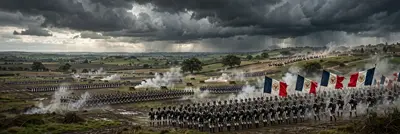
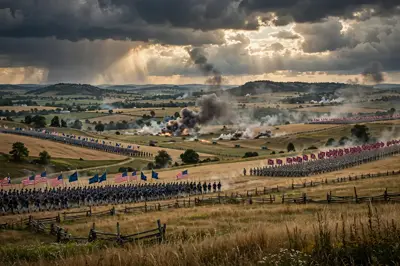
On the morning of September 1, 1870, the Emperor of France rode out of Sedan in a carriage — too ill with a kidney stone to sit a horse — to watch his army fight for its life. By the afternoon, the French guns had fallen silent around him. By the following day, he had handed his sword to the King of Prussia, and with it the last full field army France had left: 104,000 men. This Battle of Sedan summary is the story of how roughly twelve hours of fighting cost France a battle, an emperor, and an empire — and how modern Germany was born in the wreckage.
What Was the Battle of Sedan?
The Battle of Sedan was the decisive battle of the Franco-Prussian War, fought September 1, 1870 near Sedan in northeastern France. German armies under Helmuth von Moltke surrounded the French Army of Châlons — roughly 120,000 men — and pounded it into surrender. Emperor Napoleon III was captured, and France's Second Empire collapsed within days.
It remains the largest capitulation in European warfare up to that date: a whole army, with its emperor, giving up in a single day. Fifty-five years earlier, another Napoleon had met his end at Waterloo — our Battle of Waterloo 1815 guide tells that story. Sedan was the second fall of the house of Bonaparte, and in some ways the more total one.
The Road to Sedan: How France Walked Into a Trap
France and Prussia had been circling each other for years. Napoleon III's Second Empire looked strong from the outside — glittering Paris, a big army, a famous name. Prussia's chancellor, Otto von Bismarck, had his own reason to want a fight: a victorious war against France would push the hesitant south German states into a unified Germany under Prussian leadership. The spark was a vacant Spanish throne and a doctored telegram. Bismarck edited the Ems Dispatch of July 13, 1870 so that it insulted both Paris and Berlin, released it to the press, and watched the outrage do his work. France declared war on July 19, confident it would be over by autumn. It was — just not the way Paris expected.
The French army that marched east was brave and experienced in colonial wars, and badly organized for a European one. The disasters stacked up in three weeks: Wissembourg on August 4, Spicheren on August 6, Mars-la-Tour on August 16, and the bloody Gravelotte–St. Privat on August 18. Marshal Bazaine's Army of the Rhine — about 154,000 men — fell back into the fortress of Metz, where the Germans simply locked the gates on them and waited.
Paris demanded a rescue. Marshal Patrice de MacMahon scraped together the Army of Châlons — roughly 120,000 men — and, with Napoleon III himself traveling alongside, marched northeast to break Bazaine out of Metz. It was the wrong move, and Helmuth von Moltke the Elder knew it. Instead of falling back to shield Paris, the French marched into open country while two German armies — the Third Army under Crown Prince Friedrich Wilhelm and the Army of the Meuse under Crown Prince Albert of Saxony — swung wide around their exposed flank. At Beaumont on August 30 the Germans mauled a French corps, and the retreat funneled straight into Sedan.
The Armies That Met at Sedan
Sedan sits in a bend of the Meuse river, close to the Belgian border, in the wooded Ardennes. On August 31, MacMahon's exhausted army crowded into the pocket of ground around the old fortress town — about 120,000 men, the figure Britannica uses, though some histories count a few thousand fewer or more. They were tired, short of supplies, and outgunned: the Prussian Krupp steel breech-loading guns outranged the French bronze cannon, and there were simply more of them. Britannica puts the German strength at some 200,000 men; other accounts run as high as 222,000. Whatever the exact count, the French were outnumbered roughly two to one.
Worse than the numbers was the command. Napoleon III held nominal command but was in no state to lead — a painful bladder stone kept him in a carriage rather than on horseback. Real command lay with MacMahon until a shell fragment wounded him around 6:30 on the morning of September 1. Command passed to General Auguste-Alexandre Ducrot, who read the battlefield correctly and ordered a retreat west toward Mézières. Then General Emmanuel Félix de Wimpffen — who had arrived the previous evening carrying sealed orders from the war minister in Paris — produced his papers, claimed command for himself, and countermanded the retreat. In the space of an hour the French army had three commanders and no plan.
Across the lines there was no such confusion. Moltke directed the operation from the heights with King Wilhelm I of Prussia beside him, moving corps by telegraph like pieces on a board. The Prussian general staff was the real wonder weapon of 1870: railways and timetables instead of heroic charges. Sedan would become its masterpiece — the textbook encirclement battle, and a preview of a German tactic that would terrify Europe again forty-four years later, as our Battle of Tannenberg 1914 summary shows.
September 1, 1870: How the Battle Unfolded
Dawn — the fight for Bazeilles. Bavarian troops forced the Meuse crossings at first light and hit the village of Bazeilles, where French marines fought house to house with desperate courage. The village was stormed, retaken, and stormed again; by day's end it was burning, and civilians caught in the fighting were killed in what the French remember as the Bazeilles massacre. It set the tone: this would be a battle with no soft edges.
Morning — the French lose their commander, twice. Around 6:30 AM MacMahon went down wounded. Ducrot took over and ordered the army to pull out westward toward Mézières — the one move that might have saved part of it. Then Wimpffen's sealed orders surfaced. He stopped the retreat and ordered the army to hold its ground and fight its way east, toward Bazaine. The corps that had started marching west turned around. Hours were lost. The Germans were not waiting.
Midday — the ring closes. German corps swung around both French flanks and seized the heights ringing Sedan — the Marfée and the ridges to the north. From those hills, more than 500 German guns began pounding the packed French positions. The French were being squeezed into a triangle: the fortress of Sedan at their back, the Meuse on one side, the Belgian border on the other. Some units broke for Belgium and were disarmed and interned — about 3,000 men. There was nowhere left to maneuver.
Afternoon — the emperor rides the field. Napoleon III spent the afternoon riding through the artillery fire, and witnesses said he seemed to be seeking a soldier's death. The story goes that, looking at the hopeless position, he muttered: "We are in a chamber pot, and we shall be covered in filth." The quote is famous, though like many battlefield one-liners it may have been polished in the retelling. What is certain is that by late afternoon the French artillery was silenced, German shells were falling into Sedan itself, and the emperor ordered a white flag raised over the citadel.
Evening — the argument over surrender. Wimpffen was furious at the white flag and wanted to fight on. Moltke's answer was simple: surrender the army, or the bombardment resumes at dawn and Sedan is shelled to rubble. A ceasefire held through the night while the terms were haggled out at Donchery. The French had nothing left to bargain with.
The Surrender: An Emperor Hands Over His Sword
On the morning of September 2, Napoleon III drove out to meet the victors. He spoke first with Bismarck — a strange, almost courteous conversation between the man who had engineered the war and the man who had lost it — and then wrote to King Wilhelm I: "Not having been able to die in the midst of my troops, it only remains for me to place my sword in the hands of Your Majesty." Wilhelm accepted the sword, and the emperor with it, as his prisoner. But when Napoleon suggested they might now make peace, the Prussians declined: their quarrel, they said, was with France, not with its emperor. The war would go on.
The military capitulation was signed that same day by Wimpffen, in the presence of Moltke and Bismarck. Its terms were staggering: the entire Army of Châlons — 104,000 men, the figure given in Britannica and most histories — laid down its arms. Officers kept their swords; everyone else became prisoners of war. Columns of French soldiers were marched off to captivity in Germany, many to a miserable camp on the Iges peninsula that the prisoners called the Camp of Misery. Napoleon III himself was sent to the palace of Wilhelmshöhe near Kassel: a gilded cage for a fallen emperor.
The scale of it is hard to overstate. In a single day, France had lost its emperor, its last field army, and — though nobody in Sedan knew it yet — its regime. For the wider 19th-century butcher's bill that Sedan belongs to, see our ranking of the bloodiest battles in history.
Casualties: The Price at Sedan
The butcher's bill tells the story of the encirclement. French losses ran to about 3,000 killed and some 14,000 wounded — roughly 17,000 casualties in all — with another 21,000 men taken prisoner during the fighting itself. Then came the capitulation: 104,000 men surrendered with the army. German casualties were around 9,000 killed and wounded. These are the commonly cited figures, repeated in Britannica's account; as with all 19th-century battles, expect the exact numbers to shift a little from source to source.
Raw numbers hide the human part. Thousands of French soldiers died because they were maneuvered into an impossible position by their own high command — marched into a pocket, given three commanders in an hour, and then pounded by artillery they couldn't answer. Courage wasn't the shortage at Sedan. Leadership was.
Why Was the Battle of Sedan Important?
Sedan didn't just end a battle; it ended a regime. When news of the capitulation reached Paris on September 3, crowds filled the streets, and on September 4 the Second Empire was overthrown and the Third Republic proclaimed. The new Government of National Defense decided to fight on — and France paid for that decision with the five-month Siege of Paris, which began on September 19, and with Bazaine's surrender of Metz on October 27, when another 140,000-plus French soldiers laid down their arms.
For Germany, Sedan was the founding victory. On January 18, 1871 — in the Hall of Mirrors at Versailles, the palace of the French kings — the German Empire was proclaimed with Wilhelm I as Kaiser. The Treaty of Frankfurt, signed May 10, 1871, made it official: France ceded Alsace-Lorraine and paid an indemnity of five billion francs. Bismarck had his unified Germany. He also had something he hadn't bargained for: a France that would spend the next forty years burning for revenge — the "revanchism" that helped poison European politics all the way to 1914.
Militaries studied Sedan for generations. It was the proof that the general staff system — railways, telegraphs, timetables, and encirclement — had replaced the heroic frontal assault as the way wars were won. Moltke's famous observation, that no plan survives first contact with the enemy, is quoted in every staff college on earth; Sedan is the battle that proved the second half of his wisdom, which was to build an organization that could improvise. France learned the opposite lesson, and learned it bitterly.
What the Sources Tell Us: A Note on the Numbers
Honest history comes with asterisks. French strength at Sedan is usually given as about 120,000, but you'll see 104,000 to 124,000 depending on whether the counter includes every straggler and fortress gunner. German strength runs from 200,000 (Britannica) to 222,000 in some German accounts. The prisoner figure of 104,000 is the standard one, and the casualty ranges above are the consensus.
Napoleon's "chamber pot" remark is one of history's great quotes — and one of its most suspicious. It comes to us through memoirs and secondhand reports, and it may have been sharpened in the retelling. The same caution applies to the fine details of his meeting with Bismarck. What the documents do confirm: the date, the surrender letter's wording, the capitulation terms signed by Wimpffen, and the political earthquake that followed. The color commentary, take with a pinch of salt.
3 Lessons from Sedan
Sedan is a battle, but it's also a case study in how organizations fail. Three lessons worth stealing:
1. One commander, one plan. The French army changed commanders three times in a morning — MacMahon to Ducrot to Wimpffen — and reversed its orders mid-march because of sealed paperwork from Paris. An army that doesn't know who's in charge is already beaten. Any team, military or otherwise, pays the same price for divided leadership.
2. Systems beat heroes. The French fought with well-documented bravery at Bazeilles and on the ridges. It didn't matter. Moltke's staff moved 200,000 men into a ring around them on schedule, by rail and telegraph, and then let the artillery do the talking. When the other side has the better organization, courage becomes a casualty statistic. Build the machine before you need it.
3. Don't confuse the symbol with the strategy. Napoleon III rode through shellfire at Sedan, and it changed nothing — the battle was lost on maps and timetables days earlier. A leader's personal bravery can't fix a broken plan. The emperor's ride is remembered; Moltke's timetables are what won.
Sources
- Britannica — Battle of Sedan
- Britannica — Franco-Prussian War
- Wikipedia — Battle of Sedan
- Wikipedia — Franco-Prussian War