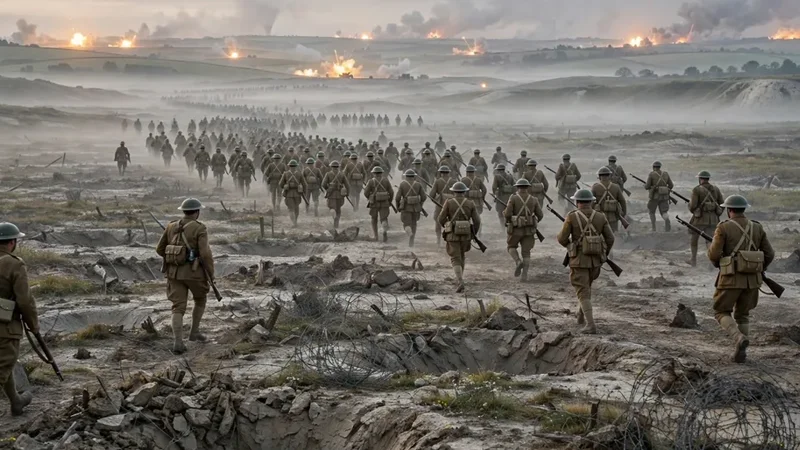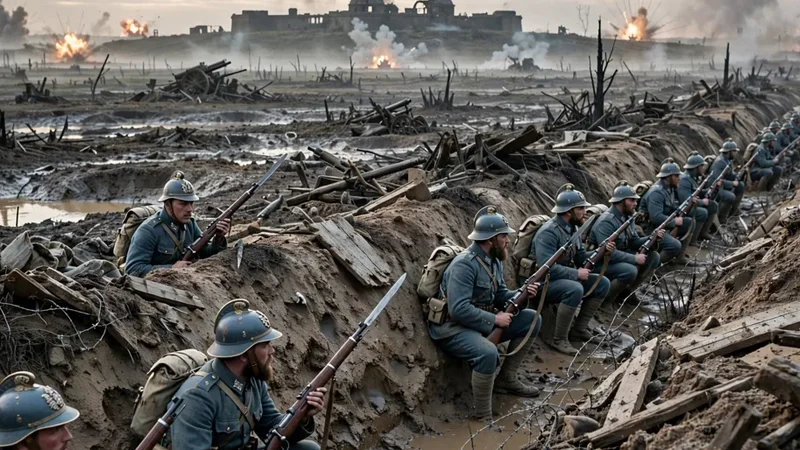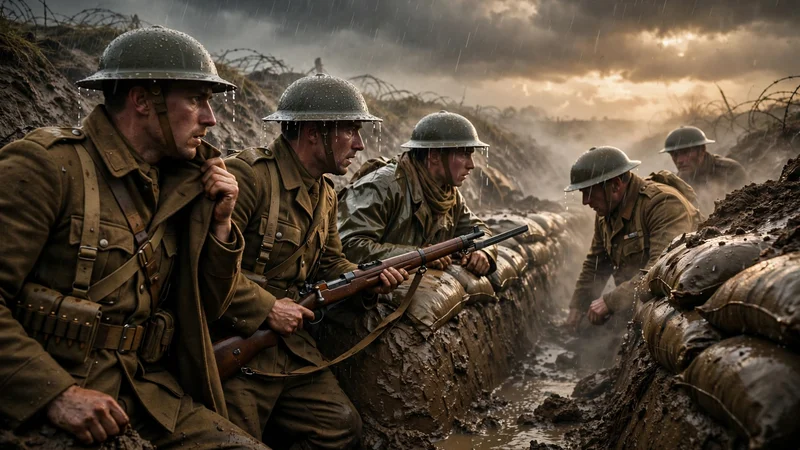
In the last week of August 1914, the German Empire came closer to losing the war in the east than most history books admit. Two Russian armies — close to half a million men between them — had poured into East Prussia. The German Eighth Army standing in their way numbered barely 150,000. One Russian army had already bloodied the Germans at Gumbinnen on August 20, and the German commander was talking about abandoning East Prussia altogether. Then, on August 23, a 66-year-old retired general and a staff officer almost nobody knew took command. They read the enemy's uncoded radio messages, left one Russian army completely alone, and threw everything they had at the other. Four days later, the Russian Second Army had essentially ceased to exist.
What Was the Battle of Tannenberg?
The Battle of Tannenberg was a decisive German victory on the Eastern Front of World War I, fought from August 26 to 30, 1914, in East Prussia. Paul von Hindenburg and Erich Ludendorff used railways and intercepted Russian radio messages to surround Alexander Samsonov's Second Army, destroying it and capturing around 92,000 men.
August 1914: Russia Invades East Prussia
Germany's whole war plan in 1914 depended on a gamble: throw almost everything at France in the west, hold in the east with a skeleton force, and count on Russia being too slow to mobilize to matter. This was the Schlieffen Plan in action, and it had one fatal assumption baked into it — that the Russian war machine would need six weeks to get moving. The Russians needed about two.
On August 17, 1914 — just thirteen days after Germany declared war on Russia — two Russian armies crossed into East Prussia. From the east came General Paul von Rennenkampf's First Army, driving toward Königsberg. From the south came General Alexander Samsonov's Second Army, pushing up into the Masurian lake country. Together they were supposed to squeeze the German Eighth Army between them and crush it, then keep marching on Berlin. The plan was sound on paper. The execution was a catastrophe.
The Eighth Army's commander, Colonel-General Maximilian von Prittwitz, had roughly 150,000 men against a Russian force more than twice his size. On August 20, at Gumbinnen, Rennenkampf's First Army bloodied the German I Corps under Hermann von François and forced it back. Prittwitz panicked. He told the high command he intended to retreat behind the Vistula River — in plain terms, to abandon East Prussia, the homeland of the Prussian officer class, to the invader. The German high command found this unacceptable. On August 22, Prittwitz was sacked.
His replacement was a legend nobody had heard of. Paul von Hindenburg was 66 years old, three years into retirement, when the summons reached him at Hanover. The Kaiser asked him to take the Eighth Army; Hindenburg accepted on the spot. As his chief of staff, Berlin sent Erich Ludendorff — the energetic 49-year-old who had won fame storming the Belgian fortress of Liège in the war's first week. They reached the front on August 23. They had about 72 hours to stop an invasion.
Two Russian Armies, Zero Teamwork
What Hindenburg and Ludendorff found when they arrived was better than they could have hoped: two Russian armies that refused to act like one army.
Start with the commanders. Paul von Rennenkampf and Alexander Samsonov despised each other personally — a hatred dating back to the Russo-Japanese War of 1904–1905, where the two men, both serving in Manchuria, reportedly came to blows at a railway station after the Battle of Mukden. Nearly a decade later, they were still not on speaking terms. Each commanded an army in East Prussia. Each mostly ignored the other.
Above them sat General Yakov Zhilinsky, commander of the Northwest Front, whose orders made things worse. On August 26, believing the Germans were beaten and retreating, Zhilinsky ordered Rennenkampf's First Army to turn west toward Königsberg — chasing a phantom, and marching steadily away from Samsonov's Second Army, which was advancing alone into the German trap. Samsonov, meanwhile, was pressing north with his supply lines stretched thin, his men exhausted from marching in summer heat, and his army's flank hanging in the air. He had no idea he was the target.
And then there was the detail that decided the battle before it started. The Russian armies broadcast many of their operational orders by wireless in the clear — unencrypted. German listening stations intercepted them. The Germans knew where Samsonov's corps were, where they were going, and — the crucial piece — that Rennenkampf's First Army had been ordered west, away from the fight. Hindenburg and Ludendorff didn't have to guess what the Russians would do. They could read it in the morning's intercepts.
Hoffmann's Plan: The Staff Officer Who Designed the Trap
Here's the part the legend usually skips. The plan for Tannenberg wasn't really Hindenburg's or Ludendorff's. It was drawn up by Lieutenant Colonel Max Hoffmann, the Eighth Army's operations officer, who knew East Prussia's terrain and the Russian order of battle better than anyone on the German staff.
Hoffmann's insight was simple and brilliant: the two Russian armies were separated by the Masurian Lakes, a tangle of water and marsh that made cooperation between them slow and difficult. Germany held the interior position with a dense railway network. So the Germans could do what the Russians couldn't — move fast. Hoffmann's plan: use the railways to shuttle the bulk of the Eighth Army south, leaving only a thin screen (a single cavalry division and a few brigades) to watch Rennenkampf, and throw everything at Samsonov's isolated Second Army. Destroy it, then turn back and deal with Rennenkampf.
The risk was terrifying. If Rennenkampf had turned south instead of west, he would have walked into nearly empty German trenches and been in Samsonov's rear. But the intercepts said he wouldn't. Hindenburg, to his credit, backed Hoffmann's plan without flinching — and Ludendorff, after a wobble of nerves on the 26th, held it together. On August 23, the German troop trains started rolling south. What followed was one of the great rail movements of military history: an entire army sliding sideways across the front, under the enemy's nose, in a matter of days.
How Tannenberg Unfolded: August 26–30
August 26 — the jaws open. General von François's I Corps, swung around by rail to the far German left, smashed into the Russian right wing near Uzdowo. At the same time, the German XX Corps under Friedrich von Scholtz held firm in the center against Samsonov's frontal attacks — fighting defensively, exactly as Hoffmann had designed. Samsonov, still believing he was chasing a beaten enemy, kept pushing north. He never realized the armies hitting his flanks were the bulk of the German Eighth Army.
August 27 — the ring tightens. Mackensen's XVII Corps, arriving from the northeast by rail, crashed into the Russian left. François kept driving from the west. Samsonov's army was now being squeezed on three sides. The Russians fought hard in places — this was no rout yet — but their corps were becoming separated from each other, their artillery was running short of shells, and their men hadn't eaten properly in days. German official records would later note that the Eighth Army's losses for the whole August 21–30 period were 13,873 men (1,726 killed, 7,461 wounded, 4,686 missing) — a fraction of what was about to happen to the Russians.
August 28 — Samsonov sees it, too late. By the 28th, Samsonov finally understood his peril. His VI Corps had been shattered. His communications were collapsing. He ordered a general retreat. It was too late. German forces had already closed the escape routes: François's men blocked the roads from Neidenburg to Willenberg — the exact roads the retreating Russians needed. Russian columns, starving and exhausted, walked straight into prepared German positions.
August 29 — the cauldron. The Second Army disintegrated into pockets of surrounded troops. In the forests south of Willenberg, tens of thousands of Russian soldiers, out of food, out of ammunition, and out of hope, began surrendering in masses. German accounts describe whole regiments stacking their rifles and marching into captivity. The bag was enormous: War History Online's account of the battle notes that of Samsonov's entire army, only about 10,000 men ever made it back to Russia.
August 29–30 — the lone shot in the forest. Samsonov himself was caught in the collapse. Unable to control his disintegrating army and unwilling to report the disaster to the Tsar, he rode off with a small party into the forest south of Willenberg. In the early hours of August 30, a single gunshot echoed through the woods. Alexander Samsonov had taken his own life. German search parties later found his body and gave him a military burial.
By August 30, the Battle of Tannenberg was over. The Russian Second Army — an army of well over 100,000 men — had been annihilated in four days.
Turning Points: Five Moments That Decided Tannenberg
1. Gumbinnen, August 20. Paradoxically, the Russian victory at Gumbinnen set up the German triumph. It panicked Prittwitz into proposing retreat, which got him fired, which brought in Hindenburg and Ludendorff — and it convinced the Russian high command that the Germans were beaten and running. Zhilinsky's orders grew bolder and sloppier. Overconfidence is a weapon that cuts both ways.
2. The uncoded wireless. This is the quiet, technical turning point — no heroics, just radio operators. Because the Russians transmitted operational orders in the clear, the Germans knew Rennenkampf was marching away from Samsonov and exactly where Samsonov's corps were headed. Hoffmann's plan was bold, but it wasn't blind. An army that can't keep its orders secret is fighting with its plans pinned to its chest.
3. The railways, August 23–26. Tannenberg was won as much by timetables as by tactics. Germany's dense East Prussian rail network let the Eighth Army shift its weight from one end of the front to the other in days — a concentration of force the Russians, marching on foot with broken supply lines, couldn't match. Interior lines plus railways meant the outnumbered side could be locally stronger everywhere it mattered.
4. Zhilinsky's order of August 26. Directing Rennenkampf's victorious First Army west toward Königsberg — away from Samsonov — was the single worst decision of the campaign. The Germans intercepted it and knew immediately that Samsonov was on his own. Had Rennenkampf turned south instead, Hoffmann's thin screen would have crumbled, and Tannenberg would be remembered as a German disaster.
5. The roadblock at Willenberg, August 28. François's sealing of the Neidenburg–Willenberg roads turned a defeat into an annihilation. Without that roadblock, Samsonov's army could have retreated in disorder and lived to fight again. With it, retreat became encirclement, and encirclement became 92,000 prisoners.
Tannenberg Casualties: The Price on Both Sides
Who won the Battle of Tannenberg? Germany — completely, and at a cost so lopsided it shocked even the victors.
The Russian Second Army lost an estimated 30,000–78,000 men killed or wounded, and approximately 92,000 were taken prisoner — some accounts put the prisoner total as high as 95,000. The Germans captured 400–500 guns and so much equipment that, by one account, sixty trains were needed to haul the captured war material back to Germany. Of Samsonov's whole army, only around 10,000 men escaped the cauldron.
German losses, by contrast, were light. German official records list 13,873 casualties for the Eighth Army between August 21 and 30 — 1,726 killed, 7,461 wounded, and 4,686 missing. Even the highest estimates keep German losses under 30,000. It was one of the most one-sided major battles of the entire war.
The numbers deserve a moment of honesty. These were not cowards who surrendered; they were exhausted, starving men, many of them peasants in uniform, abandoned by a command system that couldn't feed them, couldn't supply them with shells, and broadcast its plans to the enemy. The dead on both sides deserve to be counted accurately — which is why the figures above carry ranges. Precision about 1914 casualties is often a fiction; the scale of the disaster is not.
Why Was the Battle of Tannenberg Important?
So why was the Battle of Tannenberg important — beyond the staggering casualty figures?
First, it saved East Prussia. Had Samsonov and Rennenkampf linked up and kept advancing, the road to Berlin lay open with almost nothing behind the Eighth Army. Instead, within weeks the Germans turned on Rennenkampf's First Army and smashed it too, at the First Battle of the Masurian Lakes (September 7–14, 1914), driving the Russians out of German territory entirely. The eastern invasion was over before autumn.
Second, it created the Hindenburg legend — and with it, a political force that would shape Germany for decades. The 66-year-old savior of East Prussia became the most popular man in Germany. That fame carried Hindenburg to supreme command of the entire German war effort in 1916, and eventually to the presidency of the Weimar Republic. Ludendorff, the brilliant and ruthless chief of staff, rode the same wave to near-dictatorial power. Tannenberg made both men — and Germany would pay for that later.
Third, it broke something in the Russian army. Losing an entire field army in four days — plus the follow-up defeat at the Masurian Lakes — shattered Russian confidence and morale. The rot that would eventually destroy the Tsar's army in 1917 started, in part, in the forests south of Willenberg.
Fourth, it had a direct effect on the Western Front — and not entirely in Germany's favor. After Tannenberg, the German high command detached two army corps and a cavalry division from the east and sent them west to reinforce the drive on Paris. They arrived after the Battle of the Marne had already been fought and lost. Some historians argue those troops, stripped from the crucial right wing in France, might have made the difference at the Marne — the battle that, like Tannenberg, decided the war's opening month. Our Battle of the Somme 1916 summary picks up the Western Front story two years later, when the war of movement had frozen into the trenches. And for the fullest measure of what industrial-age slaughter looked like at its worst, see our bloodiest battles in history guide — Tannenberg's numbers are grim, but the Eastern Front had worse in store.
Finally, there's the name itself. The battlefield lay near Allenstein, some 30 kilometers from the village of Tannenberg. But the German command deliberately named the victory "Tannenberg" — reaching back 504 years to the Battle of Grunwald in 1410, where a Polish-Lithuanian army had annihilated the Teutonic Knights at that very place. It was propaganda as place-naming: the defeat of 1410, avenged. The name stuck, and the myth grew with it.
What the Sources Tell Us: A Note on the Numbers
Honest history comes with asterisks, and Tannenberg has plenty. The Russian Second Army's strength is given anywhere from 123,000 to 230,000 men depending on the source and on whether support troops are counted — a spread wide enough to drive a troop train through. German strength is more consistent at roughly 150,000. The prisoner count is usually cited as 92,000, though some accounts say 95,000. German casualty figures range from the official 13,873 up to about 30,000 in some histories.
The famous details also deserve their usual caution. Samsonov's suicide in the forest is well documented, but the exact hour and his precise motives come from the accounts of his surviving staff officers. The story that Rennenkampf and Samsonov physically fought at a Manchurian railway station in 1905 is widely repeated and plausible — the two men's mutual hatred is a matter of record — but it rests on secondhand telling. And while Hindenburg got the glory, modern historians give the real operational credit to Hoffmann's planning and Ludendorff's staff work; Hindenburg's calm authority held the team together, which mattered enormously, but he didn't draw the arrows on the map.
What isn't in doubt: the dates (August 26–30, 1914), the commanders, the encirclement, the uncoded Russian wireless traffic, the scale of the Russian losses, Samsonov's death, and the result. The rest is rounding.
3 Lessons from Tannenberg
Tannenberg is a battle, but it's also a masterclass in how smaller forces beat bigger ones. Three lessons worth keeping:
1. Speed beats size when size can't coordinate. The Russians had the men. The Germans had the railways. By moving an entire army sideways in days, Hindenburg and Ludendorff were stronger than Samsonov at the one point that mattered — while Rennenkampf, with a whole army of his own, might as well have been on another continent. If your opponent can't concentrate, you don't need to outnumber him. You just need to outmaneuver him.
2. Protect your communications like your life depends on it — it does. The Russians didn't lose Tannenberg only on the battlefield; they lost it at the radio set. Every uncoded order they transmitted was a gift to German intelligence. Modern readers should hear the echo: the side that reads the enemy's mail fights with an enormous, invisible advantage.
3. Glory goes to the calm, not just the clever. Hoffmann designed the trap. Ludendorff ran the staff work. But when Ludendorff's nerves cracked on August 26, it was Hindenburg's unshakeable calm — the old man's refusal to panic — that held the headquarters together long enough for the plan to work. Cleverness designs victories; composure delivers them.
Frequently Asked Questions
Who won the Battle of Tannenberg?
Germany won decisively. Between August 26 and 30, 1914, Hindenburg and Ludendorff's Eighth Army surrounded and destroyed the Russian Second Army, taking about 92,000 prisoners and inflicting an estimated 30,000–78,000 killed or wounded, at a German cost of under 20,000 casualties.
Why is it called the Battle of Tannenberg if it was fought near Allenstein?
The fighting took place around Allenstein (now Olsztyn, Poland), about 30 kilometers from the village of Tannenberg. The German command chose the name deliberately to echo — and symbolically avenge — the 1410 Battle of Tannenberg (Grunwald), where Polish-Lithuanian forces had destroyed the Teutonic Knights.
How did General Samsonov die?
On the night of August 29–30, 1914, with his Second Army disintegrating around him, Alexander Samsonov rode off into the forest south of Willenberg rather than report the disaster to the Tsar. A single gunshot was heard in the early hours of August 30 — he had taken his own life. German search parties found his body and gave him a military burial.
Why was the Battle of Tannenberg important?
Tannenberg saved East Prussia from Russian invasion, destroyed an entire Russian field army, and made Hindenburg and Ludendorff national heroes — launching both toward supreme power in Germany. It also shattered Russian morale early in the war and demonstrated how railways, interior lines, and signals intelligence could let a smaller army annihilate a larger one.
Sources
- Britannica (via Universalium) — Tannenberg, Battle of
- Wikipedia — Battle of Tannenberg
- War History Online — Battle of Tannenberg: Annihilation of the Russian Second Army
- Timenote — The German Army Defeated Russian Forces at the Battle of Tannenberg