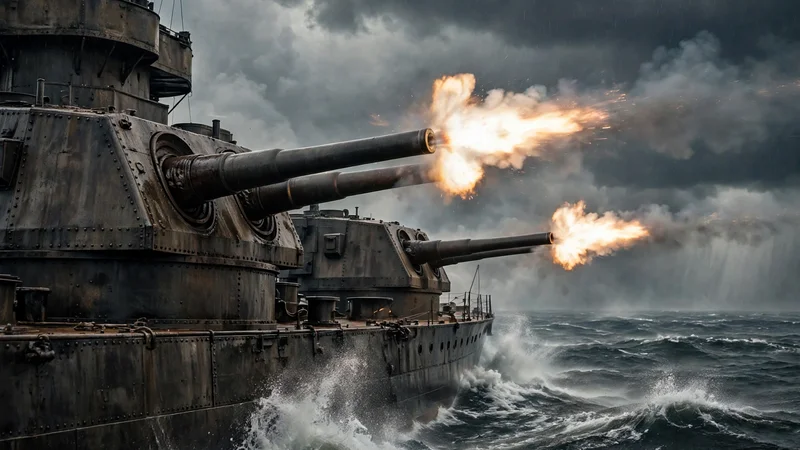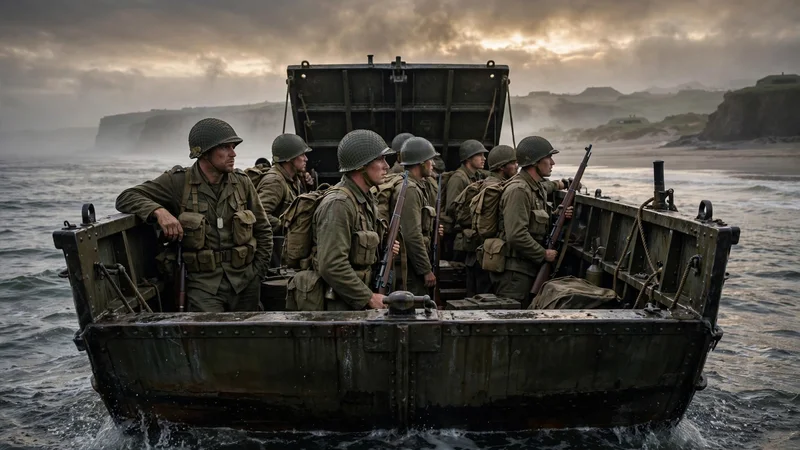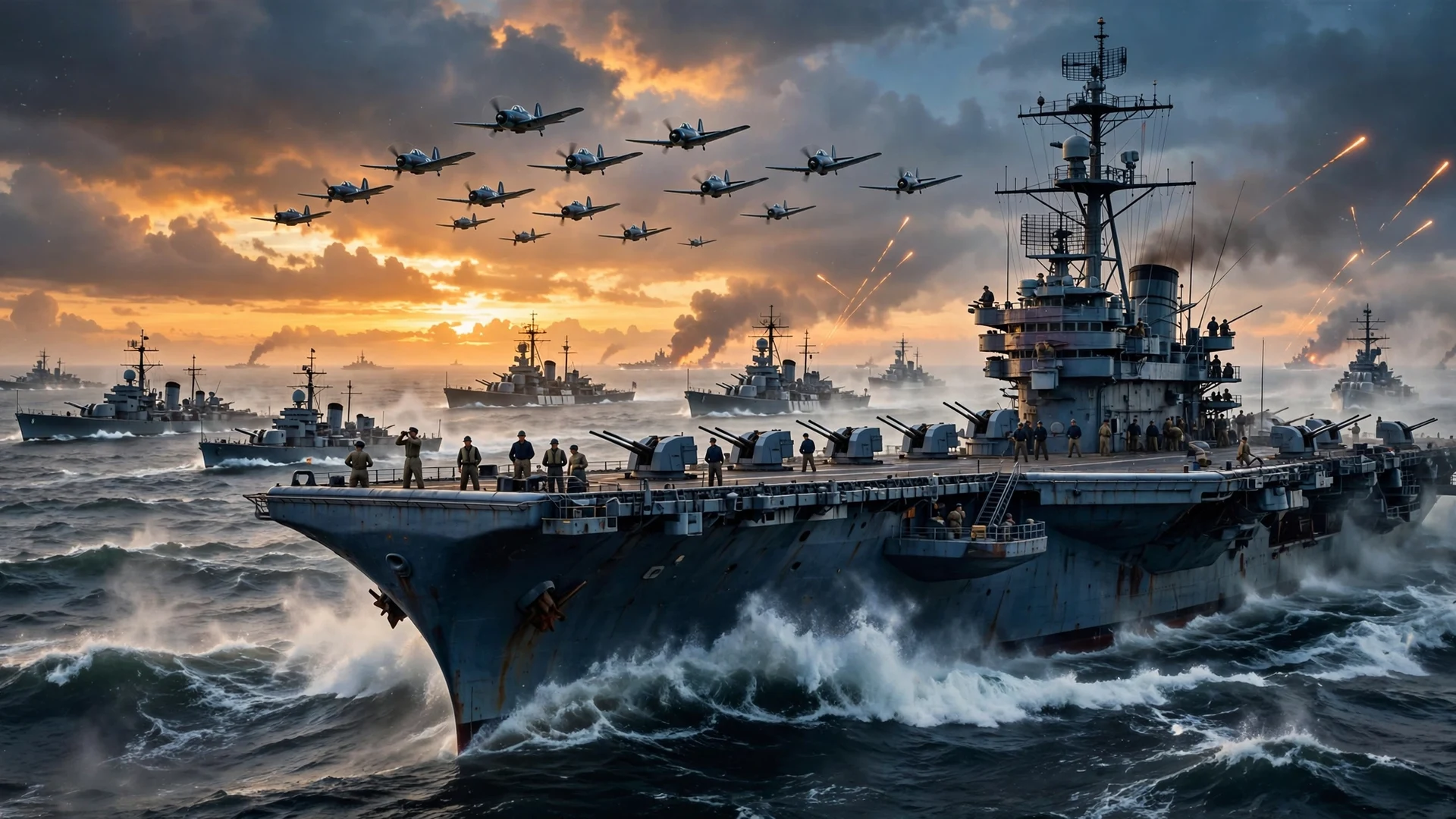
On the morning of December 7, 1941, Japanese bombs fell on Pearl Harbor, and the United States Pacific Fleet was wrecked at its moorings. Less than four years later, American battleships sat at anchor in Tokyo Bay while Japan signed its surrender. Between those two moments lies the Pacific War — a war fought on specks of coral, across ten thousand miles of ocean, and decided in a handful of battles that still rank among the most dramatic ever fought. Here they are: the ten best Pacific War battles of World War II, ranked by how much each one changed the course of the war.
A note on the ranking, because it's ours: "best" here means most decisive — which battles bent the war's arc the farthest, at the greatest stakes. Some picks will be obvious. A couple will start arguments. That's the point.
1. Midway, June 4–7, 1942 — The Turning Point
Six months after Pearl Harbor, the US Navy was still the underdog. Japan's Admiral Yamamoto planned to lure the American carriers into a trap at Midway Atoll and finish them. But American codebreakers had cracked the Japanese naval code, and Admiral Nimitz knew exactly where Yamamoto was going. He sent his three available carriers — Enterprise, Hornet, and Yorktown, patched up from Coral Sea damage in a 72-hour repair miracle — to wait in ambush.
On the morning of June 4, American torpedo bombers found the Japanese carriers first and were slaughtered — but their sacrifice pulled the Japanese fighter cover down to sea level. Minutes later, dive-bombers from Enterprise and Yorktown arrived over a sky emptied of defenders. In about five minutes, three Japanese fleet carriers — Akagi, Kaga, and Soryu — were turned into burning wrecks. The fourth, Hiryu, was finished off later that day. Japan lost all four carriers and some 3,000 men; the US lost Yorktown, the destroyer Hammann, and 307 men. The initiative passed to America that afternoon and never came back. If you want to compare turning points, our explainer on why Germany lost WW2 covers how the other half of the war broke the same way. For the minute-by-minute story, see our Midway battle guide.
Key stat: Four Japanese fleet carriers sunk for one American — plus the veteran pilots Japan could never replace.
2. Guadalcanal, August 7, 1942 – February 9, 1943 — America's First Offensive
Two months after Midway, the Marines went on the attack for the first time — landing on Guadalcanal in the Solomon Islands to seize an airfield the Japanese were building. They named it Henderson Field, and for the next six months both sides fed men, ships, and planes into a grinding fight over that single muddy airstrip. The naval battles around the island were so savage that the strait earned the name Ironbottom Sound.
It was total war in three dimensions: Marines in the jungle perimeter, ships slugging it out at night, planes dueling overhead. Disease and hunger killed almost as many Japanese as bullets did — the "Tokyo Express" destroyer runs couldn't keep the garrison fed. By February 1943 Japan gave up and evacuated its survivors. The cost: about 7,100 Allied dead against at least 19,000 Japanese. Many historians actually rate Guadalcanal above Midway as the real turning point, because it proved America could take Japanese ground and hold it.
Key stat: Six months of fighting for one island — and the first ground Japan ever lost in the war.
3. Leyte Gulf, October 23–26, 1944 — The Largest Naval Battle in History
When MacArthur returned to the Philippines, Japan threw everything it had left at the invasion fleet — and the result was the biggest naval battle ever fought: nearly 200,000 men and some 282 ships across four separate engagements. The Japanese plan was clever: dangle empty decoy carriers to the north to pull Admiral Halsey's powerful 3rd Fleet away, then drive battleships through the unguarded San Bernardino Strait straight at the landing beaches.
It nearly worked. Halsey took the bait, and the Japanese Center Force — battleships and heavy cruisers — broke through. What stood between it and the troop transports was Taffy 3: a handful of slow escort carriers and destroyers under Rear Admiral Clifton Sprague. Off Samar, those destroyers and their tiny planes charged Japanese battleships in one of the bravest fights in naval history — and the Japanese commander, rattled, turned back. Japan lost 26 ships, including four carriers and the super-battleship Musashi; the US lost about 3,000 men and six ships. The Imperial Japanese Navy never sailed as an offensive fleet again. This battle tops our ranking of the largest naval battles in history, and it was also the first battle to see organized kamikaze attacks.
Key stat: 282 ships, four days, one ocean — no naval battle has ever been bigger.
4. Okinawa, April 1 – June 22, 1945 — The Bloodiest Battle of the Pacific War
The last great battle of the Pacific War was also the worst. Okinawa, 340 miles from the Japanese mainland, was the staging ground for the planned invasion of Japan — and Japan defended it with everything: fortified caves, waves of kamikazes that slammed into American ships for weeks, and the battleship Yamato sent out on a one-way suicide mission (US planes sank it before it arrived). The fighting lasted 82 days and earned the nickname "the typhoon of steel."
The numbers are staggering and honest: about 12,500 Americans killed and 39,000 wounded; roughly 100,000 Japanese soldiers dead; and some 100,000 Okinawan civilians caught between the two armies. Both commanding generals died — America's Lt. Gen. Simon Bolivar Buckner, killed by artillery on June 18, and Japan's Lt. Gen. Mitsuru Ushijima, who took his own life as the island fell. It was the largest amphibious assault of the Pacific theater — in Europe, only our D-Day landings in Normandy were on a comparable scale. What Okinawa taught Washington was simple and terrible: if one island cost this much, invading Japan itself would be a bloodbath. That lesson weighed heavily in the decision to use the atomic bomb.
Key stat: A death toll near a quarter of a million — nothing else in the Pacific War comes close.
5. Iwo Jima, February 19 – March 26, 1945 — The Flag and the Price
Iwo Jima was eight square miles of volcanic rock, 660 miles from Tokyo — and the Japanese turned it into a fortress. General Kuribayashi skipped the usual beach defense and buried his men in eleven miles of tunnels and caves, planning to make the Marines pay for every yard. He succeeded. The battle ran 36 days. The Marines lost 6,821 killed and about 19,200 wounded — the only battle of the Pacific War where American casualties outnumbered Japanese ones.
On February 23, five days in, Marines reached the top of Mount Suribachi and raised a second, larger flag — the moment AP photographer Joe Rosenthal captured in the most famous image of the war. Three of the six flag-raisers would die in the fighting that followed. The island's airfields gave damaged B-29s a place to land instead of ditching in the ocean, and the battle produced 27 Medals of Honor — more than any other single battle in American history. The flag photo made Iwo Jima the war's defining image; the casualty lists made it a warning.
Key stat: 27 Medals of Honor — a record no other single battle in US history has matched.
6. Philippine Sea, June 19–20, 1944 — The Great Marianas Turkey Shoot
While Marines fought on Saipan, Japan sent its last great carrier fleet to destroy the American invasion — and sailed into the most lopsided air battle in history. Admiral Spruance's 5th Fleet and Admiral Mitscher's Task Force 58 picked up the Japanese planes on radar and vectored Hellcat fighters to meet them wave after wave. One American pilot, watching the sky fill with burning Japanese aircraft, called it "an old-time turkey shoot." The name stuck.
Japan's Admiral Ozawa launched some 430 carrier planes on June 19; most never made it home. Over two days Japan lost three carriers — Taiho and Shokaku to American submarines, Hiyo to air attack — along with about 600 aircraft and nearly 3,000 men. The US lost 123 planes, 109 men, and not a single ship. It was the day Japanese carrier aviation died as a fighting force. From here on, Japan's remaining pilots would fly one-way missions.
Key stat: ~600 Japanese aircraft destroyed for 123 American planes — the end of Japan's naval air arm in 48 hours.
7. Saipan, June 15 – July 9, 1944 — Tokyo Comes Into B-29 Range
Saipan mattered because of what it carried: airfields close enough for the new B-29 Superfortress to reach Tokyo. Two Marine divisions and the Army's 27th Infantry Division landed on June 15, 1944, and spent nearly a month fighting through caves and ridges against a garrison ordered to die where it stood. The cost was steep — about 3,400 Americans killed, roughly 24,000 Japanese soldiers dead, and thousands of Japanese civilians who threw themselves from the island's cliffs rather than surrender.
Saipan was also the battle that broke Japan's government. When the island fell, Prime Minister Hideki Tojo — the man who had led Japan into the war — resigned in disgrace. The Japanese home islands were told, for the first time, that the war was going badly. And the B-29s that took off from Saipan's captured airfields would soon be burning Japanese cities to the ground.
Key stat: The island whose fall put Tokyo in bomber range — and ended the career of Japan's wartime prime minister.
8. Coral Sea, May 4–8, 1942 — The Carriers That Never Saw Each Other
A month before Midway, the Pacific saw the first naval battle in history fought entirely by carrier aircraft — two fleets hunting each other across the Coral Sea, off Australia, without a single ship ever sighting the enemy. Japan was moving to take Port Moresby in New Guinea, the stepping stone to Australia. The US carrier force moved to stop them.
On paper, Japan won: the carrier Lexington ("Lady Lex") was lost with 216 of her crew, along with the destroyer Sims and the oiler Neosho. Japan lost only the light carrier Shoho. But the real bill came due at Midway. Japan's fleet carrier Shokaku was damaged, and Zuikaku's trained air groups were gutted — both missed the decisive battle a month later. And the Port Moresby invasion convoy turned back, easing the threat to Australia. Tactical Japanese win, strategic American win — and the lesson that carrier aviation had replaced the battleship as the queen of the sea.
Key stat: Japan paid for Midway in the Coral Sea — two fleet carriers' worth of air power, lost a month early.
9. Tarawa, November 20–23, 1943 — 76 Hours of Hell
Tarawa was the first time the Marines assaulted a heavily fortified atoll — and almost everything went wrong. The planners expected a rising tide; they got a neap tide that stranded the landing craft on the reef hundreds of yards offshore. Marines waded through chest-deep water under machine-gun fire, pinned against a coconut-log seawall while Japanese bunkers fired down on them. For 76 hours, they fought bunker to bunker across 291 acres of coral.
When Betio was declared secure on November 23, about 1,000 Americans were dead and 2,100 wounded. Of the roughly 4,500 Japanese defenders, only 17 survived. Photographs of dead Marines floating in the lagoon shocked the American public — newspapers ran headlines asking whether any island was worth that price. But the lessons learned at Tarawa — about tides, reefs, bombardment, and tracked landing vehicles — were written into the doctrine for every amphibious assault that followed, saving countless lives later.
Key stat: ~1,000 Americans dead in 76 hours, for an island you could walk across in twenty minutes.
10. Peleliu, September 15 – November 27, 1944 — The Battle That Shouldn't Have Happened
The 1st Marine Division's commander, Maj. Gen. Rupertus, promised Peleliu would take four days. It took 73. The Japanese had abandoned beach defense entirely and honeycombed the island's coral ridges — the Umurbrogol — with over 500 caves, fighting from the rock itself. The Marines suffered 2,336 killed and 8,450 wounded in what the National Museum of the Marine Corps calls "the bitterest battle of the war for the Marines."
Here's the bitter part: the airfield Peleliu was captured for was never meaningfully used in the Philippines campaign. Admiral Halsey had recommended canceling the assault. Historians still argue about whether a single one of those 2,336 American lives needed to be spent. Peleliu makes this list not because it decided the war, but because it shows the war's other face — the grinding, questionable fights that didn't make the headlines. And even here, the tactics it forced the Marines to learn fed directly into the assaults on Iwo Jima and Okinawa.
Key stat: 2,336 Americans killed for an airfield the war never used.
The Pacific War was won at sea and on the beaches — by sailors who never saw the enemy's ships, and Marines who took islands one cave at a time.
How This List Compares
These ten battles decided the Pacific — but how do they stack up against the war's other great fights? See our ranking of the greatest battles of WW2 overall, where Midway and Stalingrad sit side by side. For the single-day naval showdown that nearly changed everything, read our Midway battle guide — and for the European turning points, why Germany lost the war.
FAQ
What was the turning point of the Pacific War?
Most historians name the Battle of Midway (June 4–7, 1942), where the US sank four Japanese carriers for the loss of one. But it’s a genuine debate — many argue Guadalcanal (August 1942 – February 1943), America’s first offensive, was the true turning point because it proved Japan could be beaten and held. Either way, the initiative passed to the US in late 1942 and never came back.
What was the bloodiest battle of the Pacific War?
Okinawa (April 1 – June 22, 1945): about 12,500 Americans killed, roughly 100,000 Japanese soldiers killed, and some 100,000 Okinawan civilians dead — a total toll near a quarter of a million. No other Pacific battle came close.
Why was Iwo Jima so important?
Two reasons: the island’s airfields gave damaged B-29 bombers an emergency landing strip on the long run to Japan, and the battle showed how savagely Japan would defend home soil — 36 days, 6,821 Americans killed, and the only Pacific battle where US casualties outnumbered Japanese ones. The flag-raising photo also made it the war’s most famous image.
Did the US win every major battle of the Pacific War?
No. The war opened with catastrophic American defeats — Pearl Harbor, the fall of the Philippines, the loss of Guam and Wake Island — and Coral Sea was a tactical Japanese win (though a strategic American one). The US won every major battle from Midway onward, but the price was staggering: Okinawa and Iwo Jima showed how costly ‘winning’ could be.
What was the “Great Marianas Turkey Shoot”?
The nickname US pilots gave the Battle of the Philippine Sea (June 19–20, 1944), when radar-directed American Hellcats shot down wave after wave of Japanese carrier planes. Japan lost three carriers and about 600 aircraft; the US lost 123 planes and no ships. It effectively ended Japanese carrier aviation as a fighting force.
What was the largest naval battle in history?
The Battle of Leyte Gulf (October 23–26, 1944), by most measures: nearly 200,000 men and some 282 ships across four separate engagements off the Philippines. Japan lost 26 ships, including four carriers and the super-battleship Musashi; the Imperial Japanese Navy never fought as an offensive fleet again.
Sources
- U.S. National Park Service — battle summaries for Midway, Iwo Jima, and Okinawa: https://www.nps.gov/subjects/wwii/index.htm
- Wikipedia — Battle of Midway, Guadalcanal campaign, Tarawa, Philippine Sea, Leyte Gulf, Iwo Jima, Okinawa, Coral Sea, Saipan, Peleliu (dates, strengths, casualty figures cross-checked): https://en.wikipedia.org/wiki/Battle_of_Midway
- HISTORY — "Why Guadalcanal Was WWII's Turning Point in the Pacific": https://www.history.com/articles/guadalcanal-turning-point-wwii-pacific
- Commemorative Air Force — "The Great Marianas Turkey Shoot Remembered": https://CommemorativeAirforce.org/news/the-great-marianas-turkey-shoot-remembered
- DVIDS / U.S. Marine Corps — Okinawa memorial coverage: https://www.dvidshub.net/news/238939/us-and-japan-alliance-honors-240000-lives-lost-battle-of-okinawa
- Military Times — USS Lexington (Coral Sea) wreck discovery: https://www.MilitaryTimes.com/news/your-navy/2018/03/05/expedition-led-by-microsoft-co-founder-locates-lost-wwii-carrier/
- ThoughtCo — Battle of Peleliu summary: https://www.thoughtco.com/battle-of-peleliu-2360460
- ThoughtCo — Battle of Saipan summary: https://www.thoughtco.com/world-war-ii-battle-of-saipan-2361471