Every war has its arguments about which battle mattered most, and the Second World War has the loudest of them all. Was it D-Day? Midway? Stalingrad? "Greatest" isn't the same as "deadliest" or "largest" — a battle can be great for what it cost, what it stopped, or what it started.
So here is our answer: the 15 greatest battles of WW2, ranked by the scale of the fighting and the mark each left on the war's outcome. WW2 casualty numbers are disputed, so we give the ranges historians themselves use.
How This Ranking Works
Two questions decide each battle's place: how big was the fight, and how much did the result change the war? That's why the Battle of Britain — small in casualties, enormous in consequence — outranks battles that killed far more men. Soviet and German records are incomplete, many Japanese records were destroyed, and every side shaded its own losses.
1. Stalingrad (Aug 1942 – Feb 1943): The Deadliest Battle in History
For nearly six months, German and Soviet armies fought street by street through a ruined city on the Volga — for a grain elevator, a factory floor, a single staircase. A newly arrived Soviet soldier was said to have a life expectancy measured in hours. When Friedrich Paulus surrendered on February 2, 1943, some 91,000 frostbitten Germans marched into captivity; barely 6,000 ever saw home again. Stalingrad broke the myth of German invincibility — and the Eastern Front's initiative passed to the Soviets for good. Full guide: our Stalingrad summary.
| Battle | Dates | Approx. casualties |
|---|---|---|
| Stalingrad | 23 Aug 1942 – 2 Feb 1943 | ~2 million total (Soviet ~1.1M; Axis 800K–1.5M) — estimates disputed |
2. D-Day / Normandy (Jun – Aug 1944): The Largest Amphibious Invasion Ever
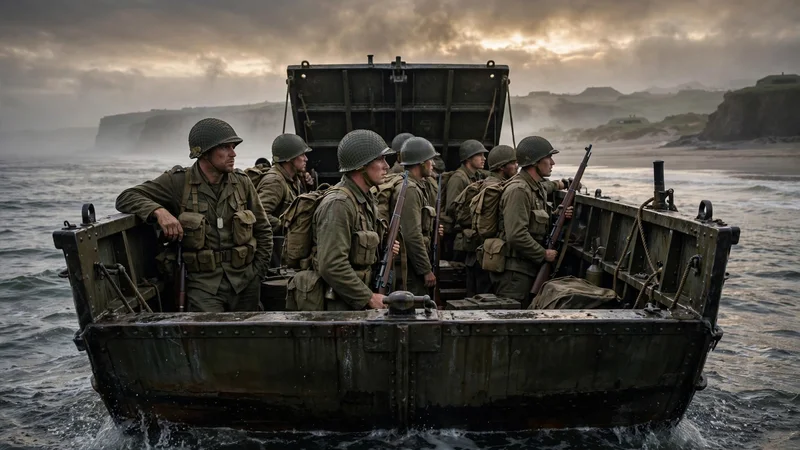
On June 6, 1944, nearly 160,000 Allied troops crossed the Channel in 5,000 vessels — history's largest seaborne invasion. At Omaha Beach the first waves were cut down so badly that Bedford, Virginia, lost 19 young men in one day. By nightfall all five beachheads held. D-Day forced Germany into an unsustainable two-front war and decided the map of postwar Europe. Eisenhower had pre-written a letter taking full blame; he never sent it. See our D-Day Normandy landings summary.
| Battle | Dates | Approx. casualties |
|---|---|---|
| D-Day landings | 6 Jun 1944 | Allies ~10,250 (~4,414 dead); German 4,000–9,000 — estimates disputed |
| Normandy campaign | 6 Jun – 30 Aug 1944 | Allies ~226,000; German ~80,000 killed + 233,000 captured — estimates disputed |
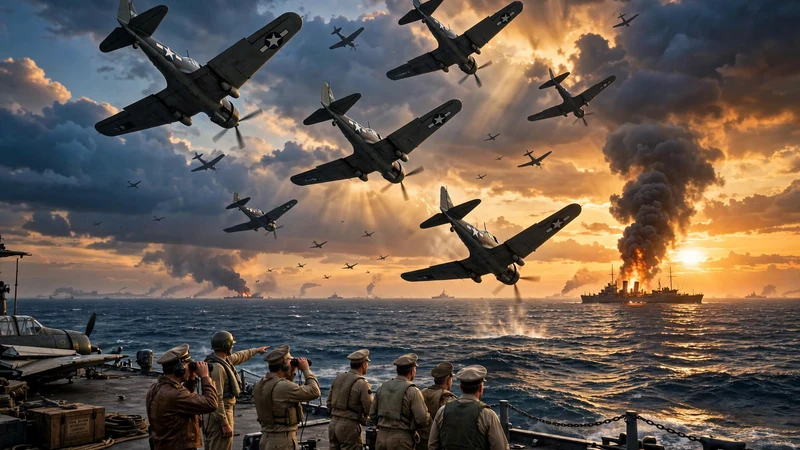
3. Midway (Jun 1942): Five Minutes That Sank a Fleet
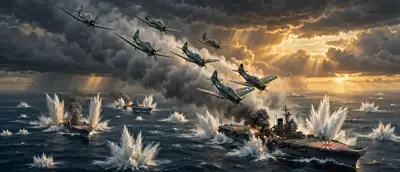
American codebreakers had cracked Japan's naval code, so Nimitz waited with three carriers against Japan's four. Japanese torpedo squadrons were wiped out almost to a man — then, in about five minutes from 10:20 a.m. on June 4, US dive-bombers found the Japanese carriers with decks full of armed aircraft and sank three (Akagi, Kaga, Sōryū); Hiryū died that afternoon. Japan lost four carriers and 3,057 men against 307 Americans, and never advanced in the Pacific again. See our Midway explained guide.
| Battle | Dates | Approx. casualties |
|---|---|---|
| Midway | 4–7 Jun 1942 | Japan 3,057 killed (4 carriers sunk); US 307 killed (1 carrier, 1 destroyer lost) |
4. Moscow 1941 (Oct 1941 – Jan 1942): Where the Blitzkrieg Died
Operation Typhoon was meant to finish the Soviet Union. In October 1941 German officers claimed to see the Kremlin's spires through binoculars. Then came mud, then −40°F cold — and on December 5 Georgy Zhukov counterattacked with fresh Siberian divisions while German soldiers wrapped their feet in newspaper. The Wehrmacht was driven back up to 150 miles. Moscow was Germany's first strategic failure: Hitler's promised quick victory was gone, and the war became a grind Germany could not win.
| Battle | Dates | Approx. casualties |
|---|---|---|
| Moscow | 2 Oct 1941 – 7 Jan 1942 | Soviet ~1,029,000; German ~174,000 — estimates disputed |
5. Kursk (Jul – Aug 1943): The Largest Tank Battle in History
After Stalingrad, Germany's last chance to retake the initiative was Operation Citadel, a giant pincer at the Kursk salient. The Soviets knew it was coming and built the war's most fortified position — minefields, anti-tank guns, trenches over 2,500 miles long. At Prokhorovka on July 12, hundreds of tanks fought in dust so thick crews couldn't see a hundred yards. Germany lost ~200,000 men against ~800,000–860,000 Soviets. After Kursk, Germany only retreated — see our largest tank battle in history guide.
| Battle | Dates | Approx. casualties |
|---|---|---|
| Kursk | 5 Jul – 23 Aug 1943 | Soviet ~800,000–860,000; German ~165,000–200,000 — estimates disputed |
6. Battle of Britain (Jul – Oct 1940): The Few Who Saved an Island
In summer 1940, after France fell, Britain stood alone. The Luftwaffe had to destroy the RAF to clear the way for invasion — and failed. Radar, the Dowding fighter-control system, and fewer than 3,000 aircrew broke the assault; on September 15 the Luftwaffe's biggest daylight raid was smashed and the invasion was shelved. The first major German defeat, the first campaign fought entirely in the air — and the reason Britain survived to launch D-Day.
| Battle | Dates | Approx. casualties |
|---|---|---|
| Battle of Britain | 10 Jul – 31 Oct 1940 | RAF ~1,495 aircrew killed; Luftwaffe ~2,500 aircrew killed — estimates disputed |
7. Operation Bagration (Jun – Aug 1944): Germany's Worst Defeat
Sixteen days after D-Day, the Soviets attacked with 1.7 million men and destroyed 28 divisions of German Army Group Centre — the largest single defeat in German military history. On July 17, 1944, Stalin marched some 50,000 German prisoners through Moscow. Bagration gutted the German East while Normandy gutted the West — Germany was now losing catastrophically on both fronts at once.
| Battle | Dates | Approx. casualties |
|---|---|---|
| Operation Bagration | 22 Jun – 19 Aug 1944 | Soviet ~550,000–770,000; German ~400,000–500,000 — estimates disputed |
8. El Alamein (Oct – Nov 1942): The Desert Turned
For two years Rommel's Afrika Korps had run rings around the British, driving to within 60 miles of Alexandria. Montgomery stopped him with preparation: the "Devil's gardens" — half a million mines — and 1,000 guns for the opening barrage. Rommel was sick in Germany when the attack began; his stand-in died of a heart attack on the first morning. The Axis retreat never stopped, all the way to Tunisia. Churchill's verdict — "Before Alamein we never had a victory, after Alamein we never had a defeat" — says it all; see our El Alamein explained guide.
| Battle | Dates | Approx. casualties |
|---|---|---|
| El Alamein (2nd) | 23 Oct – 11 Nov 1942 | Allied 13,560; Axis ~30,500–73,000 — estimates disputed |
9. Battle of the Bulge (Dec 1944 – Jan 1945): Hitler's Last Gamble
In December 1944 Hitler threw a quarter-million men at the thinly held Ardennes. Bastogne was surrounded, and when the Germans demanded the 101st Airborne's surrender, Anthony McAuliffe answered "Nuts!" Patton wheeled his Third Army 90 degrees through the snow and broke the siege. The Bulge was the bloodiest single battle Americans fought in the war — and it burned Germany's last reserves of men, tanks, and fuel.
| Battle | Dates | Approx. casualties |
|---|---|---|
| The Bulge | 16 Dec 1944 – 25 Jan 1945 | US ~81,000–89,500 (~19,000 killed); German ~63,000–100,000 — estimates disputed |
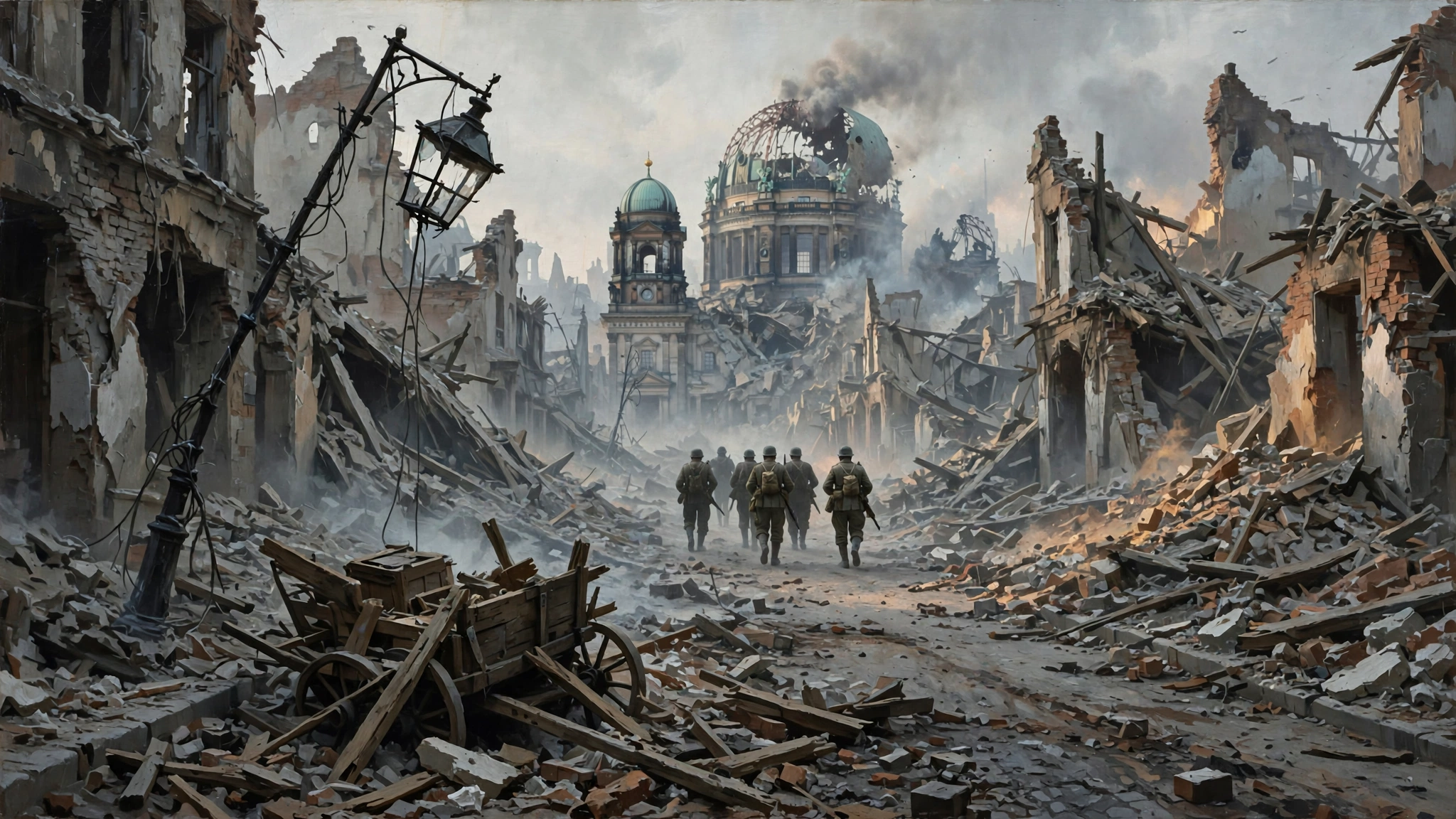
10. Berlin 1945 (Apr – May 1945): The End of the Reich
Over 2.3 million Soviet and Polish troops closed on a defense of shattered divisions, Volkssturm old men, and Hitler Youth teenagers, while Zhukov and Konev raced to the capital. On April 30, with fighting room to room in the government quarter, Hitler took his own life in the bunker; Berlin surrendered May 2. The outcome was never in doubt — but the battle ended Nazi Germany and drew the Cold War's lines.
| Battle | Dates | Approx. casualties |
|---|---|---|
| Berlin | 16 Apr – 2 May 1945 | Soviet 81,116 dead/missing + 280,251 wounded; German ~100K dead, 220K wounded, 480K captured — disputed |
11. Guadalcanal (Aug 1942 – Feb 1943): America's First Offensive
Six months of jungle, malaria, and night naval battles around one muddy airstrip — America's first major Pacific offensive, fought on land, at sea (six major engagements, including the night USS Juneau sank with the five Sullivan brothers), and in the air over Henderson Field. A Japanese general called it "the graveyard of the Japanese Army." Guadalcanal proved Japan could be beaten and taught the Marines the amphibious craft they'd use all the way to Japan. See our best Pacific War battles.
| Battle | Dates | Approx. casualties |
|---|---|---|
| Guadalcanal | 7 Aug 1942 – 9 Feb 1943 | US 7,100 dead + 7,789 wounded; Japanese ~19,200–24,000 dead — estimates disputed |
12. Okinawa (Apr – Jun 1945): The Typhoon of Steel
The Pacific War's last great battle was its bloodiest. Okinawa was to stage the invasion of Japan, and the Japanese defended it with 100,000 dug-in troops and waves of kamikazes — the "Typhoon of Steel." Both generals died: America's Simon Bolivar Buckner to artillery, Japan's Mitsuru Ushijima by suicide. Some 100,000 civilians died too, and the horror weighed directly on the decision to use the atomic bomb instead of invading.
| Battle | Dates | Approx. casualties |
|---|---|---|
| Okinawa | 1 Apr – 22 Jun 1945 | US ~12,500 killed + 38,900 wounded; Japanese ~95,000–110,000 killed; civilians 42,000–150,000 — estimates disputed |
13. Iwo Jima (Feb – Mar 1945): 36 Days for Eight Square Miles
Planners said a week; it took 36 days. Japan's Tadamichi Kuribayashi skipped beach defense and honeycombed the island with 11 miles of tunnels — the only Pacific battle where American casualties exceeded Japanese ones. Twenty-seven Medals of Honor were awarded, the most for any single battle in American history. Joe Rosenthal's February 23 flag-raising on Mount Suribachi became the Pacific War's most famous photograph, and the airfields gave 2,200+ damaged B-29s an emergency landing strip.
| Battle | Dates | Approx. casualties |
|---|---|---|
| Iwo Jima | 19 Feb – 26 Mar 1945 | US 6,821 dead + 19,217 wounded; Japanese ~18,000 killed — estimates disputed |
14. Monte Cassino (Jan – May 1944): Four Assaults on the Gustav Line
To reach Rome the Allies had to break the Gustav Line, keyed on a 1,400-year-old Benedictine abbey. The Germans weren't even inside when Allied bombers dropped 1,400 tons on it February 15, 1944 — but the rubble made a better fortress, and German paratroopers moved in. Four assaults finally took it; on May 18 the Polish II Corps raised its flag over the ruins, and Rome fell June 4 — two days before D-Day.
| Battle | Dates | Approx. casualties |
|---|---|---|
| Monte Cassino | 17 Jan – 18 May 1944 | Allied ~55,000; German ~20,000 — estimates disputed |
15. Leyte Gulf (Oct 1944): The Largest Naval Battle Ever Fought
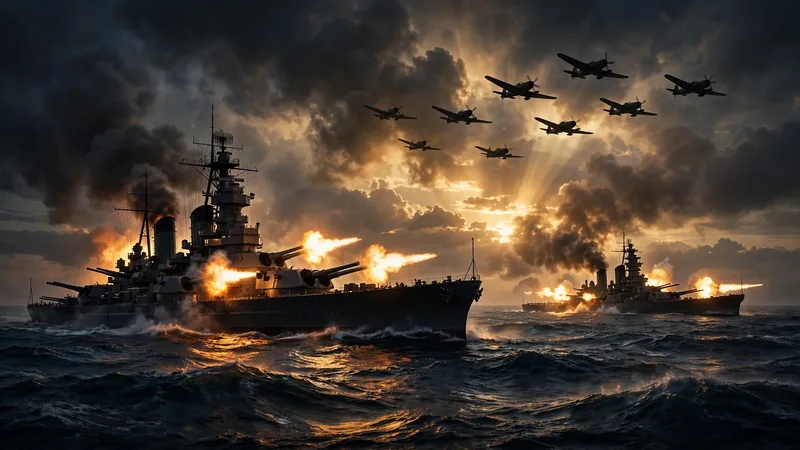
The biggest sea fight in history: when America returned to the Philippines in October 1944, Japan staked everything on a four-pronged attack across the Sibuyan Sea, Surigao Strait, Cape Engaño, and Samar. At Surigao, American battleships crossed the Japanese "T" in one of history's last battleship duels; off Samar, tiny escort carriers and destroyers charged battleships and turned them away. Japan lost 26 ships and never fought as a fleet again — and the battle saw the war's first organized kamikaze attacks. Full largest naval battle in history ranking.
| Battle | Dates | Approx. casualties |
|---|---|---|
| Leyte Gulf | 23–26 Oct 1944 | US ~3,000 dead/wounded; Japan ~10,000–12,500 dead (26 ships sunk) — estimates disputed |
All 15 Battles at a Glance
| # | Battle | Dates | Approx. casualties |
|---|---|---|---|
| 1 | Stalingrad | Aug 1942 – Feb 1943 | ~2 million total |
| 2 | D-Day / Normandy | Jun – Aug 1944 | Allies ~226,000; German ~313,000+ |
| 3 | Midway | Jun 1942 | ~3,400 total |
| 4 | Moscow 1941 | Oct 1941 – Jan 1942 | ~1.2 million total |
| 5 | Kursk | Jul – Aug 1943 | ~1 million total |
| 6 | Battle of Britain | Jul – Oct 1940 | ~4,000 aircrew |
| 7 | Operation Bagration | Jun – Aug 1944 | ~950,000–1.2 million total |
| 8 | El Alamein | Oct – Nov 1942 | ~44,000–87,000 total |
| 9 | Battle of the Bulge | Dec 1944 – Jan 1945 | ~144,000–190,000 total |
| 10 | Berlin 1945 | Apr – May 1945 | ~1 million total (incl. civilians) |
| 11 | Guadalcanal | Aug 1942 – Feb 1943 | ~34,000–39,000 total |
| 12 | Okinawa | Apr – Jun 1945 | ~150,000–260,000 total (incl. civilians) |
| 13 | Iwo Jima | Feb – Mar 1945 | ~44,000 total |
| 14 | Monte Cassino | Jan – May 1944 | ~75,000 total |
| 15 | Leyte Gulf | Oct 1944 | ~13,000–15,500 total |
Sources
- Wikipedia — Battle of Stalingrad; Battle of Midway; Operation Overlord; Battle of Kursk; Battle of Britain; Second Battle of El Alamein; Battle of the Bulge; Battle of Iwo Jima; Battle of Okinawa; Battle of Berlin; Battle of Moscow; Battle of Guadalcanal; Battle of Monte Cassino; Operation Bagration.
- Also: HISTORY (Battle of Midway, D-Day deaths), Britannica (Iwo Jima flag-raising), WW2Days (Leyte Gulf), History of War (Leyte Gulf).
FAQ
What was the deadliest battle of WW2?
Stalingrad — around 2 million killed, wounded, or captured between August 1942 and February 1943, more than any other single battle in history. Soviet losses topped 1.1 million; Axis losses ran from roughly 800,000 to 1.5 million depending on the estimate.
Which battle turned the war?
No single battle did it alone. Midway (June 1942) broke Japanese naval power; Stalingrad (February 1943) broke the German Army's aura of invincibility; El Alamein (November 1942) turned North Africa. Those three defeats, all within eight months, mark the high-water mark of Axis expansion.
Why isn't Pearl Harbor on the list?
Pearl Harbor was a surprise raid that lasted hours, not a sustained battle. It matters because it brought the United States into the war, not because of what happened on the battlefield. This ranking covers battles fought over days, weeks, or months.
Stalingrad vs D-Day — which mattered more?
It depends what you mean by 'mattered.' Stalingrad destroyed more German fighting power; D-Day opened the Western Front and decided the map of postwar Europe. Most historians give Stalingrad the bigger military blow — and D-Day the bigger political consequence.
What was the largest naval battle in history?
Leyte Gulf, fought October 23–26, 1944, off the Philippines. It spanned four separate engagements across a huge area of ocean, involved more than 300 American and 67 Japanese warships, and ended with the Japanese Navy crippled beyond recovery — 26 of its ships sunk.
How accurate are the casualty figures for WW2 battles?
Less accurate than the neat numbers suggest. Soviet and German records are incomplete, Japanese records were destroyed, and every side undercounted its own losses. Serious historians give ranges — Axis casualties at Stalingrad, for example, run from 800,000 to 1.5 million. The ranges in this article show the honest spread.
Keep exploring: our Stalingrad summary, bloodiest battles of WW2 ranked, best Pacific War battles, Battle of Midway, largest tank battle in history, and largest naval battle in history.