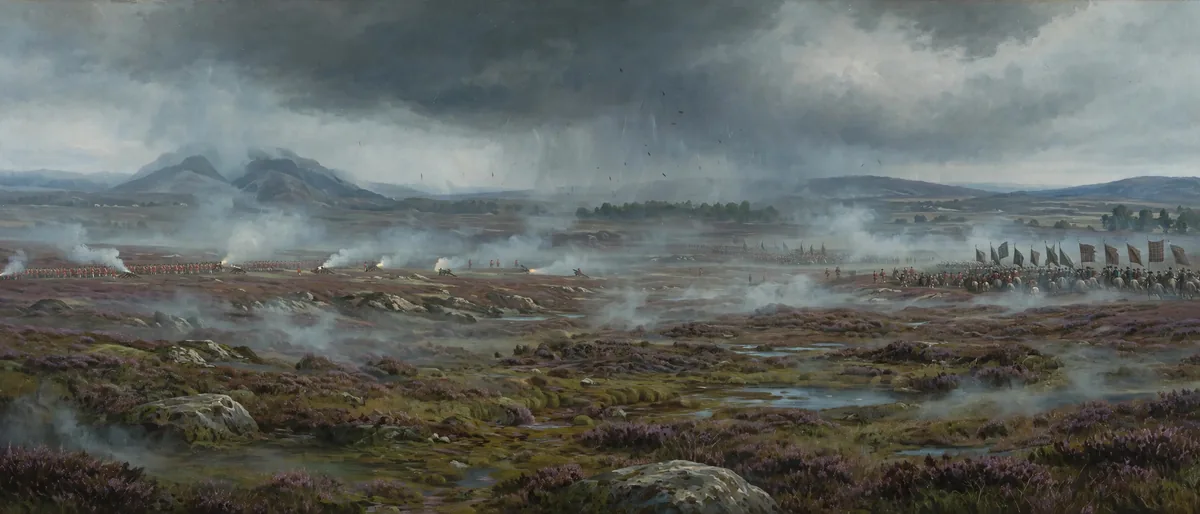
On April 16, 1746, on a wet moor five miles east of Inverness, two armies lined up for a fight that barely lasted an hour. One side went in hungry and tired, badly outgunned. The other was fed, rested, and drilled for exactly this moment. You can guess how it ended. What you probably cannot guess is how fast it ended, and how much damage one short morning did to a whole way of life.
You have probably heard the songs about Bonnie Prince Charlie. They make Culloden sound like a grand, doomed romance. It was not grand. It was cold, wet, badly planned, and over before many men on the field had time to understand what was happening. And that gap, between the song and the moor, is why this battle still matters.
The Battle of Culloden was the final battle of the Jacobite rising of 1745, fought on April 16, 1746, on Drumossie Moor near Inverness, where a government army under the Duke of Cumberland defeated the Jacobite army of Charles Edward Stuart in under an hour and ended Jacobitism as a serious political force in Britain.
Here is the part people skip. Culloden was not decided by courage. Both sides had plenty of that. It was decided by food, sleep, ground, and guns, and by one army that had all four and one army that had almost none of them. If you want to understand the battle, start there, not with the charge.
How did a prince with no army end up marching on London?
Charles Edward Stuart landed on the island of Eriskay in July 1745 with only a handful of companions and a claim: his father, James Francis Edward Stuart, was the rightful king of Britain, pushed aside in 1688 and again in 1714 when the Hanoverians took the throne. Charles was 24, charming, and sure that Scotland, and then England, would rise for him. Honestly, that confidence was his best weapon and his worst flaw. It got him an army. It also kept him from hearing bad news until it was too late.
At Glenfinnan on August 19, 1745, he raised his father's standard and clan levies began to gather. By September he held Edinburgh, and on September 21 his army beat a government force at Prestonpans, east of the city. That win did two things. It gave the rising guns, money, and a story. It also fed a dangerous idea in Charles's camp: that the government army would fold if pushed hard enough.
So they pushed. In November the Jacobites crossed into England. They took Carlisle, then Manchester, then marched south to Derby by December 4, 1745. London was about 130 miles away, and for a few days the capital genuinely panicked. Shops closed. The Bank of England braced for a run. And then the rising hit its wall.
The English did not rise. French help did not arrive in force. Two government armies were closing in, and the Jacobite council voted to turn back. Charles fought the decision and lost it. That retreat, through winter, with government troops at their heels, bled the rising of men and hope. By the time the army got back to Scotland, it was a different force from the one that had marched south singing.
They won once more, at Falkirk Muir on January 17, 1746, but the win changed nothing. Supplies were short. Pay was short. Men were drifting home to plant crops or just to eat. Cumberland, meanwhile, had taken command of the government army, rested it, fed it, and drilled it for one specific problem: the Highland charge. He knew what was coming. The Jacobites, by April, had run out of places to go.
Why did the Jacobites pick this moor?
They did not pick it so much as run out of choices on it. Lord George Murray, the Jacobite lieutenant-general, wanted to fight on rough, broken ground where government cavalry and cannon would struggle. Drumossie Moor was the opposite. It was open, flat, and wet, perfect for artillery and for horsemen, and terrible for men on foot charging uphill into guns. Murray argued against standing there. Charles overruled him. That argument, in a tent the night before, tells you most of what went wrong.
The night before the battle made things worse. On April 15, the Jacobites tried a night march to surprise Cumberland's camp at Nairn, about 12 miles east. The columns lost their way in the dark, men straggled, and the attack was called off. The army marched back to Culloden through the night, hungry and soaked. Many men had eaten little for two days. Some simply lay down on the moor and slept where they fell.
Across the field, Cumberland's men had spent April 15 rested and fed in camp. The contrast was brutal. One army woke up to a fight. The other woke up already beaten by hunger and lack of sleep, and still had to fight. If you ever wonder why battles turn on boring things like bread and blankets, Culloden is your answer.
There was one more wound before a shot was fired, and it was about pride. The MacDonalds, who by custom fought on the right of the Jacobite line, were moved to the left that morning to make room for other clans. They took it as an insult. Some accounts say they hung back in the charge that followed. Maybe. Nobody knows for sure, but the bad feeling was real, and it did not help an army that needed every man moving together.
What happened in under an hour?
The government army formed in two lines, with cannon in front and cavalry on the flanks. The Jacobites formed in three lines, their front rank made up of Highland clans with muskets, broadswords, and targes, the round shields they carried on their left arms. Between them lay open moor, crossed by boggy patches that would slow any charge to a walk in places.
The guns opened first, and for a long stretch that was the whole battle. Government artillery, better served and better placed, tore gaps in the Jacobite ranks while Jacobite cannon, short of trained gunners and good ground, did far less damage in return. The Jacobites stood and took it. That is the hardest part of the story to read. For maybe half an hour, men stood in ranks on an open moor while cannonballs cut through them, waiting for an order that did not come at once.
When the order came, the right and centre of the Jacobite line charged. They ran into a wall of fire. Government infantry fired by platoon, rank after rank, so the shooting never stopped. Then the cannon switched to grapeshot, a spray of small balls that turned each gun into a giant shotgun at close range. Men fell in heaps on the wet ground. A few hundred broke through the first government line at points on the right, where the fighting turned hand to hand with swords and bayonets. But there was a second line behind the first, steady and untouched, and the breakthrough had nowhere to go.
On the Jacobite left, the MacDonalds and other units moved late or not at all, and government cavalry began to work around the flank. The charge stalled, then broke. Men turned and ran back across the same boggy ground they had just crossed, now under fire from front and flank. The Irish and French regulars in Jacobite service held together longest and covered the retreat, a fact their own side rarely gets credit for in the songs.
How long did all of that take? Sources differ on the minutes, and you should be wary of any account that gives you a stopwatch reading. The sharpest fighting lasted roughly 40 minutes by some accounts, and the whole battle was over in under an hour. That is the figure that matters. An army that had marched for nine months was destroyed in less time than a church service.
Why did the famous charge fail?
The Highland charge had worked before. At Prestonpans and at Falkirk Muir, clan regiments fired one volley, dropped their muskets, and rushed in with sword and shield before the enemy could reload. It was fast, loud, and terrifying, and against a shaken line it worked. Cumberland studied it like an exam question and built a reply.
His reply was simple, and that is why it worked. Instead of each soldier bayoneting the Highlander directly in front of him, where the targe shield blocked the thrust, each man was drilled to bayonet the Highlander to his right. That man's shield was on his left arm, so his right side was open. The sword arm, the arm that did the killing, was the arm the bayonet found first. It was a small change in drill. It turned a terrifying charge into a killing ground.
But drill alone does not explain Culloden. The charge also failed because the ground, the guns, and the state of the men were all against it. A charge needs speed. Boggy moor took the speed away. It needs a single crashing line. The Jacobite line went in ragged, with the left lagging. It needs an enemy already shaken. Cumberland's line was not shaken. It was fed, rested, and standing behind cannon that had already thinned the ranks before the charge began.
Here is the uncomfortable truth nobody tells you in the romantic version: the Jacobites did not lose because they were old-fashioned or because Highlanders could not fight a modern army. They lost because they fought a modern army on ground picked for that army, after a night march, hungry, with divided commanders. Change any two of those facts and you still get a hard fight. Change all four and you get Culloden.
What happened after the guns stopped?
The numbers tell the first part. Jacobite losses were between 1,500 and 2,000 killed or wounded, with 376 men captured, according to the commonly cited figures. Government losses were about 50 killed and 259 wounded. That gap, roughly 30 Jacobite casualties for every government soldier killed, is why Culloden reads less like a battle and more like a one-sided slaughter in the record books. And the killing did not stop when the Jacobite line broke. Wounded Jacobites on the field were killed where they lay, and prisoners were treated harshly. That is where Cumberland earned the name history still sticks to him: Butcher Cumberland.
Charles got away from the field with a small party and began five months on the run through the Highlands and islands, hunted, sheltered by people who risked their lives for him, and finally helped to Skye by Flora MacDonald in June 1746. In September 1746 he sailed for France. He never returned to Scotland. He died in Rome in 1788, a bitter old man who had outlived his cause by 42 years.
The crackdown that followed was deliberate, not just revenge in the heat of a day. Suspected Jacobites were executed or transported. Estates were forfeited. Then Parliament passed laws meant to break the clan system itself: the Disarming Act of 1746 banned Highland weapons and, through the Dress Act of the same year, banned Highland dress including tartan. The Heritable Jurisdictions Act of 1747 ended the chiefs' hereditary legal powers over their people. The aim was plain. Never again would a chief be able to raise an army from his glen in a week.
Did Culloden cause the Highland Clearances? No, not directly, and you should be careful with any account that draws a straight line from April 1746 to the evictions of the next century. The Clearances had their own later causes, landlords, sheep, and rents. But Culloden broke the old order that might have resisted those changes, and it left the Highlands open to a new kind of landlord power. That is a slower, quieter kind of damage, and in the long run it may have mattered as much as the battle.
So was this really the end?
As a political movement, yes. After Culloden there was no Jacobite army, no rising, and no serious plan that got past talk in exile. A few plots flickered in the years that followed, but they never raised a field army again. The Stuarts were finished as contenders for the British throne, even if Charles himself lived on for decades.
As a story, no, and that is the strange part. Culloden got bigger after it ended. Songs, poems, and later novels turned a cold, badly run battle into a legend of a lost world. Honestly, Culloden is remembered wrong in one big way: the songs make it sound like the Highlands stood as one for the prince. They did not. Highlanders fought on both sides at Culloden, Lowland Scots and Englishmen fought for the Jacobites, and many Scots wanted nothing to do with either army. The real story is messier, and better, than the song.
That mess is also the honest downside of writing about this battle. The sources disagree. Troop totals vary by source, with some popular accounts rounding the government army up to about 9,000 men against about 5,000 Jacobites, while the more careful totals sit closer to 6,900 to 7,200 against 5,000 to 6,000. Casualty counts vary too. I have used the ranges most modern accounts agree on, and flagged where they differ, because pretending to know an exact number would be a lie dressed up as history.
And here is my second judgment, for what it is worth. Culloden deserves its place in the books, but not as a simple tragedy of brave men against guns. It deserves it as a warning. Armies do not lose only on battlefields. They lose in council tents the night before, on night marches that go wrong, in supply wagons that never arrive, and in the moment a commander stops listening to the general who knows the ground. Culloden had all of that before the first cannon fired.
Culloden's Long Shadow: Clearances and the Moor Today
The battle ended in under an hour, but Culloden's consequences ran for more than a century. The crackdown of 1746 and 1747, the executions, the forfeited estates, the bans on Highland dress and weapons, and the end of the chiefs' hereditary legal powers, was the fast violence. What followed was slower, and for the Highlands it may have been more destructive: the unraveling of the world that had made a rising like the '45 possible at all.
The most painful chapter of that unraveling is the Highland Clearances. Encyclopaedia Britannica defines them as the forced eviction of inhabitants of the Highlands and western islands of Scotland, beginning in the mid-to-late 18th century and continuing intermittently into the mid-19th century. The removals cleared people off the land primarily to make room for sheep pastoralism, destroyed the traditional clan society, and began a long pattern of rural depopulation and emigration from Scotland. The most notorious evictions came on the Sutherland estates, where the Duke of Sutherland's family removed thousands of families between about 1810 and 1820, burning cottages to make way for large sheep farms. The age of forced eviction did not legally end until the Crofters Holdings Act of 1886.
Draw no straight line from April 1746 to those evictions. The Clearances had their own drivers: landlords, rents, and sheep prices. But Culloden broke the clan order that might have resisted them. The chiefs' legal power died with the Heritable Jurisdictions Act of 1747, and the new landlord class that replaced them answered to profit, not kinship. Culloden did not evict anyone. It removed the shield behind which the old Highlands might have survived.
The moor itself survived as a place of memory. The National Trust for Scotland now cares for the battlefield, and its most recognizable feature is the 20-foot memorial cairn erected in 1881 by Duncan Forbes, the landowner of the moor, with the clan grave markers added in the years that followed. According to the Trust's own history of the site's memorials, the first monument was a tower built in the 1820s by Lachlan Mackintosh, west of the battlefield. Two nations were left out of the Victorian memorials, Ireland and France, whose regiments fought at Culloden. They are commemorated by a plaque installed in 1994 by the White Cockade Society. The current visitor centre, opened in the late 2000s, sets the rising in its full political and human context before visitors step onto the moor.
Measured against the standard of history's most decisive battles, Culloden earns its place not for its size but for its reach: a one-hour battle that ended a cause, rewrote the law of a nation, and reshaped how two centuries of Scots saw themselves. And if you do visit, give the moor the same treatment as Agincourt's quiet farmland and museum: go slowly, read the ground, and let the songs fade. The real story is better.
What should you do with this story?
If you go to Scotland, go to the moor. The battlefield is now cared for by the National Trust for Scotland, about five miles east of Inverness, and you can walk the field where the lines stood. The clan grave markers are simple stones, not grand monuments, and that fits the place. Stand where the Jacobite line waited under cannon fire and look toward the government position. The ground is still open. You will understand in one look why the charge never had a chance.
If you cannot go, read one good book on the rising before you trust any film version. Films love the charge. Books will give you the Derby retreat, the night march, and the argument in the tent, and those three things explain Culloden far better than any charge scene ever will. And if you read a version that makes one side all heroes and the other all villains, put it down. That version is selling you a song, not history.
One last thing. The men who died at Culloden were not fighting for a flag you or I would recognize as a country. They were fighting for a king, for a chief, for pay, for home, or because everyone else in their glen was marching. Remember that the next time someone tells you a battle was simple. It never is. Culloden took under an hour. Understanding it takes a lot longer, and that is exactly why it is worth your time.