England won. On 25 October 1415, Henry V's tired, hungry army beat a French force that was far bigger, near the village of Azincourt in northern France. It's one of the most famous upsets in medieval history, and honestly, it should never have gone that way.
How Henry Ended Up There
Henry V had crossed the Channel that summer to press his claim to the French crown. The plan was simple enough: take the port of Harfleur and see what happens. But Harfleur held out for about five weeks, and by the time it fell, disease had torn through the English camp. Dysentery killed some men and sent plenty more home. Henry was left with a much smaller army than he'd started with.
He could have sailed back and called it a win. Instead he marched toward Calais, the English-held port, probably to show he wasn't running away. That was a risky call. The French saw their chance and moved to cut him off.
The march itself was an ordeal that nearly finished the army before any battle. Henry set out from Harfleur on 8 October with the men still fit to march, leaving a garrison behind in the town he had just taken. He expected to reach Calais in little more than a week. Instead, the French blocked the crossings of the River Somme ahead of him, and each guarded ford forced him further inland, until he finally crossed at unguarded fords near Béthencourt and Voyennes on 19 October. The detour stretched the march to 17 days. His men, many of them already weakened by the dysentery that had swept the Harfleur camp, were on short rations, soaked by autumn rain and reduced to foraging nuts, berries and unripe fruit from the hedgerows as they marched.
By the last week of October, French scouts were shadowing the column and a large French army was gathering across his road. When the two armies finally came face to face near the villages of Agincourt and Tramecourt, Henry's men were hungry, sick and far from home, and there was no way around the army in front of them. They had to fight where they stood, or surrender.
The Battlefield
By the time the two armies faced each other, the English had been marching for days in bad weather. They were short on food and worn out. The French stood between them and Calais.
The ground mattered more than anything else. The field was narrow, squeezed between two patches of woodland, and it had been freshly ploughed. After heavy rain it was thick, sticky mud. Nobody knows the exact numbers, and historians still argue about them. A common estimate is something like 6,000 to 9,000 English, most of them archers, against a French army several times that size, with figures ranging from about 12,000 to well over 20,000.
The woods on either side, Tramecourt on one flank and Agincourt on the other, made the open ground only about 1,000 yards (roughly 900 metres) across, and it narrowed toward the English position. Rain through the night of 24 October soaked the ploughed clay, and under the weight of thousands of armoured men it churned into mud deep enough to drag at the legs and pull a fallen man down. For the French, this was supposed to be the place where their numbers told. Instead it became the place where their numbers jammed.
The French had a plan, and on paper it was a sensible one. A plan associated with their commanders put bodies of cavalry on both wings to ride down the English archers before they could shoot, missile troops to answer the arrow fire, and the great mass of dismounted men-at-arms to advance in the centre. It fell apart before the first arrow flew. So many great nobles demanded the place of honour in the front division that it became dangerously overcrowded, the divisions behind had no room to deploy properly, and the cavalry wings were far weaker than the plan required. The French army that advanced at Agincourt was less a single army following one design than a crowd of proud men all trying to reach the English first.
How the Fight Went
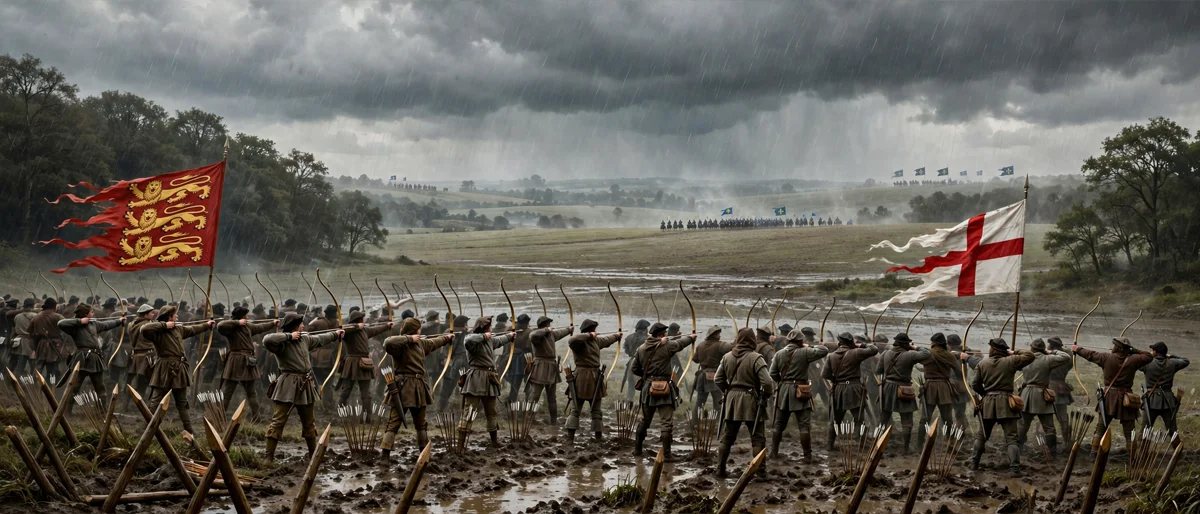
Henry lined up his men-at-arms in the middle with the archers on both flanks, and the archers had sharpened stakes planted in the ground in front of them. Then he did something bold. He moved his whole line forward until the French were inside bow range, and the archers opened fire.
Those stakes deserve a moment of attention, because they were one of the cheapest and cleverest defences of the medieval battlefield. Each archer carried a sharpened wooden stake, about six feet (roughly two metres) long, and before the battle the archers hammered their stakes into the mud in a row, angled toward the French like a portable palisade. A charging horse that struck such a stake at full speed could be impaled on it. A horse that checked or swerved lost the momentum that made heavy cavalry terrifying, and bunched into the riders behind. When the French cavalry wings charged the archers, as their plan required, they ran into arrow fire and a fence of points, and the survivors fell back through their own advancing infantry, trampling the front ranks and churning the mud even worse before the main fight had begun.
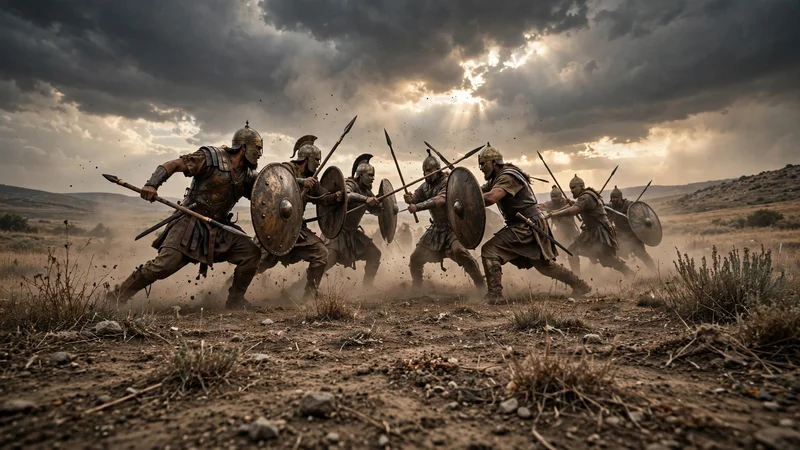
The French knights, many of them in heavy plate armor, charged across that muddy field. Horses were hit and panicked. The narrow ground jammed the French together, so the knights in front couldn't spread out and the ones behind kept pushing in. By the time they reached the English line, they were exhausted from slogging through mud in full armor, and they were packed so tightly that many couldn't fight properly.
The English archers then dropped their bows and went in with swords, axes and mallets. Men who fell in the mud often couldn't get back up. A lot of the French dead are thought to have been killed or smothered in the crush rather than by arrows alone.
Why England Won
It wasn't one thing. It was a few things stacking up:
The terrain. A narrow, muddy field took away the French advantage in numbers. The longbow. Thousands of arrows in the air at once wrecked the French charges before they even landed. Poor French coordination. Too many nobles wanted to be at the front, and the army never really acted as one. Henry's leadership. He made a hard decision to advance and the men followed him.
England won by holding a narrow front and breaking the French charges. The opposite lesson, a whole army destroyed because it was wrapped up from both flanks, is Hannibal's double envelopment at Cannae.
One honest complication belongs here, because modern research has tested the longbow legend rather than simply repeating it. Experiments with replica longbows shot against replica plate armour suggest that arrows often could not pierce a good-quality breastplate head-on, particularly at longer range. What the arrow storm certainly did was kill and wound the horses, force knights to fight with visors down and heads bowed, drive shafts through mail and the weaker joints of armour at closer range, and exhaust men who were already wading through mud under fire. The great killing then happened at arm's length, with swords, axes, mallets and daggers, and in the suffocating press of bodies itself. The longbow broke the French attacks before they landed. The mud, the stakes and the melee finished them.
What Happened Next
The French losses were huge, and many of their top nobles were killed or captured, including the Constable of France, Charles d'Albret. Estimates of French dead usually run into the thousands. English losses were far smaller, though the exact figure is uncertain. One of the notable English dead was the Duke of York.
There's one dark moment too. During the fighting, Henry ordered many French prisoners to be killed, fearing they might rejoin the battle behind his lines. It's still debated how many died this way.
That dark moment deserves its fuller story, because it is the gravest stain on the victory. By the customs of the age, a captured knight or noble was worth a ransom, and Henry's men had taken prisoners in extraordinary numbers, probably more prisoners than the English had men left to guard them. Late in the battle, a French force fell on the English baggage camp in the rear, killing servants and camp boys there, and at much the same moment it seemed the French might be rallying for another attack. Henry, fearing that thousands of prisoners at his back might seize discarded weapons and rejoin the fight, ordered them killed. Many were, likely hundreds and possibly more, before the alarm passed and the killing was stopped. The most valuable prisoners, men whose ransoms were fortunes, were largely spared. French chroniclers were divided: some condemned the order, others treated it as a grim necessity of war. Judged by the laws of war today it would be a crime. Judged by the standards of 1415 it was brutal pragmatism at the moment Henry feared he might still lose the battle he had just won, and historians argue over the numbers and the blame to this day.
Politically, Agincourt gave Henry a huge boost. A few years later, in 1420, the Treaty of Troyes named him heir to the French throne. It didn't last, since he died young in 1422, but the victory is the reason people still remember him.
Why We Still Talk About It
Agincourt has become a symbol of the underdog winning against the odds. Shakespeare gave it new life in Henry V, and the story has been retold ever since. Looking at it clearly, though, it wasn't magic. It was mud, discipline and a bad day for the French.
Want more battles like this? Browse the rest of Echoes of Battle for stories like Vicksburg, where one campaign changed the course of a war, or see where Agincourt ranks among the most decisive battles in history. Three centuries after Agincourt, the last battle fought on British soil took place at Culloden in 1746. And for a Civil War lesson in what happens when courage meets a prepared position, read our guide to the Battle of Fredericksburg in 1862.
The Battlefield Today
The field itself is still farmland. The battle was fought beside the modern village of Azincourt in the Pas-de-Calais department of northern France, and the open ground between the woods remains agricultural land, much as it was in 1415, though historians still debate the exact placement of the two armies on it. The village is home to the Centre Azincourt 1415, a visitor centre and museum devoted to the battle that opened in 2001, and a memorial marks the traditional site of the fighting. For a battle that decided so much, it is a quiet place now: fields, woods and a small French village, which may be the most fitting monument of all.