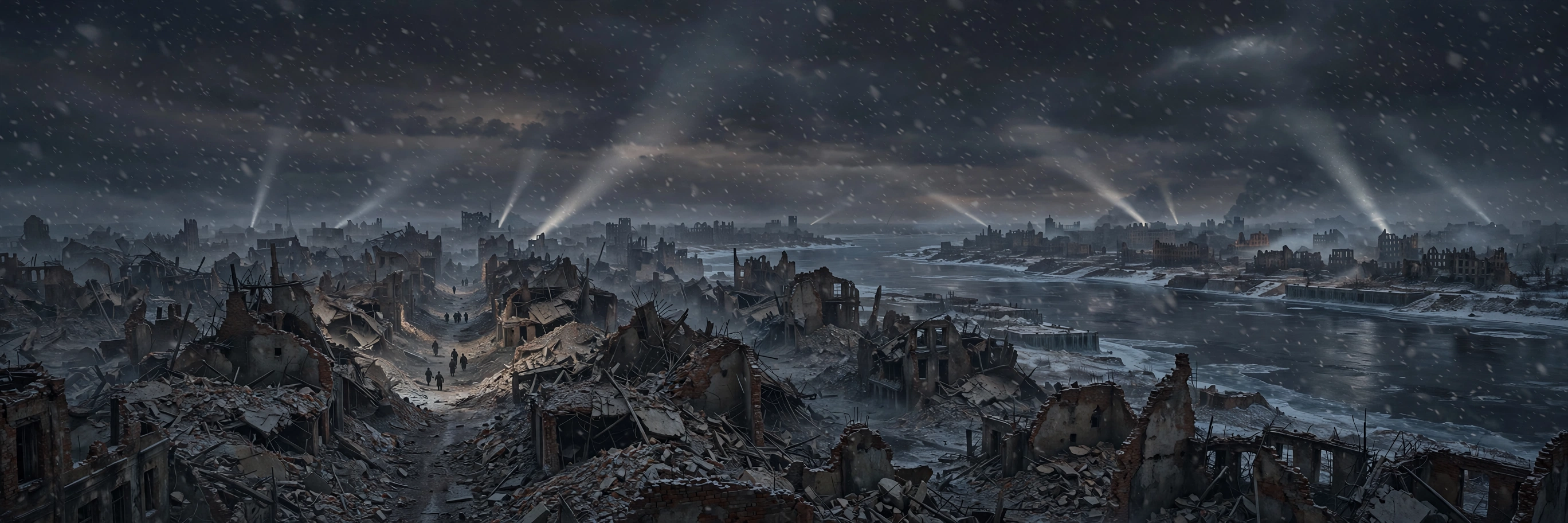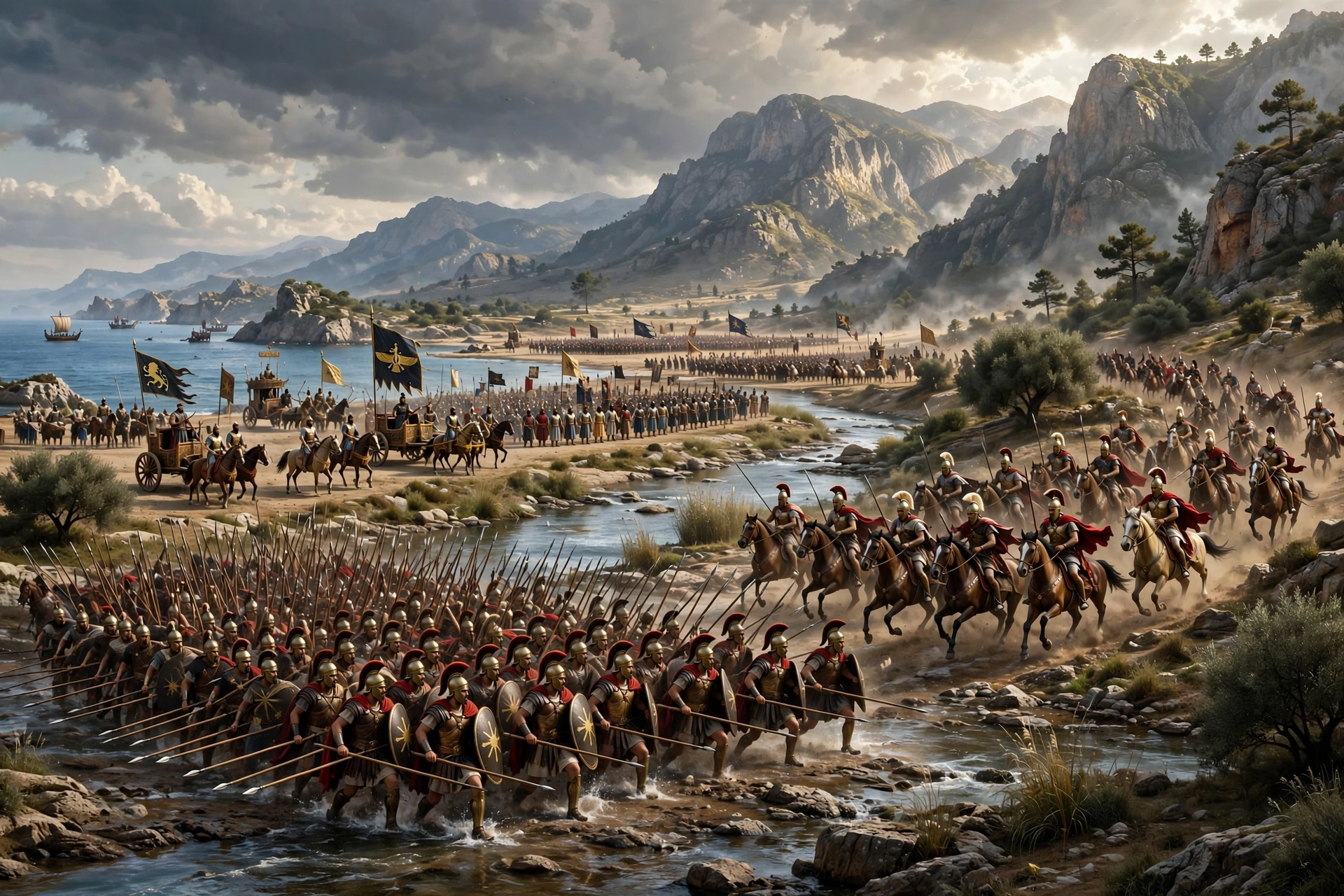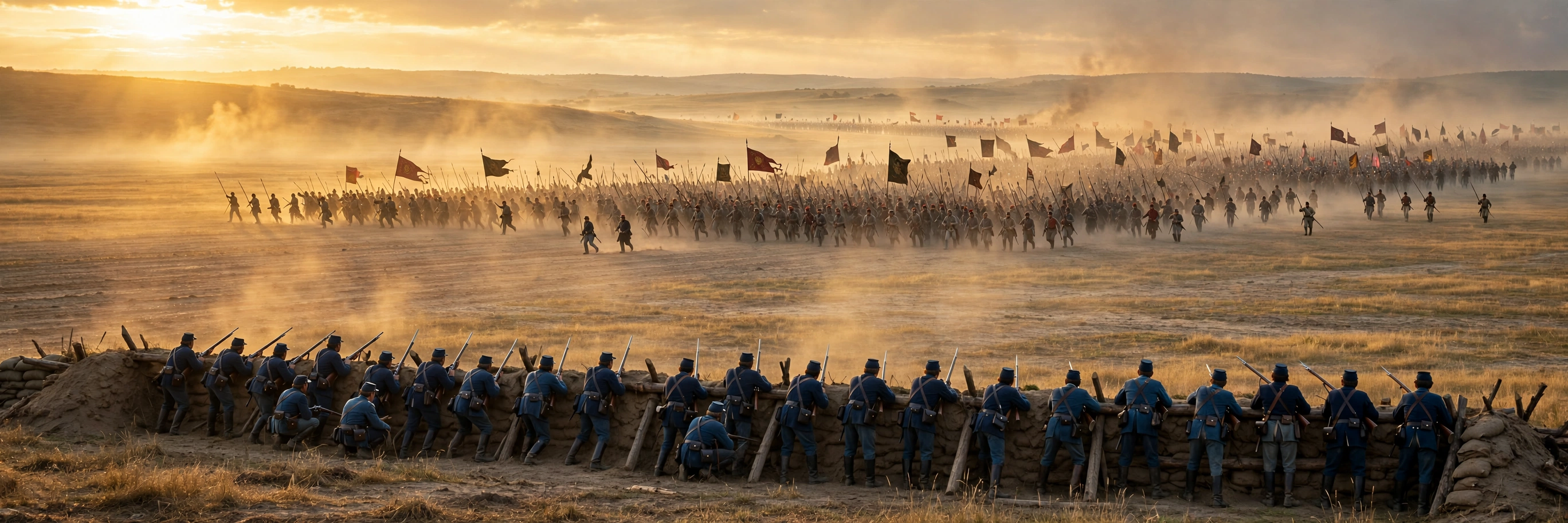
Every so often, history serves up a fight so lopsided it barely looks like a battle at all. Hundreds against thousands. Spears against machine guns. One side walks away; the other doesn't walk away at all. What makes these mismatches fascinating isn't the body count — it's the why. Because "one-sided" almost never means what you think it means. Sometimes it's technology. Sometimes it's terrain. And sometimes — the most interesting cases — the side that should have been crushed does the crushing. Here are the most one-sided battles in history, ranked by sheer disproportion.
What Makes a Battle One-Sided?
A quick note before the ranking, because the phrase needs unpacking. A battle becomes one-sided through some combination of four things: technology (guns vs spears), terrain (a narrow pass, a muddy field), surprise (an ambush, a trap), and collapse — the moment one army's nerve breaks and a fight becomes a slaughter. Most entries below involve at least two of the four. Keep count as you read.
1. Cajamarca (1532)
The numbers first, because they're almost hard to believe. On November 16, 1532, in the main plaza of Cajamarca, Peru: 168 Spaniards — 106 on foot, 62 on horseback, one small cannon — against some 6,000 unarmed Inca attendants surrounding their emperor, with tens of thousands more warriors camped nearby. By sunset: roughly 2,000 Inca dead. Spanish casualties: one man wounded. Not killed. Wounded.
How? Start with the setup. Francisco Pizarro had lured the Inca emperor Atahualpa into the plaza for a "meeting." The Inca came in ceremonial procession, carried on a golden litter, confident and unarmed — why would he fear 168 foreigners? Then a Spanish friar offered Atahualpa a Bible and demanded submission to the Spanish crown. Atahualpa, unimpressed, tossed the book aside. Pizarro gave the signal. Cannon fired. Horsemen — animals the Inca had never seen — charged into a packed crowd. Steel swords met cotton armor.
But here's what the numbers hide: this wasn't really a battle. It was an ambush of unarmed men, and the "victory" was capturing Atahualpa alive, which decapitated the empire's command in a single afternoon. The Inca Empire — 12 million people, the largest state in the Americas — unraveled from that one plaza. Technology mattered (steel, horses, guns). Surprise mattered more. And collapse did the rest: with their god-emperor in chains, the Inca military system simply stopped functioning.
2. Omdurman (1898)
If Cajamarca was an ambush, Omdurman was an execution carried out in the open. On September 2, 1898, outside Khartoum in the Sudan, Lord Kitchener's Anglo-Egyptian army — about 25,000 men with rifles, Maxim machine guns, and modern artillery — faced the Mahdist army: tens of thousands of brave men armed mostly with spears and swords, charging across open ground.
The Mahdists charged with extraordinary courage. It didn't matter. The result: 48 British dead. Nearly 11,000 Mahdists killed. Read that again. For every British soldier lost, more than two hundred Mahdists died.
Omdurman is the purest technology-gap battle in history — the moment industrial warfare met pre-industrial courage and the outcome was never in doubt. Even the British press, celebrating the revenge for General Gordon's death at Khartoum thirteen years earlier, felt queasy about it. The Westminster Gazette attacked the bayoneting of wounded Mahdists. Queen Victoria herself was appalled when she heard the Mahdi's tomb had been desecrated. The empire had won its most complete victory and somehow felt worse about it than about its defeats.
3. Plassey (1757)
June 23, 1757. A mango grove outside the village of Plassey in Bengal. Robert Clive — a former clerk turned soldier, commanding about 3,000 men of the British East India Company — faced Siraj ud-Daulah, the Nawab of Bengal, with over 50,000 troops and 53 guns. On paper, this should have been a footnote about British overconfidence.
Instead, it's the battle that won Britain an empire. British losses: 22 killed, 50 wounded. Bengali losses: about 500. And the reason wasn't technology or terrain — it was treason. Clive had bought the Nawab's commander-in-chief, Mir Jafar, who simply held his troops back while the battle raged. A rainstorm soaked the Nawab's gunpowder (the British had covered theirs). By 5 p.m., the Nawab's army was melting away, and Clive owned the field.
Plassey is the odd one on this list: the most one-sided battle ever decided by bribery. Within years, the East India Company controlled Bengal — the richest province in India — and the road to two centuries of British rule was open. All because one general's deputy decided he'd rather be Nawab himself.
4. Rorke's Drift (1879)
Now the most famous last-stand-that-wasn't. January 22–23, 1879: about 139 British soldiers — many of them sick, the garrison of a mission station turned supply depot — against roughly 4,000 Zulu warriors. The British had just learned that a full column had been annihilated at Isandlwana that same morning. The Zulus were coming. There was nowhere to run.
So Lieutenants Chard and Bromhead did the only thing they could: they built a fortress out of mealie bags and biscuit tins and waited. What followed was eleven hours of attacks — wave after wave, hand-to-hand in the hospital building, bayonets in the dark. When dawn came, the Zulus withdrew. British dead: 17. Zulu dead: over 500.
The aftermath is part of the legend: 11 Victoria Crosses awarded for a single action, still the record. But don't mistake Rorke's Drift for a simple hero story. It was rifles and barricades against spears — technology again — plus discipline under fire that bordered on the superhuman. The Zulus fought with immense bravery against impossible odds. The odds were impossible because of the Martini-Henry rifle.
5. Agincourt (1415)
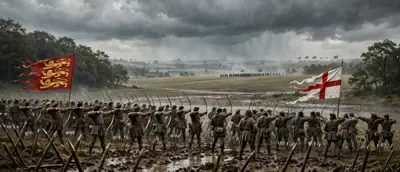
October 25, 1415. Henry V's exhausted, dysentery-ridden English army — about 6,000 men, most of them archers — against a French host of 20,000 to 30,000, the flower of French chivalry, on a freshly plowed field turned to glue by rain.
You know how this ends: the longbow. English archers, shooting from behind wooden stakes, poured arrows into French men-at-arms floundering through knee-deep mud in heavy armor. English dead: perhaps 400. French dead: 6,000 to 10,000, including much of the French nobility. It was the most complete victory of the Hundred Years' War, won by sick men with yew bows.
We've told this story in full — mud, arrows, and all — in our Battle of Agincourt summary. The short version for this list: terrain (the mud) plus technology (the longbow) plus French overconfidence, in exactly the proportions that make a massacre.
6. Cannae (216 BC)
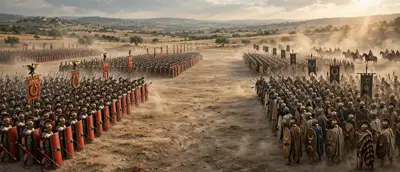
August 2, 216 BC. Hannibal Barca — 31 years old, operating in Italy with no supply line and no reinforcements — faced a Roman army of about 86,000 men, the largest Rome had ever fielded. His own force: roughly 50,000. The Romans planned to crush him with sheer weight.
Instead, Hannibal executed the most famous maneuver in military history: the double envelopment. His center gave way deliberately, drawing the Romans in; his cavalry swept around both flanks and closed the trap. Roman dead: somewhere between 50,000 and 70,000 in a single day — including a consul, 29 military tribunes, and 80 senators. Carthaginian dead: about 6,000.
Cannae is the tactician's entry on this list — no technology gap, no ambush of unarmed men, just one general out-thinking another so completely that the bigger army was destroyed almost to the last man. Military academies still teach it. Our full Cannae guide walks through the trap hour by hour.
7. Adwa (1896)
And now the exception that proves the rule — the one-sided battle where the "weaker" side did the crushing.
March 1, 1896. Emperor Menelik II of Ethiopia, commanding 73,000 to 100,000 men, faced an Italian invasion force of about 15,000–18,000 under General Baratieri near the town of Adwa. The Italians had modern rifles and artillery. The Ethiopians had numbers, terrain, and — the part Europe didn't expect — modern rifles of their own, bought from France and Russia, plus superior knowledge of the ground.
The result stunned the world: about 6,000 Italians killed, nearly 4,000 captured. Ethiopian losses were real too (several thousand dead), but the empire's sovereignty was secured — Ethiopia remained independent while the rest of Africa was carved up. Adwa is the most one-sided upset in modern military history, and a reminder that "one-sided" cuts both ways: bring a colonial army into the mountains against a united, well-armed nation, and the mismatch can run the other direction.
The Italians brought a colonial army to the mountains. Ethiopia brought a nation — with rifles of its own. Guess which mattered more.
FAQ
What was the most one-sided battle in history?
Cajamarca (1532): 168 Spaniards against thousands of Inca, with roughly 2,000 Inca dead and a single Spaniard wounded. It was less a battle than an ambush of unarmed men — but it toppled an empire of 12 million people.
What happened at the Battle of Omdurman?
On September 2, 1898, Kitchener’s Anglo-Egyptian army — 25,000 men with rifles, Maxim guns, and artillery — killed nearly 11,000 Mahdist warriors at a cost of 48 British dead: the purest technology-gap battle ever fought.
How did 139 men hold Rorke’s Drift?
Barricades of mealie bags and biscuit tins, Martini-Henry rifles, and eleven hours of discipline under fire against roughly 4,000 Zulu warriors. The defense earned 11 Victoria Crosses — still the record for a single action.
What was the most one-sided battle of the ancient world?
Cannae (216 BC): Hannibal’s double envelopment destroyed 50,000–70,000 Romans in a single day at a cost of about 6,000 Carthaginians — no technology gap, just one general out-thinking another completely.
Has the weaker side ever won a one-sided battle?
Yes — Adwa (1896), where Emperor Menelik II’s Ethiopians crushed an Italian invasion force, securing Ethiopia’s independence while the rest of Africa was colonized. The mismatch ran the other way.
What makes a battle one-sided?
Some combination of four things: technology (guns vs spears), terrain (a narrow pass, a muddy field), surprise (an ambush or trap), and collapse — the moment one army’s nerve breaks and a fight becomes a slaughter.
For more lopsided numbers from antiquity, our Battle of Issus guide covers Alexander beating a Persian host three times his size — and the bloodiest battles of WW2 shows what industrial-age mismatch did on a continental scale. Colonial warfare’s later chapters include Mogadishu 1993, and for a WW2 battle where maneuver decided everything, El Alamein.
Sources
- John Hemming, The Conquest of the Incas (Harcourt, 1970) — Cajamarca and the fall of the Inca Empire.
- Winston Churchill, The River War (1899) — Omdurman, by a participant.
- U.S. Army Center of Military History — Rorke's Drift and the Anglo-Zulu War.
- Adrian Goldsworthy, Cannae: Hannibal's Greatest Victory (2001).
- Raymond Jonas, The Battle of Adwa (Harvard University Press, 2011).