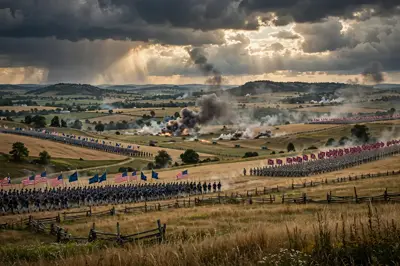
Picture this. You are standing in a valley in Tennessee, looking up at a ridge four hundred feet high, and the whole Confederate army is dug in along the top. Your orders are simple. Take the little ditch at the bottom. Then stop. Nobody in their right mind would order an attack up that slope, straight into loaded rifles. And yet, on November 25, 1863, about twenty thousand Union soldiers did exactly that. They went up anyway. And the ridge fell in about an hour.
Why Was Chattanooga Worth Starving For?
Start with the map, because the map is the whole reason this battle happened. Chattanooga sat where the railroads met, in a bend of the Tennessee River, and it was the gateway to Georgia and the Deep South. Whoever held it held the door. The American Battlefield Trust calls the city the gateway to the Deep South, and in the autumn of 1863 both armies knew it.
The Battle of Missionary Ridge was the November 25, 1863 fight that broke the siege of Chattanooga. Grant's Union army, about 56,000 strong, attacked Bragg's 44,000 Confederates along a ridge east of the city, and a charge nobody ordered carried the crest by late afternoon.
Two months earlier, the Union army had been beaten at Chickamauga, on September 19 and 20, 1863. General William Rosecrans and his Army of the Cumberland fell back into Chattanooga, and Braxton Bragg followed them and took the high ground. His men sat on Missionary Ridge to the east and Lookout Mountain to the southwest, looking down into the town. The supply lines were cut. Rations ran short. Horses and mules starved. The army that had marched into Tennessee in the summer was now trapped in a town it could not leave.
Washington reacted fast. On October 17, Grant took command of the Military Division of the Mississippi, three western armies under one man. He replaced Rosecrans with George H. Thomas, the general who had held the line at Chickamauga and earned the name the Rock of Chickamauga. Reinforcements poured in. Joseph Hooker brought two corps from Virginia. William T. Sherman marched about 20,000 men from Mississippi. And on the night of October 27, Thomas's men crossed the Tennessee River at Brown's Ferry and opened a supply line the soldiers called the Cracker Line. Food came back. The siege was still on, but the army was no longer starving.
And honestly, Bragg had already lost the campaign before the ridge was ever attacked. His army was feuding with itself. Bragg had spent the autumn quarreling with his generals, and his corps commanders did not trust him. Then he made the decision that doomed him. He sent James Longstreet away toward Knoxville with about 15,000 of his best men, to deal with a Union force up in East Tennessee. That left the ridge short of the men it needed, on the very ground where the war would be decided.
What Was Missionary Ridge, and Why Did Bragg Think It Was Safe?
The ridge itself runs for several miles east of Chattanooga, a long spine of rock and timber rising about 400 feet above the valley floor. It took its name from the Brainerd Mission, a mission station for the Cherokee that stood at its foot. The slopes were steep. The crest was narrow. From the valley floor, it looked like a wall.
Bragg laid his army out along that wall. He put rifle pits at the base, a thin line of men in shallow ditches, and his main line along the crest. William Hardee's corps held the right, the north end. John C. Breckinridge's corps held the center and the left, the south end. About 44,000 men in all, looking down at an enemy they outnumbered in height, if not in numbers.
But the position had a flaw, and it was a bad one. Bragg's main line sat on the geographic crest, the very top of the ridge, instead of the military crest, the spot a little forward where a man can actually see the slope below him. From the top, Bragg's men could not see the ground right under their own feet. The slope hid the climbers. And the guns up there could not depress far enough to hit men coming up the hill. It was a strong position that could not shoot down its own front.
The rifle pits made it worse. If the men in the pits had to fall back, they would have to run uphill, under fire, straight through their own army's line. And the men on the crest would have to hold their fire while their own troops ran in front of their guns. Bragg had built a trap, and he had put his own men inside it.
Grant knew all this, and so did Thomas. That is why the plan gave the main job to Sherman, up at the north end of the ridge, while Thomas's men in the center were supposed to make a demonstration, a show of force, and nothing more. Nobody planned to storm the crest. The crest was supposed to be the one place the Union army did not attack.
November 23: Orchard Knob, the Dress Rehearsal
Grant wanted to know if Bragg was slipping away. On November 23 he ordered Thomas to push out from Chattanooga and feel the Confederate line. Thomas sent more than 14,000 men at Orchard Knob, a small hill halfway between the town and the ridge.
It was supposed to be a probe. It turned into a capture. The Confederates were driven off the hill in short order, about 200 prisoners were taken, and the Union held the ground. Grant moved his headquarters up onto Orchard Knob the next day, so he could watch the whole field from a front-row seat.
That night, Bragg reinforced his line on the ridge. He knew the attack was coming now. What he did not know was where it would fall, and he spent the night worrying about the wrong end of his line.
November 24: The Battle Above the Clouds
Hooker's job was Lookout Mountain. On November 24, his men climbed the mountain in thick fog and drove the Confederates off it. The fog was so heavy that the men watching from Orchard Knob could hear the fighting and not see it. That is how the fight got its name, the Battle Above the Clouds.
But Bragg was already worried about his left. Hooker was coming down from Lookout Mountain toward Rossville Gap, the road Bragg needed to get his army out of Chattanooga if things went wrong. So Bragg shifted men south to guard it. Every man he moved south thinned the center of the ridge, and nobody on his staff said it out loud.
By the evening of the 24th, the Union held Orchard Knob in the center, Lookout Mountain in the south, and Sherman's men were across the Tennessee River in the north. The ring was closing. Bragg's army was still on the ridge, but the ridge was starting to look lonely.
November 25: Sherman's Morning Goes Nowhere
Grant's plan for the 25th was simple on paper. Sherman would hit the north end of the ridge, at Tunnel Hill, at dawn. Thomas would demonstrate in the center. Hooker would come in from the south, through Rossville Gap. Sherman had about 16,000 men against Patrick Cleburne's 4,000 on Tunnel Hill. On paper, it was not a fair fight.
It went wrong from the start. Sherman's men crossed the river and took a hill they thought was Tunnel Hill. It was not. A deep ravine separated them from the real hill, and Cleburne was waiting on it with his men already dug in. Sherman's attacks started late, around 11 in the morning, and Cleburne threw every one of them back. The National Park Service puts it plainly: the Confederates successfully defended both ends of the ridge that day.
By mid-afternoon, Grant was watching Sherman stall, and the clock was running. He turned to Thomas and ordered the Army of the Cumberland to take the rifle pits at the base of the ridge, to take pressure off Sherman. Just the pits. Stop there. Reorganize. Wait for orders. Thomas passed the order on, and four divisions stepped off: Sheridan and Wood from Gordon Granger's IV Corps, Johnson and Baird from John Palmer's XIV Corps.
Then Thomas's Men Just... Kept Climbing
The pits fell fast. The Confederates in them broke and ran uphill, and the Union men came pouring after them. And then the men did not stop. They kept climbing.
Why? Look at it from the bottom of that slope. The pits were the worst place to be. They offered no cover, and the fire from the crest was already falling on them. Staying put meant dying in a ditch. Going up was the only cover there was, because the slope itself hid the climbers from the men on top. Once the first regiments went, the rest followed. Officers shouted to halt. Nobody listened. Or nobody heard.
Grant watched from Orchard Knob and, so the story goes, turned to Thomas and asked who had ordered those men up the ridge. Thomas said he had not. Granger's answer is the one people still quote: when those fellows get started, all hell can't stop them.
So who gave the order? Nobody. And that is the honest answer. The National Park Service says it the same way: finding little resistance at the base, and without orders, the recently defeated Army of the Cumberland kept charging up the rocky slopes. Two months after Chickamauga, the same army that had been driven off the field was climbing a ridge in front of its own generals, and the generals could only watch.
The climb took about an hour. The crest line broke. Bragg's headquarters was overrun, and Bragg himself rode off just ahead of the Union troops. Breckinridge barely escaped capture. The Confederates poured off the back of the ridge and ran south, and the Union took about 40 guns and thousands of prisoners. By late afternoon, the ridge that was supposed to be untakeable belonged to the Union.
Why Did the Ridge Fall So Fast?
It looks like a miracle. It was not. Bragg had stacked the deck against himself, and the Union men who climbed were the ones who collected on it.
First, Longstreet was gone. About 15,000 of Bragg's best men were marching on Knoxville when the battle was fought, and the ridge was short of the troops it needed most. Second, the ground itself betrayed the defenders. The crest line could not shoot down its own slope, and the men falling back from the pits ran straight through the line of fire, so the men on top held their shots rather than kill their own troops. That gave the climbers a free approach for the last stretch, the part of the climb where they should have been cut down.
Third, the army itself was coming apart. Bragg had spent the autumn fighting his own generals, orders moved slowly, trust was gone, and when the center broke, nobody moved fast enough to plug it. An army that does not trust its commander does not rally when the line breaks. It runs.
None of this takes anything away from the men who climbed. But it is fair to say the ridge was lost as much by Bragg's mistakes as it was won by Union courage. A well-run defense, with the guns placed right and Longstreet's men in line, could have turned that slope into a killing field. The climbers were exposed for most of the way up. They were lucky, and they were brave, and both things can be true at once.
The Cost: What Three Days Around Chattanooga Took
The battle lasted one afternoon. The campaign lasted three days. Across Orchard Knob, Lookout Mountain and Missionary Ridge, the Union lost 5,824 men: 753 killed, 4,722 wounded, and 349 missing. The Confederates lost 6,667: 361 killed, 2,160 wounded, and 4,146 missing, most of them prisoners. The Union also took about 40 guns.
Here is the ledger, so you can see both sides at a glance.
| Union strength | About 56,000 men engaged |
|---|---|
| Confederate strength | About 44,000 men engaged |
| Union losses | 5,824 total (753 killed, 4,722 wounded, 349 missing) |
| Confederate losses | 6,667 total (361 killed, 2,160 wounded, 4,146 missing, mostly prisoners) |
| Guns captured | About 40 Confederate guns |
The lopsided part is the prisoners. The Confederates lost more men while defending the high ground, and most of the extra loss was men taken prisoner, not men killed. That tells you how complete the collapse was. Armies holding a ridge do not usually lose twice as many prisoners as killed. Bragg's army did not just retreat. It came apart.
Why Missionary Ridge Still Matters
Bragg pulled his army back to Dalton, Georgia that night, with Hardee's corps covering the retreat. Within weeks Bragg was out of command, replaced by Joseph E. Johnston that December. The road into Georgia was open, and it stayed open.
The next spring, Sherman walked through that open door. His Atlanta campaign started in May 1864, and it ended with the fall of Atlanta, the March to the Sea, and the Confederacy cut in two. None of it happens without Missionary Ridge. Chattanooga gets less attention than Gettysburg, and that is a shame, because Gettysburg stopped an invasion and Chattanooga started one.
It changed the men, too. Grant was made lieutenant general in March 1864 and given command of every Union army. Thomas, the Rock of Chickamauga, had his revenge. The same Army of the Cumberland that had been driven off the field at Chickamauga two months earlier had just done the impossible in front of the whole army. And Sherman, the general whose attack had stalled that morning, learned a lesson about broken ground that he carried all the way to Atlanta.
The battle sits in the middle of the bloodiest year of the war, the same year that saw Chancellorsville and Gettysburg, and it is the one that decided what the next year would look like. If you want to understand how the Union won the West, start here.
A Note on the Numbers: What the Sources Actually Say
Honest history comes with asterisks, and Chattanooga has its share. The strength figures, 56,359 Union and 44,010 Confederate, come from the standard campaign totals, Livermore's Numbers and Losses in the Civil War, as carried by Wikipedia. Round them to about 56,000 and 44,000 and you are safe.
The casualty figures, 5,824 and 6,667, cover all three days around Chattanooga, not just the ridge itself. Grant's own first report gave a lower Union total, 5,286, which is why you will see different numbers in older books. The 5,824 figure is the one the Park Service and the standard histories use, so it is the one used here.
The guns are the same story. Most sources say about 40 were captured. A few say 41. Call it about 40 and move on. What is not in doubt: the dates, November 23 to 25, 1863, the commanders, the charge nobody ordered, and the result. The rest is rounding.
3 Lessons from Missionary Ridge
Missionary Ridge is a battle, but it is also a case study in how strong positions fail. Three lessons worth stealing:
1. Put your line where it can actually shoot. Bragg's crest line looked strong and could not fire down its own slope. A position is only as good as the ground it covers, not the ground it sits on. Walk the ground before you trust the map.
2. Momentum is a weapon, but it is not a plan. The charge worked because Bragg's defense was already broken in three places. If the crest line had held its fire discipline for ten more minutes, the climb could have been a disaster. Never count on the enemy making your luck for you.
3. A divided command loses before the first shot. Bragg spent the autumn fighting his own generals. Longstreet was gone, the corps commanders did not trust him, and when the center broke, nobody moved. Armies do not fall apart in an hour. They fall apart over months, and then the hour just makes it obvious.
If you ever drive through Chattanooga, take the road up Missionary Ridge. Stand on Orchard Knob where Grant stood, look up at the slope, and ask yourself if you would have climbed it. The men who did are the reason the ridge still has a name you know.
Sources
- Wikipedia, Battle of Missionary Ridge
- National Park Service, The Battles for Chattanooga
- American Battlefield Trust, Chattanooga: Missionary Ridge, Nov 25, 1863, 4 pm (battle map)
- Civil War Months, The Battle of Chattanooga: Missionary Ridge
- Encyclopedia.com, Missionary Ridge, Battle of