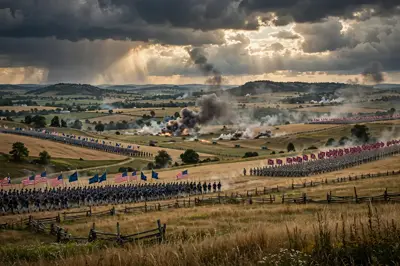
Joseph Hooker had the numbers, the plan, and the confidence. On May 1, 1863, his Army of the Potomac, about 133,000 strong, stood west of Fredericksburg with Robert E. Lee's 60,000 Confederates caught between two Union forces. Hooker had already written the victory speech in his head. "May God have mercy on General Lee, for I will have none," he told his staff. Three days later Hooker was pulling his army back across the Rappahannock in the rain, and Lee had just won the battle historians still call his masterpiece. The price was Stonewall Jackson. That price would haunt the Confederacy for the rest of the war.
Why Was Hooker So Confident?
Start with the winter before. The Union army had just been wrecked at Fredericksburg on December 13, 1862, when Ambrose Burnside threw wave after wave at a stone wall below Marye's Heights. Our Battle of Fredericksburg 1862 summary covers that disaster in full: 12,653 Union casualties to 5,377 Confederate, and an army that went into winter camp angry, hungry, and deserting by the thousand. Abraham Lincoln fired Burnside and gave the army to Joseph Hooker in January 1863.
Hooker, to his credit, fixed the army. He improved the food. He granted furloughs. He cleaned up the camps. He gave each corps its own badge, a small thing that did real work for morale, because suddenly a man could look at another man's cap and know whose outfit he belonged to. Desertion fell. The men started to believe in themselves again. Hooker called the Army of the Potomac "the finest army on the planet," and in the spring of 1863, on paper, he wasn't wrong.
His plan for the spring was a good one. Really. Lee's army sat along the Rappahannock River at Fredericksburg, and Hooker meant to go around it. John Sedgwick's VI Corps, about 40,000 men, would make a loud demonstration at Fredericksburg and hold Lee's attention there. George Stoneman's cavalry, close to 10,000 troopers, would ride deep into Virginia and cut Lee's supply lines. Hooker himself would take the bulk of the army upriver, cross at Kelly's Ford and Germanna Ford, march through the Wilderness, and come down on Lee's left flank and rear. Lee would have to turn and fight with a river at his back, or run. That was the plan. On a map it looked beautiful.
By April 30, Hooker was across the river and at the Chancellorsville crossroads, a little cluster of buildings around the home of the Chancellor family, about ten miles west of Fredericksburg. He had done it. Lee's army was split, Hooker's main force was in Lee's rear, and Sedgwick was pressing from the east. Hooker had Lee just where he wanted him.
So why did it all fall apart?
How Did Lee Answer a Two-to-One Attack?
Lee did what Lee did. He refused to panic, and he refused to run.
When word came that Hooker was across the river in force, Lee left Jubal Early's division, about 10,000 men, to hold the Fredericksburg lines against Sedgwick, and marched west with the rest of his army to meet Hooker. That meant leaving a small force to face 40,000 Union soldiers while he took roughly 40,000 to face 70,000. Any textbook of the day would have called that madness. Lee called it Tuesday.
On May 1, Hooker's columns pushed east from Chancellorsville along the Orange Turnpike and the Orange Plank Road, and ran into Confederate resistance. The fighting was sharp but small. And then Hooker did the thing that lost him the battle. He stopped. He pulled his army back into a defensive position around the Chancellorsville crossroads and waited. "I have got Lee just where I want him; he must fight me on my own ground," he said. Maybe he believed it. Maybe he was scared of fighting in the Wilderness, a dense tangle of second-growth scrub oak and pine where you could barely see fifty yards and artillery was almost useless.
But here is the thing. Lee was not going to attack Hooker's chosen ground. Lee was going to make Hooker fight on his.
That night, May 1-2, Lee and Jackson met at a crossroads near the Catherine Furnace, an old ironworks in the woods. The story goes they sat on a log and talked, with Jackson sketching the roads in the dirt. The plan they agreed on was the kind of plan that gets generals fired or gets them statues. Jackson would take his entire Second Corps, about 28,000 men, and march around Hooker's right flank. Lee would stay in front of Hooker with about 14,000 men and keep him busy. That meant splitting an army of 60,000 in the face of an army of 133,000, and then splitting it again. Jackson's column would march for hours within earshot of Union pickets. If Hooker attacked Lee's thin line while Jackson was gone, Lee would be crushed. If Hooker spotted the march and hit the moving column, Jackson would be crushed.
Honestly, this is the part of the story that still makes generals argue. Was it genius or was it a gamble that happened to pay off? Look, Lee knew Hooker. He had watched him hesitate on May 1. He was betting the whole war that Hooker would hesitate again.
What Was Jackson's Flank March?
Jackson's men started moving before dawn on May 2. Twenty-eight thousand men, with artillery and wagons, on narrow forest roads, marching roughly 12 miles in a wide loop to the west and then north, aiming to come out on the Union right flank. It took all day. The column was spotted. Union lookouts on the high ground saw the long line of men and wagons moving west past the Catherine Furnace, and Hooker was told about it.
Hooker read it wrong. He decided Lee was retreating. The column was heading west, away from the Union army, so the obvious conclusion was that Lee was pulling out. Daniel Sickles, commanding the Union III Corps, was sent to attack the tail of the column and cut it off, and his men did real damage, capturing prisoners and wagons. Nobody reinforced Sickles. Nobody sent a strong force to find out where that column was actually going. The chance to break Jackson's march in the middle, strung out on forest roads, came and went.
Hooker did send one warning. He told Oliver Howard, commanding the XI Corps on the Union right, to watch his flank. Howard did almost nothing with it. His corps, about 11,000 men, many of them German immigrants, sat facing south with its right flank hanging in the air, no trenches on that side, no cavalry screen worth the name. Men were cooking supper. Rifles were stacked. Some of the regiments had never been in a real fight. The flank was, in the blunt phrase of the day, "in the air."
Do you see the shape of it now? Hooker had 133,000 men. He had Lee outnumbered and outflanked. His own right flank was wide open.
May 2, 1863: The Attack That Broke the Union Right
Jackson's column reached its jumping-off point in the late afternoon, formed a battle line nearly two miles wide across the Orange Turnpike, and waited. At about 5:15 p.m., the order came.
The attack hit like a door being kicked in. The Confederates came out of the woods shouting, and the XI Corps broke almost at once. Men who had been cooking supper ran. Whole regiments dissolved. The road back toward Chancellorsville jammed with fleeing soldiers, wagons, and artillery. Jackson's line pushed on, mile after mile, rolling up the Union flank as it went. Some accounts say the animals gave the first warning: deer and rabbits burst out of the woods ahead of the Confederate line, fleeing the noise, and Union pickets saw them running before they saw the men.
By dark, Jackson's troops had advanced about two miles and were within a mile of the Chancellorsville crossroads. The Union army was bending but not yet broken. Alfred Pleasonton's cavalry guns, firing point-blank down the turnpike, and Sickles' men, hurried over from the south, finally stopped the advance. Jackson wanted to keep going by moonlight. He rode forward with his staff to look at the ground himself, to see if a night attack could finish the job.
That ride killed him.
The Night Jackson Fell
It was about 9 p.m. on May 2. Jackson and his staff were returning from their reconnaissance when Confederate pickets of the 18th North Carolina, nervous in the dark and convinced Union cavalry was in front of them, opened fire on the horsemen. Jackson was hit three times, in the left arm and the right hand. His men carried him to a field hospital at Wilderness Tavern, where Dr. Hunter McGuire amputated his left arm.
When Lee heard the news, he said the words everyone remembers: "He has lost his left arm, but I have lost my right arm." Lee meant it. Jackson was the one subordinate Lee trusted to take a plan and run with it, the man who had marched his corps 12 miles through the woods and smashed an army's flank. There was no replacement for that.
Command of the Second Corps passed to J.E.B. Stuart, the cavalry chief, who had never commanded infantry in a battle this size. He spent the night getting the corps sorted out for a dawn attack. On the Union side, Hooker spent the night pulling his army into a tight defensive position, his back to the river, his grand plan in ruins.
May 3: The Bloodiest Morning
May 3 was the hardest fighting of the battle, and it started at first light.
Stuart attacked with everything he had. He had one gift Hooker had handed him the day before. The high ground at Hazel Grove, the best artillery position on the field, had been held by Sickles' men. Hooker ordered it abandoned on May 2, pulling Sickles back to the main line. Stuart put 30 guns on Hazel Grove and shelled the Union position for hours. The Chancellor House, Hooker's headquarters, caught fire. Shells tore through the clearing where the Union army was packed in.
Hooker himself was hurt that morning. A cannonball struck the porch pillar of the Chancellor House while he was leaning against it, and the blow knocked him senseless. He was out of action for a time, command passed briefly to Darius Couch, and by the time Hooker resumed command the army was already falling back to a new line closer to the river. The Union line bent, held, and bent again, and by midday the fighting around Chancellorsville had burned itself out. Lee had the field. Hooker had a bridgehead and a broken plan.
Meanwhile, ten miles east, Sedgwick finally moved. On May 3 his VI Corps stormed Marye's Heights at Fredericksburg, the same stone wall that had stopped Burnside in December, and took it. Then he marched west toward Chancellorsville and ran into a wall of his own at Salem Church on May 4, where Early's men and reinforcements Lee sent back from Chancellorsville stopped him cold. Sedgwick fought his way back across the Rappahannock on the night of May 4-5.
Hooker held his bridgehead for two more days, in the rain, and then gave the order. On the night of May 5-6, the Army of the Potomac crossed back over the Rappahannock. The campaign was over. Lee had won.
What Did Chancellorsville Cost?
The National Park Service puts the butcher's bill at about 17,197 Union casualties, 1,606 killed, 9,762 wounded, and 5,919 captured or missing. Confederate losses ran to about 13,460, with 1,665 killed, 9,081 wounded, and 2,714 captured or missing. More than 30,000 men, in three days, around a crossroads most Americans had never heard of.
But the raw numbers hide the real cost. The Union lost about 13 percent of its army. The Confederacy lost about 22 percent of its. Lee's army was smaller, and it could not replace those men. Every casualty list that spring was a list of men the South would never get back.
Then there was Jackson. He was taken to a house at Guinea Station, where pneumonia set in. He died on May 10, 1863, eight days after he was shot. His last words, as his wife Anna recorded them, were: "Let us cross over the river, and rest under the shade of the trees." He was 39 years old.
Lee lost his best corps commander, and the Army of Northern Virginia never fought quite the same way again. Two months later, at Gettysburg, Lee would attack without Jackson, and the men who replaced him, Ewell and Hill, would not do what Jackson would have done. Our Battle of Gettysburg turning points guide picks up the story there. Hooker lost his job too. Lincoln replaced him with George Meade on June 28, 1863, three days before Gettysburg. Hooker kept his army intact, but he lost his nerve on May 1, and that was the moment that mattered.
What Is the Battle of Chancellorsville?
The Battle of Chancellorsville was a Civil War battle fought May 1-3, 1863, near Chancellorsville, Virginia, where Robert E. Lee's outnumbered Confederates defeated Joseph Hooker's Army of the Potomac. Lee split his force and sent Stonewall Jackson on a 12-mile flank march that routed the Union right. The South won, but lost Jackson to friendly fire that night.
Why Does Chancellorsville Still Matter?
So why does Chancellorsville still matter? Really. Not the textbook answer. The real one.
First, it is still the textbook flank attack. Military schools teach it because it is the cleanest example of the idea: find the open flank, march around it, hit it hard, and let panic do the rest. Jackson's march is studied alongside Hannibal at Cannae and Scipio at Zama, and for the same reason. The plan was simple, the execution was everything, and it worked.
Second, it decided the summer of 1863. The victory gave Lee the confidence, and the political room, to invade Pennsylvania. That invasion ended at Gettysburg two months later, and Gettysburg ended the Confederacy's hopes of winning the war outright. Chancellorsville made Gettysburg possible. That is the chain. Pull out the first link and the rest never happens.
Third, the ground itself would matter again. A year later, in May 1864, Ulysses S. Grant and Lee fought the Battle of the Wilderness on this same tangled ground, and the same scrub oak and pine that hid Jackson's march would hide Grant's first bloody steps toward Richmond. If you ever visit, the woods are still thick. You can stand on the Orange Turnpike and understand in about ten seconds why nobody saw Jackson coming.
Now the honest downside, because every victory has one. Lee's win at Chancellorsville was the worst kind of victory, the kind that costs you more than it gains. The Confederacy lost 22 percent of an army it could not rebuild, and it lost Jackson, the one man Lee could not replace. The South celebrated for weeks. It should have been mourning. The army that marched north to Gettysburg was a weaker army than the one that had fought at Chancellorsville, and Lee knew it. He went anyway, because the victory had convinced him, and Richmond, that his army could do anything. That belief died on the third day at Gettysburg.
A Note on the Numbers
Honest history comes with asterisks, and Chancellorsville has its share. The strength figures come from the Official Records: Hooker's army at about 133,868 men present for duty, Lee's at about 60,298. The casualty figures are the National Park Service totals, and other sources differ by a few hundred on either side. Jackson's march is usually given as about 12 miles, though some accounts stretch it to 14 depending on which roads you count. The exact time of the flank attack is usually given as about 5:15 p.m., from the reports of the officers on the spot.
What is not in doubt: the commanders, the flank march, the collapse of the XI Corps, Jackson's wounding by his own pickets, the May 3 fighting, the withdrawal across the Rappahannock, and the death of Jackson on May 10. The rest is rounding.
3 Lessons from Chancellorsville
Chancellorsville is a battle, but it is also a warning about what wins wars and what loses them. Three lessons worth keeping:
1. Numbers don't win battles. Nerve does. Hooker had more than twice Lee's men, a better plan, and the initiative. He lost because he stopped on May 1, when he had Lee in the open, and never started again. An army with a hesitant commander is just a crowd with rifles.
2. A flank in the air is a disaster waiting for a date. Howard's XI Corps sat with its right flank hanging in empty woods, and everybody knew it. Hooker warned him. Scouts reported the Confederate column. Nobody acted. If your flank is open, it is not a matter of if someone finds it. It is a matter of when.
3. Winning can cost more than losing. Lee won the battle and lost the war's best corps commander plus a fifth of his army. Hooker lost the battle and kept his army. Two months later, at Gettysburg, the difference showed. Count the cost of a victory the same way you count the cost of a defeat, or the victory will fool you.
Here is the uncomfortable truth nobody tells you about Chancellorsville: Lee's greatest victory was also the beginning of the end for his army. He won the field, the headlines, and the summer. He lost Jackson and a fifth of his men, and he never got either back. The South celebrated a triumph. It should have counted the cost.
Want to see where this story started? Our Battle of Fredericksburg 1862 summary covers the winter disaster that put Hooker in command. If you want the battle that came next, our Battle of Antietam summary covers America's bloodiest day, the fight that made the Emancipation Proclamation possible.