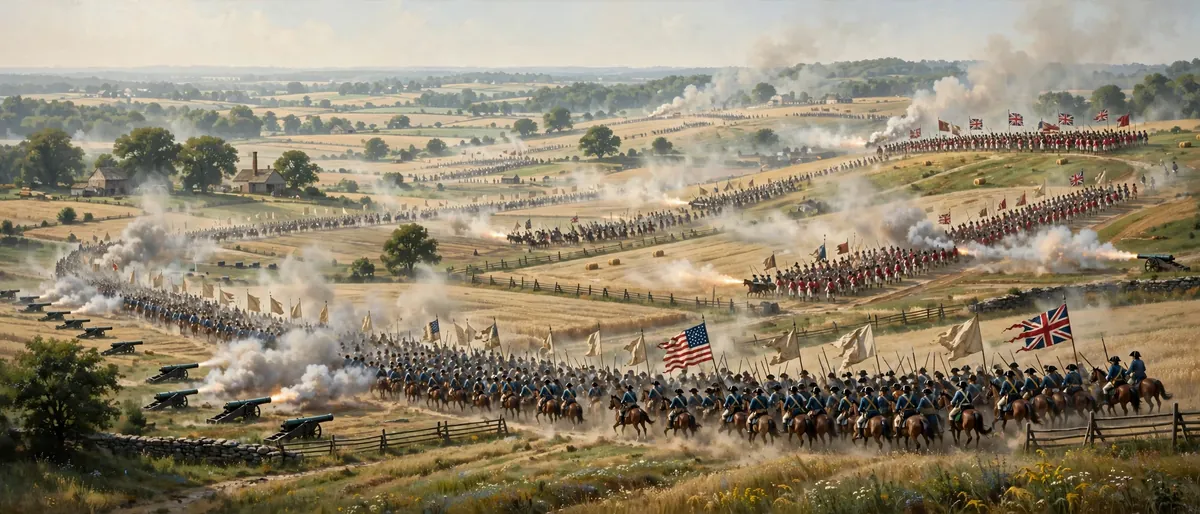
Picture this. It's late morning on June 28, 1778, and you are George Washington, riding toward the sound of guns near a courthouse in New Jersey. Your plan is simple. Your advance guard is supposed to be tearing into the British rear. What you find instead is your own army walking back toward you, hot, confused, and leaderless. And in the middle of the road sits their commander, Major General Charles Lee, with no explanation worth hearing. Washington, the most self-controlled man in America, exploded. The next sixty seconds became legend.
Every account agrees on one thing. Nobody had ever seen Washington that angry, before or after. Witnesses described a burst of profanity from a man famous for holding his temper. The Marquis de Lafayette, riding beside him, said he had never witnessed anything like it. Lee was stripped of his command on the spot. And then, with his army reeling, Washington did something remarkable. He rebuilt the line himself, in the open, under fire, in murderous heat. The Continentals held. That combination of fury and calm is why Monmouth is still taught.
The Battle of Monmouth was fought on June 28, 1778, at Monmouth Courthouse in New Jersey, between Washington's Continental Army and Sir Henry Clinton's British force withdrawing from Philadelphia. After Charles Lee's botched attack and his famous rebuke, Washington rallied his army and fought the British to a standstill in the war's longest single-day battle.
Did Washington Really Curse Out His Own General?
Yes, and the witnesses agree it was extraordinary. Washington reached the field around noon and met the head of Lee's retreating column coming the other way. He rode straight to Lee and demanded an explanation. Anyone who quotes you the exact words verbatim is guessing, because the accounts differ, but the substance is settled. Washington swore at Lee, in front of officers and men, in language his own aides found shocking. Then he relieved him on the spot. Lee was sent to the rear. The advance guard now answered to Washington directly.
Why did it matter? Because armies watch their commanders the way children watch their parents. Washington had spent two years being careful, dignified, almost distant. In one afternoon his men saw both extremes: white-hot anger at failure, then total steadiness under fire. He spent the rest of the day riding the line, placing guns, steadying regiments. The men who watched him that day remembered it for the rest of their lives. And yeah, there's a lesson about leadership in there that has nothing to do with war.
Why Was Clinton's Army Crawling Across New Jersey?
To understand Monmouth, you have to start in Philadelphia. The British had held the American capital since the fall of 1777, but holding it was costing them more than it was worth. In February 1778, France signed an alliance with the Americans, and that changed everything. A war with France meant a global war, and London decided Philadelphia was a luxury it could no longer afford. Sir Henry Clinton, who had replaced William Howe as commander-in-chief that same month, got the order: get the army to New York.
So on June 18, 1778, the British marched out of Philadelphia. Clinton had about 19,000 men, and he had a problem no general wants. Behind his column rolled a wagon train stuffed with loyalist refugees, supplies, and plunder, stretching for miles down the road. An army that big, moving that slow, across New Jersey in June, was a target begging to be hit. Washington knew it. His generals knew it. The question was whether the Continental Army, fresh out of a brutal winter at Valley Forge, was ready to hit back. One day later, on June 19, Washington's army broke camp and started after them.
Who Was Charles Lee, and Why Did He Attack Anyway?
Charles Lee was the oddest man in the American high command. He was a former British officer, well-read, sharp-tongued, and convinced he understood war better than Washington did. He had been captured by the British in late 1776, spent more than a year as a prisoner, and was exchanged in the spring of 1778. He came back to an army that had changed while he was gone. That army had just spent the winter at Valley Forge drilling under Baron Friedrich von Steuben, the Prussian officer who had turned a starving rabble into something like a real army. Lee didn't fully believe it. He thought the Americans were still too weak to face British regulars in the open.
When Washington's council of war voted to harass Clinton's column, Lee argued against a serious attack. Washington first gave the advance command to the young Marquis de Lafayette, the French volunteer. Then Lee, as second in command, decided he couldn't stand by while a junior officer took the job. He asked for it himself. Washington gave it to him, with about 5,000 men and orders to hit the British rear. Think about that for a second. A general who opposed the attack took command of the attack. What could possibly go wrong?
What Went Wrong on the Morning of June 28?
Lee moved before dawn on Sunday, June 28, and made contact with the British rear near Monmouth Courthouse. At first it worked. His men pushed back the rear guard and the morning looked promising. Then Lord Charles Cornwallis, commanding that rear, turned his troops around and came back with reinforcements. Lee's orders had been vague, his subordinates were improvising, and when the pressure hit, Lee ordered a retreat.
This is where it gets messy. A retreat is one of the hardest maneuvers in war, and Lee's turned ragged fast. Units fell back at different speeds, along different roads, with nobody quite sure where they were supposed to stop. Some of Lee's officers, including "Mad" Anthony Wayne, wanted to stand and fight. Lee overruled them. By late morning, what had started as an attack was a confused withdrawal, and the British were following it up. That's the mess Washington rode into at noon.
Was Lee a coward? No. The evidence doesn't support that, and it's worth saying plainly. Was he incompetent that day? Honestly, yes, or at least badly rattled. He had no clear plan for what to do if the British turned on him, and when they did, he improvised badly. The court-martial later charged him with an "unnecessary, disorderly, and shameful retreat." The first word is arguable. The other two are hard to dispute.
What Did Washington Do After He Took Charge?
He built a new line, fast. Washington rallied the troops on high ground behind marshy, broken terrain that would slow any British attack, then rode up and down the line for the rest of the day so every man could see him. Nathanael Greene, his best subordinate, placed a four-gun battery on Combs Hill, a rise that let American guns fire down the length of the British line. Guns firing down the length of a line, what gunners call enfilade fire, are devastating, and the British felt every round of it.
The afternoon settled into the largest artillery duel of the war, with infantry clashes flaring at the edges. The heat was already brutal and it kept getting worse. British grenadiers attacked the American left and were thrown back. Washington's line bent in places but never broke. By evening both armies were exhausted and both were still on the field. Clinton, who had started the day trying to reach New York, ended it fighting for his baggage train.
And this is the part that should make you stop and think. The Continental Army, the same army that had nearly starved at Valley Forge six months earlier, had just gone toe to toe with the best infantry in the world and held its ground. Von Steuben's drilling had worked. The men stood in line, took volleys, and did not run.
Nobody who watched that afternoon could call the Americans amateurs anymore.
The Heat Killed More Men Than the Bullets Did
June 28, 1778, was one of the hottest days of that summer. Soldiers fought in wool uniforms under a blazing sun, on ground with little shade and less water. Men dropped from heatstroke in the ranks. In some tallies, the heat killed more men than enemy fire on both sides that day. Washington's own horse reportedly died of heat exhaustion.
The casualty figures tell a strange story, and you should treat every number from this battle with care. Washington reported 69 Americans killed, 161 wounded, and 132 to 140 missing, a total of roughly 370. The British, according to the Friends of Monmouth Battlefield fact sheet, lost about 360 in all: roughly 67 killed in action, 59 dead from fatigue and heat, 170 wounded, and 65 missing. Look at that British breakdown again. Heat and fatigue killed almost as many of Clinton's men as American bullets did.
Some modern estimates push British losses as high as 1,100, counting deserters who slipped away in the chaos and never came back. That figure is contested, not settled, so treat it as the high end of a range rather than a fact. What's not contested is that Monmouth was a battle where the weather was nearly as dangerous as the enemy. Eighteenth-century armies feared summer campaigns for exactly this reason, and Monmouth is the textbook example of why.
So Who Actually Won Monmouth?
Both sides claimed it. Clinton said he had protected his column and continued his march. Washington said he had driven the British from the field. The honest answer is that it was a tactical draw with a clear strategic winner, and the winner was the Americans.
Here's why. First, Clinton's whole purpose was to get to New York without a fight, and he failed at that. He spent a day and hundreds of casualties to end up exactly where he had started, then slipped away overnight and marched on to Sandy Hook, where his men were ferried across to New York. Second, and far more important, the battle proved the Continental Army could stand against British regulars in open battle. That was the entire point of the Valley Forge winter. Monmouth was the exam, and the army passed it.
Third, Monmouth was the last major battle of the northern theater. After it, the war moved south, to Camden, Cowpens, and finally Yorktown. The British never again tried to crush Washington's main army in the North. Not a coincidence. A consequence.
And here's the honest downside, because every battle story needs one. Monmouth could easily have been a disaster. Lee's retreat nearly handed Clinton a rout, and Washington's fury, however justified, was a gamble. If the army hadn't steadied itself that afternoon, we'd remember Monmouth as the day the Continental Army fell apart in front of its own commander. The margin between legend and catastrophe was about an hour wide.
Honestly, Monmouth is a little overrated as a tactical triumph and a lot underrated as a psychological one. Nothing decisive happened on the field that day. Clinton got away with his army intact. But the Americans walked off that field believing, for the first time, that they were the equal of the redcoats. In a war of morale, that belief was worth a division.
Was Molly Pitcher a Real Person?
You've probably heard the Molly Pitcher story. Mary Ludwig Hays McCauly, the wife of an artilleryman, carried water to the guns during the battle, which is where the nickname comes from, and when her husband fell, she took his place on the gun crew. Washington is said to have noticed her and made her a sergeant on the spot.
Here's the gentle truth. The legend is bigger than the evidence. Mary Hays was a real person, she was at Monmouth, and women really did carry water and work the guns in that war. But the details of the famous story were stitched together years later, and historians still argue about which parts actually happened. That doesn't make her unimportant. She stands for the hundreds of camp followers, wives, and laborers who kept the Continental Army alive and whose names nobody wrote down. The legend is true in the way that matters, even if the details are fuzzy.
Why Monmouth Still Matters
Three things, and they're all practical.
First, it ended Charles Lee. Court-martialed at Englishtown in August 1778 on charges of making an unnecessary, disorderly, and shameful retreat, disobeying orders, and disrespecting Washington, Lee was suspended from command for a year. His career never recovered. He was dismissed from the army in 1780 and died in obscurity two years later. Talent without judgment is a liability, in war and everywhere else. Anger wasn't Washington's problem that day. What he did in the hour after the anger was the whole story.
Second, it was the longest single day of fighting in the entire Revolutionary War, and one of the largest battles between the two main armies, with somewhere between 20,000 and 29,000 men involved depending on how you count them. If you want one day that shows what the war actually felt like, this is the one.
Third, the ground is still there. Monmouth Battlefield State Park in New Jersey preserves the field, including Combs Hill, and runs one of the largest Revolutionary War reenactments in the country. If you ever drive through central New Jersey, stop. Stand on the hill where Greene's four guns sat and look down the old British line. The fields are quiet now.
They were not quiet on June 28, 1778.
Sources
- Wikipedia, Battle of Monmouth
- Encyclopaedia Britannica, Battle of Monmouth
- EBSCO Research Starters, Battle of Monmouth
- Friends of the Monmouth Battlefield, Battle of Monmouth Fact Sheet (adapted at Monmouth Timeline)