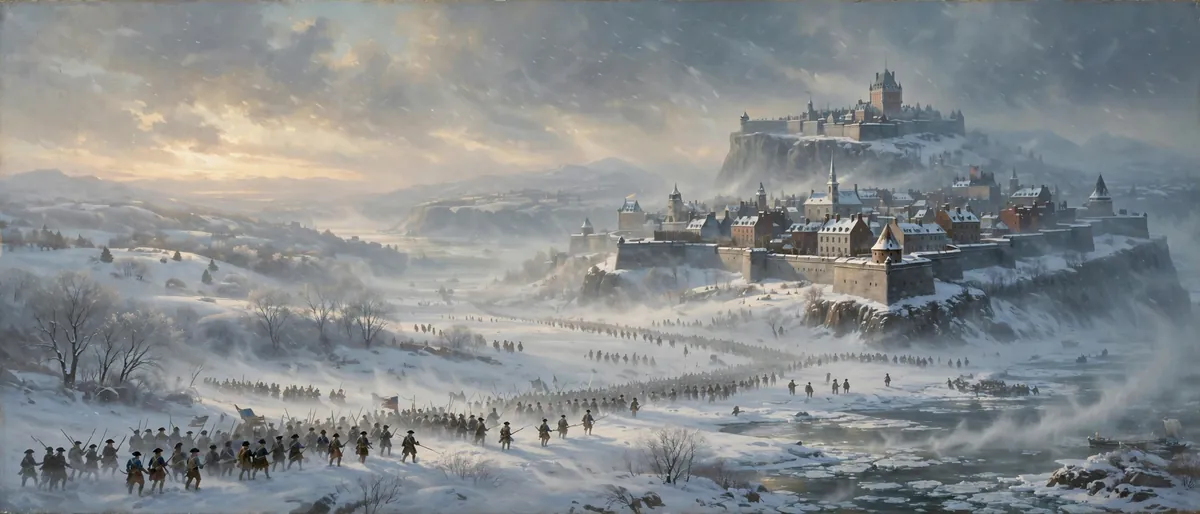
This Battle of Quebec summary comes down to one brutal night in a snowstorm. On December 31, 1775, in the middle of a blizzard, about 1,200 American soldiers attacked the walled city of Quebec. Their general was killed in the first minutes. Their other commander was carried off the field with a shattered leg. By sunrise, more than 400 Americans were prisoners. Canada stayed British. The whole invasion was over. If you want the short version, here it is: America tried to make Canada its fourteenth colony, and Quebec City said no.
Why Was America Invading Canada in the First Place?
Here is the thing most people miss about 1775. The Revolutionary War was barely six months old, and the Americans were already on the attack. They had chased the British out of Boston's countryside at Lexington and Concord in April. They had captured Fort Ticonderoga in May. In June, the Continental Congress made a big call: invade Canada.
Why? Three reasons, and all of them made sense on paper. First, Canada was the perfect base for a British counterattack. If the British held Quebec and Montreal, they could sail down the Hudson River and cut New England off from the rest of the colonies. Second, Congress hoped the French Canadians would join the rebellion. The French had lost Canada to Britain only twelve years earlier, in 1763, and Congress figured they would welcome American liberators. Third, Canada was full of British supplies, and the Continental Army was broke.
Honestly, it was a gamble. And gambles sometimes work. The Americans had already proven that in 1775. But this one had a flaw that nobody wanted to admit. The French Canadians mostly stayed neutral. They had no love for the British, sure, but they had even less reason to trust an army of Protestant New Englanders marching into their Catholic, French-speaking home. Congress sent letters promising religious freedom and friendship. The letters did not work. So the invasion went ahead anyway, with no local uprising to greet it.
The plan had two arms. General Philip Schuyler was supposed to lead the main force up Lake Champlain toward Montreal. Schuyler fell ill, though, and his second-in-command, Richard Montgomery, took over. The second arm was the crazy one. Colonel Benedict Arnold, then one of America's most promising officers, would march a second force through the Maine wilderness, straight to Quebec City, and attack from the east. Two armies, one city, one winter. What could go wrong?
Two Armies, One Terrible March
Montgomery's half of the plan worked, more or less. He laid siege to Fort St. Johns, on the Richelieu River, and after about 45 days the British garrison gave up on November 3, 1775. Ten days later, on November 13, Montgomery walked into Montreal. The British governor of Canada, Lieutenant Colonel Guy Carleton, slipped out of the city by boat on the night of November 18, and reached Quebec on November 19. Montreal was American. Quebec was the prize that was left.
Arnold's half of the plan was something else entirely. He left Cambridge, Massachusetts, in September 1775 with about 1,100 men and marched them through the Maine wilderness toward Quebec. Think about that for a second. There were no roads. There were rivers, swamps, rain, and cold, and the men were hauling boats and supplies through country that ate armies alive. The march ran about 350 miles. Men drowned in rapids. Food ran out. One whole detachment turned back. By the time Arnold's survivors reached the St. Lawrence River across from Quebec on November 9, he had about 600 men left. Half his force was gone, and they had not fought a single battle yet.
Arnold crossed anyway. On the night of November 13, his men paddled across the St. Lawrence in canoes and landed on the far shore. They climbed the cliffs to the Plains of Abraham, the same ground where the British had beaten the French in 1759. Then they waited. Because 600 cold, hungry men could not take a walled city alone. They needed Montgomery.
Montgomery arrived in early December with about 300 men. Put the two forces together and the Americans had roughly 1,200 soldiers outside Quebec City. And the clock was ticking. Most of the men's enlistments expired on December 31, 1775. After that date, the army would simply melt away. Montgomery had to attack before New Year's Eve, or lose his army without firing a shot. So he picked the last night of the year. A blizzard was coming. He decided that was a good thing. The storm would hide his men.
Who Actually Fought at Quebec?
The numbers tell you why this was a long shot. Inside the walls, Governor Guy Carleton had about 1,800 defenders. That sounds like a small force, but look at the mix. There were British regulars, a battalion of Royal Highland Emigrants under Lieutenant Colonel Allan Maclean, Canadian militia, British militia, sailors, and marines. Highland soldiers in British service, thirty years after Highland clansmen had fought the Crown at Culloden. They had walls, cannon, and warm barracks. They had spent weeks getting ready. They were fighting on ground they knew, in weather they were used to.
Outside, Montgomery had about 1,200 men, and that number flatters the truth. Arnold's survivors were exhausted, sick, and short of everything. Montgomery's men were in better shape but they were few. The Americans had almost no artillery that mattered, no siege train, and no time. They were attacking a fortress city in a Canadian winter with an army that was about to expire. Would you have bet on them? Be honest. Most people in Quebec did not.
But the Americans had two things going for them. First, they had good officers. Montgomery was a former British officer, a veteran of the Seven Years' War, steady and respected. Arnold was bold to the point of reckless, and his men followed him because of it. Second, they had surprise. A night attack in a blizzard, against a city that had already been waiting for weeks, might just catch the defenders slow and cold. That was the plan. Attack before dawn on December 31, from two directions at once, and crack the Lower Town before Carleton could react.
The Quebec City they were attacking was not one place but two. The Upper Town sat on the cliffs of Cape Diamond, high above the river, behind stone walls. The Lower Town sat at the water's edge, a tangle of narrow streets along the St. Lawrence. Between them ran steep lanes and barricades. Montgomery would attack from the west, along the river road. Arnold would attack from the north, through the suburb of St. Roch. If both columns broke through the barricades, they would meet in the Lower Town. Then they would have a city to fight over.
December 31, 1775: The Blizzard Attack
Around 4 AM: the columns move. The storm was at its worst, snow driving sideways, wind howling off the river. Montgomery led his column of about 300 men along the narrow road at the base of the cliffs, toward the first barricade at Sault-au-Matelot. The men could barely see each other. The snow swallowed sound. For a few minutes, it looked like the storm might actually do its job.
Minutes later: Montgomery is killed. The defenders at the barricade were waiting. When Montgomery's column came into range, a cannon loaded with grapeshot fired at point-blank range. Montgomery was killed instantly, along with his aide Jacob Cheesman and several others. The column broke. With their general dead in the snow, the men fell back. Montgomery's attack was over before it had really started. He was 37 years old, and he had been a soldier since he was a teenager. He died in a blizzard, in a country he had never expected to fight in, leading a column that had no idea what was coming.
At the same time: Arnold goes down. On the other side of the city, Arnold's column pushed through St. Roch and hit the Palace Gate barricade. The fighting was close and ugly, muskets flashing in the snow. Early in the attack, Arnold took a musket ball in the leg. The wound was bad enough that he had to be carried off the field. His men kept going without him, and that says a lot about the man. Daniel Morgan, a tough Virginia rifleman, took command of the column and kept the attack moving.
Dawn: Morgan breaks in, then gets trapped. Morgan's men fought their way through the first barricade and into the Lower Town. For a while, it looked like the plan might work. The second barricade, back at Sault-au-Matelot, was held in strength, and Carleton's men were now moving fast. Worse, the defenders started coming at Morgan's column from behind. The Americans were caught in the narrow streets, in the dark, in the snow, with enemy fire from both ends. Morgan fought on for hours. He refused to surrender until he was completely surrounded, his men out of options, and his ammunition nearly gone. Then he gave up. About 370 to 400 Americans were taken prisoner in the streets of the Lower Town. The battle was over by about 8 or 9 in the morning.
Think about that timeline. The whole attack lasted about four hours. Two generals down. One army shattered. And the city never came close to falling.
Three Moments That Decided Quebec
1. The grapeshot at Sault-au-Matelot. Montgomery was the plan. He was the senior commander, the steady hand, the man who held the two columns together. One cannon shot at the first barricade killed him and ended his entire attack. If his column had gotten through, the battle would have looked very different. Instead, half the American attack vanished in the first minutes, and Arnold's column was left to fight alone. Battles turn on small things. A single cannon, loaded with grapeshot, in a snowstorm. That was the whole battle, right there.
2. Arnold's wound. Arnold was the energy of the attack. His men had followed him through the Maine wilderness, and they trusted him. When he went down with a shattered leg, the column lost its leader at the worst possible moment. Morgan did a fine job taking over, and he deserves real credit for it. Morgan was fighting his way into a trap he could not see, in streets he did not know, in a blizzard. Arnold's wound did not lose the battle by itself. It took the one man who might have smelled the trap off the field.
3. Carleton's patience. Here is the part people forget. Guy Carleton did almost nothing flashy, and that was exactly right. He had spent weeks preparing the city. He kept his men behind walls and barricades. He let the Americans come to him, in the dark, in the snow, into streets where every window could hide a musket. Then, when Morgan's men were deep inside the Lower Town, he closed the door behind them. It was not a brilliant counterattack. It was discipline. And discipline beats courage when courage is walking into a walled city in a blizzard.
What Did Quebec Cost?
So who won the Battle of Quebec? Britain, and it was not close. The American losses were brutal for such a small army. Roughly 50 to 60 Americans were killed, including General Montgomery, and more than 400 were taken prisoner, including Daniel Morgan. The wounded numbered in the dozens. The exact killed figure varies a bit by source, which is normal for a night battle in a snowstorm, but the shape of it is clear. About half the attacking force was killed or captured in about four hours.
The British losses were tiny. Carleton reported 5 men killed and 13 wounded. Five. Against an attacking force of 1,200. That number tells you everything about what a walled city, a blizzard, and a prepared defender do to an attacker. The Americans never had a real chance, and the casualty figures prove it.
And the human cost went beyond the battlefield. The prisoners, including Morgan, spent months in captivity before they were exchanged. The American army outside Quebec was left leaderless, sick, and freezing. Smallpox swept through the camps that winter and killed more men than the battle had. Arnold, his leg still healing, held the siege together through the winter with a force that was shrinking by the week. It was a miserable, freezing, losing effort, and everyone in the camp knew it.
What Is the Battle of Quebec?
The Battle of Quebec was the failed American assault on Quebec City on December 31, 1775, during the Revolutionary War. Generals Richard Montgomery and Benedict Arnold attacked the walled city in a blizzard. Montgomery was killed, Arnold was wounded, and more than 400 Americans were captured. The defeat ended the invasion of Canada.
Why Did Quebec Actually Matter?
So why was the Battle of Quebec important? Really. Not the textbook answer. The real one.
First, it ended the invasion of Canada. The Americans kept up a loose siege of Quebec through the winter, but it was hopeless. On May 6, 1776, British ships arrived with reinforcements, and the American army fell back in disorder. By the summer, the Americans were out of Canada entirely. The dream of a fourteenth colony died in that snowstorm, and it never came back.
Second, Quebec shaped the map of North America. Canada stayed British, and that single fact shaped everything that followed. The border between the United States and Canada, the whole northern half of the continent, looks the way it does partly because of one night in December 1775. If Montgomery had lived and the city had fallen, who knows? Maybe Canada joins the rebellion. Maybe it does not. The Americans never got to find out, and Canada went its own way.
Third, Quebec was the first major defeat of the Revolutionary War for the Americans, and it taught them something they needed to learn. Attacking a fortified city in winter, with an army that was about to expire, on a gamble, was not how this war would be won. The Americans got better at picking their battles after Quebec. They had to. The alternative was more nights like December 31.
What about the men? Benedict Arnold recovered from his wound, and his reputation as a fighter only grew. He went on to win the Battle of Saratoga in 1777, the victory that brought France into the war. Then, in 1780, he betrayed the cause and became the most famous traitor in American history. People forget that before the treason, Arnold was the man who marched through the Maine wilderness and bled in the snow at Quebec. Daniel Morgan, captured at Quebec, was exchanged and went on to win the Battle of Cowpens in 1781, one of the great American victories of the war. And Montgomery? His body was buried in Quebec, and in 1818 his remains were moved to St. Paul's Chapel in New York, where they still lie.
Here is the honest downside, because history needs one: the invasion of Canada was a bad idea from the start, and the Americans should have known it. They assumed the French Canadians would rise up. They did not. They assumed a winter campaign would work. It did not. They assumed two starving columns could crack a walled city in a blizzard. They could not. Every assumption was wrong. Quebec was not bad luck. It was a bad plan meeting a prepared enemy.
A Note on the Numbers
Honest history comes with asterisks, and Quebec has its share. The American strength at the battle is usually given as about 1,200 men, Montgomery's 300 plus Arnold's 600 to 700, with a few hundred more in support. The defenders are usually put at about 1,800, though the exact mix of regulars, militia, sailors, and marines varies by source. The American killed figure runs from about 48 to about 60 depending on which account you trust, and the prisoner count runs from about 370 to about 430. The British figures, 5 killed and 13 wounded, come from Carleton's own report and are the standard numbers.
The dates are solid. Arnold reached the far side of the St. Lawrence on November 9, 1775. Montreal fell on November 13. Carleton reached Quebec on November 19. The attack came on the night of December 30 to 31, and the fighting was over by the morning of December 31. Montgomery's death at the Sault-au-Matelot barricade, Arnold's leg wound at the Palace Gate, and Morgan's surrender in the Lower Town are all well documented. The rest is rounding.
One more thing worth saying plainly. The sources for this battle are mostly American and British military reports, letters, and memoirs. The French Canadian view, the view of the people whose city was being attacked, is much thinner in the record. That is a gap, not a conspiracy. It is worth remembering that Quebec City was full of people who just wanted the war to go away, and their city was the battlefield.
3 Lessons from Quebec
Quebec is a defeat, but defeats teach better than victories. Three lessons worth stealing:
1. Do not attack a deadline. Montgomery attacked on December 31 because his army was about to expire. The calendar picked the battle, not the general. When your plan depends on a date instead of a real advantage, you are already in trouble. If the only reason to attack is that you cannot wait, you probably should not attack at all.
2. Assumptions are not allies. The whole invasion rested on the idea that French Canadians would rise up and help. They did not. A plan that needs the locals to love you is a plan that needs a backup. The Americans had none. Never build a campaign on what you hope people will do. Build it on what you know they will do.
3. Winter is a weapon, and it was not yours. The blizzard was supposed to hide the Americans. Instead, it blinded them, froze them, and swallowed their columns in streets they did not know. Carleton's men were warm, behind walls, and waiting. Weather is neutral. It helps the side that is ready for it. The Americans were not ready for a Canadian winter. The Canadians were.
Here is the uncomfortable truth nobody tells you about Quebec: the Americans lost this battle before they ever reached the walls. They lost it in September, when Arnold's men started dying in the Maine wilderness. They lost it in November, when the French Canadians stayed home. By December 31, the blizzard was just the ending. The story was already written.
Want to see what the Americans learned from this defeat? Our Battle of Yorktown 1781 summary covers the siege that ended the war, fought with French help, proper artillery, and a plan that actually fit the ground. If you want the victory that came right after the Quebec disaster, our guide to the Battle of Saratoga shows how Arnold himself turned the war around two years later.